Connect with us

Featured

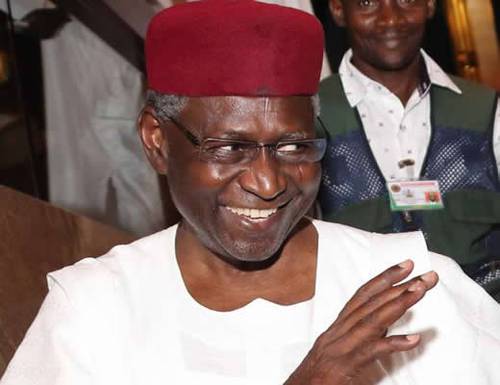
Abba Kyari: Chief of Staff to the President of Nigeria (1952 – 2020)

Published

on

By William Wallis

Abba Kyari was an unlikely svengali. The most prominent African victim so far of coronavirus, who has died at the age of 67, his appointment to one of the most influential positions in Nigeria, as the president’s closest adviser, took many seasoned politicians by surprise.

A lawyer by training and banker by profession, Kyari was also an outsider by nature, uncomfortable with the intrigues of political elites. Yet President Muhammadu Buhari knew what he was getting when he made his friend of more than 40 years his chief of staff, after an against-the-odds election victory in 2015: fierce loyalty, hard work and an attention to detail that often unsettled his opponents.

Kyari’s abrupt death has left friends and rivals alike pondering how the self-effacing intellectual could have become so powerful in the past five years. He leaves behind a vacuum in a time of uncertainty, with the price of oil, on which Nigeria depends for export earnings, in free fall, and the world beyond paralysed by the virus that took his life.

Kyari was born in Bama, a town in Borno state that has been razed to the ground during the ongoing insurgency by Islamist extremists in Nigeria’s north-east. Although a Muslim, he attended a Christian missionary school before studying at Warwick and Cambridge universities in the UK in the 1980s. Starting as a journalist, he went on to become a banker, was chief executive of United Bank for Africa, one of Nigeria’s leading banks, and sat on the board of subsidiaries of both Unilever and ExxonMobil.

An inveterate Anglophile, he counted Radio 4, Private Eye magazine, Martin Wolf’s columns in the Financial Times, and kippers among his favourite indulgences, and left-leaning thinkers, such as the economists Amartya Sen and Arthur Lewis, as enduring influences.

He was acutely aware of the dilapidated state, and limited capacity, of the public administration in Nigeria. Yet, his experience in business also made him wary of a private sector too often defined by a parasitic relationship with government. He was sceptical about liberal market solutions to Nigeria’s many problems, in the absence of the rule of law. That tension underlay much of his time in office, as he rebuffed advice, from the IMF among others, to curtail a controversial exchange rate regime.

His friendship with the president went back to before the coup that first brought Mr Buhari to power in 1983, and he stood by the former general during three fruitless attempts to gain power at the ballot box, a passionate supporter of his anticorruption agenda.

Often he would appear as Mr Buhari’s mouthpiece, finishing his sentences when interviews veered into areas in which he was less conversant. That was a role he carried into office when Mr Buhari finally unseated the incumbent president, pledging to root out graft, end conflict and diversify Nigeria’s economy away from oil. It was an agenda that quickly ran into obstacles. Recession, institutional resistance and Mr Buhari’s faltering health all took their toll. Throughout, Kyari acted as a gatekeeper to the president, shielding him from intrigue and deal making.

Along the way he lost friends and ruffled feathers. His critics accused him of locking down the administration as the head of a cabal that exercised too much influence on key decisions and appointments. Yet even from the centre of power, Kyari would express exasperation at the institutional inertia and systemic corruption that held up change.

“He wanted to protect the president and to take time to understand all the terrible things that had been going on,” said a former official who worked with him. History would be kinder to Kyari than his contemporaries, the official added, and credit him with playing a crucial firefighting role from behind the scenes. “People were saying we would end up like Venezuela. It wasn’t perfect, but we didn’t.”

Increasingly Kyari focused his energies on a few priorities: agricultural reform and efforts to revive a moribund power sector and transport infrastructure, symbolised by the construction of the first new bridge in a generation to span the river Niger. He was close to launching long-delayed initiatives to restructure the notoriously underperforming oil and gas sector.

Nigeria has a long history of frustrating and diverting those who most want to bring change. Kyari’s own efforts have been cut short, just as he had manoeuvred himself into a position where he could have had greater impact. Against medical advice, many officials trooped to attend his burial. They have been told to stay away from the president since. The virus that took Kyari’s life has temporarily taken on his role as gatekeeper.

Continue Reading
Click to comment

Leave a Reply

Your email address will not be published. Required fields are marked *

Featured

Why Tinubu Was Absent at Commissioning of Sanwo-Olu’s Projects in Lagos – Presidency

Published

on

By

The Presidency has come up with reasons behind President Bola Tinubu’s absent at the commissioning of Governor Babajide Sanwo-Olu’s projects in Lagos, on Wednesday.

Tinubu was noticeably absent at the scheduled project commissioning in Lagos, sparking public curiosity.

However, Sunday Dare, his Special Adviser on Public Communications and Orientation, has clarified the reason behind the last-minute development.

Speaking during an interview on Channels Television, Dare revealed that the President had to prioritise urgent national security matters over the event.
According to him, although Tinubu is currently in Lagos, he has been deeply engaged in high-level State duties, particularly ongoing security briefings tied to recent developments across the country.

“The president has been busy taking constant briefs and has to prioritise when it comes to state matters, especially security,” Dare stated.

He referenced rising security concerns, including recent unrest linked to incidents in Jos, noting that the President has been closely monitoring the situation and working directly with intelligence agencies.

Dare emphasised that Tinubu remains fully engaged behind the scenes, actively coordinating with security operatives and receiving continuous updates to address emerging threats.

The absence, he stressed, should not be seen as neglect of official duties but rather a reflection of the President’s focus on safeguarding national stability at a critical time.

Tinubu skipped the Lagos commissioning not out of disregard, but to handle pressing security issues demanding immediate presidential attention.

Continue Reading

Featured

Benin Republic 2026: Romuald Wadagni, The President in Waiting

Published

on

By

By Eric Elezuo

As the presidential election draws very close, one man stands taller than most of the candidates that would be on the ballot paper, or may have been on the ballot paper as far as the presidential election in Benin Republic is concerned. He is the hard working and most Indefatigable achiever, Monsieur Romuald Wadagni.

He us young, able and full of experience, having practiced positive and sincere politics for a very long in his young existence.

Wadagni comes across as the typical chip off the old block, when it comes to genuine leadership qualities and agenda. He has been tested, trusted and ready to take up the mantle of leadership towards providing genuineness and purposeful living condition for the people of Benin Republic.

In 10 consecutive years, since he was 39, Wadagni, has supervised the Finance and Economy ministry without blemish, and has received accolades from far and wide.

It is therefore not a fluke as the 49 years old, Romuald Wadagni was nominated as the ruling majority’s candidate for the upcoming presidential election in Benin.

Consequently, listed below are three things to know about him: 1:he has been the Minister of Finance for nearly 10 years. Romuald Wadagni was appointed Minister of Economy and Finance in April 2016. He was reappointed to the position in 2021 with the rank of Minister of State. He is considered one of the main architects of Benin’s economic recovery.

At the end of January 2025, he welcomed “average growth of more than 6.5% in recent years.” In 2018, Financial Afrik magazine ranked him among the 100 African personalities transforming the continent. In December 2024, the same media outlet named him “Best Finance Minister in Africa,” praising Benin’s macroeconomic stability in the face of international crises. 2: He is an expert in finance and accounting. Romuald Wadagni is a chartered accountant. After studying finance, private equity, and venture capital, he began his professional career in 1998 at Deloitte, one of the largest audit and consulting firms in the world.

At Deloitte, Romuald Wadagni rose through the ranks and successively held several positions of responsibility in France, the United States, and then in Francophone Africa. In 2012, at the age of 36, he became a partner at Deloitte. He later led the firm’s expansion across the African continent. After 17 years, he left the firm in April 2016 when he was appointed Minister of Economy and Finance of Benin.

He is the heir apparent of Patrice Talon. After two consecutive terms, President Patrice Talon, who can no longer run again, had promised to play an active role in choosing his successor. On August 31, 2025, he officially endorsed his Minister of Finance, Romuald Wadagni, as the candidate of the presidential majority.
This designation was confirmed in a joint statement by the Union Progressiste le Renouveau (UPR) and the Bloc Républicain (BR), the two main parties of the majority. On October 4, 2025, in Parakou, Romuald Wadagni and Mariam Chabi Talata, the current Vice President, were officially nominated during a major rally of the presidential majority. In his speech, the candidate minister promised to “consolidate the achievements” of his predecessor.


Prior to entering politics, Wadagni worked for the consulting firm Deloitte for 17 years. He was first appointed the minister of economy and finance on 7 April 2016, in the first Talon government, and subsequently reappointed in 2021 with the rank of senior minister.

Wadagni was born in Benin in 1976 in Lokossa, the eldest of five children. His father, Nestor Wadagni, a statistician and economist with a degree from ENSAE, had a career in the Beninese civil service before writing a thesis in fundamental mathematics after his retirement.From an early age, he took an interest in manual work and trained himself in bricklaying and mechanics.

After obtaining a scientific baccalaureate in Benin, he continued his studies in France. From 1995 to 1999, he studied at the École supérieure des affaires de Grenoble (ESA) where he obtained a master’s degree in finance, graduating top of his class. During his studies in Grenoble, he met a partner from Deloitte who identified his potential and recruited him into the consulting firm in 1998.Among honours attached to his ebullient services and achievements, are as follows:

In 2021, the financial newspaper Financial Afrik named Romuald Wadagni “Best African Minister of Economy and Finance”.

In 2024, the financial newspaper Financial Afrik named him “Finance Minister of the Year” for the 4th time in its ranking of “The 100 who are transforming Africa”.

ROMUALD WADAGNI AT A GLANCE 

Romuald Wadagni is Senior Minister in charge of Economy and Finance of Benin. He was appointed on April 7, 2016, in the first government of President Patrice Talon and reappointed to this position in May 2021.

Romuald Wadagni is a public accountant certified in France and the USA. He also holds a master’s degree in finance and has completed specialized training in private equity and venture capital.

Before being appointed Minister of Economy and Finance in 2016, Romuald Wadagni had a leading international experience within Deloitte. In France from 1998, then in the United States from 2003, he developed cutting-edge expertise in several fields, serving customers in various sectors of activity (Mining, TMT, Financial Sector, Public Sector, Retail) and various governments and donors.

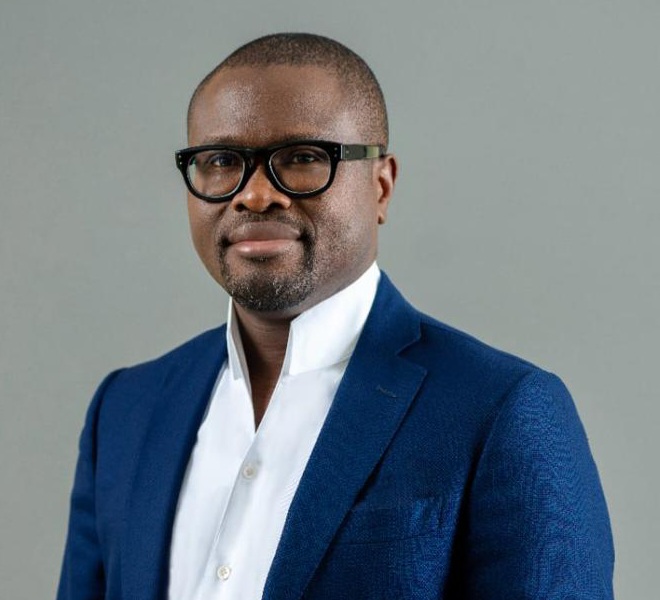
Wadagni is a handful in service delivery, transformation and economic re-engineering. He is the best suited for the presidency of Benin Republic as election holds on Sunday, April 12, 2026

Continue Reading

Featured

ADC Raises Alarm over INEC’s Plot to Prevent Party from Fielding Candidates

Published

on

By

The African Democratic Congress (ADC) has revealed the deliberate administrative landmines being deployed by the Independent National Electoral Commission (INEC) to prevent the Party from fielding candidates in the upcoming elections.

In a statement signed by its National Publicity Secretary, Mallam Bolaji Abdullahi, the party stated that at the heart of this emerging crisis is INEC’s stated position that it will no longer receive any correspondence from the ADC pending the determination of a matter before the Federal High Court. On its face, this may appear procedural. In reality, it creates a direct and dangerous conflict with the clear timelines imposed by the Electoral Act (2026), which provides defined windows, including the mandatory 21-day notice period and subsequent submission requirements, within which political parties must complete critical electoral processes.

The full statement reads:

We are compelled to raise serious concerns about a developing situation that appears designed to prevent the African Democratic Congress (ADC) from fielding candidates in the upcoming elections. It is based on documentary evidence which we are now placing before the Nigerian public, including certified INEC records, attendance logs, monitoring reports, and excerpts from the Commission’s own sworn affidavit. Taken together, these documents establish a clear and consistent record of events.

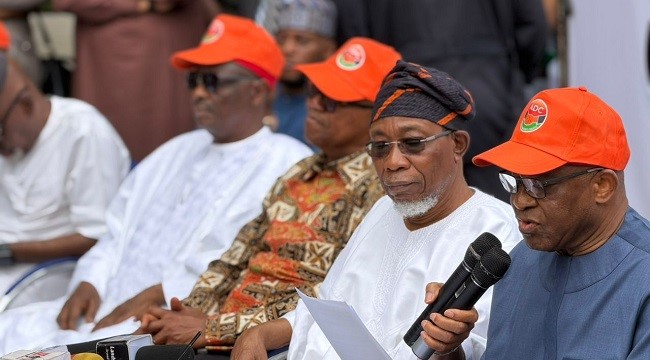
INEC received formal notice of the July 29, 2025 National Executive Committee (NEC) meeting of the ADC. It deployed officials to monitor that meeting. It documented the proceedings and received formal reports from its field officers. Following this, INEC updated its internal records and uploaded the names of the new leadership, including Senator David Mark as National Chairman and Ogbeni Rauf Aregbesola as National Secretary.
These are not claims. They are facts contained in INEC’s own records.

In addition, the Commission’s sworn affidavit before the Federal High Court, in its response to Nafiu Bala Gombe on 12 September 2025, particularly in Clauses 14 to 19, affirms key legal principles: that the leadership transition had already been completed and recognized, that such internal party matters fall outside the scope of judicial interference, that completed acts cannot be reversed by injunction, and also recognizes the David Mark-led NWC.

Yet, despite this clear documentary trail, INEC has now taken the position that it will no longer receive any correspondence from the ADC pending the determination of a matter before the Federal High Court. This is where the contradiction becomes dangerous.

The Electoral Act imposes strict timelines on political parties, including the 21-day notice requirement and submission deadlines. INEC itself has fixed May 10 as the deadline for the submission of relevant documents. However, by refusing to receive communication from the ADC within this same period, the Commission is effectively preventing the Party from complying with the law.

In simple terms, INEC is effectively threatening that unless the courts deliver judgment on the ADC leadership issue by May 10, it will prevent the ADC from producing candidates.

This places the ADC in an impossible position and creates a clear pathway to artificial non-compliance, which can then be used to justify excluding the Party from fielding candidates. That is the landmine.

INEC has claimed that its April 1 decision was taken to avoid rendering the proceedings before the Federal High Court nugatory. The reality is the opposite. By intervening in a matter already before the court and issuing a pronouncement with clear legal and operational consequences, the Commission has itself undermined the very process it claims to protect.

What is even more concerning is that this position contradicts INEC’s own prior conduct and legal stance. The same Commission that monitored, documented, recognized, and swore to an affidavit confirming the ADC leadership is now acting in a way that contradicts its earlier position.
We therefore call on the Commission to immediately reverse this position, resume the acceptance of all lawful correspondence from the ADC, and uphold its constitutional responsibility to ensure a level playing field for all political parties.

We also call on Nigerians to be wary and remain vigilant about these dangerous machinations to subvert Nigeria’s democracy and impose a civilian dictatorship on the country.

Continue Reading

Trending