Headline
Why We Suspended Nationwide Strike – ASUU
Published
7 years agoon
By
Eric
Academic Staff Union of Universities (ASUU) on Thursday suspended its nationwide strike after three months.
ASUU National President, Professor Biodun Ogunyemi, announced this at a press conference in Abuja, the nation’s capital.
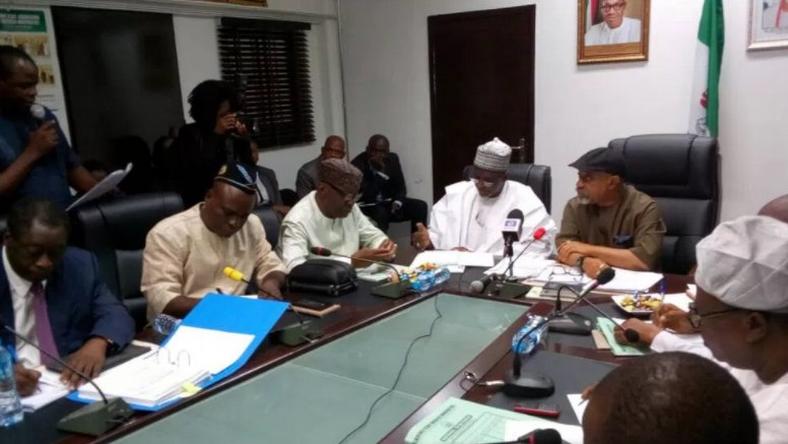
The union suspended the industrial action following its latest meeting with representatives of the Federal Government led by the Minister of Labour and Employment, Senator Chris Nigige.
Read the full statement issued by the ASUU President below;
ACADEMIC STAFF UNION OF UNIVERSITIES (ASUU), NATIONAL SECRETARIAT. TEXT OF A PRESS CONFERENCE BY THE ACADEMIC STAFF UNION OF UNIVERSITIES (ASUU), THURSDAY, 7TH FEBRUARY, 2019, AT NIGERIA LABOUR CONGRESS HEADQUARTERS, PASCAL BAFYAU HOUSE, ABUJA
Protocol
Friends and compatriots of the Press, On Sunday, 4th November, 2018, the Academic Staff Union of Universities (ASUU) resumed its strike action which was conditionally suspended on 14th September, 2017.
The action of 2017 was suspended following the signing of a Memorandum of Action (MoA) in which the Federal Government of Nigeria (FGN) promised to address the contentious issues within a timeline that was to end in October 2017.
While announcing the suspension of the nationwide action, however, our Union made it categorically clear that “ASUU will not hesitate to review its position should government renege on the signed Memorandum of Action”.
Predictably, Government implemented the MoA in the breach, thereby forcing ASUU to resume the suspended strike action.
Comrades and compatriots, as we have always argued, the last thing ASUU members love doing is to cause disruption in smooth intellectual engagements with colleagues, friends and students right on our university campuses.
This has nothing to do with the dubious advertorial of “non-disruption of academic calendar” by proprietors and administrators of some cash-and-carry universities and other self-styled enemies of ASUU.
Rather, it is about deep-seated pains members of the Union undergo to prevent strike actions and the equally painful consequences strike situations bring to all who are genuinely averse to the mercantile disposition to university education.
Why Strike Action? The question has been asked time and time again: Why does ASUU like embarking on strike action that causes disruption and dislocation in the universities?
However, ASUU is strongly convinced that if academics fail to fight the cause of university education, the fate that befell public primary and secondary schools would soon become the lot of the public university system in Nigeria.
ASUU’s advocacy on the need to stem the continued slide into rot and decay in public universities since the 1980s has fallen on deaf ears. Our experience, as a trade union, shows that successive governments in Nigeria always entered into negotiated agreements only to placate those pleading the cause – be it education, health, transportation, employment or any other issue of meaningful living.
This proclivity of the Nigerian ruling class, irrespective of which wing of the insensitive stock they belong, must be continually be tracked, engaged and resisted by all people of goodwill.
ASUU ‘s action strike, which started on 4th November, 2018, was situated in the context of accumulated records of indifference and lackadaisical attitude of Government to negotiated agreements with the Union.
At our media interaction in University of Lagos on 23rd December, 2018, we highlighted the outstanding issues in the crisis to include the following:
– Funding for the revitalization of Public Universities based on the FGN-ASUU MoU of 2012, 2013 and the MoA of 2017
– Reconstitution of the current Government Team to allow for a leader and Chairman of the FG-ASUU Renegotiating team who has the interest of the nation and the people at heart.
– Release of the forensic audit report on Earned Academic allowances (EAA), offsetting the outstanding balance of the EAA and mainstreaming of same into the 2018 budget.
– Payment of all arrears of shortfall in all universities that have met the verification requirements of the Presidential Initiative on Continuous Audit (PICA)
– Provision of a platform by the federal government for ASUU to engage Governors on the proliferation of universities, underfunding of university education and undue interference in the affairs of the universities
– Release of PFA operational license to NUPEMCO
– Payment of EAA to loyal ASUU members at the University of Ilorin A new Memorandum of Action and Our Resolution To date, ASUU has had a total of ten (10) interactive meetings with representatives of FGN which have culminated into a Memorandum of Action of
2019.
Highlights of the MoA include the following:
- In addition to the N20 billion for 2018, the sum of N25 billion only would be released in April/May 2019, after which government would resume full implementation of the MoU of 2013.
- Part-payment of the outstanding arrears of the earned academic allowances; defraying the balance up to 2018 in 4 tranches within 36 months; and mainstreaming further payments of EAA into the annual budgets beginning from 2019 budget.
- PICA verification and the release of the arrears of salary shortfall at the Federal University of Agriculture, Makurdi, not later than 15th February 2019.
- Strengthening the Consultative Committee on State-owned Universities (CCSOU), inaugurated on Monday, 28th January, 2019 to look into the issues of proliferation, underfunding and governance to consistently deliver on its mandate.
- Payment of the outstanding EAA arrears of all eligible staff in the University of Ilorin, especially the loyal ASUU members whose appointments were illegally terminated by today, 7th February,2019.
- Acknowledgement and appreciation of Government for facilitating the release of the final letter of approval for the granting of operationallicense to NUPEMCO.
- Visitation to all Federal Universities would commence tentatively by 11th March, 2019.
- Provision of documented guidelines on procedures and roles of parties in the process of renegotiating FGN-ASUU Agreement of 2009 which would commence not later than 18th February 2019 and end by Friday 29th March 2019.
Based on the initial proposals from Government, the Union made extensive consultations through its various organs. The final level of consultation was the meeting of the National Executive Council (NEC) which took place 6th-7th February 2019.
NEC resolved that: Following a careful review of the report of engagements with the Federal Government on proposals for addressing all outstanding in the 2013 MoU and 2017 MoA, NEC resolved that the current strike action by the Union should be suspended conditionally with effect from 12.01 a.m on Friday 8th February 2019.
However, should Government fail to fulfill its part of the agreement as reflected in the 2019 Memorandum of Action, ASUU shall resume its suspended strike action as the Union deems necessary.
Conclusion
ASUU notes, with serious concern, the covert and overt roles of some vice-chancellors in the management and application of funds attracted by our Union to Nigeria’s public universities.
Consequently, we condemn, in the strongest terms, Vice-Chancellors who have made efforts to undermine and, in some cases, attempted to break our patriotic struggles for the revitalisation of public universities in Nigeria.
ASUU will not shy away from taking headlong those Vice-Chancellors who are reputed for acts of impunity, nepotism and other forms of conduct which are antithetic to university culture and the progressive development of our universities.
Our union will compile all their shenanigans and forward them to relevant authorities for further action.
Finally, ASUU acknowledges the understanding and support demonstrated by patriotic Nigerian students and their parents all through the strike period.
We equally appreciate the comradely assistance from the Nigeria Labour Congress (NLC), represented by the newly re-elected President, Comrade Ayuba Waba, who has stood by us throughout the struggle.
We also acknowledge the solidarity of the civil society organisations, especially the Joint Action Front (JAF) and the Education Rights Campaign (ERC), and members of the progressive wing of the media who have consistently partnered with us in our mission to rescue Nigerian public universities from imminent collapse.
While we put a closure to this phase of the struggle, it is our hope and desire that the Nigerian governments (Federal and State) will play the roles expected of them in order to make the new Memorandum work.
We shall never abandon our obligation to ensure the survival of a sound university system.
For ASUU, the struggle certainly continues!
Thank you for listening.
Biodun Ogunyemi
President
7th February 2018
Related
You may like
Headline
Otunba Adekunle Ojora: Farewell to a Good Man
Published
1 day agoon
February 1, 2026By
Eric
By Eric Elezuo
The curtain dropped on the elitist life of prominent Lagosian, traditional custodian, boardroom guru, refined journalist and elaborate philanthropist, Otunba Adekunle Ojora, on January 28, 2026, bringing to an over nine decades of spreading good tidings, prosperity, unity and humanity. He was 93 years.
His death was announced via a statement by his daughter, Mrs Toyin Ojora-Saraki, on behalf of the Ojora Family, saying he died early in the morning in full submission to the will of Almighty Allah (SWT)
“With total submission to the will of Almighty Allah (SWT), the Ojora family of Lagos hereby announces the passing of our beloved patriarch, Otunba Adekunle Ojora, the Otunba of Lagos and Lisa of Ife, who returned to his creator early this morning.
“We say Alhamdulilahi for a life well lived, and we comply with Allah’s words: ‘Surely, to Allah we belong, and to Him we will all return’ (Q2:156),” the statement reads.
A distinguished businessman, people-oriented-person, the Olori Omo Oba of Lagos and the Lisa of Ife, Adekunle Ojora’s passing came with a much ancipated heartbreak, wailings and regrets, among his hugely extended family members, circle of friends, mentees, colleagues in and across business and traditional terrain, associates and the well impacted general public.
With the announcement of his death came the heavy traffic of personalities, dignitaries and nobles to his Ikoyi palatial home, where his adorable wife, Ojuolape Ojora, and one of his distinguished daughters, Mrs Toyin Saraki, who is the wife of the former Senate President, Bukola Saraki, played significant hosts.
President Bola Tinubu was one of the first mourners with a statement signed by his spokesperson, Bayo Onanuga, acknowledging the dimunitive personality of the deceased, noting how he had affected humanity in a positive light.
Tinubu commiserated with the government and people of Lagos State, as well as the Ojora and Adele royal families.
“The passing of Otunba Ojora is a significant loss to the country, the private and public sectors, and traditional institutions,” the President said, describing the late industrialist as a man whose life was defined by humility, perseverance, hard work and generosity. He further noted that his values shaped his long and distinguished career.
“He remained a towering figure whose counsel and experience benefited institutions at both national and subnational levels,” Tinubu added.
In his condolence message, former President Olusegun Obasanjo described Ojora’s death as painful, saying his absence would be difficult to fill, according to a statement released by his Special Assistant on Media, Kehinde Akinyemi.
The ex-president described Ojora as “an amiable and distinguished Nigerian who, during his lifetime, built a remarkable legacy of integrity, wisdom, and unwavering dedication.”
“By his death, the country has lost a notable captain of industry and commerce, but there is no doubt that his memory lingers on through his many landmark contributions to the development of the South-West zone in particular, and the country in general,” Obasanjo added.
He also stated that “He was a remarkable entrepreneur whose vision, determination, and resilience added value to the community and to hundreds of families who depended on his commercial activities. He was a role model and exemplar whose personal life and achievements inspired a generation of entrepreneurs, industrialists, and merchants. Over the years, with his wise counsel, unquestioned strength, and gentle guidance, Otunba Ojora commanded respect and reverence, and took particular pleasure in mentoring younger men and women to succeed in life.”
Also reacting, a former Minister of Communications, Major General Tajudeen Olanrewaju (Rtd) described Ojora as a “veteran journalist and boardroom titan”.
The former General Officer Commanding (GOC) 3 Division Nigerian Army noted that he made positive contributions to the industrial and entrepreneurial sectors of the economy, lightened up the social fabric of his time in Lagos, in particular, and across our nation.
Among dignitaries that called to the home of the Ojora’s to express heartfelt condolences were the Governor of Osun State, Senator Ademola Adeleke and his elder brother, Dr. Deji Adeleke; Africa’s richest man, Alhaji Aliko Dangote, Mr. Femi Otedola and former governor of Akwa Ibom State, Udom Emmanuel.
As a revered Muslim, versed in Islamic doctrines, the nonagenarian’s burial followed the very next day, drawing an avalanche of well wishers and mourners to the Central Mosque, on Lagos Island, where the funeral rites or the Janazah, led by the Chief Imam of Lagos, Sheikh Sulaiman Abou-Nolla, and assisted by other prominent Islamic clerics, were conducted, and finally to the Vaults and Garden, Ikoyi, where the remains were committed to mother-earth. The events were a meeting point of some sort, as they drew together prominent Islamic scholars, family members, political bigwigs and other distinguished guests.
A roll call of the elite callers at the events include the deceased’s wife, Erelu Ojuolape Ojora; his daughter, Toyin Ojora-Saraki, and her husband, former Senate President and Kwara State Governor, Bukola Saraki. Also in attendance were Lagos State Governor Babajide Sanwo-Olu, former Ogun State Governor Ibikunle Amosun, former Speaker of the Kwara State House of Assembly Ali Ahmad, former PDP National Chairman Kawu Baraje, Mufti of Ilorin Sheikh Sulaiman Onikijipa, and National President of Ansar-Ud-Deen Society of Nigeria Prince Adeniji Kazeem.
The burial ceremonies began with a recovery of the remains, which were borne by pallbearers for a burial procession before it was a motorcade bore it to the venue of the Janazah.
The long convoy of dignitaries that accompanied the body to the mosque spoke volumes of the personality of Adekunle Ojora. As the solenm approached, Imam Sulaiman Abou-Nolla led the congregation in prayers, asking for the repose of the siul of the deceased.
At the conclusion of the prayers, the body was conveyed to the Ikoyi Vault, where pallbearers and Muslim Ummah as well selected members of the family and notable dignitaries accompanied the remains, amid chants, to its final resting place.
THE MAN, OTUNBA ADEKUNLE OJORA
The highly principled businessman was born Isiaq Adekunle Ojora on June 13, 1932, into the distinguished Ojora Royal Family of Lagos, where he grew with a deeply-rooted tolerance for the history, culture and traditional governance of the Yoruba race and Lagos in particular.
His lineage placed him among the foremost royal families in the state, a heritage he upheld with dignity throughout his long life. Over several decades, he emerged as one of the most influential figures within Lagos’ traditional institutions, commanding respect across royal, cultural and civic circles.
Ojora was a member of the Ojora and Adele royal families of Lagos and was himself the holder of the chieftaincy of the Otunba of Lagos. He studied journalism at Regent Street Polytechnic, with the intention of developing a career in journalism. He started work as a staffer at the BBC where he rose to become an assistant editor.
In 1955, he switched his services to the Nigerian government as a reporter with the Nigerian Broadcasting Corporation. He was soon transferred to Ibadan as an information officer in the office of the regional premier. Ojora’s stint with NBC lasted until 1961 when he took up appointment as the public relations manager at United African Company.
Ojora soon developed interest in the commercial units of enterprises, he became an executive director of UAC in 1962. After a military coup truncated the first republic, Ojora was nominated as a member of Lagos City Council in 1966. A year later, he was given political appointments in two government agencies, in 1967, he was managing director of WEMABOD, a regional property and investment company and also in 1967, he succeeded Kola Balogun as chairman of Nigerian National Shipping Line.
After leaving WEMABOD, he became an investor in various firms including AGIP petroleum marketing and NCR Nigeria. He also founded the private firms Nigerlink Industries, Unital Builders and a holding company Lagos Investments. After the Nigerian Enterprise Promotion Act, he took equity interest in some foreign companies operating in Nigeria such as investments in the Nigerian operations of Bowring Group, Inchape, Schlumberger, Phoenix Assurance, UTC Nigeria, Evans Brothers and Seven-Up. He married Erelu Ojuolape, and among their children is Toyin Saraki.
Beyond royalty, Otunba Ojora was widely regarded as a bridge between tradition and modern governance.
The Otunba Adekunle Ojora would be remembered as a quintessential gentleman, astute businessman, excellent in speech, dignified in conduct, and deeply respected across generations.
For as many as those who know him, Ojora has for decades, remained a familiar and revered presence in elite social and cultural spaces, where his highly sought-after counsel and calm disposition have proved relevant and needful.
He is also known for his refined lifestyle and strong family values, an embodiment of a “brand of old-school nobility that earned him admiration well beyond wealth or status. He was often described as a man of honour whose life reflected discipline, tradition, and unwavering integrity.
Otunba Adekunle Ojora is survived by his wife, Erelu Ojuolape Ojora, his children, grandchildren and great-grandchildren.
Related
Headline
Incumbency Factor Will Not Determine 2027 Election, Atiku, Obi, Others Talk Tough
Published
4 days agoon
January 29, 2026By
Eric
The 2027 general elections will not be determined by incumbency, control of State power or wave of political defections, opposition leaders have declared.
They argued that voter choice, opposition unity, and the integrity of the electoral process would ultimately decide the outcome.
The opposition leaders made the declaration at the public launch of “The Loyalist,’’ a memoir by National Publicity Secretary of the African Democratic Congress, ADC, Bolaji Abdullahi, in Abuja.
The event drew a wide mix of opposition leaders, former public office holders, lawmakers, intellectuals and party stakeholders.
Speakers included former Vice President, Atiku Abubakar; former Anambra State governor, Peter Obi; former Minister of Interior and ADC National Secretary, Rauf Aregbesola; former Senate President and ADC National Chairman, David Mark, and veteran columnist and public intellectual, Hakeem Baba-Ahmed, who reviewed the book.
Although convened as a book presentation, the gathering quickly assumed a strong political tone, with speakers repeatedly returning to the issues of opposition unity, leadership responsibility, and the limits of incumbency power, ahead of the next general election.
Addressing what he described as a growing misconception in Nigerian politics, Aregbesola argued that governors and incumbents do not automatically determine election outcomes.
Drawing on the 2023 electoral results, he said the belief that political office guaranteed victory was not supported by evidence.
“The fact that certain governors are defecting to the APC shows that our unity is weakened, but the statistics do not support the belief that governors win elections,” Aregbesola said.
Using the South-West as an example, he said ruling party dominance at the state level had not translated into overwhelming electoral success.
“In the South-West, the APC controlled all the states except one, yet the maximum performance of the party was 55 per cent, with the other parties sharing the rest,” he said.
On his part, former Vice President, Atiku Abubakar, speaking as special guest of honour, linked the political moment to the theme of the book, describing loyalty as both a moral test and a personal burden in public life.
Atiku, who noted that his participation was informed by his own role in the political history examined in the memoir, said: “I am honoured to be part of this launch because I was also involved in the eventual inauguration of the Bukola Saraki administration, which this book deals with in very great detail.’’
He praised the author for taking on difficult questions about loyalty and conscience, saying “this is a work that dares to question loyalties, illuminate conscience, and broaden our public imagination.’’
Drawing a contrast between military discipline and political life, Atiku said loyalty in politics was rarely absolute and often exacted a heavy price.
“For those of us who come from the military and paramilitary professions, loyalty is non-negotiable; there is only absolute obedience. But in political life, loyalty is not as rigid, and it comes with consequences,” he said.
The former vice president also spoke candidly about his own experiences.
“Many of us have suffered because of loyalty. I have faced exile as a result of loyalty. I have survived assassination attempts as a result of loyalty,” he said.
Atiku warned that loyalty should never become blind allegiance, adding that “loyalty should strengthen the common goal, not narrow the circle of belonging.’’
Similarly, a former Governor of Anambra State, Peter Obi, who arrived late due to flight delays from Lagos, apologised for not observing traditional protocol before addressing the audience.
Obi also signalled political solidarity and regional commitment, saying: “I have been directed to represent the South-East, and I want to assure you that you will not be disappointed.’’
In one of the most direct political moments of the event, the author, Bolaji Abdullahi, appealed to opposition leaders to rise above rivalry and present a united front, ahead of 2027, adding that Nigerians were ready for change, though political leaders were not yet matching that urgency.
“For 2027, Nigerians are ready. But I don’t think we are ready. Nigerians look at us and see different enclaves and different entities. They see competition, rather than cooperation,” Abdullahi said.
Reviewing the book, Hakeem Baba-Ahmed said it initially provoked skepticism but ultimately impressed him.
“I brought to the book some prejudice and heightened curiosity. I expected the author to fall on his face somewhere. I was wrong,” he said.
He described the memoir as revealing and historically significant.
“This book is easily one of the most readable and revealing books I have read in a long while. It captures the essence of our contemporary social and political character,” Baba-Ahmed said.
Former Senate President, David Mark, described the task of rescuing Nigeria as a shared responsibility and praised Abdullahi’s character.
“He is a straightforward person. Even when I disagreed with him, his advice was always adopted,” Mark said.
He also clarified the long-standing controversy around the Doctrine of Necessity, saying “it was the sole responsibility of the Senate and had nothing to do with Kwara State or anyone from Kwara State.’’
Related
Headline
Coup: Investigators Widen Probe Scope to Unmask Civilian Financiers
Published
5 days agoon
January 28, 2026By
Eric
Fresh intelligence details have surfaced on the foiled coup attempt against President Bola Tinubu’s administration, shedding light on how a serving Army Colonel allegedly assembled a covert, cross-service network to undermine the constitutional order before security agencies moved in.
The Defence Headquarters had announced the arrest of 16 officers for acts of indiscipline and breaches of service regulations, following weeks of quiet tension within the Armed Forces.
In October 2025, rumours of an alleged coup plot against President Tinubu’s administration spread across social media. At the time, the Defence Headquarters (DHQ) dismissed the claims as “false and misleading,” yet the sudden cancellation of the Independence Day parade fuelled speculation about deeper security concerns.
However, fresh findings from an interim investigation report, sighted by Punch Newspapers, suggest that the alleged architect of the plot was a Colonel whose repeated failures in promotion examinations reportedly bred resentment and alienation. Rather than nursing his grievances quietly, he is said to have turned them into a recruitment tool, drawing officers from the Army, Navy and Air Force into a loose but coordinated network.
According to the report, members of the group were allegedly assigned to discreetly study sensitive installations, including the Presidential Villa, the Armed Forces Complex, Niger Barracks in Abuja and international airports in Abuja and Lagos, mapping access routes, routines and vulnerabilities. What began as expressions of dissatisfaction soon graduated into early-stage operational planning.
Security sources say searches on the officer’s vehicle uncovered charms and anti-government materials, while a raid on his residence in Lokogoma, Apo, yielded sensitive documents detailing assigned roles and outlining how key national dignitaries were to be handled once the operation commenced.
The plotters are also said to have exploited insider access, infiltrating the Presidential Villa and compromising workers linked to construction firm Julius Berger to obtain security information on the premises. Encrypted communication platforms were allegedly used to coordinate movements, logistics and funding, while discreet vehicle repairs and unusual cash flows pointed to preparations for mobilisation.
Investigators traced financial inducements of between N2 million and N5 million to some principal actors, with intelligence agencies now analysing the money trail through the Nigerian Financial Intelligence Unit.
One of the suspects, Lt-Col S. Bappah, reportedly turned a critical witness, admitting his role and providing details on recruitment methods, funding channels and communication patterns within the network.
The danger, security officials note, lay in the cross-service reach of the conspiracy, which cut across the Army, Navy and Air Force and involved officers up to the rank of Brigadier-General.
The alleged plan, uncovered ahead of its execution date of October 25, 2025, was described as lethal in scope, with the President, Vice-President Kashim Shettima, ministers, service chiefs and other top officials marked as targets.
Beyond the military hierarchy, investigators are now widening the probe to civilian financiers and political contacts who may have interacted with the core suspects. Communication trails, financial flows and external interfaces are being reviewed as part of efforts to dismantle every layer of the network and secure strategic national assets.
With the investigation concluded and reports forwarded to superior authorities, the Defence Headquarters has confirmed that indicted personnel will face appropriate military judicial panels, as Nigeria’s security establishment moves to ensure that what officials describe as a well-funded, coordinated threat never advances beyond the planning stage.
Related


Court Restrains NLC, TUC from Embarking on Strike, Protest in Abuja
Glo Leads in Investments, Performance As NCC Sets New Standard for Telecoms
Memoir: My Incredible 10 Years Sojourn at Ovation by Eric Elezuo
Ghana 2028: Mahamudu Bawumia Claims NPP’s Presidential Ticket
Otunba Adekunle Ojora: Farewell to a Good Man
Voice of Emancipation: President Tinubu’s Recent Trip to Turkey
FirstHoldCo Grows Gross Earning to N3.4trn for Unaudited Full Year 2025
Court Sends Actress Angela Okorie to Prison for Alleged Cyber-Stalking
FG vs Sowore: Court Admits As Exhibit Video of Reno Omokri Calling Tinubu ‘International Drug Baron’
Spider-Man Voice Actor Alexis Ortega Dies at 38
Coup: Investigators Widen Probe Scope to Unmask Civilian Financiers
Tinubu’s Stumble Purely Accidental, Not Health Related – Presidency
Otunba of Lagos Adekunle Ojora is Dead
El-Rufai Makes Case for Tinubu’s Impeachment, Accuses President of Illegal N100bn Monthly Deductions
Trending
-
Entertainment5 days agoCourt Sends Actress Angela Okorie to Prison for Alleged Cyber-Stalking
-
Featured6 days agoFG vs Sowore: Court Admits As Exhibit Video of Reno Omokri Calling Tinubu ‘International Drug Baron’
-
Entertainment4 days agoSpider-Man Voice Actor Alexis Ortega Dies at 38
-
Headline5 days agoCoup: Investigators Widen Probe Scope to Unmask Civilian Financiers
-
National6 days agoTinubu’s Stumble Purely Accidental, Not Health Related – Presidency
-
News5 days agoOtunba of Lagos Adekunle Ojora is Dead
-
Featured6 days agoEl-Rufai Makes Case for Tinubu’s Impeachment, Accuses President of Illegal N100bn Monthly Deductions
-
News6 days agoDiezani Appears in London Court, Denies Bribery Allegations