Connect with us

Featured

Why Nigerians Must Reconcile and Return to the Spirit of June 12 – Dele Momodu

Published

on

By Charles Kumolu

One of the closest associates of the late Chief Moshood Kashimawo Olawale Abiola, Chief Dele Momodu, in this interview, reveals the efforts he is making to ensure that key June 12 actors offer apology for their roles, in order to achieve true reconciliation.

The veteran journalist also narrated his encounter with the daughter of the late Gen. Sani Abacha about the latest development and disclosed the impetus that propelled Kola Abiola to seek recognition for MKO Abiola among other issues.

Excerpts:

As a close associate of the late Chief MKO Abiola, would you say that his recognition by President Muhammadu Buhari has pacified all aggrieved parties?

For any member of the Abiola family or his political family, it is natural that we are happy because we had to wait for 25 years for someone to recognise that on June 12, 1993, something monumental happened in this country. Chief Abiola won the election and nobody ever contradicted that, not even those who annulled it. They knew that he won, but they just didn’t want him to govern. There was no controversy about the fact that he won, and no one accused him of cheating. He suffered for winning an election. In literature, we call it oxymoron because it is a contradiction.

How can a man win an election and he will not be allowed to take over power? The case of Nigeria is compared to that of a vulture that has been extremely patient with reference to a James Hadley Chase book I read as a student titled: The Vulture is a Patient Bird. However, 25 years after, at God’s appointed time, honour came for Abiola and all those who fought for June 12. We are extremely grateful to Buhari. On this one, Buhari scored a hat trick because it is like scoring three goals at a time. It does not matter whether we agree with his government or not.

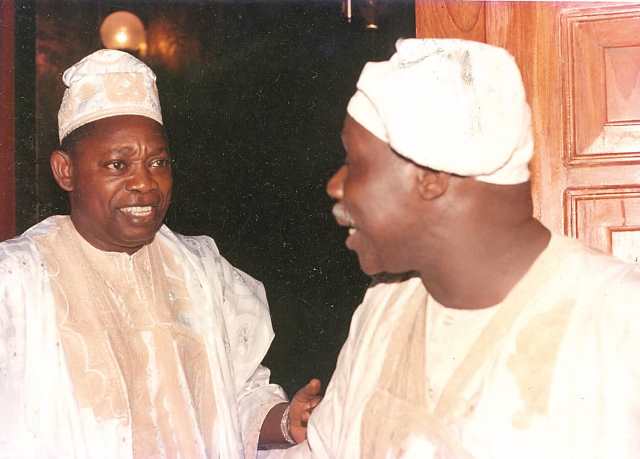
MKO Abiola with associates

Where were you when you heard the news and how did you receive it?

I was in London at the time. A friend called me on phone, and said he had something very urgent to discuss with me. It was in the afternoon of that day. He said something major was about to happen in Nigeria. When I asked further, he said I would hear it later. However, he whispered and said Buhari was about to recognise Abiola. I laughed, and said he can even wake Abiola up if he liked because we were already frustrated about promises that he would be honoured. The nearest to it was former President Jonathan, but it was mismanaged. And somehow, it collapsed.

What do you think happened?

In life, there must be preparation and readiness. After readiness comes victory. President Jonathan didn’t prepare very well. It was a spur of the moment gesture. Even this one that happened; some people think Buhari just woke up and did it. No, there was a process. As far back as last year, Kola Abiola got a legal opinion to know if what they were asking government to do for their father was possible, legally. He spoke to a Senior Advocate of Nigeria, who responded through a letter, saying it was possible to do so, posthumously. And Kola had approached past leaders to honour Abiola, but met a brick wall. Other members of the family might have done so as well, but I know of Kola Abiola. When this finally came, I was very excited. People have called me to ask if the motive was not political.

The motive, for me, is irrelevant. What is important is the fact that we got what we wanted. God has used President Buhari deliberately and frontally to recognise the winner of June 12. And I had advised the President a few weeks before the gesture that the best way to move Nigeria forward was to reconcile Nigerians. Even the issue of the President apologising to the family is the best way to bring a closure to such a monumental and unfortunate event like the June 12 tragedy. It happened in Kenya where Kenyatta called the opposition leader, Odinga to apologise so they can move forward. That is how to move the nation forward. In fact, the greatest mistake the APC made was to start fighting the moment they assumed leadership as if we were under the military. That has been my advice, and they thought we were fighting. It is embarrassing to get to power and start fighting.

What was the problem?

It is because Buhari’s biggest brand is that of a no-nonsense soldier. They felt that if they changed the brand they will lose their core loyalists. I remember telling (Rt. Hon. Rotimi) Amaechi (Transportation Minister) that we should call Buhari the Peoples General. It is the same problem that President Trump is having in America where he carried his base along. Now, his base wants him to destroy the existing system. In Nigeria, people still want Buhari to continue to be seen as a friend of the poor, who will probe corrupt people. And in Nigeria, the poor people see every rich man as their enemy which is a very dangerous mindset. I have warned government about that. The job of government is to promote prosperity and not to project poverty. It is a very delicate balance.

MKO Abiola with key military officers

Now they are knocking the head of the poor against the rich. That is why the economy will not pick up because even those who have money are scared of investing because of the fear of being targeted. That is why people are now hiding money outside Nigeria. On the Abiola issue, I want to remind the President that what I have told him on Pendulum has happened. When there is an atmosphere of joy and happiness and peace in the land, he will be the greatest beneficiary. What he has gained in the last one week is greater that whatever could be ascribed to him in the last three years.

You described the gesture as a closure on the June 12 saga but there are still other strands of the matter that are yet to be addressed. For instance, the results have not been officially released. What do you make of that?

I am not saying it has brought a closure because there are still other bridges to cross. I said it should be brought to a closure. By giving Abiola GCFR, it is assumed that he won the election, whether the result is declared or not. I know there are litigations challenging the release of the results. What I know is that symbolically, he has brought a closure to the matter. I believe the courts will declare him winner if such matter comes up in court.

MKO Abiola with late Nelson Mandela

A lot of people are saying that the June 12 political family is bigger than Abiola and Ambassador Babagana Kingibe. This explains the feeling that many who fought for June 12 were supposed to have been honoured alongside Abiola, Kingibe and Gani Fawehinmi.

What do you make out of that argument?

There is nowhere in the world where everyone will take credit for all that has happened in a struggle. I was not even invited for the investiture but I am not bothered because what I did for June 12 was not for personal reasons. I was even in Ghana when the President honoured Abiola in Abuja. Kola Abiola called me on the evening of June 11 that he wanted me to be around for the event, but I was not in the country. I don’t do things because I expect to be compensated. One of my favourite philosophers, Whitehead, said “Blessed are those who expect nothing because they shall never be disappointed.” I don’t waste my time thinking of what I will get from someone. Even when we were following Abiola; a lot of people were following him for different reasons. Some were following him because of houses; some did because of cars; some wanted money, but mine was because of wisdom. And I got it from him. Anytime I wanted to do something, I will consider how Abiola would have handled it. I believe that Abiola, as the leader, should take the credit alone. If he can take the blame, he can as well take the credit alone. Abiola lost his wife, Kudirat, but why are they not talking about her? It goes beyond that because the symbol of the struggle is Abiola. The head of June 12 is the one that has been recognised.

Who was Abiola to you and who was the Abiola you knew?

Abiola was definitely not a saint because I don’t think there is any living saint. But he was close to a saint. Whatever deficiency he had, he made up for in many other areas. I don’t know why anybody would say he sponsored this and that. In life, someone must have friends and every businessman must also have friends. Those friends must cut across all spheres of human endeavour. Abiola had friends in the military and everywhere. Abiola did not say because former Military President, General Babangida, was his friend, he would not campaign. He campaigned more than anybody, and suffered more than anybody. And when he had to fight his friend, he fought on the side of the people. If someone’s friend is in power, it will be wrong to abandon that friend so that you will not be accused of planning a coup. One thing I told the members of his family is that God has made him an everlasting martyr.

When the books would be written, questions would be asked about the real reason the election was annulled. Did Abiola confide in you as regards what he felt was the reason for the annulment?

No. Several times, we tried to discuss that – he would say that Babangida assured him that he was leaving. I remember Dr. Doyin Abiola telling me that he went to see Babangida severally to ask if he was sure of leaving. The general consensus was that Babangida didn’t want to leave, but they asked him and he swore that he would relinquish power. Abiola told me that if he knew Babangida was not ready to go, he would not have wasted his time. He told me that he didn’t like wasting his time. Based on my own private investigation, I found out that apart from the fact that the military didn’t want to go, Babangida didn’t want to go. There were also people who connived with the military and conspired against Abiola.

MKO Abiola with late Head of State, Gen Sani Abacha

That was what happened to Abiola. They came together to say that it will not fly. Babangida did not do it alone. Babangida was just a victim. It would have been resolved long ago. All they needed to do was to have apologized the way Buhari did. The Abiola family should be compensated because they lost so much. Abiola was involved in so many businesses, but when the June 12 saga started, all his businesses were destroyed. It is not enough to just honour him, his family should be compensated. For a man who was the richest in his time, some of his children found it difficult to go to school because of what happened. Government owes the company a lot of money. A fraction of that can be released. Abiola’s company, Summit Oil, was the second company to find oil in commercial quantity in Nigeria. I handled their media relations. The license was revoked. I think they have got it back now, but they have not been able to do much. By the time Abiola died, they would have spent in excess of N500 million on that project. That was when our currency had value.

They owned a bakery – Wonder Bakery, in the same compound with Concord Newspapers. By the time all these happened, all the machines went bad. They owned the biggest printing press, Bulk Delivery in Oshodi; Concord Airlines, a farm in Taraba State, Lafiagi, Ogun State, Senegal and other businesses. Government should just find some billions for them so that they can bring closure to all these.

MKO with Chief Obasanjo and others

On the failure of former President Obasanjo to honour Abiola, I know that a lot of things would be revealed very soon in Nigeria. For instance, when we talked about those who annulled June 12, I said that IBB did not do it alone. How come he left Abacha behind when he was leaving? I know that one day, IBB will tell us what was remotely responsible for his action, and why he did that. People are going to give different versions of what happened, but the fact remains that Babangida annulled the election.

On IBB, Obasanjo, Abacha families

If I find myself among them, I will tell them to apologise to the Abiola family and Nigerians. I have made overtures already. I am not just a journalist; I am a journalist who is blessed with a lot of contacts. I am reaching out to everybody because that is what Abiola would have done. He was not a vindictive person. Abiola was my adopted father. My father-in-law handed my wife over to Abiola during my wedding in December 1992. I know Abiola well enough.

Even after the annulment, Abiola wrote a letter to Babangida saying ‘let us be friends again’. He said IBB was his friend and that he did not know why he annulled the election. That is statesmanship. The Abacha, Obasanjo and Babangida families should raise their hands and beg God and Nigerians for forgiveness, and it will be over.

I was speaking to Abacha’s daughter, Gumsu, a few days ago and I asked her views about these things happening now. He said the Abacha children and Abiola’s children were friends before. She was mentioning names of the Abiola children, saying that they attended the same school and were very close. She said the Abiolas used to drive Volvo at that time, adding that anytime they saw a Volvo, they would conclude it was the Abiolas.

MKO Abiola with former President Ibrahim Babangida

She said there was a  time she saw one of Abiola’s daughters in Abuja and wanted to take her to meet her father (Abacha). But the girl was felt uncomfortable and refused to go. She narrated that if the girl had gone with her, Abacha would have allowed her to see her father (Abiola) in detention. And she stressed that she felt bad that Abiola’s children lost their father in the process, adding that she also lost her father. Abacha’s daughter informed also that her father (Abacha) also had a human side. I was so touched that I wondered what could have made Nigerians to act like that towards one another. Now the children are the ones suffering it. When Abacha’s name is mentioned, nobody wants to listen.

How do they close those gaps? How do we reconcile these Nigerian families because some of the children were so young when these things happened, and they don’t know anything about June 12? We have had the first closure, but the reconciliation of these Nigerian families is also another form of closure. Nigerians should learn to forgive one another. The only way to forgive is to admit wrongdoing. Let these families come out to admit that they were wrong.
Continue Reading
Click to comment

Leave a Reply

Your email address will not be published. Required fields are marked *

Featured

Ribadu’s Office Denies Arming Miyetti Allah in Kwara

Published

on

By

The National Counter Terrorism Centre (NCTC), under the office of the National Security Adviser Mallam Nuhu Ribadu, has refuted claims that it armed members of the Miyetti Allah group for counter-terrorism operations in Kwara State.

The Head of Strategic Communication at NCTC, Mr. Michael Abu, issued the rebuttal on Wednesday in Abuja.

Abu described the reports circulated by some online platforms as false and misleading, saying they misrepresented ongoing security operations in forested areas of the state.

He said that in line with the Terrorism Prevention and Prohibition Act, 2022, it continued to coordinate and support law enforcement, security and intelligence agencies in countering all forms of terrorism across the country.

NCTC spokesman explained that Nigeria’s counter-terrorism efforts guided by the National Counter Terrorism Strategy (NACTEST), involved the deployment of hybrid forces comprising regular security personnel and trained auxiliaries such as hunters and vigilante elements, particularly in difficult terrains.

According to him, the hybrid approach, which was previously deployed with the Civilian Joint Task Force in the North-East, is currently being applied in parts of the North-West and North-Central, including Kwara State, and has recorded several successes against banditry and other criminal activities.

He stressed that the Federal government was not conducting kinetic operations with any socio-cultural group, adding that claims that the Office of the National Security Adviser provided arms to such organisations are unfounded and should be disregarded.

According to him, all auxiliary personnel involved in hybrid operations were recruited directly by authorised security and intelligence agencies after due diligence, and that all operations were conducted strictly in line with the law and established standard operating procedures.

He urged the media to exercise responsibility by protecting sensitive security information and seeking clarification through designated official spokespersons, while advising the public to ignore unverified reports capable of undermining ongoing operations.

He reaffirmed the centre’s commitment to transparency and stakeholder engagement to deepen public understanding of Nigeria’s counter-terrorism efforts.

Continue Reading

Featured

Respite As Court Stops Police, IGP from Enforcing Tinted Glass Permit Nationwide

Published

on

By

A Delta State Court sitting in Orerokpe has restrained the Inspector General of Police (IGP) and the Nigeria Police Force from resuming the enforcement of the tinted glass permit policy nationwide.

Justice Joe Egwu, while ruling on a motion ex-parte in a suit marked HOR/FHR/M/31/2025 filed by Isreal Joe against the IGP and two others, through his counsel, Mr. Kunle Edun (SAN), who led other lawyers, restrained, stopped and barred the respondents from resuming the enforcement of the tinted glass permit policy nationwide.

The order was sequel to the announcement by the Nigeria Police of its decision to resume the tinted glass permit enforcement on January 2, 2026.

Aside from the IGP, the court also restrained the Nigeria Police Force and the Commissioner of Police, Delta State Police Command, from resuming the enforcement of the tinted glass permit policy nationwide.

Justice Egwu also barred the police from harassing, arresting, detaining or extorting citizens and motorists on account of the said policy, pending the hearing and determination of the substantive suit.

The case has also reignited a dispute between the Nigeria Police and the Nigerian Bar Association (NBA). The NBA has maintained that the matter remains before the courts and warned that enforcement could constitute contempt.

The association said a suit challenging the constitutionality of the policy had been filed at the Federal High Court, Abuja, and that a judgment had been reserved following the conclusion of hearings.

The NBA further cited a Federal High Court order in Warri directing parties to maintain the status quo pending an interlocutory injunction. The association accused the police of disregarding the rule of law and urged President Bola Tinubu to intervene. “Any contrary executive action amounts to overreaching the Court and undermines the rule of law,” NBA President Mazi Afam Osigwe (SAN) said.

The police, through Force Public Relations Officer CSP Benjamin Hundeyin, insisted that no court order barred enforcement and defended its planned resumption on grounds of public security. Hundeyin noted a rise in crimes facilitated by vehicles with unauthorised tinted glass, citing incidents ranging from armed robbery to kidnapping.

“The Inspector-General of Police, out of respect and understanding, temporarily suspended enforcement to give Nigerians additional time to regularise their tinted glass permits.

That decision was not based on any court order but was a discretionary move to accommodate public concerns,” he said.

The announcement prompted warnings from the NBA that enforcement could trigger committal proceedings against the IGP and the Force spokesperson. The police, however, maintained that enforcement continues until directed otherwise by a court, highlighting recent incidents in which occupants of vehicles with tinted glass allegedly attacked officers.

The ruling by the Delta State High Court now legally bars the police from implementing the tinted glass permit policy nationwide while litigation on the policy’s constitutionality continues.

Continue Reading

Featured

Operation Wetie of the Western Region in Sweet Retrospect: Its Metaphors and Lessons

Published

on

By

By Hon. Femi Kehinde

History, it has been said, is a reflection seen through the eyes of others into events of the past.

The world rotates around its history, and the universality of its lessons and constancy. Like beauty, history is in the eyes of the beholder.

In the old Western Region, attempts were made to stifle democracy, and give the region a government she did not vote for; that really drove the people wild, and justifiably so.

The disturbance was confined to the floor of the House; it did not extend to other parts of the city, and all other parts of the region were completely at peace and were not in the least aware of what was happening in the House of Assembly, until they heard the broadcast of the Prime Minister from Lagos.
The trail that started from the crisis in the Action Group went on to cause at the federal level, a major crisis between the coalition partners that destabilized the Western Region, ultimately leading to the intervention of the military and the collapse of the First Republic. The ramifications and scars of that crisis are still visible today.

The crisis in the Action Group was in retrospect, a watershed in the course of Nigeria’s journey to nationhood. All countries that became Nation-states have their watersheds, which at the time they were happening looked insignificant. Their significance is usually realized long after they have happened. The storming of the Bastilles in France was a spontaneous reaction to the excesses of the monarch and his wife, but it led to a revolution. This revolution, which caused the death of Louis the sixteenth and his wife – Marie Antoinette.

The Action Group crisis which started as a localized brawl, catalyzed into a bloody civil war and much more. During the debate on the motion which was to authorize the state of emergency in the western region, Chief Anthony Enahoro warned against setting in motion a chain of events, the end of which nobody could see or desire. What a prediction! So prophetic, so profound and so historic. He was not taken seriously then. The protagonist of the state of emergency could not see through their noses. They forgot to take to heart the lessons of history.
Ibadan is anything but far away, in fact below 100 miles to Lagos. Just about three years later, not only the prime minister, but two regional premiers, several civilians and military leaders lost their lives. Had the warning of Chief Anthony Enahoro been heeded and had there been no precipitous rush to declare state of emergency in the region, the course of Nigerian history might have been different and certainly less bloody.

A French philosopher, Paul Valery said “History is the science of things which do not repeat themselves”. History does not repeat itself. It is fools who are forced by their folly to repeat history.

The West was demonized and the plot to create disorder was hatched to give a pretext to take over running of the government and use that period to install a puppet government.

Nigeria has always suffered for lack of courage and conviction on the part of those whose duty it is to advise and counsel. Sycophancy, spinelessness, and lack of moral courage, intellectual dishonesty in the ivory tower are commonplace characteristics in all echelons of life in the country and the leadership has to be acutely focused, courageous and discerning not to fall victim.

The leaders did have moments to pause and reflects on the catastrophe they were about to unleash on themselves, but they failed to utilize these opportunities because they were blinded by their own self-interest and personal aggrandizement. They walked into the trap set for them with their eyes wide open. It was a tragedy of errors.

The Western Region, gradually going into the abyss, formally inaugurated the Egbe Omo Olofin, as against the well known Egbe Omo Oduduwa at the Mapo hall, Ibadan. Very prominent dignitaries and first class Yoruba Obas, Oba Akran, Oba Olagbegi, Oba Gbadegbo, the Alake of Egba Land, Oba Abimbola, the Oluwo of Iwo, were very prominent. Chief S.L.A Akintola and the highly partisan Chief Justice of the Federation- Justice Adetokunbo Ademola were the host. The leader of the opposition, Alhaji D.S Adegbenro, a man with few words, regarded these developments as “a sad mistake”. It should be well noted that the Supreme Court of Chief Justice Adetokunbo Ademola had in 1964 affirmed the treasonable felony jail sentence imposed on Obafemi Awolowo by Justice George Sodeinde Sowemimo in 1963.

The Federal Cabinet in its super belief of being all in all, accepted the census result and asked NCNC members, unwilling to accept the result to resign.

The Ogunde Concert Party organized a theatre tour of the Western Region, to show Yoruba Ronu, its new play from March 28 to April 25, 1964. The concert was to kick off at Ile-Ife and thereafter, move to Abeokuta, Ibadan, Oyo, Owo, Shagamu, Ilesha Ikare, Oka, Osogbo, Gbongan, Iwo, Ado-Ekiti, Ijebu Ode. In the midst of this Concert Tour, the epic play, Yoruba Ronu, was banned by the Government of the Western Region and thus, another gradual descent into anarchy.

Earlier, on the 27th of March, 1964, Kola Balogun lost his seat as a special member of the House of Chiefs, following the withdrawal of recognition of his Chieftaincy title as Jagun of Otan Ayegbaju, by the NNDP Government of the Western Region. Kola Balogun had lost face with the Akintola Government. The electioneering campaign towards the 1965 election had started. The Premier, Samuel Ladoke, was on tour of Ijesha Division on Saturday, the 4th of April, 1964. At Ilesha, in front of Ilesha Grammar School, the Premier and his entourage were booed by students of Ilesha Grammar School, perhaps with the encouragement of their principal – Rev. Josiah Akinyemi, a staunch member of the Action Group and father of Prof. Bolaji Akinyemi.

Rev. Akinyemi was the following morning, transferred to Oyo to replace Bishop Seth Kale as Principal of St. Andrews College, Oyo. An NNDP Chieftain in llesha and a member of the Western House of Assembly- Barrister Oladiran Olaitan, had his car severely damaged and in an attempt to escape the onslaught, bottles and stones were thrown at him.

Ilesha Grammar School was eventually shut down and was only reopened after the intervention of prominent Ilesha elites, like Chief S.T Adelegan, the Deputy Speaker of the House of Assembly and also Principal of Ipetu-ljesha Grammar School, the Attorney-General, Chief Olowofoyeku and the Governor, Sir Odeleye Fadahunsi.

Also in April, 1964, a scion of the Agbaje Family, Mojeed Agbaje, was removed as Minister for Information and the Odemo of Isara, Oba Samuel Akisanya, a first class Oba, was removed as a member of the House of Chiefs.

On the 8th of June, 1964, Chief SLA Akintola, the Premier, was driving to Mapo hall, when a pregnant woman hopped her head out of the crowd and shouted, “SLA OLE! SLA THIEF!” The visibly disturbed Premier, ordered his driver to detain the woman, who was put in the Land Rover that carried the Premier’s Body guards. The accused, Kehinde Arowolo, a native of Ikenne, was charged before the Ibadan Magistrate Court for conduct likely to disturb public peace. The accused pleaded not guilty, and she denied the charge. The case was subsequently adjourned to the 4th of November, 1964.

Alhaji Busari Obisesan for the defence said, “don’t forget to bring Chief Akintola to court as his evidence would be vital to the case!” What an audacious statement.

Around this period, an Oba in one of the Ijebu towns was burnt to ashes for being sympathetic towards Akintola’s cause. Ayo Rosiji, an Akintola apologist in July 1964, had his car stoned at a car park in Marina Lagos. His confidant in his constituency, Shittu Bamidele, had also been killed by thugs, who drove a six-inch nail through his forehead. Rosiji eventually lost the Federal Election in 1964.

When there is a quarrel, even ordinary songs would have added meanings and political songs, drums, its coinages and interpretations were now being stronger than even bazooka guns. To Awolowo’s loyalist, the popular sing song was “Se lo lo ko ogbon wa o hee, Se lo lo ko ogbon wa haa, Awolowo, baba layinka i.e. Awolowo has gone to the Prison to be fortified. Interestingly, Awolowo had no child by the name Layinka.

The Federal General Election of 1964 conducted by E. E. Esua as Federal Electoral Commissioner had showed that the Government had lost control of the Western Region, but it also introduced violence throughout the electioneering campaign, arson and assault featured throughout the election. It was a precursor of what was to be expected at the Regional General Elections coming up in 1965.

In some towns and communities, arson visited upon dwelling houses, and public buildings were also added to public roasting of government supporters in the so called “operation weti e”.

The petrol poured on human beings, and such individuals were left to be burnt to death. Indeed, law and order had broken down and perhaps irretrievably and yet, NNDP was declared the winner of a massively rigged general election and his leader, was called upon by the Governor of the Western Region, Sir Odeleye Fadahunsi to form the new government.

Undoubtedly, the region was in an uproar and tumoil. Security had broken down and no one was safe on the road. There were several unofficial road blocks, everywhere and the high level of fear, indignation and security was heightened. When the Chief Justice of the Federation, Sir Adetokunbo Ademola was manhandled on the road between Abeokuta and Lagos, the gravity of the situation became very apparent to all. It became urgent that something must be done to restore law and order to the Western Region. The NNDP was a member of the COALITION – the Nigerian National Alliance (NNA), which it had formed with the ruling NPC and so it was difficult for the Federal Government to intervene to remove a regional Government formed by its surrogate, the NNDP. Yet, something must be done.

The events in the Western Region was certainly laying the foundation to the apocalypse, that was to engulf the country. The Premier of the Eastern Region, Dr. Michael Okpara told his counterpart in the Western Region, Chief SLA Akintola, that he was coming on a visit to Ibadan. SLA Akintola told him he would not be welcome, because he could not guarantee his safety.

The visit took place nevertheless, and as an act of defiance, Premier Michael Okpara still went ahead to visit the Premier at the Premier’s lodge, Iyaganku, Ibadan. The host Premier, SLA Akintola, was nowhere to be found. Michael Okpara nonetheless, signed the visitors register and left.

It was an irony of circumstance, that Premier Ladoke Akintola, who in 1962 was prepared to defile his Party, to welcome a Northern Premier and aristocrat, on the grounds of protocol and hospitality, could not do the same thing for the Premier of the Eastern Region, who was his ally not too long ago. It would be recalled that Okpara had now joined forces with the Action Group, led by Chief (Mrs) H.I.D Awolowo and Alhaji D.S Adegbenro to form UPGA.

In the north, in the west, and in the mid-west, all was confusion. A team of lawyers sent to northern Nigeria by the United Progressive Grand Alliance (UPGA) for the purpose of looking after the legal interest of AG members was not allowed to function.

In the Western Region, trenches were dug, all in order to prevent political opponent the freedom of expression and movement. In October 1965, the Western Region went to the polls to elect a new House of Assembly, the first regional election since the Action Group crisis, an opportunity for Chief Akintola to test his popularity.

The conduct of the election caused wide spread anger which resulted in so much incidence of arson, murder, rioting and general insecurity that the army was sent to the region to maintain law and order. More than 2000 people were killed during and after the election.

After winning the 1965 election, Samuel Ladoke Akintola was called by the governor, Sir Odeleye Fadahunsi to form the new government in October 1965. His taped recorded acceptance speech and message to the people of western region to be rebroadcast by the Nigerian broadcasting corporation (NBC) had been removed and replaced with another recorded message by a mystery gunman who had stepped into the studio and made his own broadcast, denouncing Akintola. This popular gunman was later alleged to be a popular playwright, Wole Soyinka.

On the 15th of October, the newsroom of the Nigerian Broadcasting Corporation (NBC) was more fortified than ever. It was a fortress which was armed to the teeth. In the newsroom was a cubicle where the whole activity normally took place. That evening, the occupants of the cubicle, apart from the leader of the crew were Lajide Ishola, Stephen Oyewole and John Okungbona. The crew men had in their possession the recording of the speech of the Premier of the western region of Nigeria, Chief Ladoke Akintola, which had earlier been recorded at the premier’s lodge at lyaganku. The recordings which contained the message of the premier were made in both English and Yoruba. The premier had finished with the recording a few minutes before 7 o’clock in the evening and he was looking forward to listening to his speech which he had regarded as a masterpiece that will explain the situation of things in the western region.

At about quarter past 7 in the evening, Oshin breezed in into the studio cubicle with his crew men, taking with him the 2 recorded tapes which contained the premier’s speech i.e. both the English and the Yoruba version. Funnily and interestingly, just as Oshin was about to slot in the first tape, a bearded man appeared at the door, and suddenly from nowhere produced a gun and held it to Oshin’s head. There was an abrupt silence. The gunman, goatee-bearded and unmasked, demanded that the radio technician hand over the two tapes he was holding. Oshin quietly handed over the tapes to him, while the other three men in the cubicle, watched the unfolding drama with apparent shock and disbelief.

The gunman handed a tape over to Oshin and ordered him to play it. For fear of his life, Oshin slotted in the gunman’s tape and played it. The gunman listened to part of the content and quietly disappeared as mysteriously as he had come in. The whole operation was swift, brief, effective and decisive.

Pandemonium broke in as soon as members of the public heard the recording on air. Oshin had apparently run out of the studio and the gunman was nowhere to be found. The other three occupants of the cubicle were arrested and taken to the police station, where they made statements to the effect that they had no clue to who the gunman was. They had a clinical description of what exactly happened and the near unanimity about the description of the unmasked mystery gunman. The mystery gunman was eventually arrested and brought before a newly appointed Judge of the High Court, Justice Kayode Esho, sitting in High Court 6. Justice Esho was a stern, disciplined and incorruptible judge. Before the trial, the Chief Justice of the western region, Justice Adeyinka Morgan called Kayode Esho, and straight to the point said, “I have an assignment for you. It is this very important case of the hold-up of the radio station and the robbery of the premier’s tapes. It is a very sensitive assignment, which I would have undertaken myself, having regard to the importance and sensitivity, but the accused person, Wole Soyinka, is a relation of mine. I have full confidence that you will handle it very well’.

Interestingly, the Chief Justice further said, “by the way” and in a measured tone said “they are already saying you will not be able to jail this man”, Justice Kayode Esho wondered ” who are the “they”, “they” “they”. Who are those that the pronoun “they” represent.

According to Esho, why should those “they” be talking to the Chief Justice? why according to Esho? If the “they” talked to the Chief Justice, should he mention it to me while I was trying such a sensitive case, or even any case, for that matter? I got up, pretending not to have been ruffled by the statement, thanked the Chief Justice again, and left for my chambers.”

On the 26th of October, 1965, i.e exactly two weeks after the general election, Akintola lost his most cherished daughter and confidant, Omodele. Omodele died as a result of an overdose of sleeping pills.

After Omodele’s death, Akintola was beginning to have a second thought about his ability to continue with the crisis, and asked rhetorically “whether the whole warfare was worth it at all”. It was apparent then that Ladoke Akintola was greatly distressed.

According to one of the sentries at the Government house, Mr Olabode, a regional police officer attached to the government’s lodge, the premier was in a state of utter confusion, and after meetings, however late, will still travel to Ogbomoso to sleep, and come back to Ibadan in the morning. The Premier’s driver confided in the young police officer, Olabode, that the premier was fond of this trip, because the late night trip from Ibadan afforded him the opportunity of a thoughtful silence and a deep sleep.

Prince Adewale Kazeem, another known confidant of the Premier, also noticed a premier whose hands were shivering and could no longer append his signature on a straight line. Prince Adewale noticed this again and advised the premier, “Baba, why don’t you resign?” and the soberly premier replied “Adewale, O ti bo, iku lo ma gbeyin eleyi- Adewale, it is too late, it is only death that will end this feud.”

Chief Samuel Ladoke Akintola was in this state of disillusionment when on the 14th of January 1966, he asked his aide, R.A Obaleke, upon resumption of duty to get prepared for a trip to Kaduna. There was a plane already waiting for them at the Ibadan Airport, arranged from Lagos. On the premier’s entourage to Kaduna were Chief Lekan Salami, Alhaji Lamidi Adedibu, R. A. Obaleke, N.A.B Kotoye and a host of others, to meet with the Premier of the Northern Region, Sir Ahmadu Bello. At this meeting at the Premier’s lodge in Kaduna, the two premiers went into a long private session. Before the commencement of the meeting, Premier Ladoke Akintola had given some money to his Personal assistant, R.A Obaleke to buy some books for him at the bookshop.

After a long while, Obaleke came back to still find the two premiers in a very serious dialogue. Obaleke informed the premier of the need to go back to Ibadan in a good time, because there was no night landing facility at the Ibadan Airport. Premier Ladoke Akintola immediately proceeded to the Kaduna airport and was seen off by his host- the Premier of the Northern Region, Sir Ahmadu Bello. On arrival in Ibadan, the Premier and his entourage proceeded to the premier’s lodge. The cook, Effiong, a Calabar man, provided dinner for the premier, before their departure. On the 14th of January 1966, the Premier had earlier told his wife, Faderera to proceed to Ogbomoso to prepare their Ogbomoso residence for a private visit of Emperor Haile Selassie of Ethiopia. In the Premier’s lodge were Yomi, his eldest son and his wife Dupe, and their son, Akinwumi, and Gbolahan Odunjo, Omodele’s son, and the visiting Tokunbo Akintola, who came in on holidays from Eton College London. It will be recalled once again, that the British Prime Minister, Harold Wilson, at the Commonwealth Prime Ministers’ Conference in Lagos in January 1966, warned the host of the conference of an impending military insurrection and offered the Prime Minister, Tafawa Balewa, asylum in one of the British frigates on the Atlantic water.

The Prime Minister rebuffed this intelligence report and Akintola’s report, fears and apprehensions, as mere hearsay and unfounded.

In the early hours of January 15, at about 2am, and as predicted, the army struck like a thief in the night. The army mobilized from the Alamala Abeokuta Garrison of the Nigerian Army. It was led by Captain Nwobosi, to effect a change of government in the Western Region.

The Military officers after picking Deputy Premier, Fani Kayode, moved to the Premier’s Lodge. At the Premier’s lodge, with their Military trucks, they forcibly entered the lodge. The head of sentries/Police security, Chief Inspector Sokunbi, an Ijebu man, immediately put off the flood light and was chased by the soldiers. The officer manning the back of the premier’s lodge, Police Corporal Bernard Olabode, a native of Gbongan, was equally chased, but was not discovered inside the drainage where he hid.

The Military officers, immediately put off the electricity supply to the Premier’s lodge. The officer from the ministry of works, posted to the Premier’s lodge, and whose responsibility was maintenance of the two generators at the Premier’s lodge, thought it was a power outage and immediately went to put on the manual generator, since the automatic generator could not come up immediately after the power outage. He was shot on the forehead by one of the officers and he died instantly.

The leader of the Military officers, shouted the name of the Premier, “Akintola come out you are under house arrest.” They also asked his Deputy, already in their custody, to call him, “Sir, Ladoke Akintola, it is me Fani Kayode please come out.” After hearing this voice, the Premier who had immediately upon the arrival of the army officers moved his family through the walkway from the official residence, to his office in the Premier’s lodge, knew there was real danger.

A maid of one of his children, started crying saying “E jo woooo E jo woooo” meaning “please please.” The outcry of this maid exposed the location of the Premier. There was then a gunshot from the Premier to the rampaging soldiers.

According to the Police Officer, Bernard Olabode, in his hiding location he saw bullet shots going towards the Premier’s Office. One of the shots, hit the Premier on the wrist and the Officers were still insisting that he must come out of hiding. They had promised to finish the entire family.

For the Safety of his children, the Are Ona kankanfo of Yoruba land had no choice, but to come down. He was instantly arrested by the soldiers. The leader of the group according to PC Olabode, asked Fani Kayode to identify the Premier. Apparently, they didn’t even know him. Fani Power identified him as the Premier.

According to Olabode, two Officers were placed on his right and left hand, as if facing a firing squad and volley of bullets were hurled at him. The first shot hit the Premier on his forehead, some on his chest and later the Premier gave up.

When he fell down, the leader of the group placed his leg on the Premiers forehead and asked some of his soldiers to rain further bullets on the lying Premier. The group leader, speaking in various languages, said according to Olabode, “he is a juju man, perforate him further with bullets” and thus the end of Are-Ona Kankanfo, who had fought a bitter struggle with his tongue, pen and strength.

The army had also arrested Lt. Col Largemma of the Ibadan Garrison and killed him. Col. Largemma was very close to the Premier of the Western Region, and also Premier of Northern Region. The Federal Brigade of Guards Commander in Lagos, was also killed. Major Okafor had ordered the abduction and eventual murder of the Prime Minister, Tafawa Balewa, the Minister of Finance, Okotie-Eboh, whilst Major Chukwuma Nzeogwu, also invaded the Premier’s lodge in Kaduna and killed Sir Ahmadu Bello, one of his wives, Hafsat and some Military Officers, like Brigadier Ademulegun, Col. Ralph Sodeinde and several other officers and thus the end of Civil Government in Nigeria and the beginning of Military interregnum, that did not end effectively until the 29th of May 1999, when another Military man and former Head of State, Olusegun Obasanjo, became President of the Civilian Government.

In retrospect, the state of emergency on the Western Region was declared on the 29th of May 1962 by the Federal Government of Prime Minister Tafawa Balewa. No wonder, George Santyana rightly said- “those who do not know history are doomed to repeat its failures”. The “operation weti e” of Western Region certainly left its metaphors and lessons for the discerning minds!

Hon. (Barr.) Femi Kehinde is the
Principal Partner, Femi Kehinde & Co (Solicitors), and Former Member, House of Representatives, National Assembly, Abuja, representing Ayedire/Iwo/Ola-Oluwa Federal Constituency of Osun State, (1999-2003).

Continue Reading

Trending