Connect with us

National

Oshiomhole Laments Poverty Stricken Nature of Nigerian Workers Under Tinubu’s Govt

Published

on

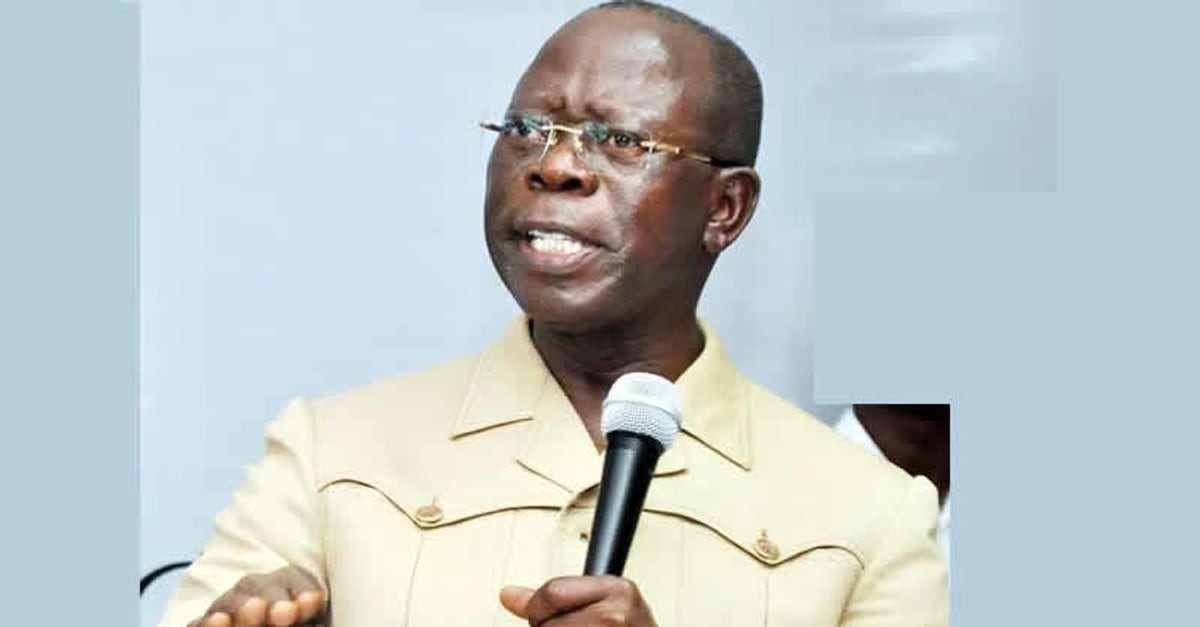
A former President of the Nigeria Labour Congress (NLC), Senator Adams Oshiomhole, has lamented that the present day Nigerian workers are poorer than those who worked for the country in the past.

Oshiomhole, a former Governor of Edo State, also decried the present N70,000 minimum wage, arguing that the celebrated wage when converted to dollars, is equivalent to only $42.

The former labour leader spoke at the National Institute of Security Studies, Abuja, during a distinguished personality lecture organised for members of the Executive Intelligence Management Course 17.

Comparing the first minimum wage in the country under the administration of Shehu Shagari as President, he noted that the N125 minimum wage at that time was equivalent to $160.

The lawmaker, who spoke on the title of the lecture: “National Minimum Wage: Reward system and productivity in Africa”, said: “When minimum wage in Nigeria was established under President Shagari – I think around 1981 – it was around N125, which was about $160 a month.

“Today, with the fat increase – 100% increase that the labour achieved last year, which is now being implemented this month – according to our current exchange rate, is $42.

“So, if you divide N70,000 by N1,650, it gives you $42. So, the working people are much poorer now than we were so many years ago. So, this opportunity will depreciate, and that affects the quality of life and everything.”

He urged the Federal government and other states generating high revenues to pay workers more than the agreed N70,000 minimum wage.

The Senator representing Edo North in the National Assembly also called for the expansion of minimum wage law to domestic staff, among others, through the amendment of the law.

He said: “But again, if you look at the law in Nigeria, which I hope will be able to amend very soon, although the Federal government and the states have agreed on a minimum wage, for example, at N70,000, there are still people who are paying less than that.

“Even under the law, because it says you have to have about 25 to 50 employees minimum for that law to be applicable to a particular enterprise. But with the changing technology, a small ICT company employing 10 people can generate much turnover. So, using the number of employees was appropriate when the economy was more broad-driven not with ICT.”

Continue Reading
Click to comment

Leave a Reply

Your email address will not be published. Required fields are marked *

National

Nine Senators Announce Defection to ADC

Published

on

By

Nine senators on Thursday announced their defection from their various parties to the African Democratic Congress (ADC).

Five of the senators dumped the Peoples Democratic Party (PDP), three left the Labour Party (LP), and one from the All Progressive Grand Alliance (APGA).

The defectors from PDP are Senators Dauda Yaroe, Lawal Usman, Ogochi Onawe, Aminu Tambuwal and Austin Akubondu.

The LP defectors are Senators Ireti Kingibe, Victor Umeh and Tony Nwoye.

Eight of the senators who dumped the PDP and LP cited leadership crises in their parties for their defection.

However, Senator Eyinnaya Abaribe said he dumped APGA because the party sacked him in September 2025.

Continue Reading

National

Police Council Confirms Tunji Disu As Substantive IGP

Published

on

By

The National Police Council has confirmed Olatunji Disu as the substantive Inspector-General of Police.

His name is now to be sent to the Senate for screening.

President Bola Tinubu appointed Disu as the acting IGP on February 25, 2026, following the resignation of former IGP Kayode Egbetokun.

Tinubu, in a statement by the presidential spokesman, Bayo Onanuga, had said he would convene a meeting of the Nigeria Police Council to formally consider Disu’s appointment as substantive IGP, after which his name would be transmitted to the Senate for confirmation,” he said.

The former AIG assumed office as the acting Inspector-General of Police (IGP) last Wednesday.

Disu, 59, took over the reins as Nigeria’s new police chief at a brief ceremony at the Louis Edet House in Abuja, shortly after President Bola Tinubu decorated him as the acting IGP.

Until his appointment, Disu served as Assistant Inspector-General in charge of the Force Criminal Investigation Department (FCID) Annex, Alagbon, Lagos.

He was promoted to the rank of Assistant Inspector-General of Police last year.

Continue Reading

National

JAMB Warns Against AI-Driven UTME Fraud, Vows Sanctions for Candidates, Parents

Published

on

By

The Joint Admissions and Matriculation Board (JAMB) has announced tough measures against candidates and parents found culpable in examination malpractice, warning that the era of leniency is over.

Speaking in Abuja on Saturday, the Registrar, Professor Ishaq Oloyede, said the Board was alarmed by recent discoveries of organised fraud networks targeting the Unified Tertiary Matriculation Examination (UTME). He described the trend as a serious assault on merit and fairness within Nigeria’s education system.

Oloyede explained that JAMB had over the years committed substantial financial and technological resources to preserving the credibility of its examinations, stressing that these measures were designed to protect millions of diligent candidates who rely solely on hard work.

Investigations, he disclosed, uncovered criminal groups deploying artificial intelligence tools to impersonate JAMB officials and extort unsuspecting candidates. More troubling, according to him, was the active participation of some candidates and their parents, who knowingly paid for illicit assistance.

“The students and their parents are willing collaborators and cannot be regarded as innocent,” the Registrar said.

He revealed that over 100 candidates were linked to the scheme, with 83 confirmed to have made payments across 25 states, indicating that the malpractice is neither regional nor isolated.
He said the Board had forwarded recommendations to the Minister of Education, including the cancellation of affected registrations.

Oloyede also refuted claims circulating in some quarters that JAMB had increased its registration fees, describing the allegation as false and urging the public to report any centre charging above the approved rate.

As part of immediate corrective steps, several Computer-Based Test centres have been sanctioned, with some suspended from further participation in the examination process.

Dismissing suggestions that the Board should negotiate with offenders, the Registrar maintained that criminal conduct must be addressed through lawful channels.
“Why should we now be negotiating with criminals?” he asked, noting that suspects who left the country after previous examinations would be referred to security agencies for due process.

He emphasised that paying for examination fraud constitutes a criminal offence, warning that ignorance would no longer be accepted as a defence. Membership in online groups offering illegal assistance, he added, could also attract penalties.

Addressing parents directly, Oloyede cautioned that financing malpractice undermines a child’s moral foundation and future prospects. Encouraging shortcuts, he noted, sends a dangerous message that dishonesty is an acceptable path to success.

The Registrar further confirmed that some school proprietors were among those arrested in connection with the fraud.

On JAMB’s capacity to confront increasingly sophisticated schemes, Oloyede expressed confidence in the Board’s upgraded technical systems and its collaboration with national security agencies. He stated that enhanced monitoring mechanisms now enable the detection of prohibited electronic devices during examinations.

He also expressed concern over the involvement of underage candidates in malpractice, attributing the trend partly to parental pressure and complicity.

While reiterating that JAMB’s core mandate is the administration of examinations, Oloyede appealed to the media to support efforts aimed at discouraging malpractice and promoting integrity within the education sector.

Continue Reading

Trending