
Headline
Make or Mar: Nigerians Elect New President


By Eric Elezuo
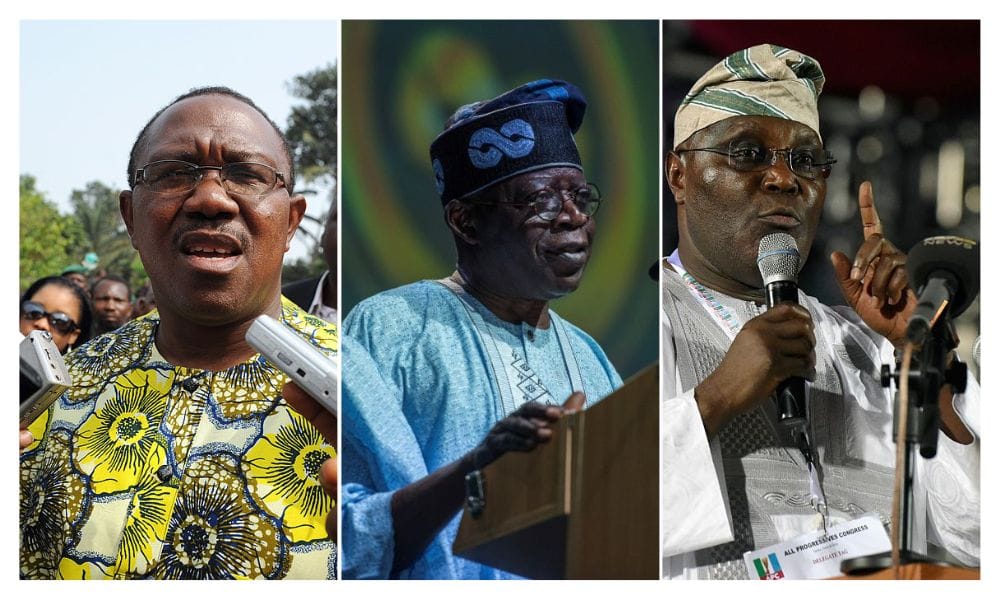
Finally, February 25, 2023 is here with us, and it marks a watershed in the annals of election in Nigeria. As 18 candidates from diverse political parties file out to present themselves for the goodwill of the over 87 million shortlisted voters by the Independent National Electoral Commission (INEC), the stage remained turbocharged, and favour is likely to smile on any of the three major and leading candidates vis a vis Mr. Peter Obi of the Labour Party, Alhaji Atiku Abubakar of the Peoples Democratic Party (PDP) and Asiwaju Bola Tinubu of the ruling All Progressives Congress (APC). The other candidates, studies have shown, are make up of number. This is because the five months window of intensive campaigns did not see the candidates present themselves for electoral scrutiny across the states, and it is obvious that majority of the Nigerian electorate do not know who they are, or they parties they represent.
The coming of February 25 brings a sudden end to the exoteric banters that have been exchanged among party spokespersons and faithful in both public spaces and from their various private corners. The salvos from the likes of Dele Momodu, Dino Melaye, Timi Frank, Phrank Shauibu, and Reno Omokri of the PDP and the counterparts, Bayo Onanuga, Dele Alake, Festus Keyamo from the APC and Kenneth Okonkwo and his team from LP will surely take a backseat till after the elections when a new set of salvos will originate. It will also mark the beginning of the end of President Muhammadu Tinubu’s eight years grip on Nigerians, filled with murmurings.
As millions of Nigerians troop out from their various comfort zones across the nation to vote the candidate, three measures will be considered including if the eight years hegemony of the ruling APC will continue in Tinubu, or if the PDP will bounce back after an eight years hiatus, having lost the presidency in 2015, or if there will a distinct change from the norms, a major paradigm shift from what was used to with a Labour Party victory. The stage is set, and the whole of today is the battle field. The victor definitely will come out with lots of scars as none of the candidates is a pushover. The victory however, lies with the candidate, whose charisma and sagacity have resonated positively with the voting public, and who has proposed tact, finesse and verifiable measures to take Nigeria to a whole new positive level and height.
Basking on the euphoria of INEC promise of a free and fair election with the use of the Bimodal Voter Accreditation System (BVAS), a facial and fingerprints technology that is thought to improve transparency by making it harder for politicians to rig the process and the Electoral Act, which has just been signed into law, as well as the massive deployment of security agencies across board, it is obvious that Nigerians are set to enjoy a calm election, the first time after a very long time, if not ever. This is not forgetting that money politics has to a limited extent been removed. The preparations, electoral laws on ground and the high use of technology is likely to reduce the usual three days it take to announce presidential election results. Nigerians may likely know who the next president is by late Sunday, everything being equal, and if BVAS also uploads vote results directly to the INEC website direct from polling stations as proposed.
For any of Peter Obi, Tinubu or Atiku to emerge winner today, he needs to have the most votes and 25% of ballots cast in two-thirds of the 36 states of the federation and Abuja, and that is a herculean task. And if no-one achieves that, a new trend in electoral history will be added as there will be a run-off within 21 days.
As at today, Nigerians have made up their minds based on the candidate who they will cast their votes based on many variables including sound economic and social policies, monetary inducement, unwavering loyalty, ethnic or religious affiliation and godfatherism irrespective of incapacitation or lost of touch with reality. As a result, there is no possibility of swerving anyone at this last minute. The candidates will only sit in their situation rooms and watch with breath held, heart panting, and hope for the best. But only one candidate will shout ‘eureka’ at the end of the day. It is also worthy of note that elections for 109 senators and 360 House of Representatives members will be held today, except for Enugu East senatorial zone, comprising six local governments where senatorial election has been postponed till March 11 following the murder of Labour Party candidate, Oyibo Chukwu, on Wednesday.
But what are the candidates’ strength and weaknesses as the face the electorate today:
PETER OBI (LABOUR PARTY)

With endorsements from great Nigerians including former President Olusegun Obasanjo, Ayo Adebanjo, Samuel Ortom and many others, Peter Obi, 61, is hoping to break up Nigeria’s two-party system after joining the Labour Party last May.
Although he was in the PDP before then, he is seen as a relatively fresh face and enjoys fervent support among some sections of Nigeria’s youth, especially in the south.
The wealthy businessman served as governor of the south-eastern Anambra State from 2006 to 2014. His backers, known as the “OBIdients” say he is the only candidate with integrity, but his critics argue that a vote for Obi is wasted as he is unlikely to win.
When asked about how he would respond to insecurity, Obi had said, “I’m going to be commander in chief, I will deal with it decisively. I can’t tell you how I’m going to deal with it because if I tell you, it won’t work.
“My first responsibility in this country is to secure lives and property. It is a critical thing because unless you do it, nobody will invest. The farmers can’t go back, so there is no food production, there is nothing that can happen without food production.
“Not even America…all the time they were going to Baghdad, they just said, they will attack massively, decisively, they never gave us how they were going to do it that night. How can I tell you? I will be in charge, I will be commander in chief and with security, we will be responsive and responsible. That means, whatever happened we will deal with it decisively and someone will have to be responsible for it. If you are not doing it, you are out. We are not going to wait.”
Obasanjo has this to say about him: “I have come to realise a number of factors in character, attributes and attitude that are necessary in the job of directing the affairs of Nigeria successfully and at a time like this. These characteristics or attributes are many but let us be mindful of some key ones together.
“From interaction and experience, and as mentees as most of them claim, I will, without prejudice, fear or ill-will, make bold to say that there are four major factors to watch out for in a leader you will consider to hoist on yourself and on the rest of Nigerians in the coming election and they are what I call TVCP: Track record of ability and performance; Vision that is authentic, honest and realistic; Character and attributes of a lady and a gentleman who are children of God and obedient to God; and Physical and mental capability with soundness of mind as it is a very taxing and tasking assignment at the best of times and more so, it is at the most difficult time that we are.”
“Let me say straight away that ‘Emi Lokan’ (My turn) and ‘I have paid my dues’ are one and the same thing and are wrong attitude and mentality for the leadership of Nigeria now. They cannot form the new pedestal to reinvent and to invest in a new Nigeria based on an All-Nigeria Government for the liberation and restoration of Nigeria. Such a government must have representation from all sectors of our national life – public, private, civil society, professional, labour, employers, and the diaspora.
“The solution should be in ‘we’ and ‘us’ and not in ‘me’ and ‘I’.
“Mind you, I reiterate that no human being is an angel let alone a Messiah, but there are elements of these attributes and on comparative basis and by measure of what we know of, and what some of us have experienced from the front-runners, we must assess judiciously and choose wisely.
“If anybody claims he or she has anything to the contrary, it will be up to him or her to prove to us.
ATIKU ABUBAKAR (PDP)

The PDP, which ruled until 2015, wants Nigerians to vote for Atiku Abubakar, 76 – the only major candidate from the country’s mainly Muslim north.
He has run for the presidency five times before – all of which he has lost. He has been dogged by accusations of corruption and cronyism, which he denies.
Most of his career has been spent in the corridors of power, having worked as a top civil servant, vice-president and a prominent businessman.

Most people consider the election a referendum on the APC, which has overseen a period of economic hardship and worsening insecurity. Its candidate, Bola Ahmed Tinubu, 70, is credited with building Nigeria’s commercial hub Lagos, during his two terms as governor until 2007.
He is known as a political godfather in the south-west region, where he wields huge influence, but like Atiku, has also been dogged by allegations of corruption over the years and poor health, both of which he denies.
In giving back to the society, Asiwaju Tinubu has established industries, and employed thousands of Nigerians. His investments cut across the media, aviation, finance and many more.
His Bourdillon Ikoyi home is home to many individuals who throng there on a daily basis for one directive or assistance or another.
Asides giving employment to thousands of Nigerians, Asiwaju has uncountable unrepentant political godsons, who would support him not minding his purported ill-health and alleged corruption ridden background .
Tinubu acceptance by his people and loyalists is showcased wherever he goes.




Nation Building Reimagined: Integrated Principles and Strategies for Sustainable Growth

Dear CDS, NSA, Your Prodigal Sons, Brothers Have Killed General Braimah

Voice of Emancipation: Lessons from the Iran/USA War

Ovation @30: A Triumph of Vision, Courage and African Excellence

ADC National Convention: To Be or Not to Be?

Israel Questions Pakistan’s Credibility in Mediating over US-Iran Ceasefire Agreement

Osun 2026: INEC Planning to Recruit APC Members As Electoral Officials, Lawmakers Allege

‘ADC Membership Hits 500,000 after INEC Derecognition of Leadership’

Trump Delays Iran’s Strike by 2-Weeks As Pakistani Leaders Intervene

FG Expels US Missionary Alex Barber

ADC Raises Alarm over INEC’s Plot to Prevent Party from Fielding Candidates

Benin Republic 2026: Romuald Wadagni, The President in Waiting

I Won’t Be Intimidated, Seun Okinbaloye Replies Wike

Amnesty Condemns Wike’s ‘Shoot’ Remark Against Seun Okinbaloye
-
 News5 days ago
‘ADC Membership Hits 500,000 after INEC Derecognition of Leadership’
-
 World3 days ago
Trump Delays Iran’s Strike by 2-Weeks As Pakistani Leaders Intervene
-
 National3 days ago
FG Expels US Missionary Alex Barber
-
 Featured5 days ago
ADC Raises Alarm over INEC’s Plot to Prevent Party from Fielding Candidates
-
 Featured2 days ago
Benin Republic 2026: Romuald Wadagni, The President in Waiting
-
 Featured5 days ago
I Won’t Be Intimidated, Seun Okinbaloye Replies Wike
-
 Headline5 days ago
Amnesty Condemns Wike’s ‘Shoot’ Remark Against Seun Okinbaloye
-
 News3 days ago
Prominent ADC Leaders Storm INEC Hqrs in Protest Against Dictatorship