Headline
Controversies Surrounding Death, Burial of High Chief Olu Benson Lulu Briggs
Published
5 years agoon
By
Eric
By Eric Elezuo
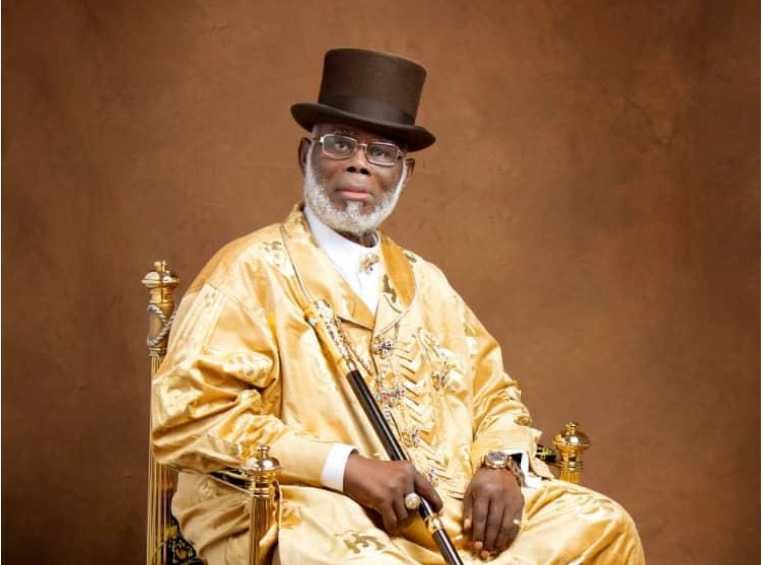
It was a huge sigh of relief when on Saturday, March 13, 2021, the remains of late Ijaw traditional ruler, philanthropist and businessman, High Chief Olu Benson Lulu-Briggs, were finally committed to mother earth. The body of the deceased had remained in the mortuary since December 27, 2018 when he dropped dead shortly after arriving Accra, Ghana, for a month long vacation with a retinue of family members and staff, his wife of over two decades, Seinye Lulu Briggs, inclusive.
There are personalities whose remains have caused a lot of stir among family members; remaining in the custody of mortuary attendants for months and sometimes years, but Lulu Briggs unwarranted incarceration in the Accra morgue, was one case too many. The beef was centred on the widow, Seinye and the deceased children, led by one of his sons, Dumo Lulu Briggs.
While Dumo alleged that the widow had a hand in the death of his father, and therefore, has a case to answer, the widow, on her part felt she had been wrongly accused, and as a result, must prove her innocence. Consequently, both parties, each with a retinue of supporters drawn from various quarters including the business environment, traditional class, media and more, were locked in a battle of wits, which culminated in the 27 months stay of the body of the deceased in the mortuary.
Recall that in November 2017, Lulu Briggs escaped an assassination attempt at his hometown, Abonnema, in Akuku-Toru Local Council of Rivers State while on a peace and reconciliation meeting between chiefs, opinion leaders and elders of the area, in respect of the crisis rocking the position of the chairman of the council of chiefs.
He had just taken over from Chief Disrael Gbobo Bob-Manuel as Acting Chairman of the Council a week earlier.
Many however, are of the opinion that the major crux of the matter is nested on who lays his hands on the magnificent and sprawling estates of the deceased much more than proving that the billionaire businessman did not die of natural causes, and so the fierce debacle, springing up intrigues, accusations, counter accusations and elongated legal processes. In all these, the body of a man, who was said to be averse to long depositing of corpses in the mortuary, laid dejectedly in cold preservation, waiting for the warring factions to sheath their swords. But that was not to happen very soon.
The first sign of controversy regarding the death and burial of Lulu Briggs arose shortly after the sudden death on arrival to Accra, Ghana.
Seinye narrated as follows:
“On the 27th of December 2018, my beloved husband, High Chief (Dr.) O.B. Lulu-Briggs passed on to glory shortly after our arrival at Kotoka International Airport in Accra, Ghana. We traveled on a chartered flight with family, friends and some members of our staff. As soon as we alighted from the flight and the captain and crew bade us farewell, my husband’s nurse asked for an ambulance when she noticed his pulse had dropped. The ambulance took him to the medical center at the airport where a doctor informed us that my husband had passed on. You cannot imagine how shocked we all were.
“Somehow, I managed to notify my husband’s son and eldest daughter Dumo and Solate. They arrived with their siblings on the evening of 28th December and on 29th December, as a family we all visited the mortuary where my husband’s body was eventually on the morning of 28th of December. Thereafter, Senibo and Dumo, his two elder sons, started making arrangements for a casket that would be used to bring back his body to Nigeria.
“While we were preparing for the burial, Senibo – my husband’s eldest son- informed us that he was not ready, and the initial burial date was canceled due to closeness of elections. After several family meetings we agreed on another date, which was 6th of April 2019. But that too was canceled.”
The cancellation of the second date, The Boss was told, was not unconnected with major discoveries in between. Within the period between December 2018 and when the next burial date was programmed, it was revealed that the content of the deceased’s Will had been made public, and therefore, warranted accusations, and need to respond to the arising accusations. Everyone wanted a huge piece of the cake, and they all went about it the best way the deemed fit. “Otherwise, why would a family keep their dead benefactor in the mortuary for that long. It’s all about a selfish interest,” a respondent told The Boss.

Dumo, being the eldest son of the deceased, was not ready to let the death of his father go uninvestigated, especially having suspected foul play. He therefore, instituted a judicial process to stop the burial until a verifiable autopsy has been conducted. He further stated that his father did not die of natural causes, rather was murdered, pointing accusing fingers at his stepmother, Seinye.
The court had therefore, ordered an autopsy, with representatives of all the feuding parties present. This was embarked upon based on a police report, acting on a petition by the three eldest of the deceased’s seven children, which claimed among others, that “the children suggest that the deceased died a violent or unnatural death or has died a death of which the cause is unknown at present.”
At the end of the day, the Pathology laboratory of the ISO-certified 37 Military Hospital in Ghana, conducted the postmortem on July 19, 2019.
According to the result which was released following the orders of the Supreme Court of Ghana, the deceased reportedly did not die a violent death, ruling out insinuations by some of his relatives that he was murdered.
The cause of death of the High Chief as stated in his autopsy report was “right lung infarction and severe haemorrhages in both lungs due to or as a consequence of pulmonary thromboembolism, the most likely source is inferior vena cava, site of filter.”
Other significant conditions contributing to the death of the statesman, who was steadily climbing to his 89th birthday, according to the report, were “congestive cardiac failure, hypertensive heart and kidney disease.”
More significant pathological findings contained in the report included Hypertensive heart disease, complicated atherosclerosis of aorta and major vessels, right lung infarction with severe haemorrhages, chronic congestion of the liver, hypertensive nephropathy and many other debilitating pathologies.
The autopsy report was signed by both Dr Seth Attoh, the officer-in-charge of Pathology Division of 37 Military Hospital in Ghana and Dr Lawrence Edusei, the Specialist Pathologist of the same hospital.
The release of the autopsy report after months of litigations made some fundamental proofs including that the deceased businessman died of natural causes, and can now be buried, and that Seinye was innocent.
The road was therefore paved for a befitting burial and the preservation of his glowing legacies, but more hitches unceremoniously cropped up to ridicule the January 25, 2020 date later agreed upon by the family for the burial.
Before then, a flurry of activities were on to reconcile warring family members, even as Rivers Government showed interest in early resolution of the matter. There was every indication that a consensus might be reached soon on contentious issues for the burial to hold.
On December 23, 2019, a Ghanaian High Court- had imposed preconditions for the release of the body by the Ghanaian Police and Mortuary for onward transfer to Nigeria for burial. These preconditions, which according to Seinye Lulu Briggs were not difficult, were:
“That the delegation led by Chief Dumo Lulu-Briggs that will convey the body of the deceased to Nigeria, should include two representatives of the Plaintiff/Widow, who should be part of the delegation that will convey the body to Nigeria;
”That the family of the deceased, led by Chief Dumo Lulu-Briggs, will give a binding unconditional undertaking that, under no circumstance will the family allow or suffer the Plaintiff/Widow to undergo any cruel, inhumane or barbaric customary practices in Nigeria, when the body is conveyed;
“That the family, led by Chief Dumo Lulu-Briggs, will further undertake that the Plaintiff/Widow will be ably represented in the burial and funeral preparations, and will be allowed to play her role as a widow mourning her deceased husband.”
While the court went further to order the filing of the report of the autopsy done on the deceased, the release of the filed autopsy report was blocked by an appeal by Dumo Lulu-Briggs. His reasons were not known but imagined. Some said not to allow the public know that High Chief Lulu-Briggs died of natural causes.
It was reported that in blocking the release of the filed autopsy report, Dumo made more accusations, one of which was that his father’s widow had buried the High Chief in March 2019. This was many months after the autopsy was authorised, conducted, released and verified. the accusation raised many questions of how, when and where.
On September 6, 2019, Dumo Lulu-Briggs secured an order from the Magistrate Court in Accra, Ghana to carry out an inquest and a second autopsy on his father’s body. This was countered by Seinye, who vehemently refused with an appeal at a higher court thereby stopping the release of the corpse for a second autopsy.
Giving her reasons for stopping the second inquest and autopsy, Seinye’s spokesperson, Oraye St. Franklyn, said:
“Dr (Mrs) Seinye O. B. Lulu-Briggs repeats that her appeal was made because Dumo without fulfilling any of the three pre-conditions imposed on him by the Court Judgement had gone to the mortuary to pick up the body of her husband in the company of her supposed nominated representatives none of whom she knew, authorized or whose identities she could verify. She views that action as desperation taken too far and part of a sinister plot to obtain the body of her husband in order to wickedly tear it open yet again in the guise of conducting a private autopsy; a sinister autopsy that would fabricate false evidence supporting Dumo’s contrived allegation of her killing her 88 year old husband whom she cared for and loved for more than 2 decades.”
On December 27, 2019, Dumo’s lawyers went back to court to seek clarification of the preconditions before the remains could be released. A mild drama occur on the day in the courtroom as Seinye’s lawyers claimed that the matter will not be heard as it lacked merit. They said Dumo only wanted to further delay the burial of the late businessman. The court however, insisted that the matter would be heard, but went ahead to throw it out.
The Judge said: “I have been invited to clarify my order of the 23rd of December 2019. My order is self-explanatory and need no other clarification.
“I should not appear to be shifting the goal post so as to prejudice the appeal and the applications pending at the Supreme Court. Finding no need for the clarification, I dismiss the application.”
Much as Dumo and the family chiefs went ahead to unilaterally cancel the January 25 burial date, Seinye was optimistic it would hold, believing that the preconditions given to Lulu Briggs children were not difficult to meet.
While Dumo Briggs was withholding the release of the filed autopsy reports, Seinye was withholding the release of remains of the High Chief by her appeal at the High Court of Ghana. She maintained that unless Dumo release the autopsy report and fulfill the preconditions laid down by the court, she would not withdraw her appeal. The stalemate persisted. She maintained that till date none of the pathologists that represented all the parties (herself, Dumo, Police etc) had queried the outcome of the autopsy, and wondered why the report is held in secrecy. One of Dumo’s representatives was President of the Nigerian Medical Association, Dr Adedayo Faduyile.
In the midst of the apparent disagreements, Seinye alleged through her spokesperson that Dumo’s intention was to falsify a report, which might help him to alter her husband’s last will and testament.
“Dr (Mrs) Seinye O. B. Lulu-Briggs is of the firm belief that the reason Dumo is desperately clamouring for his private autopsy is to manipulate the outcome in order to procure a false report to use as the compelling tool in forcing her to set aside her husband’s last wishes as contained in his Last Will and Testament. Dr Mrs Seinye O. B. Lulu-Briggs states clearly that she maintains both her innocence and unpreparedness to set aside her husband’s last wishes as contained in his Last Will and Testament,” he said.
As matters deteriorate, the Amanayabo of Kalabari, King Theophilus J.T. Princewill, Amachree XI, waded in with a committee to help resolve this matter without further delay.
While the king tried to find a solution, two institutions; the Chiefs from Oruwari Briggs compound in Abonnema and the Abonnema chiefs were fighting dirty on the same issue. Seven chief from the Oruwari Briggs compound had placed an advert on national dailies, declaring the dead High Chief missing. The Abonnema Chiefs acted swiftly, placing a counter advertisement.
These controversies and litigations that trailed his demise, including legal tussles in Nigerian and Ghanaian Courts where he truly, finally came to a conclusive end, and the body was finally released and brought back to Nigeria on March 16, 2020. This was the peak of the Coronavirus pandemic.
The pandemic and subsequent restrictions by the federal and state governments as regards funerals and large gatherings further dragged the final burial rites to a later date.
Speaking to the press in January at Abonnema on behalf of the Oruwari Briggs House, Ibim Dokubo, a lawyer, stated as follows: “It is our pleasure at this point to break the news that the late High Chief Olu Benson Lulu-Briggs, OON, DCF, DSSRS, the Iniikeiroari V of Kalabari Kingdom and Paramount Head of Oruwari Briggs House of Abonnema will be committed to mother Earth on Saturday, March 13, 2021.
“The major reason we could not plan the burial ceremony was because for more than fifteen months we could not take custody of the mortal remains of High Chief O.B. Lulu- Briggs because of the series of Court cases that denied the family from taking custody of the body. The controversy (that) surrounded the demise of our Paramount Head was widely reported in the media.
“Even when on December 23, 2019, a High Court in Ghana ruled that the body of the monarch be released to the family led by Chief Dumo Lulu-Briggs, the matter was appealed up to the Supreme Court before the body was finally brought on March 16, 2020 into the waiting arms of the prevailing Covid restrictions.
“The overwhelming view was we needed to wait for the relaxation of the COVID-19 restrictions because High Chief O.B. Lulu-Briggs was a man of many parts, who had positively touched many lives.
“He was a public servant, a labour leader, a politician, a businessman, a philanthropist par excellence and a very High Chief. It would therefore be a gross disservice to his memory to deny his legion of friends and associates the opportunity to honour him at his funeral.”
On March 13, 2021 therefore, the entire family came together, set up a broad-based burial committee and gave the patriarch the honour that he very well deserves.
All is well that ends well, according to William Shakespeare, and swords are sheathed today, paving the way for the grand funeral that was accorded the Abonnema High Chief in his hometown.
Contrary to beliefs, there were no disturbing incidents as the who in who in Ijaw kingdom and their friends were on ground to bid the great philanthropist farewell in dignity, panache and pomp.
High Chief O. B. Lulu Briggs was the founder of Moni Pulo Limited, and a prominent traditional influence in the affairs of Abonnema Kingdom of Rivers State. In 2012, he was named number 31 among the 40 richest men in Africa by Forbes.
His company has oil blocks in Ondo, Abia and Akwa-Ibom states. Its flagship project, OML 114, produces 10,000 barrels per day. Along with his wife, he funds the O.B Lulu Briggs Foundation, which provides humanitarian services to rural communities.
Opuda, as he was fondly called while growing up, was a man of many parts who rose from a humble beginning to become a great force in the business world, creating impacts and affecting humanity positively.
He had his primary education in Abonnema before moving to Calabar and Jos. Most of his learnings were privately sought before he left for the United Kingdom for advanced studies. This strong will to succeed marked him out and elevated him even among his contemporaries.
His first career experience as a clerk with the Mandilas and Karabaris. He later proved his mettle and showed signs of greatness when he joined the Nigerian Ports Authority in 1955, rising to the position of Principal Industrial Relations Officer. He served as secretary of NPA’s workers’ Union for seven years and chairman of the Maritime Trade Union Federation, Eastern Port from 1968-1971.
He was never found wanting in any of his positions, but wrote his name in gold through achievements that have remained unequalled.
Related
You may like
Headline
Tinubu’s 2026 Budget Bad Omen for Nigerians – PDP
Published
2 days agoon
December 21, 2025By
Eric
By Eric Elezuo
The 2026 Appropriation Bill presented by President Bola Tinubu before a joint session of the National Assembly has been rated below par, and described as a bad omen for Nigerians, by the opposition Peoples Democratic Party (PDP).
The Tanimu Turaki-led Peoples Democratic Party (PDP) said on Friday that President Bola Tinubu’s 2026 budget would add to the sufferings of Nigeria rather than giving them any renewed hope or consolidation of economic reforms.
The party noted that there would be no renewed hope in an environment where hunger, insecurity and other forms of deprivation were the lot of Nigerians.
It cited the 2025 World Bank Poverty & Equity Brief, which placed more than 30.9% of Nigerians below the international extreme poverty line.
“This shows that there is growth without prosperity for our citizens, meaning that despite GDP growth, poverty remains endemic”, the National Publicity Secretary, Comrade Ini Ememobong, stated on Friday soon after Tinubu presented the 2026 Appropriation Bill of N58.18trillion to a joint session of the Senate and the House of Representatives in Abuja.
Ememobong noted: “The budget, which is themed ‘Budget of Consolidation, Renewed Resilience and Shared Prosperity’, claims that the economy is stabilising and promises shared prosperity.
“In response, we see it rather as a budget of consolidated renewed sufferings, because what Nigerians have witnessed since the birth of this administration is nothing but unmitigated hardship on the people, while the governing class relishes in affluence.
“Nigerians have suffered greatly from many economic woes under this administration.
“President Tinubu cited a 3.98% GDP growth rate as evidence of economic stabilisation under his administration.
“However, it is well established that economic growth alone does not and cannot guarantee improved living standards for citizens.
“According to the 2025 World Bank Poverty & Equity Brief, more than 30.9% of Nigerians live below the international extreme poverty line. This shows that there is growth without prosperity for our citizens, meaning that despite GDP growth, poverty remains endemic.
“This clearly indicates that whatever economic gains exist are not reaching the majority of Nigerians.”
The PDP rejected the President’s figures on economic progress, saying rather that Nigeria has been on rever gear.
“The President stated that the economy under his watch grew by 3.98% without stating the sectors that stimulated the growth or identifying those who benefitted from it. This figure reflects the economic decline the nation has suffered under the leadership of the APC-led Federal government when compared to the growth rate of 6.87% recorded in 2013(same period under the last PDP administration), which was driven largely by non-oil sectors such as agriculture and trade.
“Today, the President celebrates a 3.98% growth rate, whereas a reality check reveals excruciating hunger, a high cost of living, and other indices of economic hardship, which Nigerians are currently facing.
“While we acknowledge the security allocation in the 2026 budget, we must remind the government and Nigerians that allocation alone is insufficient.”
The party added, “We therefore, demand effective and transparent execution to ensure that security funding translates into tangible improvements -modern equipment, adequate ammunition, improved intelligence capabilities, and better welfare for security personnel who are currently engaged in different theatres of armed conflict, where criminal non-state actors are alleged to possess superior arms compared to our security forces.
“Overall, we are deeply concerned about the unapologetic admission by the President that the execution of the 2024 capital budget had been extended to December 2025, while the 2025 budget is still in force.
“This confirms the long-standing rumours of the concurrent operation of multiple budgets.
“This cannot be described as best practice, as every budget has a defined period of operation and no two budgets should operate concurrently. The operation of different budgets at the same time undermines fiscal discipline, transparency, and accountability. These multiple budgetary regimes show yet another unprecedented negative feat by this APC Bola Tinubu-led administration.
“We hereby call for increased transparency and accountability in the administration of the finances of our country, as these have been conspicuously absent so far under this administration.
“Financial accountability and transparency are critical to public trust-building and effective public administration.”
The budget with the theme, “Budget of consolidation, Renewed Resilience and Shared Prosperity”, is N3.19trillion higher than the N54.99trillion approved for 2025.
The key aggregates of the budget are expected revenue of N34.33trillion; debt servicing of N15.52trillion; recurrent (non‑debt) expenditure of N15.25trillion; capital expenditure of N26.08trillion; a deficit of N23.85trillion representing 4.28% of GDP.
In addition, the budget will be benchmarked at $64.85 per barrel of crude oil, daily oil production of 1.8million barrels and a dollar/naira exchange.
Below is the full presentation of Tinubu’s 2026 Budget:
FULL SPEECH BY PRESIDENT BOLA AHMED TINUBU AT THE PRESENTATION OF THE 2026 NATIONAL BUDGET
“Budget of Consolidation, Renewed Resilience and Shared Prosperity”
Distinguished Senate President,
Rt. Honourable Speaker and Honourable Members of the House of Representatives,
Distinguished Senators and Honourable Members of the National Assembly,
Fellow Nigerians,,
1. I am here today to fulfil an essential constitutional obligation by presenting the 2026 Appropriation Bill to this esteemed Joint Session of the National Assembly for your consideration.
2. This budget represents a defining moment in our national journey of reform and transformation. Over the last two and a half years, my government has methodically confronted long‑standing structural weaknesses, stabilised our economy, rebuilt confidence, and laid a durable foundation for the construction of a more resilient, inclusive, and dynamic Nigeria.
3. Though necessary, the reforms have not been painless. Families and businesses have faced pressure; established systems have been disrupted; and budget execution has been tested. I acknowledge these difficulties plainly. Yet, I am here, today, to assure Nigerians that their sacrifices are not in vain. The path of reform is seldom smooth, but it is the surest route to lasting stability and shared prosperity.
4. Today, I present a Budget that consolidates our gains, strengthens our resilience, and takes this country from out of the dark tunnel of hopelessness, from survival to growth.
5. The 2026 Budget is themed: “Budget of Consolidation, Renewed Resilience and Shared Prosperity”. It reflects our determination to lock in macroeconomic stability, deepen competitiveness, and ensure that growth translates into decent jobs, rising incomes, and a better quality of life across for every Nigerian.
6. Mr. Chairman, Leaders of the National Assembly, while the global outlook continues to improve, this Budget aims to further strengthen our Nigerian economy to benefit all our citizens.
7. I am encouraged that our reform efforts are already yielding measurable results:
1) Our economy grew by 3.98 per cent in Q3 2025, up from 3.86 per cent in Q3 2024.
2) Inflation has moderated for eight consecutive months, with headline inflation declining to 14.45 per cent in November 2025, from 24.23 per cent in March 2025. With stabilising food and energy prices, tighter monetary conditions, and improving supply responses, we expect the deflationary trend to persist over the 2026 horizon, barring major supply shocks.
3) Oil production has improved, supported by enhanced security, technology deployment, and sector reforms.
4) Non‑oil revenues have expanded significantly through better tax administration.
5) Investor confidence is returning, reflected in capital inflows, renewed project financing, and stronger private‑sector participation.
6) Our external reserves rose to a 7‑year high of about US47 billion dollars as of last month, providing over 10 months of import cover and a more substantial buffer against shocks.
8. These outcomes are not accidental or lucky. They are the consequence of our difficult policy choices. Our next objective is to deepen our gains in pursuit of enduring and inclusive prosperity.
9. Mr. Chairman, Distinguished Members, our 2025 budget implementation faced the realities of transition and competing execution demands. As of Q3 2025, we recorded:
• 18.6 trillion naira in revenue — representing 61% of our target; and
• 24.66 trillion naira in expenditure — representing 60% of our target.
10. Following the extension of the 2024 capital budget execution to December 2025, a total of 2.23 trillion naira was released for the implementation of 2024 capital projects as of June 2025.
11. While fiscal challenges persisted, the government met its key obligations. However, only 3.10 trillion naira — about 17.7% of the 2025 capital budget — was released as of Q3, reflecting the emphasis on completing priority 2024 capital projects during the transition period.
12. Let me be clear: 2026 will be a year of stronger discipline in budget execution. I have issued directives to the Honourable Minister of Finance and Coordinating Minister of the Economy, the Honourable Minister of Budget and Economic Planning, the Accountant‑General of the Federation, and the Director‑General of the Budget Office of the Federation to ensure that the 2026 Budget is implemented strictly in line with the appropriated details and timelines.
13. We expect improved revenue performance through the new National Tax Acts and the ongoing reforms in the oil and gas sector — reforms designed not merely to raise revenue, but to drive transparency, efficiency, fairness, and long‑term value in our fiscal architecture.
14. I have also provided clear and direct guidance regarding Government‑Owned Enterprises. Heads of all agencies have been directed to meet their assigned revenue targets. To support this, we will deploy end‑to‑end digitisation of revenue mobilisation — standardised e‑collections, interoperable payment rails, automated reconciliation, data‑driven risk profiling, and real‑time performance dashboards — so leakages are sealed, compliance is verifiable, and remittances are prompt. These targets will form core components of performance evaluations and institutional scorecards. Nigeria can no longer afford leakages, inefficiencies, or underperformance in strategic agencies. Every institution must play its part.
15. Mr Chairman and fellow Nigerians, the 2026 Budget is guided by four clear objectives:
1) Consolidate macroeconomic stability;
2) Improve the business and investment environment;
3) Promote job‑rich growth and reduce poverty; and
4) Strengthen human capital development while protecting the vulnerable.
16. In short: we will spend with purpose, manage debt with discipline, and pursue broad-based, sustainable growth.
17. Distinguished Members, the 2026 Federal Budget is anchored on realism, prudence, and growth.
18. The key aggregates are as follows:
1) Expected total revenue is 34.33 trillion naira.
2) Projected total expenditure is 58.18 trillion naira, including 15.52 trillion naira for debt servicing.
3) Recurrent (non‑debt) expenditure is 15.25 trillion naira.
4) Capital expenditure will be 26.08 trillion.
5) The Budget deficit is expected to be 23.85 trillion naira, representing 4.28% of GDP.
19. These numbers are not mere accounting lines. They are a statement of national priorities. We remain firmly committed to fiscal sustainability, debt transparency, and value‑for‑money spending.
20. The 2026–2028 Medium‑Term Expenditure Framework and Fiscal Strategy Paper sets the parameters for this Budget. Our projections are based on:
1) a conservative crude oil benchmark of US64.85 dollars per barrel;
2) crude oil production of 1.84 million barrels per day; and
3) an average exchange rate of 1,400 naira to the US Dollar for the 2026 fiscal year.
21. We will continue to reduce waste, strengthen controls, and ensure that every naira borrowed or spent delivers measurable public value.
22. Our allocations reflect the Renewed Hope Agenda and the practical needs of Nigerians. Key sectoral provisions include:
1) Defence and security: 5.41 trillion naira
2) Infrastructure: 3.56 trillion naira
3) Education: 3.52 trillion naira
4) Health: 2.48 trillion naira
23. These priorities are interlinked. Without security, investment will not thrive. Without educated and healthy citizens, productivity will not rise. Without infrastructure, jobs and enterprises will not scale. This Budget is, therefore, designed to provide a single, coherent programme of national renewal.
A. National Security and Peacebuilding
24. National Security remains the foundation of development. The 2026 Budget strengthens support for:
• modernisation of the Armed Forces;
• intelligence‑driven policing and joint operations;
• border security and technology‑enabled surveillance; and
• community‑based peacebuilding and conflict prevention.
25. We will invest in security with clear accountability for outcomes — because security spending must deliver results. To secure our country, our priority will remain on increasing the fighting capability of our armed forces and other security agencies and boosting the effectiveness of our fighting forces with cutting-edge equipment and other hardware.
26. We will usher in a new era of criminal justice. We will show no mercy to those who commit or support acts of terrorism, banditry, kidnapping for ransom and other violent crimes.
27. Our administration is resetting the national security architecture and establishing a new national counterterrorism doctrine — a holistic redesign anchored on unified command, intelligence gathering, community stability, and counter – insurgency. This new doctrine will fundamentally change how we confront terrorism and other violent crimes.
28. Under this new architecture, any armed group or gun-wielding non-state actors operating outside state authority will be regarded as terrorists.
29. Bandits, militias, armed gangs, armed robbers, violent cults, forest-based armed groups and foreign-linked mercenaries will all be targeted. We will go after all those who perpetrate violence for political or sectarian ends, along with those who finance and facilitate their evil schemes.
B. Human Capital Development: Education and Health
30. No nation can grow beyond the quality of its people. The 2026 Budget strengthens investments in education, skills, healthcare, and social protection.
31. In education, we are expanding access to higher education through the Nigerian Education Loan Fund. Over seven hundred and eighty eight thousand students have been supported, in partnership with two hundred and twenty nine tertiary institutions nationwide.
32. In healthcare, I am pleased to highlight that investment in healthcare is 6 per cent of the total budget size, net of liabilities.
33. We also appreciate the support of international partners. Recent high‑level engagements with the Government of the United States have opened the door to over 500 million United States dollars for health interventions across Nigeria. We welcome this partnership and assure Nigerians that these resources will be deployed transparently and effectively.
C. Infrastructure and Economic Productivity
34. Across the nation, projects of all shapes and sizes are moving from vision to reality. These include transport and energy infrastructure, port modernisation, agricultural reforms, and strategic investments to unlock private capital.
35. We will take decisive steps to strengthen agricultural markets. Food security shall remain a national priority. The 2026 Budget focuses on input financing and mechanisation; irrigation and climate‑resilient agriculture; storage and processing; and agro‑value chains.
36. These measures will reduce post‑harvest losses, improve incomes for small holders, deepen agro‑industrialisation, and build a more resilient, diversified economy.
37. In 2026, the Bank of Agriculture plans to plant confidence back into our soil; mechanising through seven regional hubs, protecting harvests with fair prices and substantial reserves, providing affordable finance to millions of small holders and growing export value. Under the plan, Nigerian farmers will cultivate one million hectares, create hundreds of thousands of jobs, and prove that prosperity can rise through better use of our God given land.
D. Procurement
38. Starting in November last year, the government has embarked upon a comprehensive framework of procurement reforms. These reforms have enhanced efficiency and generated significant cost savings for the government, resulting in resulting in reduced processing times for Government contracts and better enforcement procedures directed against erring contractors and government officials.
39. Our Nigeria First Policy has been established to encourage self-sufficiency and sustainable growth within Nigeria by promoting domestic products and businesses. By mandating that all Ministries, Departments, and Agencies (MDAs) consider Nigerian-made goods and local companies as their primary option, the policy aims to support local industries, create job opportunities, and reduce dependency on imported items. This bold new approach is expected to enhance the competitiveness of Nigerian enterprises, foster innovation, and ultimately contribute to the country’s overall economic development.
40. Distinguished Members and fellow Nigerians, the most significant budget is not the one we announce. It is the one we deliver.
41. Therefore, 2026 will be guided by three practical commitments:
1) Better revenue mobilisation through efficiency, transparency, and compliance.
2) Better spending by prioritising projects that can be completed, measured, and felt by citizens.
3) Better accountability through strengthening of procurement discipline, monitoring, and reporting.
42. We will build trust by matching our words with results, and our allocations with outcomes.
43. Distinguished Members of the National Assembly, fellow Nigerians, the 2026 Budget is not a budget of promises; it is a Budget of consolidation, renewed resilience and shared prosperity. It builds on the reforms of the past two and a half years, addresses emerging challenges, and sets a clear path towards a more secure, more competitive, more equitable, and more hopeful Nigeria.
44. I commend the people of this country for their understanding and resilience. My administration remains committed to easing the burdens of the transition to a more stable and prosperous nation. We promise to make sure that the benefits of reform reach households and communities across the Federation.
45. In united purpose between the Executive and the Legislature; and with the resilience of the Nigerian people, we will deliver the full promise of the Renewed Hope Agenda.
46. It is, therefore, with great pleasure that I lay before this distinguished Joint Session of the National Assembly; the 2026 Appropriation Bill of the Federal Republic of Nigeria, titled: “Budget of Consolidation, Renewed Resilience and Shared Prosperity”. I seek your partnership in charting the nation’s fiscal course for the coming year.
47. May God bless the Federal Republic of Nigeria.
48. Thank you.
Bola Ahmed Tinubu, GCFR
President, Commander-in-Chief of The Armed Forces,
Federal Republic of Nigeria
Related
Headline
Insecurity: Akpabio Begs Tinubu to Reinstate Police Orderlies for NASS Members
Published
3 days agoon
December 20, 2025By
Eric
Senate President, Godswill Akpabio, has appealed to President Bola Tinubu to reconsider the directive withdrawing police orderlies from members of the National Assembly, citing safety concerns.
Akpabio made the appeal during the presentation of the 2026 budget to a joint session of the National Assembly, by President Tinubu, warning that some lawmakers fear they might be unable to return home safely following the withdrawal.
His said: “As we direct the security agencies to withdraw policemen from critical areas, some of the National Assembly said I should let you know they may not be able to go home today.
“On that note, we plead with Mr. President for a review of the decision.”
President Tinubu, on November 23, ordered the withdrawal of police officers attached to Very Important Persons (VIPs), directing that they be redeployed to core policing duties across the country.
According to Bayo Onanuga, Special Adviser to the President on Information and Strategy, Tinubu issued the directive after a security meeting with Service Chiefs and the Director-General of the Department of State Services (DSS) following heightened security issues in the country.
Under the order, VIPs requiring security are to seek protection from the Nigeria Security and Civil Defence Corps, as the Federal government seeks to boost police presence in communities, particularly in remote areas grappling with insecurity.
Tinubu later reaffirmed the directive on December 10, moments before presiding over the Federal Executive Council, expressing frustration over delays in implementation.
He instructed the Minister of Interior, Olubunmi Tunji-Ojo, to work with the Inspector-General of Police (IGP), Kayode Egbetokun, and the Civil Defence Corps to immediately replace withdrawn escorts to avoid exposing individuals to danger.
“I honestly believe in what I said…It should be effected. If you have any problem because of the nature of your assignment, contact the IGP and get my clearance,” Tinubu said.
“The minister of interior should liaise IG and the Civil Defence structure to replace those police officers who are on special security duties.
“So that you don’t leave people exposed,” he said.
Related
Headline
Defence Gulps Lion Share As Tinubu Presents N58.47trn 2026 Budget to NASS
Published
4 days agoon
December 19, 2025By
Eric
President Bola Tinubu has presented a budget of N58.47 trillion for the 2026 fiscal year to a joint session of the National Assembly, with capital recurrent (non‑debt) expenditure standing at N15.25 trillion.
Tinubu presented the budget on Friday, pegging the capital expenditure at N26.08 trillion and putting the crude oil benchmark at US$64.85 per barrel.
He said the expected total revenue is N34.33 trillion, projected total expenditure: N58.18 trillion, including N15.52 trillion for debt servicing. The budget is N23.85 trillion, representing 4.28% of GDP.
The budget was anchored on a crude oil production of 1.84 million barrels per day, and an exchange rate of N1,400 to the US Dollar for the 2026 fiscal year.
In terms of sectoral allocation, defence and security took the lion’s share with N 5.41 trillion, followed by infrastructure at N3.56 trillion.
Related


Tinubu Strips Finance Minister Edun of Critical Powers
Six Rivers PDP House of Reps Members Defect to APC
Glo Wishes Christians Joyous Christmas, Urges More Compassion, Unity
Trump Recalls US Ambassador to Nigeria, Others
Jake Paul Lands in Hospital with Broken Jaw after Anthony Joshua Trashing
Superiority War: I’ve Exclusive Authority to Confer Titles Across Yorubaland, Says Alaafin
Heirs Energies Executes $750m Afreximbank Financing to Drive Long-Term Growth
NNPCL Slashes Fuel Price by N80
Corruption Allegations: NMDPRA Boss Farouk Ahmed Meets Tinubu, Resigns
Ribadu’s Office Denies Arming Miyetti Allah in Kwara
Free at Last: Burkina Faso Releases 11 Nigerian Soldiers, Aircraft
Friday Sermon: Religion: Reflecting the Violence and Desperation of Our Time
Mike Adenuga, Emmanuel Macron Hold High-Powered Meeting in Paris
Consistent, Focused, Impactful: The Story of Bella Disu
Trending
-
Business4 days agoNNPCL Slashes Fuel Price by N80
-
Headline6 days agoCorruption Allegations: NMDPRA Boss Farouk Ahmed Meets Tinubu, Resigns
-
Featured4 days agoRibadu’s Office Denies Arming Miyetti Allah in Kwara
-
Headline5 days agoFree at Last: Burkina Faso Releases 11 Nigerian Soldiers, Aircraft
-
Islam4 days agoFriday Sermon: Religion: Reflecting the Violence and Desperation of Our Time
-
Headline5 days agoMike Adenuga, Emmanuel Macron Hold High-Powered Meeting in Paris
-
Boss Of The Week2 days agoConsistent, Focused, Impactful: The Story of Bella Disu
-
Opinion3 days agoThe Synergy Imperative: Integrating Transformative Leadership and Strategic Management for Africa’s Ascent