Connect with us

Featured

Kidnapped APC Chairman Found Dead

Published

on

The kidnapped chairman of the All Progressives Congress (APC) in Nasarawa State, Philip Shekwo, has been found dead.

A source close to the family confirmed this to PREMIUM TIMES, Sunday afternoon.

A leader of the APC in Nasarawa, who asked not to be named, also confirmed the death.

The APC was yet to officially react to the kidnap at the time of this report.

The chairman of Karu local government, Samuel Akala, also confirmed the death on his Facebook page.

Shekwon was kidnapped in the late hours of Saturday at his residence in Lafia.

The Nasarawa State Commissioner of Police, Dele Longe, confirmed his kidnap earlier on Sunday.

Premium Times

Continue Reading
Click to comment

Leave a Reply

Your email address will not be published. Required fields are marked *

Featured

2027: ADC Cries Out over Alleged Plot to Make Tinubu Sole Candidate

Published

on

By

The African Democratic Congress (ADC) has raised the alarm over what it described as a plot to make Bola Tinubu the sole presidential candidate in the 2027 general elections.

The party also accused the All Progressives Congress (APC) of attempting to impose an expelled member as its national chairman in a move it said was aimed at weakening the opposition.

Specifically, the ADC alleged that the APC is plotting to pressure the Independent National Electoral Commission (INEC) to recognise Mr. Nafiu Bala Gombe, an expelled member of the party, as the ADC National Chairman.

According to the party, the alleged move forms part of a wider strategy to destabilise the ADC and ensure that President Tinubu emerges as the only serious contender in the 2027 presidential election.

In a statement issued in Abuja and signed by its National Publicity Secretary, Bolaji Abdullahi, the ADC described the alleged plot as a calculated attempt by elements within the ruling establishment to create confusion within the party and weaken what it called a viable opposition platform.

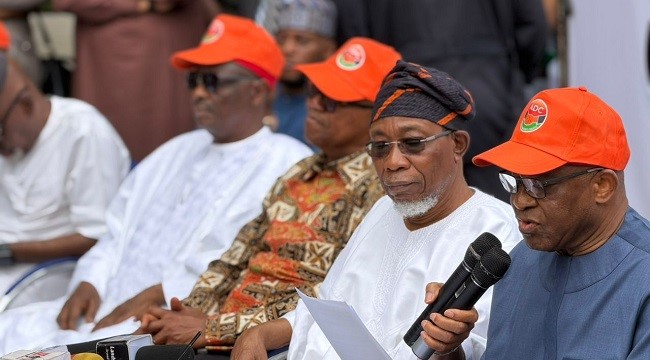
The party insisted that there is no ambiguity about its leadership, maintaining that its affairs are firmly under the control of former Senate President, David Mark, following a combined meeting of its National Working Committee (NWC) and National Executive Committee (NEC) witnessed by INEC officials in July 2025.

The ADC said it would employ all legitimate means to resist what it described as attempts by anti-democratic forces within the ruling party to undermine competitive democracy in Nigeria.

The statement alleged that powerful figures within the APC were behind efforts to pressure INEC into recognising Nafiu Bala Gombe as the party’s national chairman.

It claimed that the move was being driven by an APC governor in collaboration with a senior security official based in Abuja as part of a broader scheme to weaken the opposition ahead of the 2027 elections.

According to the party, Gombe, who once claimed to be Deputy National Chairman under former ADC National Chairman, Ralph Nwosu, had been expelled from the party for actions inconsistent with its constitution and leadership decisions.

The ADC said it is, therefore, alarming that certain political interests were allegedly attempting to use him to destabilise the party and forcibly take over its leadership.

The party further argued that the objective of the alleged plot was to manufacture internal crisis within the ADC, sponsor illegitimate leadership claims and cripple what it described as the only credible opposition platform available to Nigerians.

Reiterating its position, the party said a properly constituted joint meeting of its NWC and NEC, witnessed by INEC officials, had transferred the party’s leadership to a coalition led by David Mark and former Osun State governor, Rauf Aregbesola, in July 2025.

It added that INEC formally recognised the leadership in September 2025.

The party also cited a Federal High Court ruling delivered on March 6, which dismissed a suit challenging Mark’s leadership of the party, affirming that leadership issues within political parties are internal matters.

The ADC warned that Nigeria’s democracy could be undermined if ruling parties attempt to infiltrate or manipulate opposition platforms for political advantage.

It said such actions would constitute a serious threat to democratic pluralism and the constitutional right of Nigerians to organise and support credible political alternatives.

Continue Reading

Featured

Tinubu, Wife, 12-Man Entourage Depart to UK on Historic State Visit

Published

on

By

President Bola Tinubu, accompanied by the First Lady, Senator Oluremi Tinubu, will on Tuesday depart Abuja for a historic state visit to the United Kingdom as guests of Their Majesties King Charles III and Queen Camilla.

A statement signed by Bayo Onanuga, Special Adviser to the President Information & Strategy) disclosed that King Charles will host President Tinubu and his wife at Windsor Castle from Wednesday, March 18, to Thursday, March 19.

Onanuga noted that the state visit is the first by a Nigerian leader in 37 years, as President Tinubu is also the first Nigerian leader to be hosted by the British monarch at Windsor Castle.

Tinubu’s elaborate visit is to strengthen bilateral relations and explore avenues for collaboration on issues such as immigration, trade, investment, and cultural exchange.

Reports said senior government officials, who are central to the expanded bilateral engagement between the two countries that will eventually culminate in the signing of various Memoranda of Understanding and agreements, are already in the United Kingdom as an advanced team.

Further checks revealed that key areas of cooperation will include trade, investment, defence, and cultural cooperation.

The key bilateral deals will be sealed while as guest of Prime Minister Keir Starmer at 10 Downing Street, London.

While at Windsor Castle, their Majesties will invite the President and the First Lady to view a special exhibition of items from the Royal Collection related to Nigeria.

Later, the King and the President will hold private discussions and meet with organisations engaged in interfaith dialogue, both nationally and internationally.

The Royal Family will host a State Banquet in honour of the Nigerian guests in the evening.

Onanuga also disclosed that President Tinubu will witness the signing of the landmark £746 million financing deal between the UK Export Finance (UKEF) and the Nigerian Ports Authority (NPA) and Federal Ministry of Finance to support the refurbishment of two of Nigeria’s major national maritime infrastructure – the Lagos Port Complex (Apapa Quays) and the Tin Can Island Port Complex.

The President will be the guest of honour at the Nigerian Modernism exhibition, showcasing modern arts and culture, and will also attend a reception with Nigerian and British business leaders and the diaspora community.

The entourage of President Tinubu include Senate President, Godswill Akpabio; Attorney General and Minister of Justice, Prince Lateef Fagbemi SAN; Minister of Solid Minerals, Dele Alake; Minister of Information and National Orientation, Idris Mohammed, Minister of State for Foreign Affairs, Ambassador Bianca Ojukwu; Minister of Finance and Coordinating Minister of the Economy, Wale Edun; and Minister of Industry, Trade and Investment, Dr. Jumoke Oduwole.

Others are: Minister of Culture and Creative Economy, Hannatu Musawa; Minister of Communications and Digital Economy, Bosun Tijani; Minister of Defence, General Christopher Musa (rtd); National Security Adviser, Malam Nuhu Ribadu; and Director-General of the National Intelligence Agency, Ambassador Mohammed Mohammed.

The presidential spokesperson revealed that “President Tinubu will return to the country at the conclusion of the State Visit.”

Continue Reading

Featured

Electocral Act: Knocks As NASS Prioritized Removal of Certificate Forgery As Ground for Election Petition

Published

on

By

The removal of certificate forgery as a ground for filing election petitions in the newly amended Electoral Act 2026 has sparked widespread criticism from legal experts, political analysts and key stakeholders, who warn that the provision could weaken democracy.

BusinessDay reports that Section 138 of the Electoral Act 2026 outlines the grounds upon which an election may be challenged, but no longer includes certificate forgery among them.

Section 138(1) of the Act states that an election may only be questioned on the grounds that the election was invalid due to corrupt practices or non-compliance with the provisions of the Act, or that the respondent was not duly elected by a majority of lawful votes cast.

The law further stipulates that acts or omissions that merely contradict instructions or directives of the Independent National Electoral Commission (INEC), but do not violate the Act itself, cannot serve as grounds for questioning an election.

In addition, Section 138(3) imposes strict penalties where election petitions are filed on grounds outside those recognised by the Act. The court is required to impose fines of not less than N5 million on counsel and not less than N10 million on the petitioner.

Section 139 of the Act also provides that an election shall not be invalidated on the basis of non-compliance with the law if the tribunal or court determines that the election was conducted substantially in accordance with the principles of the Act and that the alleged non-compliance did not significantly affect the outcome of the election.

But the amendment has drawn sharp criticism from Jibrin Okutepa, Senior Advocate of Nigeria (SAN), who questioned the legality and moral implications of removing certificate forgery as a basis for challenging election results.

In a statement posted on his official X account, Okutepa described the move as an “outrage” and a troubling attempt by the political class to weaken established standards of accountability.

“This is an outrage, a brazen attempt to redefine a society’s moral code by a morally compromised political class. When criminals rule, the society’s morals are turned upside down,” he said.

The senior lawyer noted that the presentation of forged certificates had historically formed part of the grounds for questioning a candidate’s qualification in election petitions under Nigeria’s electoral jurisprudence.

“Hitherto, the presentation of forged certificates, which forms part of the qualification requirements, had always been a ground for election petitions. But the new Electoral Act 2026 has removed that ground,” he said.

Okutepa argued that the National Assembly may have exceeded its powers because issues relating to qualification for public office are constitutional matters.

According to him, the Constitution clearly outlines the qualifications required for elective offices such as President, Governor and members of the National and State Assemblies, and such provisions cannot be overridden by ordinary legislation.

He further warned that limiting the grounds for election petitions could discourage legitimate legal challenges and shield unqualified candidates from scrutiny.

Also, Aminu Yakudima, a founding member of the Peoples Democratic Party (PDP), has described the development as a serious setback for Nigeria’s democratic and institutional growth.

In a telephone interview with BusinessDay, Yakudima said the situation reflects a troubling trend that could undermine the country’s progress, particularly in the areas of education, governance and human development.

“This is a very serious retrogressive development. It is not good for a country like Nigeria that is still struggling to develop.

“We are already behind in development, education and human capacity development. If we truly want to grow as a nation, we must place strong emphasis on education, knowledge and experience,” he daid.

Yakudima, who is also a political analyst, stressed that formal education remains essential for building competent leadership and effective democratic institutions.

“Our emphasis should be on formal education, where people are required to go through proper academic processes and obtain certificates that attest to their qualifications,” he added.

Yakudima, a chieftain of the PDP warned that any attempt to downplay the importance of education or tolerate actions that undermine academic standards could harm both the country’s educational system and its democratic foundations.

“Governance is a serious business. Democracy cannot function effectively without capable, knowledgeable and well-educated individuals in leadership positions,” Yakudima said.

“When we uphold laws and standards that emphasise proper education and certification, we are strengthening the country. But if we undermine them, we risk doing serious damage to our institutions and to democracy itself,” he said.

Similarly, Peter Ameh, a politician and former chairman of the Inter-Party Advisory Council (IPAC), has also criticised the development, describing it as a troubling moment for Nigeria’s democracy.

Speaking with BusinessDay in a telephone interview, Ameh, who is also a former national chairman of the defunct Progressives Peoples Alliance (PPA), said the move raises serious concerns about the country’s commitment to education, merit and democratic integrity.

“Why are we sending our children to school? Why are families spending huge amounts of money on education if we are beginning to suggest that academic qualifications no longer matter in public leadership?

“This is a very unfortunate development. The amendment looks like a legislative overreach aimed at favouring the interest of one individual while undermining the integrity and credibility of our electoral process,” he said.

He argued that democratic leadership should be built on competence, knowledge and proven capacity, which are often demonstrated through education and experience.

“In every professional field today, people are required to present certificates and evidence of competence before they are employed. Yet we are lowering the bar for those who want to govern millions of people and make laws for the country,” Ameh said.

The former IPAC chairman warned that weakening standards for public office could erode accountability and reduce the quality of governance.

“Instead of strengthening our laws to promote discipline, transparency and credible participation in governance, we appear to be weakening them. That is not how to deepen democracy,” he added.

Ameh described the development as a setback for Nigeria’s democratic evolution and urged lawmakers to prioritise reforms that strengthen institutions rather than those that create doubts about the country’s commitment to merit and accountability.

However, Bernard Mikko, a political scientist and former member of the House of Representatives from Rivers State, offered a different perspective on the development.

Speaking with BusinessDay in a telephone interview, Mikko said the issue of certificate forgery is already adequately addressed in the Nigerian Constitution, and therefore removing related provisions from the Electoral Act may not significantly change the legal position.

“The Constitution is very clear on the issue of qualifications for elective office, including the presentation of certificates. If you check the relevant sections, the requirements are already stated there,” he said.

According to him, unless the Constitution itself is amended, the fundamental provisions governing eligibility for public office remain intact.

“If such a clause is removed from the Electoral Act, it does not automatically override what is already provided in the Constitution. Any major change would still require a constitutional amendment,” he explained.

Mikko added that if the provision is no longer emphasised in the Electoral Act, the responsibility may increasingly fall on voters to scrutinise the backgrounds and credibility of candidates seeking public office.

“In that situation, the burden shifts more to the integrity of the candidates and the vigilance of the electorate. Voters know the people from their communities, they know their background, their age, the schools they attended and their general history,” he said.

He concluded that while the debate may generate political controversy, the constitutional framework governing eligibility for public office still provides mechanisms for addressing disputes over candidates’ qualifications.

Culled from businessday.ng

Continue Reading

Trending