Connect with us

Business

FirstBank Conquers Financial Inclusion Challenge with Firstmonie Agents Banking

Published

on

By Eric Elezuo

When Nigeria’s foremost bank, FirstBank of Nigeria Plc rolled out drums to celebrate top performers among its over 37, 000 firstmonie banking agents, the reasons were obvious. In the first instance, the bank succeeded in proving that it remains the first name behind the quest to implement financial inclusion in the banking world as well as explain that the gap between the tech savvy and the low literacy clients has been breached. This is because the firstmonie agent network represents the convenient and comfortable alternative for customers that are acquainted with sophisticated digital channels.

Another reason stem from the fact that it has succeeded in looking into the future to create that ecosystem that allows easy financial transaction wherever a customer is in Nigeria.

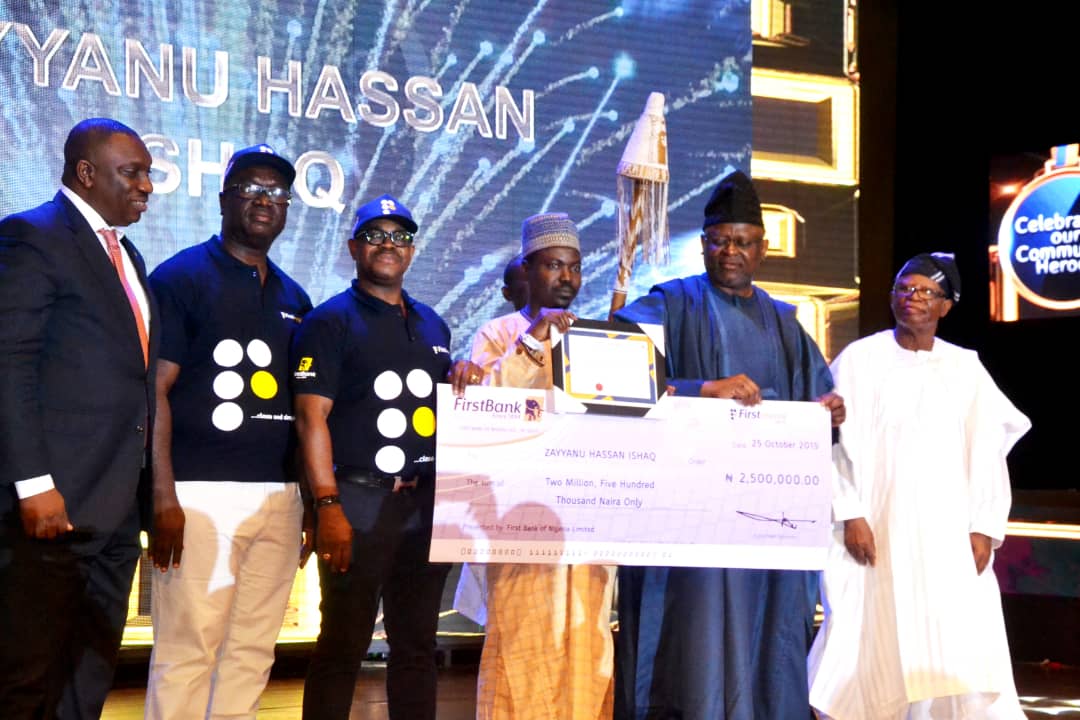
At the event, FirstBank compensated 37 leading agents with N15, 250, 000.00 as follows; the sum of N250, 000 to 31 agents at the state level; N1, 000, 000 to five agents at the regional level and a whopping N2, 500, 000 to the grand prize winner at the National level. Zayyanu Hassan Ishaq from Abuja emerged the grand prize winner.

FirstBank’s Firstmonie service is providing financial/banking solutions to rural and semi-urban locations across the country. Through this channel, the Bank is providing convenient services that endears trust and provides ease of access to banking products, irrespective of location, literacy levels, familiarity with technology and accessibility to modern infrastructural facilities.

The firstmonie initiative of FirstBank is borne out of the fact that 38 per cent of the adult population in the country is financially excluded. Of this number, according to EFINA 2018 Survey, 41.1 percent are male while 55.9 percent are female. There was need therefore, to get all hands on deck to bring about financial inclusiveness among all and sundry, invariably fostering economic development.

Trancing the origin of firstmonie, the Deputy Managing Director, First Bank of Nigeria Plc, Mr. Francis Gbenga Shobo stated that “It actually started in 2009 when it was just a concept in the bank. We have branches all over nigeria; we are one of the most spread branches in the country. But we felt that there was still an opening out there. It was in 2010 that we launched the firstmomie programme.”

Lending credence, the Group Executive eBusiness and Retail Products, Mr. Chuma Ezirim,  confirmed that steps were taken between 2014 and 2017 to give the programme the top of spot status it enjoys today.

“In 2014, we took a decision to change the scheme from wallet base to account base. It took us another two years to test the concept and officially started the pilot in 2017,” Ezirim revealed.

It is worthy of note that the firstmonie initiative had undergone several operating structure changes and value proposition. In December 2017, the bank ran its pilot test with over 400, 000 transactions processed. The success of the first run necessitated its re-launching in 2018.With a key motive of ‘planting community heroes nationwide’, FirstBank has not only succeeded in developing the small and medium scale enterprise sector, but has created independent finance experts and men and women who can hold their own financially.

Giving further details, Managing Director/Chief Executive Officer, First Bank of Nigeria Plc. Dr. Adesola Adeduntan, described how it is FirstBank’s proactive stance to leverage on gaps in the society to provide long lasting solutions beneficial to citizens towards financial inclusion, addressing poverty, hunger, unemployment and reducing crime.

He said: “The key part of our history and our future is about development and economic growth, and the key strength of our franchise is our ability to look at gaps in the society, develop products and services that address that gap. So as an integral part of our strategy, we believe that by significantly working with the Central Bank, we can improve the financial inclusion index of the country. We would, as FirstBank, be assisting this country to address poverty, hunger…thereby also promoting security of life and property because when people are gainfully employed, the implication is that they think less of crime.

He noted that FirstBank’s intention with firstmonie is to try as much as possible to make agents the ‘centre of the financial ecosystem in the country’.

Across the length and breath of the nation, tidings of great joy are the order of the day following the presence of FirstBank’s firstmonie agents, even in the remotest parts of existence. The scheme has eased the stress of trading and has raised financially independent entrepreneurs as well as thoroughbred employers of labour.

In Aiyetoro, a riverine community in Ilaje, Ondo State, where there are no banks, but FirstBank has positively impacted it. A firstmonie agent, Stephen Adeleye, confided that;

“People can easily walk in without having to travel and that has developed a savings habit because we have easy access to the bank and can deposit their money easily,” he said.

Testifying to the positive impact of the scheme, a beneficiary, Tina Farodoye, revealed that “The transaction has really helped my business to grow. I buy my things in bulk and do a transfer from here. And the things I buy from Lagos gives me more gains because they are expensive here.

“Again, Agent Emphraim Osinachi from Obohie, Asa Ukwa West of Abia State explained that people of all ages have embraced the scheme because of its positives, saying that customers are better given attention by the agents as against what is obtainable at the ATMs.

“We serve all ages, from adults to minor. Unlike the ATM machine where there is no assistance, the people feel relaxed here. Sometime ago, armed robbers invaded a house and were able to get only N50 from a home after ransacking the house while the owners were away. The reason is because of the firstmonie agent banking in place now.”

He maintained firstmonie is a veritable option to enforcing the Federal Government policy on cashless economy.

Aliu Adeleye spoke from Lekki-Aja in Lagos, and excitedly narrated how people have come to support and patronise the scheme, stressing that business improved when he added ‘mobile banking transaction using our firstmonie platform’.

“This place is heavily buzzing with transactions, especially in the evenings when the banking halls are already closed. Presently we have about six other locations because of the demands, and they are all doing well,” an elated Adeleye said.

Surajudeen Adebisi Bada from Abeokuta, Ogun State stated that “we open by 8am but people are already lined up by 7am, and there over two hundred customers trying to transfer money and over a thousand trying to collect money. If I look at our data base, I am convinced that we can beat some of the banks.”

Noting the importance of Firstmonie agents, Shobo emphasized that they are the ones the customers go to, to open accounts, take deposits, make payments, sell airtime and all the rest, adding that ‘they are the most critical part of that ecosystem’. He further lauded the CBN for its regulatory role and enablement and the Bill and Melinda Gates Foundation for their contributions and oversight functions.

“The regulators are very important, and we must give it to the CBN and its governor, Godwin Emefiele; they have done a lot of changes in regulation that have allowed the programme to scale as much as it has, today. A very, very important partner of ours has been the Bill and Melinda Gates Foundation; they helped us with grants, advice, and insight of what they had in other countries. We’ve used all that in coming up with the testimonies with which we are running now.”

Today, we have 36, 000 agents, with each having about one or two persons assisting them. We have opened more than 500, 000 accounts, processed more than two trillion transactions through the firstmonie agency, indirect employment in excess of 100, 000 people working across the entire value chain. More than 8, 000 women have been fully empowered servicing different customers, and they can begin to improve for themselves,” he said.

Sustaining the avalanche of positive feedbacks, Kehinde Kudirat Kasali from Ogun State, confessed that ‘FirstBank has been able to help me a lot. This is so that I can stand on my own. I can hold my own anywhere I am, and I appreciate Firstmonie.”

In the words of Uchechi Amogu from Obowo in Imo State, ‘There’s really been a great change in my life. I can tell you that in this very location, sometimes we do up to 200 transactions each day. I was working alone, but now I have employed two other persons.”

From Warri, Delta State, Orode Hesse, said that “Firstmonie has really impacted me; it has empowered me financially, and I have been able to employ six staff; five female and one male. I see firstmonie as a business to employ and empower women.”

Abubakar Aki Bolaji from Abuja puts it this way ‘the nearest bank here is about 15 kilometres away. We have cut the cost of transportation, and we have about 350 footprints here on a daily basis’ exposing a massive influx of customers each passing day.

Conquering harsh terrains and topography, the firstmonie agent banking scheme has reach the nook and crannies of Northern Nigeria and made impacts indelible to neglect.

“We have built up a significant number of firstmonie agents in the Northern parts of the country. A top government officer from Jigawa State told me of a couple of agents at somewhere in Gumel. This is about 70 kilometres to the nearest bank-town. Along the 70 kilometres, he said he saw two agent locations. That’s a testimony of our presence in the North.

“We are not stopping. It’s going to be a marathon; we believe there’s a lot to be done, not just in Nigeria. We also have other locations across Africa. Ghana is of interest to us, and we have started rolling our agency banking in Ghana. The Democratic Republic of Congo, a country of about 80 million people, is also a significant opportunity for us to help Africa, to promote financial inclusion and begin to address poverty across the continent,” Adeduntan said.

The assessment of Mohammed Tatari from Bauchi state seems to summarise the unquantifiable advantage of firstmonie.

He said: “We are thankful for this bank that has come closer to us. Before this time, people travel far just to enjoy banking services, but now firstmonie has brought banking close to them. This firstmonie service is helping people in many ways, as a result, we are experiencing large numbers of people here.”l

“Before firstmonie, goods have to be loaded into vehicles and will not be delivered until money has exchanged hands. But now, we just transfer the money to the supplier and the goods will be delivered without question so this has really changed our lives.”

While the tradition among people is that banks have about 600 locations, FirstBank has 37, 000 locations, and they are present in 99 per cent of the 774 local government areas of the Federation, and there’s no one close to the record. The beauty of the opportunity is that it is being used to impact positively on the society.

The Head, Marketing and Communication, FirstBank Nigeria Plc, Mrs. Folake Ani-Mumuney, was full of praises and encouragement for the Firstmonie agents, urging them to continue in their giant strides while encouraging others to follow suit to further raise the banner of financial reach and inclusion, and the Nigerian economy.

“This is about your future and the growth of your locality and the country in general. Continue to thrive and win, and do not rest on your laurels,” she admonished.

“The  unwavering efforts and remarkable contributions by our Firstmonie Agents at promoting financial inclusion in Nigeria is indeed very much appreciated. We remain committed to doing more, strengthening business activities, driving economic growth and development; thereby reducing poverty,” the CEO, Adeduntan concluded.

Continue Reading
Click to comment

Leave a Reply

Your email address will not be published. Required fields are marked *

Business

UBA Unveils Diaspora Platform to Connect Global Africans with Investment Opportunities

Published

on

By

Africa’s Global Bank, United Bank for Africa (UBA) Plc, has unveiled a diaspora banking and investment platform designed to serve Africans living and working across the world and within the continent.

The platform, launched in collaboration with leading ecosystem partners including United Capital, Africa Prudential, UBA Pensions, Afriland Properties, Heirs Insurance Group, and Avon Healthcare Limited — represents a major step in redefining diaspora banking beyond remittances toward structured wealth creation and long-term investment.

At the unveiling, which took place at UBA’s global headquarters in Lagos under the theme: “Beyond Banking: Powering the Global African Lifestyle, all the company representatives were on hand to showcase a seamless platform that goes beyond remittances, wealth creation, protection, and long-term prosperity.

Speaking at the event, UBA’s Head of Diaspora Banking, Anant Rao, described the initiative as a strategic shift in how Africa engages its global citizens.

“For decades, Africa’s engagement with its diaspora has focused largely on remittances. Today, we are moving beyond that. This platform represents a transition from simple money transfers to a financial ecosystem where Africans globally can bank, make payments, invest, protect their families, and build long-term wealth seamlessly,” he said.

Rao noted that African diaspora remittance flows exceed $100 billion annually, making them one of the most resilient and consistent sources of capital into the continent.

“Diaspora capital is not just a flow of funds — it is a strategic growth partner for Africa.
Our role is to provide a trusted platform that converts capital into structured investment and shared prosperity across the continent.”

The objective is to provide a platform that brings together offerings across the numerous needs of the Global African, including Banking and payments, Investments, securities services, asset management, Insurance, Pensions, real estate and Pensions.

Through this coordinated ecosystem, diaspora customers can access financial solutions across multiple sectors through a single trusted platform, enabling them to manage their financial lives and family commitments across borders with ease and transparency.

UBA’s Group Head, Marketing and Corporate Communications, Alero Ladipo, emphasised the importance of collaboration in delivering a seamless diaspora experience.

“The modern African is a global citizen — mobile, ambitious, and deeply connected to home. Whether living in Africa, Europe, the Americas, or the Middle East, there must be a structured and secure financial connection back home. This platform ensures that Africans everywhere can remain economically connected to the continent with confidence and transparency.”

Partners within the ecosystem highlighted growing demand among diaspora Africans for structured investment opportunities, secure property ownership, insurance protection, and long-term financial planning.

United Capital showcased globally accessible investment products designed to deliver professionally managed and transparent wealth creation opportunities.

Afriland Properties emphasised structured and well-governed real estate investment pathways for diaspora clients.

Heirs Insurance highlighted protection solutions for life, and assets, while Avon Healthcare Limited demonstrated healthcare access and insurance solutions for families across borders.

Africa Prudential and UBA Pension reinforced digital investment management and long-term pension savings solutions designed to support diaspora participation in African capital markets.

Together, the partners underscored a shared commitment to providing diaspora Africans with credible, transparent, and professionally managed financial pathways.

Rao also reiterated the guiding philosophy of Africapitalism, championed by UBA’s Founder and Chairman, Mr. Tony O. Elumelu, CFR.

He explained that Africapitalism is the belief that Africa’s private sector must play a leading role in the continent’s development by making long-term investments that generate both economic returns and social impact.

As Africa continues to position itself as one of the world’s most dynamic growth frontiers, UBA believes mobilising diaspora capital through trusted financial institutions will be central to shaping the continent’s next phase of development.

“Africa will increasingly be financed by Africans themselves, including Africans abroad.

“Our responsibility is to build the trusted financial infrastructure that makes this possible.

“When Africa’s global citizens invest back into Africa, growth becomes inevitable,” he concluded.

Continue Reading

Business

Dangote Refinery’s Crude Distillation Unit and Motor Spirit Block Hit 650,000bpd Capacity

Published

on

By

Dangote Refinery’s Crude Distillation Unit and Motor Spirit (MS) Block Hit 650,000 bpd Capacity
…First Refinery In The World to Attain This Feat

The Dangote Petroleum Refinery has achieved a major operational milestone with the full restoration and optimisation of its Crude Distillation Unit (CDU) and Motor Spirit (MS) production block. Both units are now running at optimal performance, further strengthening the steady state operations of Africa’s largest oil refining facility.

Following a scheduled maintenance exercise on the CDU and MS Block, the refinery has commenced an intensive 72 hour series of performance test runs in collaboration with licensor UOP. These tests are designed to validate operational efficiency and confirm that all critical parameters meet global standards.

Chief Executive Officer, David Bird, noted that the seamless integration and strong performance of the units demonstrate the refinery’s advanced engineering and robust operational capabilities.

“Our teams have demonstrated exceptional precision and expertise in stabilising both the CDU and MS Block, and we are pleased to see them functioning at optimal efficiency. This performance testing phase enables us to validate the entire plant under real operating conditions. We are confident that the refinery remains firmly on track to deliver consistent, world class output.

This milestone underscores the strength, reliability, and engineering quality that define our operations. We remain committed to producing high quality refined products that will transform Nigeria’s energy landscape, eliminate import dependence, and position the nation as a net exporter of petroleum products.”

Bird added that the CDU and MS Block, which comprise the naphtha hydrotreater, isomerisation unit, and reformer unit, are now operating steadily at the full nameplate capacity of 650,000 barrels per day. He further confirmed that all remaining processing units will begin their respective performance test runs in Phase 2, scheduled to commence next week.

During the recent festive period, the refinery supplied between 45–50 million litres of Premium Motor Spirit (PMS) daily. With the CDU and MS Block now fully restored, the refinery is positioned to comfortably deliver up to 75 million litres of PMS to the domestic market as required.
Expressing appreciation to customers and Nigerians across the country, Bird reaffirmed the refinery’s unwavering commitment to enhancing Nigeria’s energy security while supporting industrial development, job creation, and economic diversification.

Continue Reading

Business

FirstHoldCo Grows Gross Earning to N3.4trn for Unaudited Full Year 2025

Published

on

By

First HoldCo Plc has announced its unaudited financial results for the year ended 31 December 2025, reflecting a year of deliberate strategic actions aimed at strengthening its balance sheet, improving asset quality, and positioning the business for more resilient and sustainable growth amidst successful capital raise activities.

As stated in the unaudited Group financial statement, FirstHoldCo recorded a 4.8% year-on-year (y-o-y) increase in its Gross earnings to N3.4 trillion, supported by a 36.3% y-o-y growth in net interest income of N1.9 trillion on the back of enhanced earnings yield and margins of 17.11% and 11.0%, respectively. Similarly, net fees and commissions improved by 18.7% y-o-y to N290.7 billion. These are clear indications of the strength of the revenue generating capacity of the core business which continues to be solid. Earnings for the year were, however, lower than the prior year, primarily due to higher impairment charges in the commercial banking segment. This is in line with a deliberate strategic decision to accelerate balance sheet clean-up and adopt more aggressive provisioning standards. Management views this as a prudent step that enhances transparency, strengthens investor confidence, and aligns fully with evolving regulatory expectations.

Additionally, increased regulatory costs affected profitability. These charges, while weighing on the results, underscore the Group’s compliance with Nigeria’s financial system stability framework and its commitment to ensuring systemic confidence. Despite these pressures, underlying performance of the Group remains strong.

Deposit liabilities grew by 10.0% y-o-y, driven by sustained deposit mobilisation and continued investment in digital banking platforms. This growth reflects strong customer confidence and deepening engagement across key segments. The deposit mix also showed a deliberate reduction in foreign currency deposits, resulting from the repayment of expensive funding and the impact of naira appreciation. This shift supports improved funding efficiency and reduces foreign exchange risk.

Gross loans and advances declined marginally, reflecting a disciplined approach to credit growth, strengthened risk management, loan repayments, write-offs, and the translation impact of a stronger naira on foreign currency facilities. The Group intensified its commitment to ensuring a high-quality, cleaner asset base, aiming to optimise the portfolio and enhance future earnings potential.

Furthermore, performance in earnings was impacted by a decline in non-interest income, mainly due to lower fair value gains on financial instruments following the naira appreciation in 2025. However, this was partially offset by stronger foreign exchange (FX) trading income and reduced FX revaluation losses. Net fees and commission income also grew, supported by higher electronic banking fees, letters of credit commissions, custodian fees, and account maintenance income, reflecting the continued success of the Group’s digital-innovation strategy.

While impairment charges increased following the end of regulatory forbearance, management has intensified recovery initiatives and reinforced credit oversight. Excluding impairment and fair value gains, pre-provision operating profit grew by 23.9% y-o-y to N973.3 billion demonstrating robust performance of the core business.

Apart from the commercial banking impairments, performance across the rest of the Group remained resilient, supported by steady customer activity and disciplined execution.

Looking ahead, the Group will continue to prioritise disciplined execution of its strategic objectives, with emphasises on enhancing efficiency and profitability, continuing to build on the Group’s digital and data capabilities, while sustaining a robust balance sheet to support increased value creation and returns for shareholders. Alongside this, the Group will pursue selective growth initiatives, including new revenue streams, additional business verticals, and deeper participation in targeted African markets, in line with our strategy and risk appetite.

Further details and insights are to be provided when the audited full-year results are published and during the subsequent investor and analyst earnings call.

Continue Reading

Trending