By Eric Elezuo
On April 1, 2026, the Independent National Electoral Commission (INEC), led by its Law Professor Chairman, Joash Amupitan, threw a shocker at Nigerians, derecognising the David Mark and Rauf Aregbesola led-leadership of the hitherto main opposition party, the African Democratic Congress (ADC). The announcement has since generated chain reactions across board in the Nigerian body policy, creating divisive opinions for and against the electoral body.
Among other factors, the announcement put a question mark on the already planned April 14, 2026 National Convention of the ADC, prompting a question mark on whether or not the convention will hold as planned.
INEC had through its National Commissioner and Chairman of the Information and Voter Education Committee, Mohammed Haruna, announced the Commission’s decision to withdraw their recognition of the ADC leadership, with special emphasis to the Chairman, Senator David Mark and Secretary, Rauf Aregbesola, in a statement.
It hinged its decision on a court order which directed the commission to maintain the status quo pending the determination of a suit challenging the legality of David Mark’s leadership of the opposition party. But the maintenance of status quo was variously interpreted by interested parties to suit their various whims and caprice.
But the ADC has insisted on proceeding with its planned congresses and national convention despite the controversy surrounding its derecognition by INEC, a move the body said would amount to nullify if embarked upon.
ADC’s National Publicity Secretary, Bolaji Abdullahi, announced this while speaking on Arise Television’s Morning Show, citing the party’s current leadership struggle.
Abdullahi stated that the party had already given INEC the required 21-day notice for its operations and that the commission acknowledged receipt of the notice.
He maintained that the ADC would not halt its internal processes regardless of INEC’s position, stressing that the party remains committed to carrying out its congresses and convention as scheduled.
The spokesman also expressed concern over what he described as growing threats to Nigeria’s democracy, warning against attempts to limit political competition ahead of the 2027 general elections.
The electoral authority has also announced that it will not accept Nafiu Bala Gombe, who is seeking to be declared national chairman through the court.
He said, “If we’re in a military regime, we can understand it. We are finding ourselves in a situation where everything is being done to ensure that the election in 2027 is a fait accompli and that Nigerians will be left with no option or no choice. We’ve seen how this has ended in the past.
“So we are saying that we will go ahead with our congresses. We have given INEC 21 days’ notice. They have accepted the notice.
“So whether they come or not, we’ll continue with our congresses; we’ll continue with our convention.
“We are all Nigerians. We can see what is going on. We can see our democracy unravelling before our very eyes.”
Consequently, with only a few days left before the stipulated date for the convention, the ADC has gone ahead to set up a 361-man convention planning committee that would soon be inaugurated.
If hitches or changes do not occur in the coming moments, the former governor of Cross River State, Leyel Imoke will lead the 361-member National Convention Central Coordination Committee of the David Mark-led National Working Committee (NWC) of the ADC.
Aminu Waziri Tambuwal, former governor of Sokoto State, will serve as vice chairman of the committee, while Ajuji Ahmed has been appointed secretary. The party maintains the national convention day as April 14, 2026.
Sources within the party informed that preparations for the convention were in full swing, with several committees already constituted to handle key aspects of the event.
The speedy plans attached to the Convention is borne out of the fact that the Mark-led NWC has rejected INEC’s interpretation of the judgement and insisted that it would proceed with the planned national convention and other internal party processes.
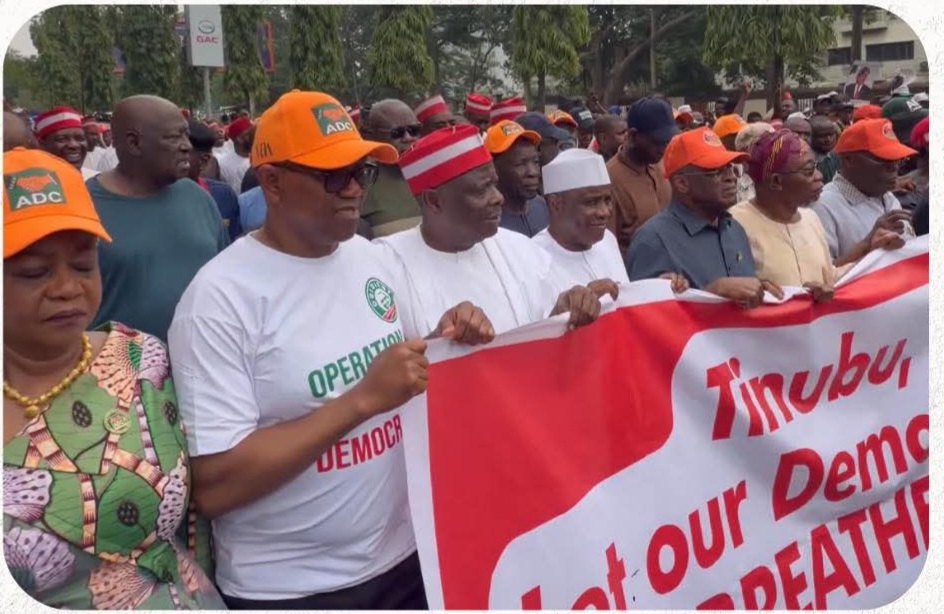
Prominent political figures backing the Mark camp including former Vice President Atiku Abubakar; formwr Anambra State governor, and Labour Party presidential candidate in the 2023 ele tions, Peter Obi; former Rivers State governor, Rotimi Amaechi; former Kano State governor, Rabiu Musa Kwankwaso; and former Osun State governor Rauf Aregbesola, had staged a protest to challenge INEC’s position.
Information reaching The Boss noted also that personalities like former governor of Imo State, Emeka Ihedioha; former Minister of State for Education, Emeka Nwajuba; FCT Senator, Ireti Kingibe and other prominent members of the ADC have been listed to play key roles in the planning of the convention.
But fresh evidence coming from several sources has noted that the state congresses sheduled for Saturday, April 11, 2026, have been stalled, no thanks to the leadership crisis rocking the party amid internal wrangling and legal hurdles.
As at today, crises have fragmented the party into three camps led by former Senate President David Mark, former deputy National chairman, Nafiu Gombe and a bloc spearheaded by some state ADC chairmen, and led by the party’s presidential candidate in the 2023 election, Dumebi Kachikwu. This fragmentation has been the major reason that for the consequent de-recognition of the Mark-led National Working Committee by the INEC.
While some states have announced the suspension of their congresses, a few states have vowed to proceed with the election ahead of the party’s convention.
On Thursday, a faction led by Gombe stormed the INEC headquarters in Abuja, demanding formal recognition.
Gombe, accompanied by a Rep member from Kogi State, Leke Abejide, and hundreds of supporters, accused the David Mark-led leadership of attempting to hijack the party’s leadership in defiance of its constitution and internal processes.
Addressing officials of the electoral body during the protest, a barely-able-to-express-himself Gombe insisted that due process must be followed in resolving the leadership dispute.
Reading a prepared text, he said, “We are here to urge INEC to follow due process. You cannot come to the ADC through the window and expect to overturn the owners of the ADC. As democrats, we don’t want any moneybags to come and destroy democracy. The ADC is for all Nigerians from wards, states, to the national level.”
Also speaking, Abejide, who had said he would quit the ADC if the Mark NWC is finally recognised, called on the commission to resist what he described as an attempted takeover of the party, stressing that the ADC constitution clearly outlines eligibility requirements for leadership positions.
“We are here to urge INEC to do the right thing and rescue democracy from the hands of usurpers. How do you come to a party and attempt to hijack the leadership on the same day? Which political platform is that done?
“The party constitution is clear about this. You have to spend at least two years in the ADC as an active member before you can aspire for any position. The commission has not erred. These people are hijackers, and INEC must follow through on reverting to status quo ante bellum by recognising Nafiu Bala Gombe as the national chairman of the party,” he said.
Abejide has also filed a case at the Federal High Court, Abuja, seeking the permanent removal of Mark and Aregbesola as leaders of the party. Hearing comes up on Monday, April 13.
Similarly, the ADC Director of Youths and Mobilisation, Mohammed Sahad, commended INEC for complying with a court order, but urged the commission to go further by affirming Gombe’s leadership.
“INEC has not erred in any way. In fact, we commend the commission for obeying the court order. But they need to recognise Nafiu Bala Gombe as the authentic national chairman of the ADC. INEC needs to do the right thing and do it now. That is why we are here,” he said.
Responding on behalf of the commission, INEC National Commissioner, Abdullahi Abdu Zuru, assured the protesters that their concerns would be reviewed.
“I am here on behalf of the chairman, and I believe INEC, as a commission, will look at your letter and give you feedback. Thank you for being orderly with your protest,” he said.
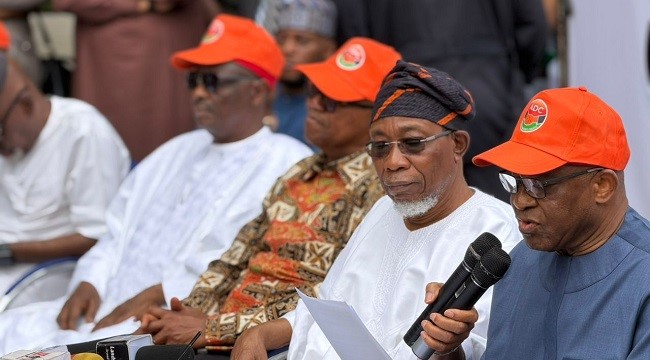
The protest comes barely 24 hours after a rival faction of the party, led by former Senate President David Mark, staged a large demonstration in Abuja under the banner of #OccupyINEC, accusing the electoral body of actions they claimed undermined democracy and the party’s internal leadership structure.
The back-to-back protests underscore the deepening rift within the ADC, raising concerns over the party’s stability ahead of future electoral contests.
In another development, Adamawa State chapter of the ADC has been barred from going ahead with the congress by a Yola High Court.
Justice Ahmed Isa, who presided over the case, ordered the suspension of the congresses, which was scheduled for Thursday until the determination of the case. The court subsequently adjourned the case to April 15, 2026, for continuation of the hearing, a day after the supposed National Convention.
The embattled ADC chairman in the State, Shehu Yohanna, had approached the court, seeking to stop the congresses due to alleged exclusion from the process.
Yohanna filed the suit against Sadiq Dasin, the state chairman of the transition committee.
According to a report on The PUNCH however, the North East Vice Chairman of the party and former Secretary to the Government of the Federation, Mr Babachir Lawal, denied knowledge of the court ruling.
“I’m in Abuja, so I don’t know about the case. Go and ask those who were in court today. I don’t know anything about the court case,” he told The Punch.
In Anambra State, the party chairman, Patrick Obianyo, disclosed that the party has suspended the proposed congresses until further notice.
Obianyo said the party’s decision underscores its unwavering commitment to the rule of law, due process, and respect for judicial authority.
He, therefore, called on all party members and stakeholders to remain calm, law-abiding, and peaceful throughout this period.
He also informed the INEC not to recognise anything done by those parading themselves as ADC leaders in the state.
“The African Democratic Congress, the Anambra State chapter, has announced the immediate suspension of all planned and proposed congresses across the state, until further notice.
“For the avoidance of doubt, the tenure of the current ADC Executive Committee in Anambra State, as well as in other states, remains constitutionally valid and duly recognised by INEC.
“Consequently, the general public is strongly advised to disregard any directives, announcements, or actions from unauthorised individuals falsely parading themselves as party leaders.
“The party will duly communicate new dates for congresses and conventions following the conclusion of ongoing national consultations and meetings.’’
Similarly, the Ondo ADC has announced the suspension of its earlier scheduled Congresses following the re-recognition of the national leadership of the party.
The party had earlier scheduled to hold its ward, local government and state congresses this month, but disclosed that the exercises had been suspended.
This was contained in a statement made available to our correspondent by the state chairman of the party, Mr Wole Ademoyegun.
It said the suspension was in line with the directive of the INEC, which asked the party to maintain the status quo ante bellum.
“We reaffirm our unwavering respect for INEC as the constitutionally constituted regulatory authority for political parties and our firm commitment to due process and institutional order.
BACK TO COURT AFTER PROTESTS
Meanwhile, the David Mark, factional has returned to court after its elaborate protests, where they called for the removal of INEC boss, Amupitan, asking the Federal High Court in Abuja to overturn the decision of the Independent National Electoral Commission (INEC) to derecognise his leadership of the party.
In a motion filed before Emeka Nwite, the presiding judge, Mark is seeking orders compelling INEC to restore his name and that of Rauf Aregbesola as national chairman and national secretary of the party, respectively.
Mark also urged Justice Emeka Nwite to grant an order of mandatory injunction setting aside INEC’s refusal to attend or monitor the ADC’s congresses or convention, pending the hearing and determination of the instant suit.
The embattled chairman also sought an order of mandatory injunction directing INEC to forthwith restore and maintain the names of all ADC’s National Working Committee (NWC) in its records and portal, prior to the institution of the suit, and pending the hearing and determination of the substantive suit.
The motion on notice, dated and filed on April 7, was filed by Mark’s new lawyer, Sulaiman Usman, SAN.
The motion is in reaction to the March 12 Court of Appeal’s judgement in a suit instituted by Hon Nafiu Bala Gombe before Justice Nwite.
The motion, which sought three reliefs, was brought pursuant to Order 26, Rules 1, 2, 3 and 4 of the Federal High Court (Civil Procedure) Rules, 2019; the inherent jurisdiction of the court and under the equitable jurisdiction of the court to grant injunctive reliefs.
By every inch of explanation, all is not well with the ADC, and its quest to be on the ballot paper come 2027. The party has consistently blamed President Bola Tinubu for its woes, saying the president is muzzling opposition in a bid to be the only one contesting against himself; the only one on the ballot in 2027.
But will Nigerians allow the plot? Time will tell.









 News5 days ago