Connect with us

Opinion

Election Postponement: Just Before We ‘Crucify’ INEC

Published

on

By Nkannebe Raymond

It would have been easier to stomach the mess the electoral umpire made of Nigeria and Nigerians the other day with its midnight abortion of Saturday polls which many Nigerians had looked forward to with so much anxiety, if it were the first time it was doing so. But that is not the case. In the last three cycles of general elections, the electoral umpire has proven beyond all iota of doubt, as criminal attorneys say, that it is either overwhelmed to deliver on its statutory duties, or incapable of doing so.

In the year 2011, in my sophomore year in University, the commision under the headship of prof. Attahiru Jega first betrayed this crass managerial vacuity. Almost midway through a parliamentary poll, he stunned a beleaguered nation with the news of the postponement of the polls citing its trademark alibi, “logistic challenges”. In 2015, under the same leadership, the Commission, this time, perhaps understandably postponed by six weeks the opening of the first day of ballot in the general election of that year. Thankfully, “logistic challenges” were not cited this time. The commision rather, was acting on the reservations and /or intelligence report of the security agencies who expressed fears that it may not be able to provide security cover for the polls in the North Eastern states of Borno, Yobe, Adamawa and Gombe owing to the activities of Boko Haram.

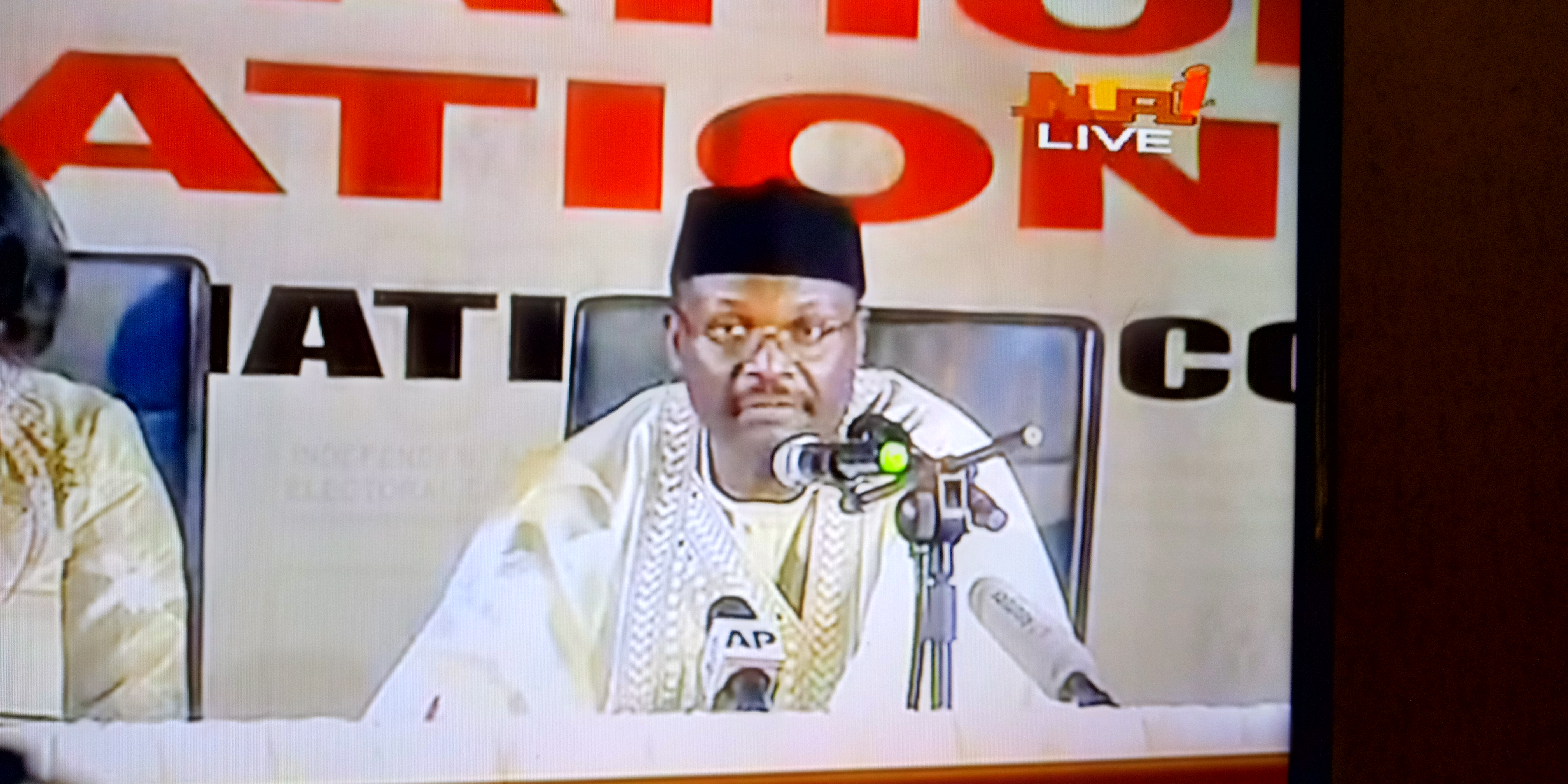
Fast forward to 2019, the commission has returned to a familiar yarn. While many Nigerians went to bed on Friday night hoping to go out and cast their ballot on Saturday morning in what is arguably Nigeria’s most keenly contested presidential election, they woke up to the shocking news of the postponement of the polls. There is no prize for guessing the reason advanvced this time: it is still the same logistics challenges. At a press briefing on Saturday afternoon, the INEC boss, Prof. Mahmood Yakubu said fire incidents at its local offices in Abia, Anambra and Plateau states, as well as poor weather conditions in some south eastern states amongst a host of other factors, prevented it from going on with the polls. He was honest to admit however that stipulation as to funding did not force its hands in coming to the decision.

Now, as much as one tries to sympathise with INEC considering its modest efforts thus far towards delivering on the onerous 2019 project, it is impossibe not to condemn the commission for what is a collosal national embarassment for Africa’s largest democracy. And this, for many reasons. Barely a week ago, the head of the commission told members of the press that it was ready and prepared to go on with the polls. In fact at a particular media outing with the delectable Osasu Igbenedion of the famous “Osasu Show”, when asked whether he sees any possibility of postponement of the polls, the INEC boss categorically responded, “i do not see any possibility of postponement”. That was how certain and reassurig the man was.

Many Nigerians as well as the international community must have taken him for his words and went as far as deploying their observers ahead of the polls. Perhaps in order to further allay any fears as to its preparedness for the elections, some 48 hours before the news of the postponement broke, the commission was still cocksure of its readiness thereby giving Nigerians the green light to embark on those risky journeys to catch up with the polls at their polling units. Strikingly, it only came to the realisation of its unpreparedness in the early hours of February 16th, the same day, it has scheduled for the polls. This, more than anything else, underscores the tardiness of the commision and leaves behind a huge question mark of its capacity to conduct elections in a country as large as Nigeria. As one commentator put it: who cancels an election on election day?

Ofcourse, the cost implication of the postponement are huge and rubs off on entire Nigerians including those in Diaspora. This intervention however, is not the forum to weigh in on the details of the ‘Opportunity Cost’ of INEC’s blunder. Ofcourse, the social media is awash with heart wrenching stories of how INEC’s miscalculations have altered other people’s calculations.

But what does the news of INEC’s postponement say about Nigeria and the quality of her public service institutions? Does it not mirror how we have been ‘served’ by Nigeria’s behemoth and comatose public service architecture but which we have somehow found a way to condone, accepting it as the base factor of our national existence and in many cases laugh over them at beer parlours and other public places? If anything, the characteristic national outrage over INEC’s serial blunders is perhaps due to the salient and peculiar nature of the role it plays in our democratic process. Otherwise, a calm appraisal of the quality of public service in Nigeria leaves behind a rather gloomy picture of a country whose progress is held back by the sub-optimal performance of her public institutions.

In a sense the INEC chairman at the press briefing last Saturday made these insinations. While rounding up his response to a question during the interractive session that followed his address, he observed, “INEC is one of the most improved public institutions in this Country in the last 10 years”. To give a context to his assertion, he asked the audience to make a comparism of the quality of elections the commision have conducted between the year 2010 and today and the innovations it has brought to bear in its operations.

I like to think that there is merit in the INEC boss’ observation. Anyone who doubts this assertion only has to interface with most of the public institutions in the country to appreciate the strides that have been made by the commisision. From the National Television Authority (NTA), to the Police, Customs, Navy, Immigration, the Universities and Health institutions to keep the list short, we are beset by organizations whose processes are either too slow or populated by unmotivated members of staff who are a bore to national productivity. Little wonder why someone once referred to the Nigerian public service as the fortress of the indolent. Otherwise there is no reason why some of the simplest things such as applying for academic records from a university can be the most difficult.

And so while this writer does not exculpate the commission from any responsibility for this gaffe, the fact of the matter is that this postponement and whatever neccessitated it, represents a microcosm of the Nigerian state of dystopia which we all should be concered about.

While the did has been done, and efforts being made to make sure we have at least a manageable election, by the 23rd of February, and 9th of March, 2019 respectively, I think the INEC chairman made a very salient observation at that press briefing on Saturday. It is this: that at the end of this election, this Country must have a conversation around the conduct and management of elections. This is the greatest take away for me, in the midst of this hullaballoo.

Raymond Nkannebe is a Legal Practitioner and Public Affairs Commentator. Comments and reactions to raymondnkannebe@gmail.com.

Continue Reading
Click to comment

Leave a Reply

Your email address will not be published. Required fields are marked *

Opinion

Reimagining the African Leadership Paradigm: A Comprehensive Blueprint

Published

on

By

By Tolulope A. Adegoke, PhD

“To lead Africa forward is to move from transactional authority to transformational stewardship—where institutions outlive individuals, data informs vision, and service is the only valid currency of governance” – Tolulope A. Adegoke, PhD

The narrative of African leadership in the 21st century stands at a critical intersection of profound potential and persistent paradox. The continent, pulsating with the world’s youngest demographic and endowed with immense natural wealth, nonetheless contends with systemic challenges that stifle its ascent. This divergence between capacity and outcome signals not merely a failure of policy, but a deeper crisis of leadership philosophy and practice. As the global order undergoes seismic shifts, the imperative for African nations to fundamentally re-strategize their approach to governance has transitioned from an intellectual exercise to an existential necessity. Nigeria, by virtue of its demographic heft, economic scale, and cultural influence, serves as the continent’s most significant crucible for this transformation. The journey of Nigerian leadership from its current state to its potential apex offers a blueprint not only for its own 200 million citizens but for an entire continent in search of a new compass.

Deconstructing the Legacy Model: A Diagnosis of Systemic Failure

To construct a resilient future, we must first undertake an unflinching diagnosis of the present. The prevailing leadership archetype across much of Africa, with clear manifestations in Nigeria’s political economy, is built upon a foundation that has proven tragically unfit for purpose. This model is characterized by several interlocking dysfunctions:

·         The Primacy of Transactional Politics Over Transformational Vision: Governance has too often been reduced to a complex system of transactions—votes exchanged for short-term patronage, positions awarded for loyalty over competence, and resource allocation serving political expediency rather than national strategy. This erodes public trust and makes long-term, cohesive planning impossible.

·         The Tyranny of the Short-Term Electoral Cycle: Leadership decisions are frequently held hostage to the next election, sacrificing strategic investments in education, infrastructure, and industrialization on the altar of immediate, visible—yet fleeting—gains. This creates a perpetual cycle of reactive governance, preventing the execution of decade-spanning national projects.

·         Administrative Silos and Bureaucratic Inertia: Government ministries and agencies often operate as isolated fiefdoms, with limited inter-departmental collaboration. This siloed approach fragments policy implementation, leads to contradictory initiatives, and renders the state apparatus inefficient and unresponsive to complex, cross-sectoral challenges like climate change, public health, and national security.

·         The Demographic Disconnect: Africa’s most potent asset is its youth. Yet, a vast governance gap separates a dynamic, digitally-native, and globally-aware generation from political structures that remain opaque, paternalistic, and slow to adapt. This disconnect fuels alienation, brain drain, and social unrest.

·         The Weakness of Institutions and the Cult of Personality: When the strength of a state is vested in individuals rather than institutions, it creates systemic vulnerability. Independent judiciaries, professional civil services, and credible electoral commissions are weakened, leading to arbitrariness in the application of law, erosion of meritocracy, and a deep-seated crisis of public confidence.

The tangible outcomes of this flawed model are the headlines that define the continent’s challenges: infrastructure deficits that strangle commerce, public education and healthcare systems in states of distress, jobless economic growth, multifaceted security threats, and the chronic hemorrhage of human capital. To re-strategize leadership is to directly address these outputs by redesigning the very system that produces them.

Pillars of a Reformed Leadership Architecture: A Holistic Framework

The new leadership paradigm must be constructed not as a minor adjustment, but as a holistic architectural endeavor. It requires foundational pillars that are interdependent, mutually reinforcing, and built to endure beyond political transitions.

1. The Philosophical Core: Embracing Servant-Leadership and Ethical Stewardship
The most profound change must be internal—a recalibration of the leader’s fundamental purpose. The concept of the leader as a benevolent “strongman” must give way to the model of the servant-leader. This philosophy, rooted in both timeless African communal values (ubuntu) and modern ethical governance, posits that the true leader exists to serve the people, not vice versa. It is characterized by deep empathy, radical accountability, active listening, and a commitment to empowering others. Success is measured not by the leader’s personal accumulation of power or wealth, but by the tangible flourishing, security, and expanded opportunities of the citizenry. This ethos fosters trust, the essential currency of effective governance.

2. Strategic Foresight and Evidence-Based Governance
Leadership must be an exercise in building the future, not just administering the present. This requires the collaborative development of a clear, compelling, and inclusive national vision—a strategic narrative that aligns the energies of government, private sector, and civil society. For Nigeria, frameworks like Nigeria’s Agenda 2050 and the National Development Plan must be de-politicized and treated as binding national covenants. Furthermore, in the age of big data, governance must transition from intuition-driven to evidence-based. This necessitates significant investment in data collection, analytics, and policy-informing research. Whether designing social safety nets, deploying security resources, or planning agricultural subsidies, decisions must be illuminated by rigorous data, ensuring efficiency, transparency, and measurable impact.

3. Institutional Fortification: Building the Enduring Pillars of State
A nation’s longevity and stability are directly proportional to the strength and independence of its institutions. Re-strategizing leadership demands an unwavering commitment to institutional architecture:

·         An Impervious Judiciary: The rule of law must be absolute, with a judicial system insulated from political and financial influence, guaranteeing justice for the powerful and the marginalized alike.

·         Electoral Integrity as Sacred Trust: Democratic legitimacy springs from credible elections. Investing in independent electoral commissions, transparent technology, and robust legal frameworks is non-negotiable for political stability.

·         A Re-professionalized Civil Service: The bureaucracy must be transformed into a merit-driven, technologically adept, and well-remunerated engine of state, shielded from the spoils system and empowered to implement policy effectively.

·         Robust, Transparent Accountability Ecosystems: Anti-corruption agencies require genuine operational independence, adequate funding, and protection. Complementing this, transparent public procurement platforms and mandatory asset declarations for public officials must become normalized practice.

4. Collaborative and Distributed Leadership: The Power of the Collective
The monolithic state cannot solve wicked problems alone. The modern leader must be a convener-in-chief, architecting platforms for sustained collaboration. This involves actively fostering a triple-helix partnership:

·         The Public Sector sets the vision, regulates, and provides enabling infrastructure.

·         The Private Sector drives investment, innovation, scale, and job creation.

·         Academia and Civil Society contribute research, grassroots intelligence, independent oversight, and specialized implementation capacity.
This model distributes responsibility, leverages diverse expertise, and fosters innovative solutions—from public-private partnerships in infrastructure to tech-driven civic engagement platforms.

5. Human Capital Supremacy: The Ultimate Strategic Investment
A nation’s most valuable asset walks on two feet. Re-strategized leadership places a supreme, non-negotiable priority on developing human potential. For Nigeria and Africa, this demands a generational project:

·         Revolutionizing Education: Curricula must be overhauled to foster critical thinking, digital literacy, STEM proficiency, and entrepreneurial mindset—skills for the Fourth Industrial Revolution. Investment in teacher training and educational infrastructure is paramount.

·         Building a Preventive, Resilient Health System: Focus must shift from curative care in central hospitals to robust, accessible primary healthcare. A healthy population is a productive population, forming the basis of economic resilience.

·         Creating an Enabling Environment for Talent: Beyond education and health, leadership must provide the ecosystem where talent can thrive: reliable electricity, ubiquitous broadband, access to venture capital, and a regulatory environment that encourages innovation and protects intellectual property. The goal is to make the domestic environment more attractive than the diaspora for the continent’s best minds.

6. Assertive, Strategic Engagement in Global Affairs
African leadership must shed any vestiges of a supplicant mentality and adopt a posture of strategic agency. This means actively shaping continental and global agendas:

·         Leveraging the AfCFTA: Moving beyond signing agreements to actively dismantling non-tariff barriers, harmonizing standards, and investing in cross-border infrastructure to turn the agreement into a real engine of intra-African trade and industrialization.

·         Diplomacy for Value Creation: Foreign policy should be strategically deployed to attract sustainable foreign direct investment, secure technology transfer agreements, and build partnerships based on mutual benefit, not aid dependency.

·         Advocacy for Structural Reform: African leaders must collectively and persistently advocate for reforms in global financial institutions and multilateral forums to ensure a more equitable international system.

The Nigerian Imperative: From National Challenges to a National Charter

Applying this framework to Nigeria requires translating universal principles into specific, context-driven actions:

·         Integrated Security as a Foundational Priority: Security strategy must be comprehensive, blending advanced intelligence capabilities, professionalized security forces, with parallel investments in community policing, youth employment programs in high-risk areas, and accelerated development to address the root causes of instability.

·         A Determined Pursuit of Economic Complexity: Leadership must orchestrate a decisive shift from rent-seeking in the oil sector to value creation across diversified sectors: commercialized agriculture, light and advanced manufacturing, a thriving creative industry, and a dominant digital services sector.

·         Constitutional and Governance Re-engineering: To harness its diversity, Nigeria requires a sincere national conversation on restructuring. This likely entails moving towards a more authentic federalism with greater fiscal autonomy for states, devolution of powers, and mechanisms that ensure equitable resource distribution and inclusive political representation.

·         Pioneering a Just Energy Transition: Nigeria must craft a unique energy pathway—strategically utilizing its gas resources for domestic industrialization and power generation, while simultaneously positioning itself as a regional hub for renewable energy technology, investment, and innovation.

Conclusion: A Collective Endeavor of Audacious Hope

Re-strategizing leadership in Africa and in Nigeria is not an event, but a generational process. It is not the abandonment of culture but its evolution—melding the deep African traditions of community, consensus, and elder wisdom with the modern imperatives of transparency, innovation, and individual rights. This task extends far beyond the political class. It is a summons to a new generation of leaders in every sphere: the tech entrepreneur in Yaba, the reform-minded civil servant in Abuja, the agri-preneur in Kebbi, the investigative journalist in Lagos, and the community activist in the Niger Delta.

Ultimately, this is an endeavor of audacious hope. It is the conscious choice to build systems stronger than individuals, institutions more enduring than terms of office, and a national identity richer than our ethnic sum. Nigeria possesses all the requisite raw materials for greatness: human brilliance, cultural richness, and natural bounty. The final, indispensable ingredient is a leadership strategy worthy of its people. The blueprint is now detailed; the call to action is urgent. The future awaits not our complaints, but our constructive and courageous labor. Let the work begin in earnest.

Dr. Tolulope A. Adegoke is a globally recognized scholar-practitioner and thought leader at the nexus of security, governance, and strategic leadership. His work addresses complex institutional challenges, with a specialized focus on West African security dynamics, conflict resolution, and sustainable development.

Continue Reading

Opinion

Rivers State: Two Monkeys Burn the Village to Prove They Are Loyal to Jagaban

Published

on

By

By Sly Edaghese

Teaser

Rivers State is not collapsing by accident. It is being offered as a sacrifice. Two men, driven by fear of irrelevance and hunger for protection, have chosen spectacle over stewardship—setting fire to a whole people’s future just to prove who kneels better before power.

There comes a point when a political tragedy degenerates into farce, and the farce mutates into a curse. Rivers State has crossed that point. What is unfolding there is not governance, not even conflict—it is ritual madness, a grotesque contest in which two men are willing to burn an entire state just to be noticed by one man sitting far away in Abuja.

This is not ambition.

This is desperation wearing designer jacket.

At the center of this inferno stand two performers who have mistaken power for immortality and loyalty for slavery. One is a former god. The other is a former servant. Both are now reduced to naked dancers in a marketplace, grinding their teeth and tearing flesh to entertain Jagaban.

The first is Nyesom Wike—once feared, once untouchable, now frantic. A man whose political identity has collapsed into noise, threats, and recycled bravado. His ministerial appointment was never a validation of statesmanship; it was a severance package for betrayal. Tinubu did not elevate Wike because he admired him—he tolerated him because he was useful. And usefulness, in politics, is key, but it has an expiry date.

Wike governed Rivers State not as a public trust but as a private estate. He did not build institutions; he built dependencies. He did not groom leaders; he bred loyalists. Before leaving office, he salted the land with his men—lawmakers, commissioners, council chairmen—so that even in absence, Rivers State would still answer to his shadow. His obsession was simple and sick: if I cannot rule it, no one else must.

Enter Siminalayi Fubara—a man selected, not tested; installed, not trusted by the people but trusted by his maker. Fubara was meant to be an invisible power in a visible office—a breathing signature, a ceremonial governor whose only real duty was obedience.

But power has a way of awakening even the most timid occupant.

Fubara wanted to act like a governor. That single desire triggered a full-scale political assassination attempt—not with bullets, but with institutions twisted into weapons. A state of emergency was declared with obscene haste. The governor was suspended like a naughty schoolboy. His budget was butchered. His local government elections were annulled and replaced with a pre-arranged outcome favorable to his tormentor. Lawmakers who defected and lost their seats by constitutional law were resurrected like political zombies and crowned legitimate.

This was not law.

This was organized humiliation.

And when degradation alone failed, Wike went further—dragging Fubara into a room to sign an agreement that belonged more to a slave plantation than a democratic republic.

One clause alone exposed the rot:
👉 Fubara must never seek a second term.

In plain language: you may warm the chair, but you will never own it.

Then came the most revealing act of all—Wike leaked the agreement himself. A man so intoxicated by dominance that he thought publicizing oppression would strengthen his grip.

That leak was not strategy; it was confession. It told Nigerians that this was never about peace, order, or party discipline—it was about absolute control over another human being.

But history has a cruel sense of humor.

While Wike strutted like a victorious warlord and his loyal lawmakers sharpened new knives, Fubara did something dangerous: he adapted. He studied power where it truly resides. He learned Tinubu’s language—the language of survival, alignment, and betrayal without apology. Then he did what Nigerian politics rewards most:

He crossed over.

Not quietly. Not shamefully. But theatrically. He defected to the APC, raised a party card numbered 001 and crowned himself leader of the party in Rivers State. He pledged to deliver the same Rivers people to Tinubu just as Wike also has pledged.

That moment was not boldness.

It was cold-blooded realism.

And in one stroke, Wike’s myth collapsed.

The once-feared enforcer became a shouting relic—touring local governments like a prophet nobody believes anymore, issuing warnings that land on deaf ears, reminding Nigerians of favors that no longer matter. He threatened APC officials, cursed betrayal, and swore eternal vengeance. But vengeance without access is just noise.

Today, the humiliation is complete.

Fubara enters rooms Wike waits outside.

Presidential aides shake hands with the new alignment.

The old king rants in press conferences, sounding increasingly like a man arguing with a locked door.

And yet, the darkest truth remains: neither of these men cares about Rivers State.

One is fighting to remain relevant.

The other is fighting to remain protected.

The people—the markets, the schools, the roads, the civil servants—are expendable extras in a drama scripted far above their heads.

Some say Tinubu designed this blood sport—unable to discard Wike outright, he simply unleashed his creation against him. Whether genius or negligence, the effect is the same: Rivers State is being eaten alive by ambition.

This is what happens when politics loses shame.

This is what happens when loyalty replaces competence.

This is what happens when leaders treat states like bargaining chips and citizens like ashes.

Two monkeys are burning the village—not to save it, not to rule it—but to prove who can scream loudest while it burns.

And Jagaban watches, hands folded.

But when the fire dies down, when the music stops, when the applause fades, there will be nothing left to govern—only ruins, regret, and two exhausted dancers staring at the ashes, finally realizing that power does not clap forever.

Sly Edaghese sent in this piece from Wisconsin, USA.

Continue Reading

Opinion

What Will Be the End of Wike?

Published

on

By

By Pelumi Olajengbesi Esq.

Every student of politics should now be interested in what will be the end of Wike. Wike is one of those names that mean different things to different people within Nigeria’s political culture. To his admirers, he is courage and capacity, to his critics, he is disruption and excess, and to neutral observers like me, he is simply a fascinating case study in the mechanics of power.

In many ways, he was instrumental to the emergence of President Tinubu, and he has long sat like a lord over the politics of Rivers, having pushed aside nearly every person who once mattered in that space. He waged war against his party, the PDP, and drove it to the edge. Wike waged war against his successor and reduced him to submission. He fights anyone who stands in his way.

He is powerful, loved by many, and deeply irritating to many others. Yet for all his strength, one suspects that Wike does not enjoy peace of mind, because before he is done with one fight, another fight is already forming. From Rivers to Ibadan, Abuja to Imo, and across the country, he is the only right man in his own way. He is constantly in motion, constantly in battle, and constantly singing “agreement is agreement,” while forgetting that politics is merely negotiation and renegotiation.

To his credit, Wike may often be the smartest political planner in every room. He reads everybody’s next move and still creates a countermove. In that self image, Governor Fubara was meant to remain on a leash, manageable through pressure, inducement, and the suggestion that any disobedience would be framed as betrayal of the President and the new federal order.

But politics has a way of punishing anyone who believes control is permanent. The moment Fubara joined the APC, the battlefield shifted, and old tricks began to lose their edge. Whether by real alignment, perceived alignment, or even the mere possibility of a different alignment, once Fubara was no longer boxed into the corner Wike designed for him, Wike’s entire method required review. The fight may remain, but the terrain has changed. When terrain changes, power must either adapt or harden into miscalculation.

It is within this context that the gradually brewing crisis deserves careful attention, because what is emerging is not merely another loud exchange, but a visible clash with vital stakeholders within the Tinubu government and the wider ruling party environment. There is now a fixed showdown with the APC National Secretary, a man who is himself not allergic to confrontation, and who understands that a fight, if properly timed, can yield political advantage, institutional relevance, and bargaining power. When such a figure publicly demands that Nyesom Wike should resign as a minister in Tinubu’s cabinet, it is not a joke, It is about who is permitted to exercise influence, in what space, and on what terms. It is also about the anxiety that follows every coalition built on convenience rather than shared identity, because convenience has no constitution and gratitude is not a structure.

Wike embodies that anxiety in its most dramatic form. He is a man inside government, but not fully inside the party that controls government. He is a man whose usefulness to a winning project is undeniable, yet whose political style constantly reminds the winners that he is not naturally theirs. In every ruling party, there is a crucial difference between allies and stakeholders. Allies help you win, and stakeholders own the structure that decides who gets what after victory. Wike’s problem is that he has operated like both. His support for Tinubu, and his capacity to complicate the opposition’s arithmetic, gave him relevance at the centre. That relevance always tempts a man to behave like a co-owner.

Wike has built his political life on the logic of territorial command. He defines the space, polices the gate, punishes disloyalty, rewards submission, and keeps opponents permanently uncertain. That method is brutally effective when a man truly owns and controls the structure, because it produces fear, and fear produces compliance. This is why Wike insists on controlling the Rivers equation, even when that insistence conflicts with the preferences of the national centre.

The APC leadership is not reacting only to words. It is reacting to what the words represent. When a minister speaks as though a state chapter of the ruling party should be treated like a guest in that state’s politics, the party reads it as an attempt to subordinate its internal structure to an external will. Even where the party has tolerated Wike because of what he helped deliver, it cannot tolerate a situation where its own officials begin to look over their shoulders for permission from a man who is not formally one of them. Once a party believes its chain of command is being bypassed, it will choose institutional survival over interpersonal loyalty every time.

Wike’s predicament is the classic risk of power without full institutional belonging. Informal influence can be louder than formal power, but it is also more fragile because it depends on continuous tolerance from those who control formal instruments. These instruments include party hierarchy, candidate selection, and the legitimacy that comes with membership.

An outsider ally can be celebrated while he is useful, but the coalition that celebrates him can begin to step away the moment his methods create more cost than value. The cost is not only electoral, it can also be organisational. A ruling party approaching the next political cycle becomes sensitive to discipline, structure, and coherence. If the leadership suspects that one person’s shadow is creating factions, confusing loyalties, or humiliating party officials, it will attempt to cut that shadow down. It may not do so because it hates the person, but because it fears the disorder and the precedent.

So the question returns with greater urgency, what will be the end of Wike? If it comes, it may not come with fireworks. Strongmen often do not fall through one decisive attack. They are slowly redesigned out of relevance. The end can look like isolation, with quiet withdrawal of access, gradual loss of influence over appointments, and the emergence of new centres of power within the same territory he once treated as private estate. It can look like neutralisation, with Wike remaining in office, but watching the political value of the office drain because the presidency and the party no longer need his battles. It can look like forced realignment, with him compelled to fully submit to the ruling party structure, sacrificing the freedom of being an independent ally, or losing the cover that federal power provides.

Yet it is also possible that his story does not end in collapse, because Wike is not a novice. The same instinct that made him influential can also help him survive if he adapts. But adaptation would require a difficult shift. It would require a move from territorial warfare to coalition management. It would require a move from ruling by fear to ruling by accommodation. It would require a move from being merely feared to being structurally useful without becoming structurally threatening. Wike may be running out of time.

Pelumi Olajengbesi is a Legal Practitioner and Senior Partner at Law Corridor

Continue Reading

Go back

Your message has been sent

Warning
Warning
Warning
Warning

Trending