Connect with us

Featured

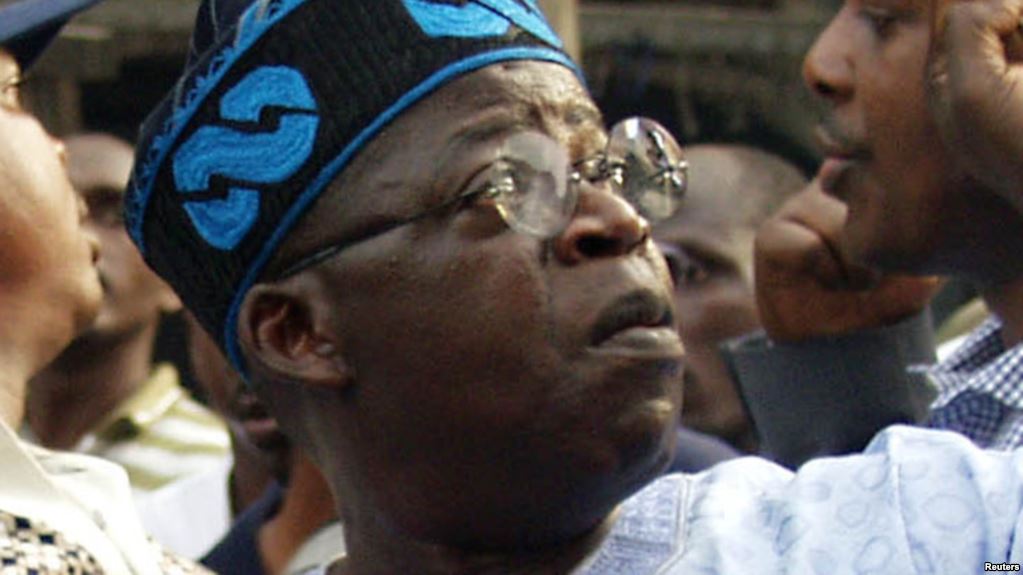
Automatic Ticket, Others Drove Saraki, Tambuwal Out of APC – Tinubu

Published

on

Defectors who dumped the All Progressives Congress left because the party could not offer them what they wanted, All Progressives Congress (APC) national leader, Bola Tinubu, has said.

Mr Tinubu’s public reaction comes few weeks after the gale of defections from the ruling party began.

In the past month, at least 12 senators, 36 members of the House of Representatives and two state governors have dumped the ruling party.

Prominent among the defectors are Senate President Bukola Saraki and Sokoto State Governor. Aminu Tambuwal.

The defectors gave varying reasons for leaving the party, mainly due to problems in various state chapters of the party. Mr Saraki, however, blamed some unnamed leaders of the party for essentially forcing him out. Many believe Mr Tinubu was one of such leaders Mr Saraki was referring to.

Mr Tinubu was however of a contrary opinion.

In a statement he personally signed on Sunday, the APC leader said the defectors wanted automatic tickets and sharing of the national wealth which the governing APC could not guarantee.

According to him, the defectors “left the party to return to a motley agglomeration that would promise them what true democracy could not: automatic tickets, sharing of the national wealth and other offices and privileges.

“Nigeria is undergoing a historic transition. Sometimes awkwardly, tentatively, yet inexorably, we nurture political and governance reform. We steadily close the door on the old malpractices that have caused a rich nation to reside in the tenement of the global poor”.

Mr Tinubu attributed Mr Tambuwal’s defection to his presidential ambition which he would not be able to actualise in APC.

“Governor Tambuwal’s exit can be distilled to one cause. He covets the presidency. However, he had not the stomach to challenge President Buhari in a primary. Tambuwal felt further insulted that he would be compelled to face a direct primary just to retain the governorship nomination.

“But for the promise made by PDP headliners like Rivers State Governor Wike that he would have the PDP presidential nomination, Tambuwal would not have left. His exit had nothing to do with governance of the nation. It was about forging a personal ambition predicated on the defeat of progressive reform not the advancement of it.”

Mr Tambuwal last week said he was under pressure from some leaders in and outside Nigeria to run for the presidency.

Mr Tinubu advanced a similar argument for the defection of Mr Saraki.

“Much the same for Senate President Saraki. Returning to the PDP, he harbors dreams of the presidency but Tambuwal’s ambition will dwarf Saraki’s when the two collide. If Saraki had remained in the APC, he would be unable to reclaim his Senate seat let alone the Senate Presidency. He thus bolted because he lusts for the presidency but was promised by the PDP, at least, a return to his position in the Senate.

“For Saraki to talk about lack of governance is for him to deny who he is and the position he holds. This man stands as Nigeria’s Number 3 citizen. Clothed is he in ample power and influence. If he saw areas where government and the nation needed help, he could have easily applied his energies to these areas. He could have drafted legislation and easily got laws passed.

“However, no progressive enactment bears his name for he cared not for progress. He has been more focused on changing the rules of the Senate to favour himself and changing the order of elections so as to coincide with his selfish designs”.

He maintained that other defectors were given assurances on their ambitions, a step the APC refused to take. Mr Tinubu said the party is better off with the exit of the defectors.

“The rest of the defectors were given similar assurances by the PDP as to their offices. The APC refused to make such bargains as they are part of the ancient regime; these bargains are not of our democratic new way.

“There is nothing wrong with ambition. Without a degree of ambition, we would never strive to improve and develop ourselves. But ambition, restrained by nothing but itself, is a dangerous commodity. Unwedded to social conscience, it leads to ruthlessness; it is the father of the deception that leaders are meant to lord over instead of to serve the populace.

“In the final analysis, the reason for the defections is as clear to see as it is crooked in its motives. The APC seeks to reform governance and politics. However, many powerful people believe the established system assures their maximum benefit. Progressive reform would defeat them. They must fight reform and never be allied to it. Thus, they had to leave the APC.

“In a fundamental way, the APC may be better for their exit. It would be untrue to say their departures did not generate concern. As the air clears and we can better assess what is lost and gained by their exit, I can truthfully say the APC will be better off because they are gone.”

He added that the party will now focus more on delivering on electioneering campaigns.

Mr Tinubu was, however, silent on the recent debate on the morality of Mr Saraki occupying the Senate President’s seat.

Since his defection to the PDP last month, Mr Saraki has been under intense pressure from APC leaders and lawmakers insisting he vacate the seat since his party is now a minority in the senate.

Mr Saraki has vowed to keep his position.

Premium Times

Continue Reading
Click to comment

Leave a Reply

Your email address will not be published. Required fields are marked *

Featured

US Cancels Visa Processing for Nigeria, Brazil, Russia, 72 Other Countries

Published

on

By

The Trump administration is suspending all visa processing for applicants from 75 countries, a State Department spokesperson said on Wednesday.
The spokesperson did not elaborate on the plan, first reported by Fox News, which cited a State Department memo.
The pause will begin on January 21, Fox News said.
Somalia, Russia, Iran, Afghanistan, Brazil, Nigeria, Thailand are among the affected countries, according to the report.
The memo directs U.S. embassies to refuse visas under existing law while the department reassesses its procedures. No time frame was provided.
The reported pause comes amid the sweeping immigration crackdown pursued by Republican U.S. President Donald Trump since taking office last January.
In November, Trump had vowed to “permanently pause” migration from all “Third World Countries” following a shooting near the White House by an Afghan national that killed a National Guard member.
Source: Reuters

Continue Reading

Featured

‘A Friend of a Thief is a Thief’, Defence Minister Warns Gumi, Other Bandit-Sympathizers

Published

on

By

The Minister of Defence Minister, Lt.-Gen. Christopher Musa, (rtd), has warned Sheikh Ahmed Gumi and other persons in the country against including bandits in northern brotherhood.

General Musa, via a statement on Wednesday in Maiduguri, declared: “A friend of a thief is a thief,” warning Nigerians against supporting terrorists and bandits in any form.

He said that the warning statement is neither accidental nor symbolic; explaining that it is a clear response to narratives previously promoted by Sheikh Gumi, who described bandits’ hiding in the bush as “our brothers” and argued that society cannot do without them.

General Musa’s message draws a firm line between compassion and complicity. While empathy has its place, justifying or normalising terrorism only strengthens criminal networks that have devastated communities, displaced families, and claimed innocent lives.

Labeling bandit as “brothers” does not reduce violence it legitimizes and undermines national security efforts.

The Defence minister’s warning serves as a reminder that terrorism thrives not only on weapons but also on moral cover. Anyone who excuses, defends, or shields criminals through words, influence, or silence shares responsibility for the consequences. In matters of national security, neutrality is not an option.

Nigeria cannot defeat banditry and terrorism while dangerous rhetoric blurs the line between victims and perpetrators. The choice is clear: stand with the law and the nation, or be counted among those enabling crime.

Continue Reading

Featured

Strategy and Sovereignty: Inside Adenuga’s Oil Deal of the Decade

Published

on

By

By Michael Abimboye

In global energy circles, the most consequential deals are often not the loudest. They unfold quietly, reshape portfolios, recalibrate value, and only later reveal their full significance.

The recent strategic transaction between Conoil Producing Limited and TotalEnergies belongs firmly in that category. A deal whose implications stretch beyond balance sheets into Nigeria’s long-troubled oil production narrative.

For Mike Adenuga, named The Boss of the Year 2025 by The Boss Newspapers, the agreement is more than a corporate milestone. It is the culmination of a long-term upstream strategy that is now translating into hard value barrels, cash flow, and renewed confidence in indigenous capacity.

At the heart of the transaction is a portfolio rebalancing agreement that sees TotalEnergies deepen its interest in an offshore asset while Conoil consolidates full ownership of a producing block critical to its medium-term growth trajectory. The parties have not publicly disclosed the monetary value, industry analysts place similar offshore and shallow-water asset transfers in the high hundreds of millions of dollars, depending on reserve certification and development timelines. What is indisputable, however, is the deal’s structural clarity: each partner exits with assets aligned to its strategic strengths.

For Conoil, the transaction represents something more profound than asset shuffling. It is the validation of an indigenous oil company’s ability to operate, produce, and partner at scale. That validation was already underway in 2024, when Conoil achieved a landmark breakthrough: the successful production and export of Obodo crude, a new Nigerian crude blend from its onshore acreage.

In a country where new crude streams have become rare, Obodo’s emergence signalled operational maturity. More importantly, it shifted Conoil from being perceived primarily as a downstream and marginal upstream player into a full-spectrum producer with export-grade assets.

The commercial impact was immediate. Obodo crude enhanced Conoil’s revenue profile, strengthened cash flows, and materially improved the company’s asset valuation.

For Mike Adenuga, Obodo represented something else entirely: oil income with scale and durability. Producing crude shifts wealth from theoretical to realised. It is the difference between potential and proof.

That momentum was reinforced by Conoil’s acquisition of a new drilling rig, a move that underscored its intent to control not just resources, but execution. In an industry where rig availability often dictates production timelines, owning modern drilling capacity gives Conoil a strategic advantage lowering costs, reducing dependency, and accelerating development cycles. It also enhances the company’s bargaining power in partnerships such as the one with TotalEnergies.

Taken together, the Obodo crude success, the rig acquisition, and the TotalEnergies transaction, these moves materially expand Conoil’s enterprise value. While private company valuations remain opaque, upstream assets with proven production, infrastructure control, and international partnerships typically command significant multiple expansion. For Adenuga, all of these represents a stabilising and appreciating pillar of wealth.

As The Boss Newspapers honours Mike Adenuga as Boss of the Year 2025, the recognition lands at a moment when his oil ambitions are no longer peripheral to his legacy. They are central. In Obodo crude, in steel rigs, and in carefully negotiated partnerships, Adenuga is shaping a version of Nigerian capitalism that privileges patience, scale, and execution over spectacle.

In the end, the most powerful statement of wealth is not net worth rankings or headlines. It is the ability to convert strategy into assets, assets into production, and production into national relevance. On that score, the Conoil–TotalEnergies deal may well stand as one of the most consequential chapters in Mike Adenuga’s business story and in Nigeria’s evolving oil future.

Continue Reading

Trending