Connect with us

World

Earthquakes in Turkey, Syria Claims Hundreds of Lives

Published

on

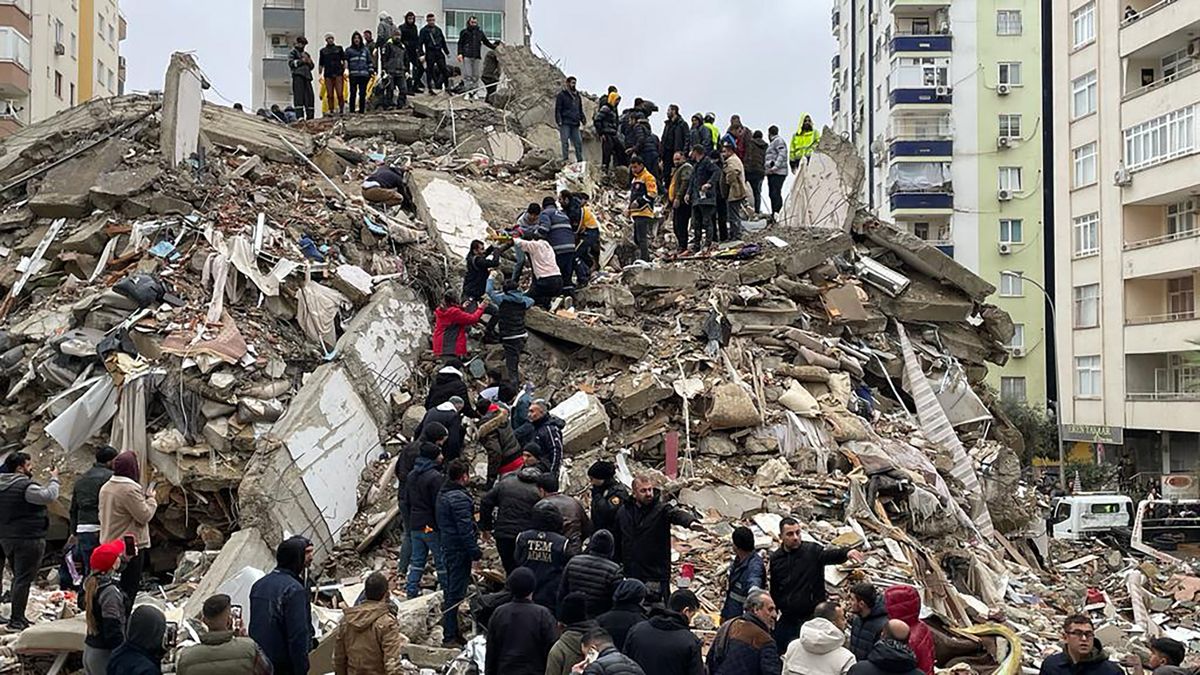
A 7.8-magnitude earthquake hit Turkey and Syria early on Monday, killing hundreds of people as they slept, levelling buildings, and sending tremors that were felt as far away as the Island of Cyprus and Egypt.

One of the largest to strike Turkey in at least a century wiped out entire sections of major cities in a region filled with millions of people who have fled the civil war in Syria and other conflicts.

The head of Syria’s National Earthquake Centre, Raed Ahmed, told pro-government radio that this was “historically, the biggest earthquake recorded in the history of the centre”.

At least 245 people died in government-controlled parts of Syria, as well as the northern areas held by pro-Turkish factions, according to the health ministry and a local hospital.

At least 284 people died in Turkey, Vice President Fuat Oktay said on Monday, adding that more than 2,300 people had been injured and that search and rescue work was continuing in several major cities.

The rescue was being hampered by a winter blizzard that covered major roads in ice and snow.

Television images showed shocked people in Turkey standing in the snow in their pyjamas, watching rescuers dig through the debris of damaged homes.

– Election test for Erdogan –

The quake struck at 04:17 am local time (0117 GMT) at a depth of about 17.9 kilometres (11 miles) near the Turkish city of Gaziantep, which is home to around two million people, the US Geological Survey said.

Turkey’s AFAD emergencies service centre put the first quake’s magnitude at 7.4, adding that it was followed by more than 40 aftershocks.

Turkish President Recep Tayyip Erdogan, who will be under intense pressure to oversee an effective response to the disaster heading to a tightly-contested May 14 election, conveyed his sympathies and urged national unity.

“We hope that we will get through this disaster together as soon as possible and with the least damage,” the Turkish leader tweeted.

US National Security Advisor Jake Sullivan said Washington was “profoundly concerned”.

“We stand ready to provide any and all needed assistance,” Sullivan said.

The earthquake struck a restive, predominantly Kurdish area of Turkey near Syria, a country gripped by more than a decade of violence that has killed hundreds of thousands and displaced millions.

– ‘People under rubble’ –

Images on Turkish television showed rescuers digging through the rubble of levelled buildings in the city of Kahramanmaras and neighbouring Gaziantep, where entire sections of cities were destroyed.

A fire lit up the night sky in one image from Kahramanmaras, although its origin remained unclear.

Buildings also crumbled in the cities of Adiyaman, Malatya and Diyarbakir, where AFP reporters saw panicked people rush out on the street.

Kahramanmaras Governor Omer Faruk Coskun said it was too early to estimate the death toll because so many buildings were destroyed.

“It is not possible to give the number of dead and injured at the moment because so many buildings have been destroyed,” Coskun said. “The damage is serious.”

A famous mosque dating back to the 13th century partially collapsed in the province of Maltaya, where a 14-story building with 28 apartments also collapsed.

In other cities, anguished rescuers struggled to reach survivors trapped under the debris.

“We hear voices here — and over there, too,” one rescuer was overheard as saying on NTV television in front of a flattened building in the city of Diyarbakir.

“There may be 200 people under the rubble.”

– Dam warning –

The Syrian health ministry reported damage across the provinces of Aleppo, Latakia, Hama and Tartus, where Russia is leasing a naval facility.

AFP correspondents in northern Syria said terrified residents ran out of their homes after the ground shook.

Even before the tragedy, buildings in Aleppo, Syria’s pre-war commercial hub, often collapsed due to the dilapidated infrastructure after more than a decade of war as well as little oversight to ensure safety of new construction projects, some built illegally.

Naci Gorur, an earthquake expert with Turkey’s Academy of Sciences, urged local officials to immediately check the region’s dams for cracks to avert potentially catastrophic flooding.

Turkey is in one of the world’s most active earthquake zones.

Continue Reading
Click to comment

Leave a Reply

Your email address will not be published. Required fields are marked *

World

US Congressman Recounts Harrowing Experience in Nigeria, Confirms ‘Systematic Genocidal Campaign’

Published

on

By

United States Congressman, Riley Moore, has described his recent visit to Nigeria as distressing, recounting harrowing encounters with victims of violent attacks, particularly in the Middle Belt region.

Moore last week led a congressional delegation on a fact-finding visit to Nigeria over killings in the northern part of the country.

The five-member team arrived in Nigeria last Sunday and spent several days in Benue State, meeting internally displaced persons, survivors of attacks, Christian leaders, traditional rulers, and communities affected by violence.

They also held meetings in Abuja with the National Security Adviser, Nuhu Ribadu, and the Attorney General of the Federation, Lateef Fagbemi.

The delegation expected to brief President Donald Trump on their findings before the end of the month.

Speaking in an interview with Fox News, Moore said his trip exposed him to the human cost of insecurity in Nigeria, particularly among vulnerable communities affected by terrorism and communal violence in the North.

The West Virginia lawmaker posted the interview on his X handle on Saturday.

Speaking on his experience, Moore said he met women who had survived brutal assaults that claimed the lives of their families.

He recalled meeting a woman who watched all five of her children murdered in her presence.

“It is really heartbreaking. I met a woman who unfortunately had to witness all five of her children murdered right in front of her. I met another woman in an internally displaced persons camp who lost her husband and her two daughters, and the Fulani Islamic radicals had murdered her unborn child—they took it out of her. She survived that, and they are all living in these IDP camps.

“There is a systematic genocidal campaign by the Fulani Muslim radicals in the Middle Belt of this country to push these Christians off their ancestral land,” he said.

The US lawmaker alleged that the violence in parts of the Middle Belt amounted to a coordinated campaign against Christian communities, claiming they are being driven off their ancestral lands.

“There is a systematic genocidal campaign by the Fulani Muslim radicals in the Middle Belt of this country to push these Christians off their ancestral land,” he reiterated.

Despite the grim accounts, Moore said his delegation held what he described as a positive meeting with the Nigerian government, expressing optimism that concrete steps could follow.

“We did have a positive meeting with the Nigerian government. There are positive things coming out of that government that I think will put us on a path toward a strategic security framework and a cooperative agreement to start addressing these issues,” he said.

Moore added that the protection of Christians facing violence remained a top concern for both him and the US President, noting the broader security challenges posed by terrorist groups in other parts of the country.

“First and foremost, my concern, and the President’s concern, is for these Christians, our brothers and sisters who are being slaughtered,” he said. “But there is also the terrorist threat in the North East from Boko Haram and ISIS, who are responsible for the unwanted deaths of Christians, non-Christians, and Muslims alike,” he added.

The Congressman described Nigeria’s security crisis as multi-layered, stressing the need for a comprehensive approach that addresses both terrorism in the North East and what he termed persecution in the Middle Belt.

“The problem is two-tier, and we have to address this Christian persecution and genocide that is happening in the Middle Belt of this country,” he said.

Source: The Punch

Continue Reading

Africa

Nigerian Soldiers Still Trapped in Burkina Faso – Foreign Affairs Minister

Published

on

By

The Minister of Foreign Affairs, Yusuf Tuggar, says the Nigerian soldiers who were on an aircraft that made a forced landing in Burkina Faso are still in trapped in that country.

Tuggar made this disclosure during a press briefing with his Beninese counterpart, Olushegun Bakari, on Thursday at the ECOWAS Commission in Abuja.

The Confederation of Sahel States (AES), on Monday, accused an aircraft carrying 11 Nigerian soldiers of violating Burkinabe airspace.

AES is a breakaway West African regional union made up of Burkina Faso, Mali and Niger Republic.

The Mali junta leader, Assimi Goita, described the landing as an unfriendly act carried out in defiance of international law.

The AES said it authorised its member states to neutralise any aircraft violating its airspace.

The development came at the same time Nigerian troops carried out air strikes in Benin to help foil a coup.

Commenting on the situation, the Nigerian Air Force, NAF, said the C-130 aircraft was on a ferry mission to Portugal.

Continue Reading

Africa

Leader of Failed Benin Republic Coup Reportedly Seeks Refuge in Togo

Published

on

By

The leader of a failed coup in Benin Republic, Colonel Tigri Pascal, has reportedly sought refuge in neighbouring Togo.

Soldiers briefly took control of Benin’s State television station on Sunday morning and claimed they had deposed President Patrice Talon, though Benin’s armed forces, backed by Nigerian firepower and French intelligence and logistical support, thwarted the attempt.

The soldiers identified Colonel Pascal as the coup leader, while his whereabouts had previously been unknown.

However, a senior Benin government official told Reuters on Wednesday that the soldier is in Togo.

The government, however, called for Pascal’s immediate extradition.

Togo’s foreign ministry did not immediately respond to a request for comment.

A Benin government statement on Monday said coup plotters attempted to seize Talon, and came close enough for the president to witness violent clashes first-hand.

The statement added that they also managed to kidnap two senior military officials who were released on Monday morning.

A Benin Republic government’s spokesperson, Wilfried Leandre Houngbedji, said on Sunday that 14 people had been arrested in connection with the coup attempt.

Reuters

Continue Reading

Trending