Connect with us

Featured

Liberia’s Vice President Jewel Taylor Calls for an African Industrial Revolution

Published

on

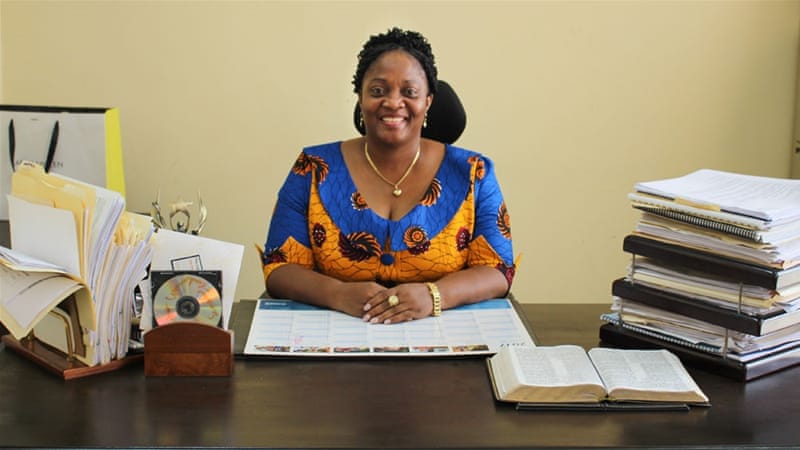
Jewel Cianeh Taylor is one of few women in top political leadership positions in Africa. In this interview with Africa Renewal’s Kingsley Ighobor, she discusses Liberia’s COVID-19 response, post-pandemic priorities, women’s empowerment in Africa, youth unemployment and other issues. These are the excerpts:

How is Liberia dealing with COVID-19?

As you know, Liberia is a developing nation, and we have had our share of challenges, including a civil conflict, Ebola and now COVID-19. Following the outbreak of the pandemic, the President [George Weah] established a rapid COVID-19 Response Unit chaired by the Ministry of Health and includes other relevant government agencies and international partners. This unit meets daily to assess the situation and to address challenges. Over a year ago, we instituted a national emergency, mandated testing and social distancing, and we continue to raise public awareness about the pandemic. We opened two new hospitals to treat COVID-19 patients. As a result of our robust response effort, we are seeing a reduction in COVID-positive numbers.

How are you addressing the socio-economic impact?

No doubt, economic activities have been severely affected. Schools were closed. There was an increase in sexual and gender-based violence across the country, as well as a drastic loss of income for women who are the primary providers and caregivers in our society.

The National Legislature approved a national stimulus package, including food rations and money to severely affected homes, and suspended taxes to allow companies and businesses to survive. We halted ongoing development projects and even redirected finances for such projects to the healthcare sector and to respond to the social and economic needs of our most vulnerable.

You contracted the COVID-19 virus. What was your experience and what message would you send to people who may still be skeptical about the disease?

I hope my voice, and the voices of others who contracted the disease will let people know that this pandemic is real. I am not sure of how or where I contracted this disease, but I did. I was severely ill and spent 35 days in the Intensive Care Unit and another 10 days just getting my breathing stabilized.

COVID-19 is not a hoax or a conspiracy theory. If we follow the health protocols, especially wearing face masks, social distancing, and getting tested immediately when we fall ill, coupled with vaccination, I am hopeful we can defeat the disease.

How is vaccination going in Liberia? 

We received about 100,000 vaccines. The vaccination process is going well. People are being vaccinated. I have been vaccinated myself.

How is Liberia preparing for a post-pandemic recovery? What are your top three priorities?

We have more than three priorities. Let me emphasize that our national budget reflects our priorities—health, education, roads, jobs and the provision of basic social services to our people, including water and electricity. We are having meetings with our international partners and friends to establish a post-COVID-19 roadmap and stabilization funds.

Photo: Jewel StarFish Foundation

We would like to re-energize agriculture and invest in infrastructure to jump-start economic activities. We hope to restore macroeconomic stability, encourage sustainable growth and private sector-driven development. Our focus is shifting to industrialization and the processing of our natural resources. We believe that the creation of a vibrant private sector is the best way forward.

What are the top three achievements of your government so far?

The first is entrenching democracy. After taking the baton of power in 2018, our government has conducted many elections: several bi-elections and the 2020 senatorial elections. And the legal processes which attend contested elections have been successfully and peacefully followed up to the Supreme Court.

The second is that we carried out a process of harmonization that allowed the government to significantly reduce the wage bill by eliminating ghost names. Implementing a biometric identification card for all government employees eliminated discrepancies. We have redirected excess finances to other critical areas.

Third, our tuition-free policy for public universities and colleges announced by President Weah in 2019 and the payment by the government of all regional testing fees for WASSCE [West African Senior School Certificate Examination] have provided huge reliefs for parents. The scheme will increase school enrollments and literacy rates.

I would like to mention infrastructural development. A former minister of works once said that, “The road to development begins with the development of the roads.” This is so true for us. The government is rehabilitating existing roads (feeder and main highways) and expanding the road network. We plan to ensure that all capital cities in Liberia are connected by paved roads, especially in the southeastern corridor. We are grateful to our international partners who are supporting us.

You are one of few African women in top political leadership positions. Before you, there was Madam Ellen Johnson-Sirleaf who was Africa’s first democratically-elected president. How do you assess the progress that Africa is making regarding women’s political empowerment?

Since Beijing, Africa has made progress regarding women’s political and economic empowerment, but there are still many gaps. Currently, across the continent, there are only two female presidents and about four female vice presidents.

The percentage of women in governance in African is still very small, though rising slowly: women ministers constitute 20.7 per cent and women in parliament is 23.7 per cent, according to IPU [Inter-Parliamentary Union] statistics. So, there is still a long way to achieving gender equity.

What are the main barriers to women’s political empowerment?

The age-old barriers to women’s empowerment are structural, patriarchal, discriminatory laws and low capacities. We must eliminate all forms of violence against women and adopt parity laws. We must build and provide leadership training. We must encourage more He-for-She [global solidarity for gender equality] champions, eliminate and punish all forms of electoral violence against women.

How do you think African women can prepare to participate in politics, which is considered tough?

The truth is that politics is tough terrain, but it takes a clear vision, proper planning and execution of plans, commitment, hard work and consistency to succeed. Despite the many challenges, women should not allow themselves to be left out of the process.

And those who have broken the glass ceilings must be role models and must mentor others. Advocates of gender equality should continue to raise their voices.

Young people account for 65 per cent of Liberia’s 4.1 million population, yet youth unemployment is about 85 per cent. What is your government doing about it?

Youth unemployment is one of the biggest challenges facing our government. Youth employment is a key component of our Pro-poor Agenda for Prosperity and Development. To address unemployment, we need a strong private sector. At the moment we are creating the policy framework to attract the private sector.

We are tackling challenges in the energy sector by enacting the Independent Power Production Law, which will open this sector to the private sector. The good news is that there are huge opportunities in agriculture and tourism. We have also approved funding for the development of small and medium enterprises.

In addition, the government has a Youth Opportunities Project, which provides training and funding for cooperatives and support to young people in agrobusinesses. There are also several programs to train young people in entrepreneurship.

This year (2021) marks the beginning of trading under the African Continental Free Trade Area (AfCFTA). Liberia has signed but has not ratified the agreement. What do you see as the benefits and challenges of free trade?

The AfCFTA is a major boost for African economies. We expect a 52 per cent boost in intra-Africa trade by 2022. Our government is aware that of the 15 countries in West Africa, only two countries, Liberia and Benin, are yet to ratify the agreement. In our case, the agreement is before the National Legislature and we hope it will be ratified soon.

Africa is the last frontier, with about 40 per cent of the world’s natural resources and the fastest-growing population globally. If Africa uses this leverage to implement an industrialized revolution, it can have sustained economic growth. We’re at a point where we need mutually rewarding partnerships, not just grants.

It’s time for an African industrial revolution. Africa’s resources have traditionally been taken out of our countries, processed abroad, and brought back. Now, African leaders are saying that we want investors to help build industries that process our natural resources locally. It is not just to take out raw materials.

What message of hope do you have for Africans, particularly women, who see you as a role model?

My message is simple: dream, prepare, build, remain committed, and don’t forget to encourage and mentor others. This is the formula for success, whether you are a man or a woman. The world is for the strong, the bold, the creative and the committed. Keep in mind that everything is possible.
Continue Reading
Click to comment

Leave a Reply

Your email address will not be published. Required fields are marked *

Featured

Superiority War: I’ve Exclusive Authority to Confer Titles Across Yorubaland, Says Alaafin

Published

on

By

The Alaafin of Oyo, Oba Abimbola Akeem Owoade I, has stated that only the throne of Oyo has the authority to confer chieftaincy titles that carry the name “Yorubaland.”

The monarch made this declaration during the installation of Senator Abdul-Aziz Yari as Obaloyin of Yorubaland and Barrister Seyi Tinubu as Okanlomo of Yorubaland on Sunday at Aganju Forecourt, Aafin Oyo.

Oba Owoade emphasised that chieftaincy in Yoruba culture is not a matter of favour or decoration but a duty that comes with responsibility.

He explained that the Oyo throne has historically served as a central coordinating authority for the Yoruba people, a role recognised both during colonial administration and in post-independence governance.

The Alaafin highlighted that titles bearing the name “Yorubaland” are collective titles representing the Yoruba people as a whole, not individual towns or kingdoms, and must therefore be conferred by an authority whose reach spans the entire region.

He noted that colonial records, post-independence councils, scholarly works, and the Supreme Court of Nigeria have all affirmed this historical authority.

Oba Owoade described the newly installed titles as positions of trust requiring courage, loyalty, and service to the Yoruba people.

He added that such honours are meant to bind recipients more closely to Yorubaland and reinforce that authority, tradition, and respect for boundaries are central to sustaining Yoruba culture.

He urged the new titleholders to serve with humility and to ensure that their honours contribute to unity, dignity, and the collective good of Yorubaland.

He said: “We are gathered here today for a purpose that goes beyond celebration. We are here to witness history and to place responsibility where tradition has long placed it. Chieftaincy, in our culture, is not an act of favour. It is not decoration. It is duty, conferred only when history, authority, and responsibility align.

“From the earliest organisation of the Yoruba people, authority was never vague. Our forebears understood structure. This understanding gave Yorubaland stability long before modern governance arrived.

“The throne of Oyo emerged in that history as a coordinating authority, by responsibility. When colonial administration came, it did not invent this reality; it encountered it and recorded it. By 1914, Oyo Province had become the largest province in Southern Nigeria, covering 14,381 square miles. It was bounded in the north by Ilorin and Kontagora, in the east by Ondo and Ijebu, in the south by Ijebu and Abeokuta, and in the west by French Dahomey. This reflected recognised leadership over a wide and diverse space.

“This history explains why certain chieftaincy titles are different in nature. Titles that bear the name “Yorubaland” are not local titles. They are collective titles. They speak not for one town or one kingdom, but for the Yoruba people as a whole. Such titles must therefore proceed from an authority whose reach, by history and by law, extends across Yorubaland.

“Today, I do not speak to provoke debate. I speak to state order. Among the Yoruba, authority has never been a matter of assumption or convenience. It has always been a matter of history, structure, and law. Thrones were not created equal in function, even though all are sacred in dignity. From the earliest organization of Yorubaland, the Alaafin of Oyo occupied a central and coordinating authority – an authority that extended beyond the walls of Oyo and into the collective political life of the Yoruba people. This was not self-declared. It was recognised, enforced, and sustained across generations.

“Colonial records acknowledged it. Post-independence councils preserved it. Scholars documented it.

“And finally, the Supreme Court of Nigeria affirmed it. The law is clear. History is settled. Chieftaincy titles that bear the name Yorubaland – titles whose meaning, influence, and obligation are not confined to a single town or kingdom – fall under a singular, established authority. That authority is the throne of Oyo.”

Continue Reading

Featured

Why I Visited Nnamdi Kanu in Prison – Alex Otti

Published

on

By

By Eric Elezuo

Governor Alex Otti of Abia State has explained the reasons behind his much talked about visit to the leader of the Indigenous Peoples of Biafra (IPOB), Mazi Nnamdi Kanu, in Sokoto Correctional Centre.

Nnamdi Kanu was found guilty of all the seven count charges of terrorism brought against him by the Federal Government, and sentenced to life imprisonment, by Justice James Omotosho of the Federal High Court, Abuja, on November 20.

The governor also declared his intention to retire from partisan politics after serving as governor of the state.

Governor made these remarks in Umuahia while reacting to a viral video in which an individual berated him for visiting the IPOB leader in Sokoto Correctional Centre recently and alleged that the visit was aimed at positioning him (Otti) for either the presidential or vice presidential ticket. Otti however, denied having any presidential or vice presidential ambition after his governorship role.

According to him, he would not even contest for the senatorial position after serving as governor of Abia State.

Criticisms, he said, are part of democracy, adding that everyone is free to hold an opinion, even as he acknowledged that some criticisms, especially undue ones, are far from being the truth.

His words, “In the first place, that is the beauty of democracy. So, people should hold their opinions, and we respect people’s opinions. And that you hold a different opinion doesn’t mean you are right.

“One of the things he talked about was my ambition after being governor. And I had said it before, and I want to say it again, that by the time I’m done with governorship, I will retire.

“So, I don’t have presidential ambition, nor vice-presidential ambition. I also don’t have senatorial ambition. So, when I finish with the governorship, I’ll retire.

“I came for a mission. And when I deliver that mission, I will give way to younger people. So, he was talking of Igbo presidency. I don’t even understand what that means.

“So, I think if his thesis is based on that assumption, the assumption has collapsed, because he won’t see me on the ballot.

The Abia governor argued that it is important for a political office holder to know when to quit, especially when the politician has done what he is asked to do.

“When you have done what you have been asked to do, you clear, give way for other people. We’ve seen people here, after being governor who went to serve as Local Government Chairman. That’s not what we are. We are not cut out for those kinds of things.

Otti used the forum to explain why he visited Mazi Nnamdi Kanu at the Sokoto prison.

He said, “The second point is about Nnamdi Kanu. And I don’t want to put this matter in the public space so that it doesn’t jeopardise the discussions that I’m having.

“The truth about it is that exactly 24 months ago, I opened up discussions at the highest level on Nnamdi Kanu.

“And going to see him is the right thing to do, because he comes from my state. In fact, he comes from this local government (Umuahia North – the state capital).

“And there are always ways to solve a problem. I don’t believe that the way to solve a problem is to ignore it. And I had written extensively, even about Nnamdi Kanu and Operation Python Dance, I think in 2017 or 2018. And I condemned it.

“And I still condemn it. And some of the recordings that the gentleman put in his video, I cannot vouch for the veracity of that recording.”

Governor Otti maintained that he knows that when an issue has been approached from the legal point of view, there is also another window called the administrative point of view, stressing that, that is where he (the governor) is coming from.

“I’m not a lawyer. And if the judiciary says the man has been condemned to life imprisonment, that is the judiciary. Even that is not the end, because that’s the court of first instance. There is still an opportunity to appeal and then an opportunity to even go to the Supreme Court.

“But what we are trying to do is to intervene. I’m not a supporter of the disintegration of Nigeria.

“So, my position is that it would be insensitive of me to sit here and say one of our own who has been convicted should die when we have an opportunity to discuss, negotiate, and sue for peace. So, that is my position,” he said.

Continue Reading

Featured

How Glo Network Became the Lifeline That Saved Two Lives: A True Story from Sallari

Published

on

By

By Dr. Sani Sa’idu Baba

It was one of those calm, bright mornings in Sallari, a town in Tarauni Local Government Area of Kano State. I had gone to visit my longtime friend and colleague, Dr. Muhammad Umar Abdullahi, at his private facility, Rauda Clinic and Maternity. We were in his office discussing research, the usual challenges of medical practice, and other issues when the sound of hurried footsteps and anxious voices broke the calm. A young man rushed in, calling for the doctor.

Without hesitation, Dr. Muhammad sprang into action. I followed him instinctively. Within moments, two people burst through the gate, one man carrying a weak, heavily pregnant woman in his arms. Her breathing was shallow and wheezy, her face pale, and her body trembling between labor contractions and an asthma crisis. The scene was intense, we both knew that every second counted.

The team quickly moved her to the emergency bed. The Chief Medical Director Dr. Muhammad and his nurses worked swiftly to stabilize her breathing and monitor the baby. Oxygen was connected, IV lines were set, and within minutes, her breathing began to steady. The baby’s heartbeat was strong. After a short but tense period, she delivered a healthy baby girl. Relief filled the room like a gentle wind.

At that moment, I couldn’t help but admire the efficiency and dedication of Rauda Clinic and Maternity. The facility operated with the precision and compassion of a modern hospital. Every member of the team knew their role, every piece of equipment was in place, and the environment radiated calm professionalism. It reminded me that quality healthcare is not only about infrastructure, but about commitment and readiness when it truly matters. Rauda Clinic stood out that day as a quiet pillar of excellence and hope for patients and families alike.

The following day, I placed a call to Dr. Muhammad to ask about the condition of the woman who had been brought in the previous morning. He sounded cheerful and relieved. “Both mother and baby are fine now,” he said. Then, with deep reflection in his voice, he narrated the extraordinary story behind their survival, a story that showed how a single phone call, made at the right moment, became the bridge between life and death. As I listened to him recount the events, I couldn’t help but marvel at how sometimes, survival depends not only on medicine but also on connection.

Her name was Amina, a mother of three. That morning, she was alone at home, her husband was in Dutse, the capital of Jigawa state where he works, and her children had already gone to school. The first wave of pain came suddenly, followed by a tightening in her chest. Within minutes, she was gasping for air, her asthma worsening with every breath. She reached for her phone to call her husband, but the call wouldn’t go through. She tried again and again, each time, “Network error.”

Her strength was fading fast. She tried to reach her neighbors, but again, no connection. Alone, frightened, and struggling to breathe, she said she felt her end was near. Then, a thought crossed her mind, her maid had left her phone in the sitting room that morning. Gathering the last of her strength, Amina crawled toward the television stand where the phone lay.

When she reached it, she noticed the green SIM icon, it was a Glo line. Hope flickered. But when she tried to make a call, she saw there was no airtime. That could have been the end until she remembered Glo’s Borrow Me Credit service. With trembling fingers, she dialed the Glo borrow me code and she got the credit instantly, and that small credit became her lifeline.

Her first attempt to reach her husband failed. Then she dialed her younger brother, Umar. This time, the call went through immediately. Interestingly, Umar is a Glo user too. Without delay, Umar and his wife rushed to her house, found her collapsed on the floor, and carried her into their car.

On their way, Umar called ahead to alert the doctor, and again, the call went through clearly. By a remarkable coincidence, Dr. Muhammad was also using a Glo line. That seamless connection meant the hospital team was fully prepared by the time they arrived. Within minutes, Amina was stabilized, and both she and her baby were safe.

The next morning, Dr. Muhammad told me that Amina had smiled faintly and said to him, “Doctor, when every other network failed me, Glo answered. If that call hadn’t gone through, I wouldn’t be here today.”

Her words carried a truth that stayed with me. It wasn’t just a patient’s gratitude, it was a testimony about the power of reliable connection. At that moment, Glo wasn’t just a telecommunications network, it was the bridge between life and death, between despair and hope.

In today’s world, a simple phone call can determine whether someone lives or dies. That day reminded me that technology, when dependable, is not just about data speed, it’s about human connection at its most critical. Glo proved to be that connection: steady, available, and trustworthy when it mattered most.

Before she was discharged, she laughed and told the doctor she had already chosen a nickname for her baby “Amira Glo.” They both laughed, but deep down, Dr. Muhammad understood the meaning behind that name. It symbolized gratitude, faith, and survival.

As I ended the call with Dr. Muhammad that day, I felt a quiet pride. I had witnessed not just the miracle of life, but the harmony of medicine, compassion, and reliable technology. Through Rauda Clinic and Maternity, I saw what true service means, dedication without boundaries, and connection that saves.

Amina’s story isn’t an advert, but living proof that sometimes, when every other signal fades, Glo stands firm, and when every other facility seems far away, Rauda Clinic and Maternity remains a beacon of care and excellence.

For patients, families, and health workers alike, Glo is proven to be a network of necessity. It connects life to hope, when every second truly counts…

Dr. Sani Sa’idu Baba writes from Kano, and can be reached via drssbaba@yahoo.com

Continue Reading

Trending