Connect with us

Featured

Meet Nigerians Appointed into President Joe Biden’s Cabinet

Published

on

By Eric Elezuo

President of the United States of America, Joe Biden has been making a number of crucial appointments across races into his cabinet as the world’s biggest democracy rolls out the drums to run a fresh administration.

The 78 years old Democrat, a former senator and Vice President, has reportedly appointed over 100 people among whom are a handful of Nigerians ever since he defeated former President Donald Trump in a much contested November 3, 2020 General Election, and sealed in December 2020 by the electoral college.

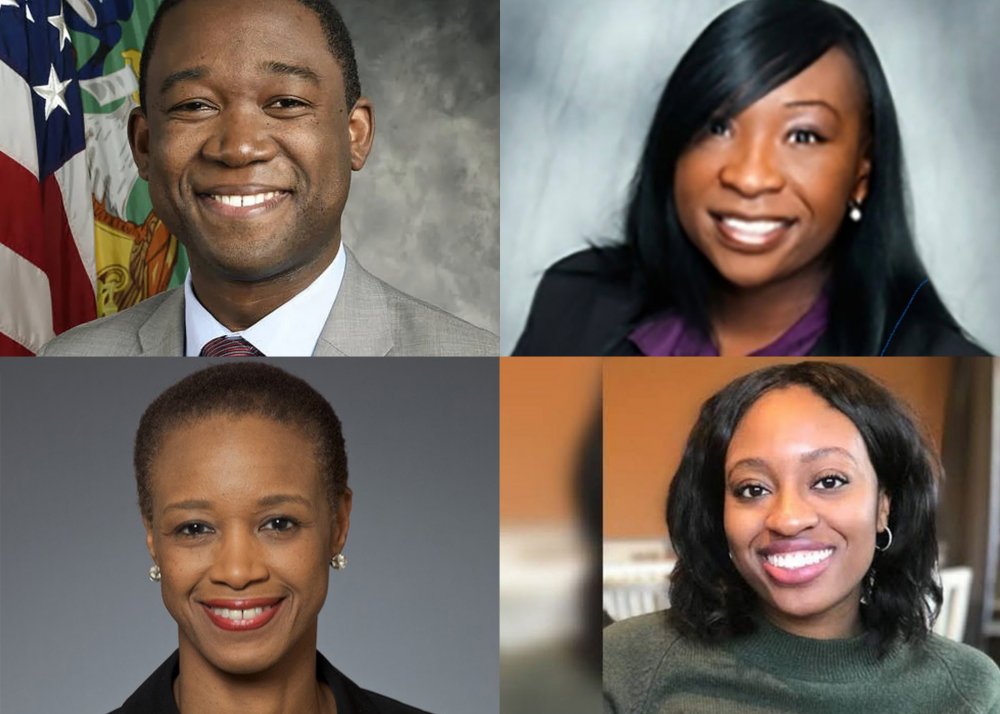
The appointment of the Nigerian-born Americans, namely Adewale Adeyemo and Osaremen Okolo, Funmi Olorunnipa Badejo as deputy treasury secretary, COVID-19 advisor and associate counsel respectively, and just recently, Enoh Titilayo Ebong has sent a message of positivity, making the world believe that all hope is not lost about Nigeria.

OSAREMEN OKOLO

Osaremen Okolo, the daughter of Nigerian immigrant, was appointed on Thursday, December 31, as one of the members of the Biden-Harris COVID-19 response team. She was born by Nigerian parents and raised in Massachusetts. She graduated from Harvard College in May 2017. She concentrated primarily in the history of science (medicine and society focus) with an allied, joint concentration in African-American studies. She also obtained a secondary in Global Health and Health Policy.

According to The Street Journal, the Democrat served as a senior health policy adviser to U.S. Representative Jan Schakowsky of Illinois. While working for Schakowsky, she drafted, negotiated, and managed the Congresswoman’s legislation, oversight, and policy across comprehensive health care and public health agenda. Outside of all things health, Okolo spends time writing creatively, fanatically cheering on her Boston sports teams and loves Nigerian food.

ADEWALE “Wally” ADEYEMO

Adeyemo has served as the president of the Obama Foundation. He was born in Nigeria and raised in Southern California. Adeyemo received his undergraduate degree from the University of California at Berkeley and a Juris Doctor from Yale Law School. He joined the Obama Foundation in August 2019 as its first president. An ally of the US former president, Barrack Obama, Adeyemo was the deputy director of the National Economic Council (NEC), the assistant secretary for international markets and development at the treasury department.

Adeyemo is a former senior international economic adviser during the Obama administration, and ihas previously served as the first Deputy National Security Advisor for International Economics from 2015-2016, and Deputy Director of the National Economic Council.

The 39-year-old has also served as the deputy chief of staff of the treasury department in 2012 and chief of staff of the Consumer Financial Protection Bureau (FPB) for 16 months, starting in 2010. Adeyemo worked as an editor at the Hamilton Project.

He later worked as the chief negotiator for the Trans-Pacific Partnership and also served as the first chief of staff of the Consumer Financial Protection Bureau under Elizabeth Warren.

FUNMI OLORUNNIPA BADEJO

Badejo was appointed as one of Biden’s legal advisers at the White House. Funmi, who married another Nigerian Tunde Badejo, is from Kogi State, and she is an alumnus of Berkeley Law College in the United States. Like Okolo, she is the daughter of an immigrant who identified herself with Florida, Funmi was the general counsel of the House select subcommittee on the coronavirus crisis.

Badejo is saddled with the responsibility of advising the president, the executive office of the president, and the White House staff on legal issues pertaining the president and the White House.

Badejo served as ethics counsel in the same office toward the end of the Obama administration.

A Biden-Harris campaign statement described her as follows:

“Her prior government service includes serving as Counsel for policy to the Assistant Attorney-General in the Civil Division of the U.S. Department of Justice, Ethics Counsel at the White House Counsel’s Office and Attorney Advisor at the Administrative Conference of the United States during the Obama-Biden administration,” the statement read.

“Olorunnipa Badejo began her legal career as an associate with the law firm of Manatt, Phelps & Phillips, LLP and was Legal Counsel at Palantir Technologies Inc. She is a graduate of the University of California, Berkeley, School of Law, Harvard University’s John F. Kennedy School of Government, and the University of Florida. Originally from Florida, Olorunnipa Badejo lives in Washington D.C. with her husband and son.”

ENOH TITILAYO EBONG

Biden also appointed Nigerian-born Enoh Titilayo Ebong as the acting director of the US Trade and Development Agency (USTDA).

“The appointment meant a return to USTDA where from 2004 to 2019, Ms. Ebong had served in a variety of roles, most recently as the Agency’s General Counsel, and Deputy Director and Chief Operating Officer,” USTDA said in a statement.“As Acting Director, Ms. Ebong leads an agency that partners with the U.S. private sector to develop sustainable infrastructure and foster economic growth in emerging economies, while supporting U.S. jobs through the export of U.S. goods and services.”

Ebong had previously served as the head of strategic partnerships at the Milken Center for Advancing the American Dream.

She is expected to lead the agency in partnering with the country’s private sector in order to develop sustainable infrastructure and foster economic growth in emerging economies.

Accepting the appointment, Ebong noted that “It is an honor to return to USTDA.

“The opportunity to lead the Agency comes at a critical moment when the world is turning to the United States for leadership on clean energy and climate-smart infrastructure, as well as safe and secure ICT solutions.”

She also noted that the agency is one of the most effective, targeted and proven tools within the U.S. government.

“I’ve longed believed in USTDA’s mission and program, which are fully aligned with the President’s vision of strengthening the country’s economy and addressing climate as an essential component of American foreign policy and national security,” Ebong said.

Ebong grew up in Lagos, Nigeria. Her father, Ime James Ebong, was a Nigerian civil servant who served as permanent secretary.

She practiced law at the Boston office of Mintz, Levin, Cohn, Ferris and Popeo, P.C., representing public and private companies in public offerings, financing transactions, mergers and acquisitions, and corporate governance issues before joining the agency in 2004.

Ebong earned a Juris Doctor from the University of Michigan Law School, a Master of Arts in Communication from the Annenberg School for Communication at the University of Pennsylvania, and a Master of Arts in History, with Honors, from The University of Edinburgh, Scotland. She is a member of the Commonwealth of Massachusetts Bar.

Continue Reading
Click to comment

Leave a Reply

Your email address will not be published. Required fields are marked *

Featured

Glo Wishes Christians Joyous Christmas, Urges More Compassion, Unity

Published

on

By

Nigeria’s technology and telecommunications company, Globacom, has extended warm Christmas greetings to Christians nationwide and globally as they commemorate the birth of Jesus Christ.

Globacom, in a statement on Monday, described the Yuletide as a season of reflection, urging Christians to embody the teachings of Jesus; love, humility, obedience to God, and a steadfast commitment to the welfare of all humanity.

“The noble but lowly circumstances of the birth of Christ teach salient virtues including obedience to God, humility, love for mankind, and a fastidious commitment to the good of all. We urge Christians to commit to practicing these virtues, as followers of Christ,” the company stated.

Globacom also highlighted the responsibility to care for others, noting that Jesus’ act of feeding the multitude (as recorded in the Gospels) serves as a timeless reminder to share and support one another, especially in challenging times.

It called on Nigerians to carry the spirit of Christmas beyond the festive season by reflecting the love and peace that Christ’s birth represents.

The company reassured its customers of uninterrupted, high‑quality services throughout the holidays and encouraged them to leverage its innovative products and services to stay connected and share the season’s joy with family and friends.

Continue Reading

Featured

Superiority War: I’ve Exclusive Authority to Confer Titles Across Yorubaland, Says Alaafin

Published

on

By

The Alaafin of Oyo, Oba Abimbola Akeem Owoade I, has stated that only the throne of Oyo has the authority to confer chieftaincy titles that carry the name “Yorubaland.”

The monarch made this declaration during the installation of Senator Abdul-Aziz Yari as Obaloyin of Yorubaland and Barrister Seyi Tinubu as Okanlomo of Yorubaland on Sunday at Aganju Forecourt, Aafin Oyo.

Oba Owoade emphasised that chieftaincy in Yoruba culture is not a matter of favour or decoration but a duty that comes with responsibility.

He explained that the Oyo throne has historically served as a central coordinating authority for the Yoruba people, a role recognised both during colonial administration and in post-independence governance.

The Alaafin highlighted that titles bearing the name “Yorubaland” are collective titles representing the Yoruba people as a whole, not individual towns or kingdoms, and must therefore be conferred by an authority whose reach spans the entire region.

He noted that colonial records, post-independence councils, scholarly works, and the Supreme Court of Nigeria have all affirmed this historical authority.

Oba Owoade described the newly installed titles as positions of trust requiring courage, loyalty, and service to the Yoruba people.

He added that such honours are meant to bind recipients more closely to Yorubaland and reinforce that authority, tradition, and respect for boundaries are central to sustaining Yoruba culture.

He urged the new titleholders to serve with humility and to ensure that their honours contribute to unity, dignity, and the collective good of Yorubaland.

He said: “We are gathered here today for a purpose that goes beyond celebration. We are here to witness history and to place responsibility where tradition has long placed it. Chieftaincy, in our culture, is not an act of favour. It is not decoration. It is duty, conferred only when history, authority, and responsibility align.

“From the earliest organisation of the Yoruba people, authority was never vague. Our forebears understood structure. This understanding gave Yorubaland stability long before modern governance arrived.

“The throne of Oyo emerged in that history as a coordinating authority, by responsibility. When colonial administration came, it did not invent this reality; it encountered it and recorded it. By 1914, Oyo Province had become the largest province in Southern Nigeria, covering 14,381 square miles. It was bounded in the north by Ilorin and Kontagora, in the east by Ondo and Ijebu, in the south by Ijebu and Abeokuta, and in the west by French Dahomey. This reflected recognised leadership over a wide and diverse space.

“This history explains why certain chieftaincy titles are different in nature. Titles that bear the name “Yorubaland” are not local titles. They are collective titles. They speak not for one town or one kingdom, but for the Yoruba people as a whole. Such titles must therefore proceed from an authority whose reach, by history and by law, extends across Yorubaland.

“Today, I do not speak to provoke debate. I speak to state order. Among the Yoruba, authority has never been a matter of assumption or convenience. It has always been a matter of history, structure, and law. Thrones were not created equal in function, even though all are sacred in dignity. From the earliest organization of Yorubaland, the Alaafin of Oyo occupied a central and coordinating authority – an authority that extended beyond the walls of Oyo and into the collective political life of the Yoruba people. This was not self-declared. It was recognised, enforced, and sustained across generations.

“Colonial records acknowledged it. Post-independence councils preserved it. Scholars documented it.

“And finally, the Supreme Court of Nigeria affirmed it. The law is clear. History is settled. Chieftaincy titles that bear the name Yorubaland – titles whose meaning, influence, and obligation are not confined to a single town or kingdom – fall under a singular, established authority. That authority is the throne of Oyo.”

Continue Reading

Featured

Why I Visited Nnamdi Kanu in Prison – Alex Otti

Published

on

By

By Eric Elezuo

Governor Alex Otti of Abia State has explained the reasons behind his much talked about visit to the leader of the Indigenous Peoples of Biafra (IPOB), Mazi Nnamdi Kanu, in Sokoto Correctional Centre.

Nnamdi Kanu was found guilty of all the seven count charges of terrorism brought against him by the Federal Government, and sentenced to life imprisonment, by Justice James Omotosho of the Federal High Court, Abuja, on November 20.

The governor also declared his intention to retire from partisan politics after serving as governor of the state.

Governor made these remarks in Umuahia while reacting to a viral video in which an individual berated him for visiting the IPOB leader in Sokoto Correctional Centre recently and alleged that the visit was aimed at positioning him (Otti) for either the presidential or vice presidential ticket. Otti however, denied having any presidential or vice presidential ambition after his governorship role.

According to him, he would not even contest for the senatorial position after serving as governor of Abia State.

Criticisms, he said, are part of democracy, adding that everyone is free to hold an opinion, even as he acknowledged that some criticisms, especially undue ones, are far from being the truth.

His words, “In the first place, that is the beauty of democracy. So, people should hold their opinions, and we respect people’s opinions. And that you hold a different opinion doesn’t mean you are right.

“One of the things he talked about was my ambition after being governor. And I had said it before, and I want to say it again, that by the time I’m done with governorship, I will retire.

“So, I don’t have presidential ambition, nor vice-presidential ambition. I also don’t have senatorial ambition. So, when I finish with the governorship, I’ll retire.

“I came for a mission. And when I deliver that mission, I will give way to younger people. So, he was talking of Igbo presidency. I don’t even understand what that means.

“So, I think if his thesis is based on that assumption, the assumption has collapsed, because he won’t see me on the ballot.

The Abia governor argued that it is important for a political office holder to know when to quit, especially when the politician has done what he is asked to do.

“When you have done what you have been asked to do, you clear, give way for other people. We’ve seen people here, after being governor who went to serve as Local Government Chairman. That’s not what we are. We are not cut out for those kinds of things.

Otti used the forum to explain why he visited Mazi Nnamdi Kanu at the Sokoto prison.

He said, “The second point is about Nnamdi Kanu. And I don’t want to put this matter in the public space so that it doesn’t jeopardise the discussions that I’m having.

“The truth about it is that exactly 24 months ago, I opened up discussions at the highest level on Nnamdi Kanu.

“And going to see him is the right thing to do, because he comes from my state. In fact, he comes from this local government (Umuahia North – the state capital).

“And there are always ways to solve a problem. I don’t believe that the way to solve a problem is to ignore it. And I had written extensively, even about Nnamdi Kanu and Operation Python Dance, I think in 2017 or 2018. And I condemned it.

“And I still condemn it. And some of the recordings that the gentleman put in his video, I cannot vouch for the veracity of that recording.”

Governor Otti maintained that he knows that when an issue has been approached from the legal point of view, there is also another window called the administrative point of view, stressing that, that is where he (the governor) is coming from.

“I’m not a lawyer. And if the judiciary says the man has been condemned to life imprisonment, that is the judiciary. Even that is not the end, because that’s the court of first instance. There is still an opportunity to appeal and then an opportunity to even go to the Supreme Court.

“But what we are trying to do is to intervene. I’m not a supporter of the disintegration of Nigeria.

“So, my position is that it would be insensitive of me to sit here and say one of our own who has been convicted should die when we have an opportunity to discuss, negotiate, and sue for peace. So, that is my position,” he said.

Continue Reading

Trending