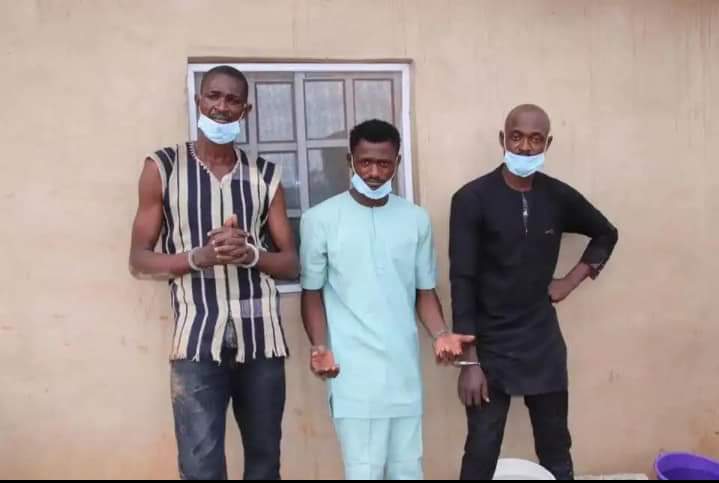
It took a little while but karma caught up with 38-year old Johnson Emmanuel who killed and buried a 55-year old woman in his backyard at Wumba Community in Apo area of the Federal Capital Territory, Abuja.
Police operatives attached to the Intelligence Response Unit of the Nigeria Police Force arrested him alongside his two younger brothers Gideon, 31 and Success, 27, for the kidnap and murder of one Mrs Janet Nnenna Ogbonnaya on Thursday May 14, 2020. She had lost her husband last year.
Johnson, though admitting to killing the woman, said they were not kidnappers.
The suspects, *all born of same parents and natives of Isiekenesi, Ideato local government area of Imo State* were arrested by the Police in their home town this week where they had taken refuge after the crime was committed in Abuja.
The police said they moved from Abuja to evade arrest.
The Police said they began investigation into the matter, when a son of the deceased, Chinedu, reported that their mother had been kidnapped and a five million naira ransome placed on her head by unknown persons.
According to Johnson, the woman had been a friend of his for two years and they had met through Facebook, a popular social media platform.
But another son of the deceased, Jonathan, who spoke with The Nation on Friday, said it was not true.
Johnson admitted that he laced the woman’s drink with drugs which killed her that Thursday night.
According to him, she had visited him that day is his house located around Second Transformer, Wumba in Apo area of of Abuja.
He said that she had told him that she wanted to leave, but he insisted that she stayed the night in his house.
He said because he did not want to struggle, he had gone to a nearby chemist shop and asked them to give him some sleeping drugs so he could put it in her drink so she could sleep off till the next morning in his house as he wanted.
According to him after she took the drink, she slept off and did not wake up again. Panicking, he called his younger brother Gideon, to help him deal with the situation, and they eventually ended up burying her in a septic tank in his backyard.
Johnson said the compound belonged to him and he had sold it off at a giveaway price, so he could get the matter behind him.
He said they decided to talk to the woman’s family about ransome, so they would think she had been kidnapped by unknown persons, and would not be traced back to him.
A Toyota Highlander Jeep, which belonged to the deceased, was also been recovered by Police operatives at a mechanic workshop in Apo where it had been repainted into a different colour, vehicle documents fraudulently changed and ownership of the stolen vehicle criminally transferred, Johnson Emmanuel.
Johnson narrated, “This thing happened on 14th of last month. I have known her for two years now. We have been dating. Anytime she comes to my house, she will always go back. So that day she came to my house and wanted to go back, and I did not want her to go. So I went and bought her sleeping medicine for her to sleep with me. I went to the pharmacy to buy the sleeping medicine. It was a powdery substance. I put it in a juice and she slept and did not wake up again. When she did not wake up, I then called my junior brother, Gideon, around 9.30 and 10. I told him I wanted to see him. He came and I told him and I told him that my friend died in my house. I explained everything to him. I suggested that I wanted to bury him in my backyard and he said no. He advised me to put her inside the car and dump her by the roadside.
“I did not agree. I was afraid people would see us and report us and it would be a murder case. That is how he helped me and we buried her in the soakaway in the compound.”
According to him, the last brother was not involved in what happened.
On why he called the woman’s family for ransome, he said, “I told my brother that I wanted to make it seem like she was kidnapped so nobody would suspect that it was me. That is why I called. I called and told them to pay ransome and after two days I broke my sim card and her own, so there would be no communication anymore.
“I knew that definitely they would trace the call, they may know I am the one that killed him. I called my brother and told him I was confused. I was afraid the police may trace her to my house and I sold the house for an auction price. My house is at Bakassi Market, Wumba, Apo. I thought by then nobody would suspect me but they would think it was kidnappers.
“When I put her SIM in her phone, one number called, but I don’t know the person. The person said his name was Mr Igwe and he was looking for the woman. I gave my brother the phone. My brother was afraid. I told him this is what we would do for us to get out of this mess. If we say it is kidnappers, they would not trace it to us. Since that day i did not call again and broke our sim cards.
“I met her on Facebook two years ago. I came to Abuja in 2018 and met her. Before then we were communicating on Facebook. And then we started the relationship. I drugged her because I wanted her to pass the night and go the next morning. I don’t know why I did that. I don’t know the name of the drug. I just asked for medicine to make someone sleep at the chemist. It was in a sachet. I am not a kidnapper. I only did that to take suspicion from me. I have never killed before. I am a welder by profession, but I also CCTV,” he claimed.
He said he regretted what he did and advised men not to be lacing women’s drinks with drugs as it was dangerous.
Johnson said he had a girlfriend, Charity, who he met in church and they started dating in January.
Gideon, who he claims he called, said he did report the matter to the police, because it was his brother involved.
He confessed that he suggested they take the body in the vehicle she brought and dump her somewhere.
“I am not happy that I had to cover his sin. I asked him why must it be me that you call? I told him to take the lady out maybe tomorrow morning, people would be able to identify her. He argued with me that very night. He said he wanted to put the lady in the soakaway at the backyard. When I came there he had opened the soakaway already and I ran out. Since that day I never went back to the house again, until when we went with the police to get the corpse on Thursday.
“I did not go to the police immediately and that is a mistake I did. I was doing it because he is my blood brother and I would not be the one to call the police for him. I told him not to involve me. It was not until I was arrested that I told the police what happened,” Gideon said.
The deceased’s son, Jonathan, said Johnson was not telling the truth.
“That is his own side of the story. From my own knowledge of people, anybody can say anything to sell their story. I don’t buy into that. Why would a woman want to throw away her marriage of 35 years. For who? A nobody? What does he have to offer? Is it not the same house we went to excavate the body from the back? So what exactly does he have to offer? Any this is a matter i should not be talking about especially with you guys. As a matter of fact, I know what you guys want is a good story to sell,” he said.
He said his mother never went out except on business, to church, town-meetings, and the market.
Jonathan, who said his father died and was buried in May last years, said there was no way his mother dated Johnson.
Narrating their traumatic experience when their mother went missing, he said, “I didn’t live with my mother. I live in Kubwa, but my family house is in Gwagwalada. So the last time we spoke was on Monday 10 May. I visited the family house that weekend and I left on Monday morning and I told her I was heading back to my base in Kubwa. That was the last time we spoke face to face, and when I got back to my base, I called to tell them I was home. Fast forward to Friday the 15th, at about 8.30 to 9 am my younger one called me that she left the house on Thursday and that was then last they heard from her. So I did the needful, i reported to the police. I filled the form for missing persons. I did that at Gwagwalada. I did my own personal search with my friends. We traced the road from Gwagwalada to town, trying to see, if we could figure out one or two things. Maybe there was an accident or something, but we could not pinpoint anything. That was Friday.
“Throughout this period her line was down. So Saturday morning, as a lot of people had been trying her number, because we informed as much friends of the family as we could just to find out if possible she could be reached. There was a storm that night so we thought maybe she had difficulty getting to Gwagwalada that night and decided to stay over somewhere. She is not someone who goes out frequently. She only goes out on business, church and townsmeeting. And of course the market. These are the things that take her out of the house. So that Saturday we kept trying and it connected. It was the voice of a man that answered. It was actually a deep voice at that time. We asked to speak to owner of the phone and the person informed us that he was a kidnapper and he was with my mum and they would be needing us to pay the sum of five million naira to facilitate her release.
“So it was surprising to mention the least. We tried rallying around to get the money. We spoke to them that Saturday and Sunday and they stopped calling. But as at Saturday when we realized what happened, we knew it was a kidnap case and we reported the case again and it was no longer the case of missing person, but a kidnap case. We did not hear from them again. So in our own little effort, we were still searching, until we heard the people that were behind the disappearance of my mother had been apprehended. The police called me on Tuesday. We were told to come around on Thursday.”
Investigations by the police began as soon as the complaint was laid Ogbonnaya, and a native of Ozuitem in Bende local government area of Abia State had been kidnapped and a 5five million naira ransom demanded before she could be released. A comprehensive and painstaking investigation by the police operatives resulted in the arrest of the three (3) suspects, whom, in the course of interrogation, revealed that the victim had long been murdered and buried.
According to the Police, further findings had revealed that the victim, a widow, had been a Facebook friend of the principal suspect – Johnson Emmanuel, and was lured from her home in Gwagwalada to visit the suspect. The suspect thereafter took advantage of the visit, served her yoghurt laced with drugs and subsequently had her murdered.
“The suspect having killed the victim and buried her remains in a septic tank, went ahead to reach out to the family of the victim using her phone and demanded 5-Million naira ransom as pre-condition for her release,” a statement by the Force Public Relatins Officer, DCP, Frank Mba, read on Thursday.
The Police said the suspects led a team of investigators, on Thursday, alongside pathologists to a residence at Wumba District, Lokogoma, Abuja where the victim’s decomposing body was exhumed from a septic tank.
The exhumed body had been taken to the University Teaching Hospital, Gwagwalada, Abuja for forensic examination.
The Police said investigations also revealed that the house where the deceased was killed and buried originally belonged to one of the suspects but was hurriedly sold-off to a third party apparently to obliterate evidence.
“The Inspector-General of Police, IGP M.A Adamu, NPM, mni, while commending the operatives for a job well done, reassures that perpetrators of any form of crimes in the country will not go undetected and unpunished. He however enjoins citizens to be more security conscious and report any suspicious activities within their neighbourhood to the nearest police station,” the statement read.










 News5 days ago