Connect with us

Opinion

Opinion: Nigeria: Leadership Vacuum at a Time of Emergency

Published

on

By Raymond Nkannebe

In a scathing editorial on the Guardian Newspaper of Monday, 23rd March 2020, the respected medium called out President Muhammadu Buahri’s “worrisome disposition” in the face of the deadly global pandemic which continues to leave its trail across nations and continents. If that very thoughtful and timely editorial was meant to jolt Mr. President from his slumber as I had thought, the contrary proves the case today. If anything, things have deteriorated between then and now, as a certain opacity appears to cloud the activities of Aso Rock while not a single Nigerian (especially for those of us far from the corridors of power), can vouch for the presence of the president in the country as at the time of this writing.

If the recent developments have taught us anything, it is that president Muhammadu Buhai was never suited to superintend over the affairs of a complex country like ours–not in 2015 and certainly not now. And the facts bear one out.

The chief reason why many Nigerians in 2015 voted for Muhammadu Buhai as against the then incumbent Good luck Jonathan was that he cut the impression of a “no-nonsence” character and according to them, that character trait (which by the way has been shown to be overrated), sufficed as the missing leak in the Nigerian leadership quagmire. Other qualities such as a vaunted ascetic lifestyle, repugnance for graft, warts and all, were also thrown into the mix to delude a beleaguered citizenry. It worked. But with huge costs against Nigeria and Nigerians today. While some of us warned, and cried hoarse that there was nothing of the man that suggested he has the intellectual stamina for 21st century leadership, many had dismissed us as ethnic irridentists and good-for-nothing-bigots. Today, the proverbial chickens have come home to roost.
Writing on Leadership in his pampheleteer, The Trouble With Nigeria(1983) Chinua Achebe deconstructed “no-nonsenseness” as a leadership quality thus:

“…A leader’s no-nonsence reputation might induce a favourable climate but in order to effect a lasting change it must be followed up with a radical programme of social and economic re-organization or at least a well conceived and consistent agenda of reform which Nigeria stood, and stands in dire need of”. He couldn’t have been more right.

President Muhammadu Buahri’s over-banked “no-nonsenseness” on the peg of which millions of Nigerians filed out to vote for him in 2015, has proven to be a ruse. The archetypal wool over the eyes. Not even the controversial re-election last year has helped matters. And understandably so; as we do not learn to be left-handed in the evening of our lives.

Times without number, Muhammadu Buhari has failed to rise up to the demands of leadership especially at critical junctures of our history under his watch, such as now. Whereas all over the world, presidents and heads of states have continued to be visible on TV, feeling the pulse of the Nation and assuring the people of government’s commitment in practical terms towards containing the spread of the deadly #Covid-19 virus, inclusive of guarantees of social palliatives ranging from necessaries and medicals as seen with Prime Minister Nerandra Mordi in India, Donald Trump in the United States, Justin Trudeau in Canada and elsewhere, Nigerians continue to contend with an absentee-president; a presidency in hiatus so much so that media hawks have began to spread rumours of his state of critical ‘unwellness’.

Some 48 hours or more, after it was widely reported that the Chief of Staff to the president, Abba Kyari had contracted the virus, there is yet no official presser from the presidency corroborating the reportage. To the contrary, we’re told by the image makers of the president that Aso Rock would be going on “partial lockdown”; an approach that has not been adopted by any state battling the pandemic. At least not to my knowledge. At a time when every information pertaining to the person of the president and his overall management of the situation was key, the government under Buhari’s watch has unwittingly outsourced that auspicious role to closet propagandists and wannabe bloggers, hence the flying rumours all over the place.

If the official cases Nigeria grapple with at this time appear to be rather marginal, the latest available report by Nigeria’s Centre for Disease Control confirms that this is as a result of our very limited testing capacity. For instance, as of 22nd March, only 152 persons had been tested. A far cry from South Africa’s over 15, 500 tests despite recording its index case a week later than Nigeria. And you would think the President would have addressed the Nation on the remote and immediate factors responsible for this deficit for a virus that is said to have a prolonged incubation period before its victim(s) exhibit the symptoms. But like criminals, mum is the word. There is also the matter of little or no ventilators throughout the country to manage the situation, especially at its most debilitating stages. Some have put the numbers of ventilators in the country to be in the region of 500 or less. Yet as of today, there is no coherence response from the government on steps being taken to checkmate the situation in the event we end up with an exponential spread. Instead Nigerians are being urged to pray that God take this ‘cup of suffering’ from us.

While it may be suggested that the Federal Ministry of Health in collaboration with the #NCDC have been doing a great job of the situation thus far, that does not compensate for the cloud of conspiratorial silence that has overtaken the seat of power. Or should we fear the worst already as many persons have began to surmise?

Away from that, those who have argued that the president need not be visibly involved in the management of this situation, miss two things. They fail to appreciate that Nigerians as a collective, voted for the president and not a Minister of Health or a Chike Ihekweazu of some sorts and that under section 14(2) of the Constitution of the Federal Republic of Nigeria, the security and welfare of the citizens remain the primary responsibility of the president so long as the Social Contract around which a democratic system is built, remain. Secondly, shorn of being the Commander-in-Chief with the rare honurs of laying wreaths at very auspicious state function, he is also the Comforter-in-Chief. Unfortunately, the events of today prove that Muhammadu Buhari has performed woefully on both counts. What a tragedy!

I see many Nigerians jubilating over the misfortune of members of our political class who so far have fallen victim to the deadly virus on the ostensible reason that our dilipaidated state of health infrastructure and overall state of misgovernance is wrought by their years of incompetence and mindbogglling corruption. While I do not share the view that victims of illehealth be mocked especially at a time of national health emergency, you may not blame the average Nigerian who have been at the receiving end of years of governmental neglect and are today condemned to living in abject poeverty.

When the citizenry of a state lose their innate human nature of empathy and compassion that defines our collective humanity, then the leadership of that nation must embark on a serious introspection as such an atmosphere, sets the stage for the toppling of governments as we saw with the French, in the Revolution, and even recently, the Arab Spring that reverberated across the Arab nation.

Unarguably, at no time in the history of Nigeria has her political and ruling class come under the weight of their own irresponsibility as now. Whereas the Nigerian politician had somehow found it a norm to fly out of the country to treat a headache, or nurse a simple stomach upset in well equipped hospitals built by other responsible governments and manned by qualified and motivated medical staff, he does not have the luxury this time. And that is why we learn that the Chief of Staff to the president is currently receiving treatment at the dilapidated Gwagwalada health facility with other infected Nigerians, or has he been flown to Lagos or even out of Nigeria as rumoured?

Whatever the case, the events of now must serve to teach the Nigerian politician a bitter lesson that sheer incompetence can come back to hurt someday in a way there would be no where to run to, such as now. If that lesson somehow is not imbibed now, then Nigeria may never remain the same again.

For we the citizenry, this is not a time for gloating and celebrating the misfortune of our leaders. I watched a comedy skit few hours ago suggesting that Nigerians burst into an orgy of laughter and celebration when it was confirmed that president Muhammadu Buhari contracted the virus according to the fictive script. While this may be a joke, as Nigerians are won’t to make out of anything, it is one that I thought was taken too far.
Instead, the president’s management of the COVID-19 pandemic so far, and his well documented history of incompetence such that many people have argued he knows not what is happening around him, should teach us how better to exercise that very solemn duty of our citizenship, at periodic elections as at the end of the day we rise and fall with our choice of leadership. Just as a commentator rightly pointed out, the COVID-19 pandemic has shown the world what it means to enthrone good leadership. And I couldn’t agree less.

All said and done, it is my prayer that our world at large, and Nigeria in particular would survive this very sad episode of human terror and rise back to its towering height. What is more, thehe history of the world is one of collective human action through moments of adversity, and this will not be an exception.

Raymond Nkannebe,. Legal practitioner and public interest commentator writes from Lagos. Comments and reactions to raymondnkannebe@gmail.com. He tweets @RayNkah

Continue Reading
Click to comment

Leave a Reply

Your email address will not be published. Required fields are marked *

Opinion

Nation Building Reimagined: Integrated Principles and Strategies for Sustainable Growth

Published

on

By

By Tolulope A. Adegoke, PhD

“True nation building is not the work of the state alone, but a harmonious convergence where empowered peoples provide the foundation, innovative corporates generate the momentum, and visionary institutions ensure direction — together forging sustainable prosperity, social cohesion, and enduring national strength for current and future generations” – Tolulope A. Adegoke, PhD

Nation building is a deliberate and continuous process of constructing cohesive, resilient, and prosperous societies capable of realising their full potential. It extends far beyond political structures or state institutions to encompass three interdependent spheres: peoples (individuals and communities), corporates (businesses and private-sector organisations), and nations (governance institutions and the state). When these spheres are strategically aligned through sound principles and practical strategies, they generate all-round exploits — inclusive economic growth, social cohesion, innovation, human flourishing, and global competitiveness.

This comprehensive framework offers actionable guidance for sustaining productive and progressive development. It is grounded in universal principles validated by international development experience, economic history, and governance studies, making it relevant for scholars, policymakers, business leaders, and development practitioners worldwide.

Foundational Principles of Effective Nation Building

Successful nation building rests on six core principles that transcend cultural, geographical, and ideological differences:

Inclusive Human Dignity and Agency — Recognising every citizen as both beneficiary and active architect of national progress through equal opportunity and rights protection.
Institutional Integrity and Rule of Law — Building transparent, accountable institutions that foster trust and predictability.
Economic Dynamism and Shared Prosperity — Promoting broad-based growth that benefits individuals, businesses, and the state simultaneously.
Social Cohesion and Cultural Resilience — Forging unity while respecting diversity to create a shared national identity and purpose.
Adaptive Leadership and Long-Term Vision — Combining strategic foresight with the flexibility to learn and adjust.
Sustainable Resource Stewardship — Balancing present needs with intergenerational equity in environmental and fiscal matters.
These principles provide a universal compass for development, as evidenced by cross-national data from the World Bank’s Worldwide Governance Indicators and the UNDP Human Development Reports.


Core Strategies Across the Three Spheres

For Peoples (Individuals and Communities): Nation building begins with empowering citizens. Key strategies include universal access to quality education and skills development, robust health and social protection systems, community-driven development programmes, and targeted initiatives for youth and women empowerment. These efforts enhance social mobility, reduce vulnerability, and foster active civic participation.

For Corporates (Businesses and Private Sector): Corporates serve as the primary engine of wealth creation and innovation. Effective strategies involve creating an enabling business environment, promoting public-private partnerships, enforcing strong corporate governance and ethical standards, and implementing talent development and local content policies. When supported appropriately, the private sector generates jobs, technological advancement, and tax revenues that fuel broader development.

For Nations (State Institutions and Governance): The state provides the overarching framework for progress. Strategies include institutional reform and capacity building, decentralisation for better responsiveness, evidence-based policy making, and strategic regional and global integration. Strong institutions ensure equitable rules, policy continuity, and effective service delivery.

Sustaining Progressive Growth in Nigeria

In Nigeria, this integrated framework offers a practical pathway to convert demographic and natural endowments into sustained prosperity. At the peoples’ level, investments in education, health, and skills development can transform the large youth population into a productive demographic dividend. For corporates, policy predictability, infrastructure development, and public-private partnerships can drive diversification beyond oil into agriculture, manufacturing, and digital services. At the national level, institutional reforms, anti-corruption measures, and evidence-based governance would reduce policy inconsistency and enhance public trust.

When these elements reinforce one another, Nigeria can achieve higher productivity, reduced poverty, greater social cohesion, and improved global competitiveness — creating a virtuous cycle of inclusive growth.

Advancing Development in West Africa

Within the ECOWAS region, the framework supports deeper integration and collective resilience. Strategies for social cohesion help address cross-border challenges such as irregular migration, climate impacts, and youth unemployment. Corporate-focused approaches encourage intra-regional trade and industrialisation through harmonised policies and stronger value chains. Institutional strategies promote policy coordination, joint humanitarian response, and shared security mechanisms.

By applying this model, West African countries can move from fragmented national efforts toward coordinated regional progress, enhancing food security, energy access, and economic competitiveness while building resilience against external shocks.

Driving Continental Transformation in Africa

Across Africa, the principles and strategies align closely with the African Union’s Agenda 2063 and the African Continental Free Trade Area (AfCFTA). Sustainable resource stewardship helps convert natural wealth into long-term human and infrastructure investments. The corporate strategies support regional value chains and industrialisation, while institutional reforms strengthen governance and reduce trade barriers.

When implemented continent-wide, this approach fosters inclusive industrialisation, technological advancement, and reduced external dependency — positioning Africa as a major driver of global growth in the 21st century.

Global Relevance and Contribution

On the global stage, the framework provides timely lessons for both developed and developing nations navigating technological disruption, climate change, and rising inequality. The emphasis on shared prosperity and social cohesion offers pathways to mitigate polarisation. The integration of corporates as development partners demonstrates how private-sector innovation can serve public goals. Institutional strategies of adaptive leadership and evidence-based policy making are universally applicable in managing complex transnational challenges.

Nations adopting this model contribute to global stability by reducing conflict drivers, enhancing food and energy security, and participating constructively in multilateral systems. In this way, the framework supports the United Nations Sustainable Development Goals and helps build a more equitable and resilient world order.

Conclusion: A Practical Pathway to Enduring Progress

The principles and strategies of nation building presented here constitute a balanced, interconnected discipline capable of sustaining productive and progressive growth across multiple scales. For Nigeria, they chart a course from potential to performance. For West Africa, they strengthen regional solidarity. For Africa, they accelerate continental transformation. And for the global community, they offer practical wisdom for building fairer, more stable societies.

True nation building succeeds when peoples, corporates, and state institutions reinforce one another in a virtuous cycle. Its greatest strength lies in this holistic integration — recognising that sustainable development requires empowered citizens, innovative enterprises, and effective governance working in harmony.

In an increasingly interdependent world, embracing these principles with consistency, courage, and collective ownership is not merely beneficial but essential. Nations and regions that do so will unlock enduring prosperity, resilience, and a respected place in the global community. The framework provides both the vision and the practical tools needed to turn potential into lasting achievement for current and future generations.

Dr. Tolulope A. Adegoke, AMBP-UN is a globally recognized scholar-practitioner and thought leader at the nexus of security, governance, and strategic leadership. His mission is dedicated to advancing ethical governance, strategic human capital development, and resilient nation-building, and global peace. He can be reached via: tolulopeadegoke01@gmail.com, globalstageimpacts@gmail.com

Continue Reading

Opinion

Dear CDS, NSA, Your Prodigal Sons, Brothers Have Killed General Braimah

Published

on

By

By Eric Elezuo

Almost five months since the yet to be explained killing of Brigadier General Musa Uba, another high ranking military officer, another Brigadier General, has been unlived. He was Brigadier General Oseni Omo Braimah, Commander of 29 Task Force Brigade Operation Hadin Kai, Maiduguri Borno State.

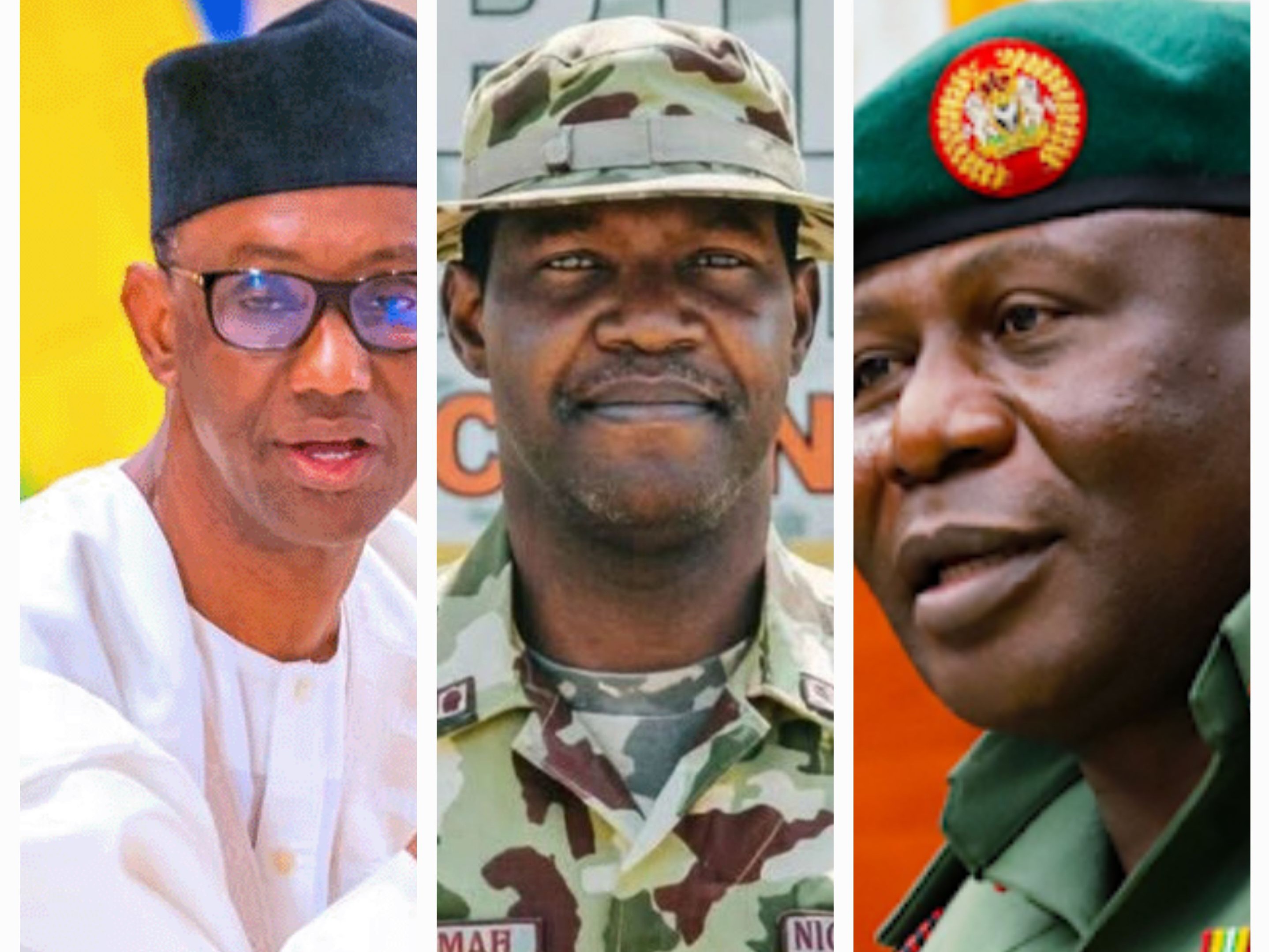
The sadness that followed the brutal killing of the Brigade Commander, can almost be touched, dear Nigerians, with special reference to the National Security Adviser, Mallam Nuhu Ribadu, and his counterpart, the Chief of Defense Staff, General Olufemi Oluyede. These men, have at separate fora concassed for the kid gloves handling of terrorism activities, and terrorists.

Ribadu, it was, that asked that they be rehabilitated as they are ‘our brothers. Oluyede echoed the stand, saying the terrorists was equated to the biblical prodigal son, and therefore should be received with open hands. This he said to justify his latest ‘Operation Safe Corridor’, designed to welcome ‘repentant’ terrorists and bandits, and have them reintegrated into the society.

It is still these touted same brothers, and prodigal sons that overran a military base in Benisheikh, reportedly killing 18 soldiers including the Brigadier General. According to the Army, however, the number of deaths was overhyped, claiming that only two officers and two other soldiers were killed in the battle they said the military had the upper hand, and auccessfully repelled the assailants and maintained their positions.

Much as the military agreed that they lost four soldiers, they have failed to produce casualties, or even speak on the number, from the terrorists side, in a battle they said they had the upper hand. It’s still had to believe, only that the prodigal sons and brothers snuffed the life of a general, and according to reports, he was caught like a sitting duck.

The prodigal sons with the ‘brothers’ did not stop there; they proceeded to kill Forest Guard Commander and five others in Kwara, just as they mercilessly hacked to death eight members of the same family in Bokkos, Plateau. The list is endless. Of prodigal sons and brothers. Thanks to the NSA and the CDS.

Someone once said that that the only mercy a terrorist or bandit deserve is the mercy of God. And it is the duties of the authority to send them to God for such mercy.

Why do we keep handling merciless killers with kid gloves, and turn around to call them sons and brothers. They in turn, are only looking for opportunity to strike again.

These people have gone from being brothers to becoming animals, very dangerous and ugly beasts that have lost the capacity to show, and so should not be shown any mercy caught.

Dear NSA and CDS, you muat understand that these people have been extremely radicalised, and can no longer fit into the society of sane beings, and therefore, should be put away permanently. We can’t continue to safe corridor to experiment with the lives of Nigerians. No bandit or terrorist is worth rehabilitating, talk less of being integrated into the military. Whoever does that is complicit, and should be treated as an enemy of the Nigerian state.

The NSA and the CDS should begin now to revisit everyone they have ever pardoned or reintegrated into the society for they are part of our problem. They are culpable.

General Uba died saraa, as we say in our local parlance. We should let Braimah die saraa. We must not allow this irresponsibility happen again. I’m not borrowing any words from the president because all his words appear empty, while Nigerians continue in droves, even when the country is not really at war.

Time to jettison this brother, cousin, prodigal son rubbish, and deal decisively with terrorists and bandits.

Continue Reading

Opinion

Ovation @30: A Triumph of Vision, Courage and African Excellence

Published

on

By

By Dr. Sani Sa’idu Baba

There is an African proverb that says, “However long the night, the dawn will surely break.” No story embody this truth more powerfully than that of Chief Dele Momodu and the remarkable rise of Ovation International. Founded in April, 1996 at the height of the Sani Abacha regime, Ovation was born not out of comfort, but from adversity. In forced exile in London, faced with uncertainty and hardship, Momodu chose not to surrender to circumstance but to challenge it, daring to create a global lifestyle magazine at a time when Africa’s image was largely defined by negativity.

From that improbable beginning emerged a publication that would go on to redefine how Africa is seen by the world. Ovation introduced a different narrative, one of elegance, achievement, culture, and pride, documenting African success stories with unmatched consistency. At a time when global media often overlooked the continent’s brilliance, Ovation boldly projected it, celebrating milestones, personalities, and cultures across Africa and its diaspora. It became a powerful cultural bridge, connecting cities and continents while showcasing an Africa that is vibrant, accomplished, and globally relevant.

Over the past three decades, Ovation has not merely reported stories, it has shaped destinies and elevated generations. It has provided a platform for emerging talents in entertainment, business, and public life, often spotlighting individuals long before they attained global recognition. Its influence extended beyond storytelling into economic and social impact, creating employment for thousands across journalism, photography, real estate, design, and event production, while also setting new standards in lifestyle media, enterprenership and event documentation. Long before the rise of digital platforms, Ovation was already global, distributing African excellence to audiences around the world and strengthening the connection between Africa and its diaspora.

Through changing times and technological revolutions, Ovation International has remained consistent in quality, bold in vision, and authentic in purpose. Its ability to evolve without losing its identity is a testament to its strength as not just a magazine, but an enduring institution. Today, as it marks 30 years of impact, it stands as one of Africa’s most influential media platforms, one that has significantly contributed to reshaping global perception and asserting Africa’s place in the world.

This milestone is a celebration of resilience, vision, and legacy. It is a tribute to the pride of Africa Chief Dele Momodu, whose courage transformed hardship into history, and whose dream once considered unrealistic became a continental force. It is also a celebration of the entire Ovation family, whose dedication over the years has sustained and expanded this vision. Thirty years on, Ovation is not just a witness to Africa’s story, it is one of its most powerful storytellers.

A big thank you to Chief Dele Momodu for proving long ago that Africa is not synonymous with bad news, and congratulations on three decades of excellence proof that when the dawn finally comes, it can illuminate the world.

Dr. Sani Sa’idu Baba writes from Kano, and can be reached via drssbaba@yahoo.com

Continue Reading

Trending