Connect with us

Economy

Withdraw your divisive comments and apologise, Federal Govt tells Obasanjo

Published

on

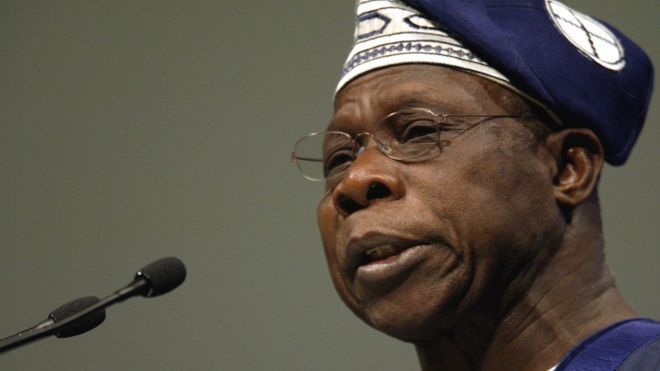
The federal government has asked former President Olusegun Obasanjo to withdraw his recent divisive comments, imputing ethno-religious motive to Boko Haram, ISWAP, and as well apologise to Nigerians.

In a statement issued in Abuja on Tuesday, the Minister of Information and Culture, Alhaji Lai Mohammed, said, such “indiscreet, deeply offensive and patently divisive comments are far below the status of an elder statesman”.

”It is particularly tragic that a man who fought to keep Nigeria one is the same one seeking to exploit the country’s fault lines to divide it in the twilight of his life”.

The minister said Boko Haram and ISWAP are terrorist organisations pure and simple, adding that they care little about ethnicity or religion when perpetrating their senseless killings and destruction.

”Since the Boko Haram crisis, which has been simmering under the watch of Obasanjo, boiled over in 2009, the terrorist organisation has killed more Muslims than adherents of any other religion.

“The terrorist group blown up more mosques than any other houses of worship and is not known to have spared any victim on the basis of their ethnicity.

“It is therefore absurd to say that Boko Haram and its ISWAP variant have as their goal the ‘Fulanisation and Islamisation’ of Nigeria, West Africa or Africa,” he said.

The minister said President Muhammadu Buhari put to rest the mis-characterization of Boko Haram as an Islamic organisation when he said, in his inaugural speech in 2015, that ”Boko Haram is a mindless, godless group who are as far away from Islam as one can think of”.

He reiterated that Obasanjo’s comments were, therefore, “as insensitive and mischievous as they are as offensive and divisive in a multi-ethnic and multi-religious country like Nigeria”

“It is wondering whether there is no limit to how far the former President will go in throwing poisonous darts at his perceived political enemies.

The minister noted that Obasanjo’s prescriptions for ending the Boko Haram/ISWAP crisis, which include seeking assistance outside the shores of Nigeria, are coming several years late.

He said President Buhari had done that and more since assuming office, “hence, the phenomenal success he has recorded in tackling the terrorists”.

”Shortly after assuming office in 2015, President Buhari’s first trips outside the country were to rally the support of Nigeria’s neighbours – Benin, Cameroon, Chad and Niger – for the efforts to battle the terrorists.

“The President also rallied the support of the international community, starting with the G7, and then the US, France and the UN.

”That explains the massive degrading of Boko Haram, which has since lost its capacity to carry out the kind of spectacular attacks for which it became infamous, and the recovery of every inch of captured Nigerian territory from the terrorists,” he said.

He also noted that Obasanjo’s call for wide consultations with various groups as part of the efforts to tackle the Boko Haram crisis has been neutralised by his ill-advised comments which have served more to alienate a large number of Nigerians, who are offended by his tactless and distasteful postulation.

The Minister called on the former President, whom he said took bullets for Nigeria’s unity, not to allow personal animosity to override his love for a united Nigeria.


Continue Reading
Click to comment

Leave a Reply

Your email address will not be published. Required fields are marked *

Economy

New Tax Laws: Presidential Committee Tackles KPMG over Criticisms of ‘Gaps’, ‘Errors’ and ‘Omissions’

Published

on

By

The Chairman of the Presidential Committee on Fiscal Policy and Tax Reforms, Taiwo Oyedele, has pushed back strongly against observations by KPMG on Nigeria’s new tax laws, saying the firm largely misunderstood the policy intent and misrepresented deliberate reform choices.

In a detailed statement shared on Saturday on X, Oyedele said the committee welcomed constructive feedback but argued that most of KPMG’s claims were flawed. “We welcome all perspectives that contribute to a shared understanding and successful implementation of the new tax laws,” he said. However, he added that “the majority of the publication reflected a misunderstanding of the policy intent, a mischaracterisation of deliberate policy choices, and, in several instances, repetitions and presentation of opinion and preferences as facts.”

According to Oyedele, several issues described by KPMG as errors or gaps were either based on “the firm’s own errors and invalid conclusions” or stemmed from “issues not properly understood by the firm.” He stressed that policy disagreements should not be framed as technical mistakes.

Addressing concerns about the taxation of shares and potential stock market sell offs, Oyedele said such fears were unfounded. “The fact is that the applicable tax rate on share gains is not a flat 30%,” he said, noting that “a significant majority of investors (99%) are entitled to unconditional exemption.” He added that market performance at an all time high showed investors understood the reforms.

On the commencement date of the new laws, Oyedele dismissed KPMG’s suggestion of aligning reforms strictly with accounting periods, describing it as “a narrow view of the complex transition issues” involved in wholesale tax reform.

He also defended provisions on indirect transfer of shares, saying they were aligned with global best practices. “The assertion that it may affect the country’s economic stability is disingenuous,” he said, explaining that the measure was designed to block long exploited tax loopholes.

Responding to claims of gaps in VAT exemptions, Oyedele said a specific exemption for insurance premiums was unnecessary. “If it is not broken, don’t fix it,” he stated, arguing that insurance premiums were not taxable supplies under existing law.

Oyedele further criticised proposals he said would undermine reform objectives, including calls to exempt foreign insurance companies from tax and allow deductions tied to parallel market foreign exchange. He said disallowing such deductions was “a critical fiscal policy choice designed to complement monetary policy, strengthen, and stabilise the Naira.”

On personal income tax, Oyedele rejected claims that higher rates would harm growth. He said the top marginal rate was competitive globally and ensured fairness without discouraging investment.

He also accused KPMG of factual errors, including references to the Police Trust Fund, noting that its taxing provisions expired in June 2025. “KPMG’s point that the new tax law should be amended to repeal the taxing section of the Police Trust Fund Act is needless,” he said.

While acknowledging clerical issues may arise in any major reform, Oyedele said these were already being addressed internally. He urged stakeholders to engage constructively. “We urge all stakeholders to pivot from a static critique to a dynamic engagement model,” he said, stressing that the reforms marked “a bold step toward a self sustaining and competitive Nigeria.”

Continue Reading

Economy

NANS Makes U-turn, Cancels Planned Nationwide Protest over Implementation of New Tax Laws

Published

on

By

The National Association of Nigerian Students (NANS) has expressed support for the recently enacted Tax Reform Laws, describing it as a well-intentioned fiscal policy aimed at strengthening Nigeria’s economy and protecting low-income earners.

Reports said the endorsement followed extensive deliberations at the maiden Expanded National Executive Council (ENEC) meeting of NANS under the theme; “National Executive Council and Structural Stakeholders’ Forum 2026 on the Tax Reform Act”, which brought together student leaders, policy experts, and key stakeholders from across the country.

The meeting, held amid public debate and controversy over the new tax law, was attended by members of the NANS National Executive Council, leaders of NAUS, NAPS, and NANCES, zonal coordinators, joint campus council chairpersons, female student associations, and other stakeholders.

Earlier concerns had prompted NANS to issue a 14-day ultimatum, threatening nationwide protests if implementation of the law was not suspended pending further investigations and public enlightenment.

However, following engagements with the National Assembly, the Department of State Services (DSS), and the Federal Inland Revenue Service (FIRS), as well as the publication of the National Assembly’s investigation report, student leaders reported being better briefed on the objectives and safeguards embedded in the law.

Chairman of the Communiqué Drafting Committee and NANS President, Comr. Olushola Oladoja, said students were satisfied with the explanations provided by the government. Tax experts from FIRS used the forum to clarify grey areas and respond to concerns raised by Nigerians, giving student leaders a clearer understanding of the reform’s intent and framework.

At the end of the meeting, ENEC resolved that the Tax Reform Law is designed to improve revenue generation, ensure fairness in taxation, and strengthen social protection for vulnerable citizens, while requiring higher-income earners to contribute more equitably. The council affirmed the authenticity of the law as released by the National Assembly and announced the cancellation of the nationwide protest that had been scheduled for January 14, 2025.

NANS also pledged to serve as ambassadors of public enlightenment, committing to educate Nigerians on the purpose and benefits of the reform to boost public confidence during its implementation.

The meeting further passed a vote of confidence in the former FIRS Chairman, Zacch Adedeji and commended President Bola Tinubu for his fiscal reforms and the NELFUND initiative, reaffirming support for his administration’s economic transformation agenda.

Continue Reading

Economy

CBN Increases ATM Daily Cash Withdrawal Limit to N100k

Published

on

By

The Central Bank of Nigeria (CBN) has increased cash withdrawal limits on all channels to N500,000 weekly for individuals and N5 million for corporates.

Announcing the policy revision in a circular on Tuesday, the regulator pegged automated teller machine (ATM) withdrawals at N100,000 daily, with a weekly cumulative withdrawal of N500,000.

The development is a major shift from tighter cash policy measures introduced under the previous administration.

In December 2022, the central bank, under Godwin Emefiele, its former governor, had directed deposit money banks and other financial institutions to limit over-the-counter cash withdrawals by individuals and corporate entities per week N100,000 and N500, 000, respectively.
The CBN’s latest policy reversal, also removed the cumulative deposit limit, saying the fee on excess deposit “shall no longer apply”.

According to the regulator, the policies form part of efforts to moderate the rising cost of cash management, address security concerns, and “reduce the potential for money laundering associated with the economy’s heavy reliance on cash”.

The bank said the policies, issued over the years in response to evolving circumstances in cash management, sought to reduce cash usage and encourage accelerated adoption of other payment options, particularly electronic payment channels.

However, with the “effluxion of time”, the apex bank said the need has arisen to streamline the policies’ provisions to reflect present-day realities.

“Consequently, effective January 1, 2026, the following cash-related policies, which are for mandatory compliance by all deposit-taking financial institutions in Nigeria, shall apply nationwide,” the circular reads.

“The cumulative deposit limit is hereby removed and the fee for excess deposit shall no longer apply.

“The cumulative weekly withdrawal limit across all channels shall be N500,000 for individuals and N5 million for corporates. Cumulative weekly withdrawals above these limits shall attract excess withdrawal fees as indicated in ‘5’ below.

“The special authorisation for withdrawal of N5 million and N10 million once monthly by individuals and corporates, respectively, shall no longer apply.

“Automated Teller Machine (ATM) withdrawal limit shall be N100,000 daily (per customer), subject to a maximum of N500,000 weekly. As indicated in ‘2’ above, cash withdrawals from ATMs and point of sale devices are part of the weekly withdrawal limit indicated therein.

“Excess cash withdrawals (withdrawals above the levels indicated in ‘2’ above) shall attract fees of 3 percent and 5 percent to individual and corporate customers, respectively, on the excess amount withdrawn. The fee shall be shared 40 percent to the CBN and 60 percent to the bank or financial institution.”

According to the circular, signed by Rita Sike, CBN’s director of financial policy and regulation department, said all currency denominations “may be loaded in ATMs”.

However, the CBN retained the limit on over-the-counter encashment of third-party cheques at N100,000.

“Account holders are advised that any withdrawal under this section will form part of the cumulative weekly set in ‘2’ above”.

“Banks shall render the following monthly returns (in a format to be advised) to the respective supervisory departments (Banking Supervision Department, Other Financial Institutions Supervision Department and Payments System Supervision Department) as applicable:

“a . Returns on cash withdrawal transactions above the specified limit;

“b. Returns on Cash Deposits

“Deposit Money Banks (DMBs) shall create separate accounts to warehouse processing charges collected on cash withdrawals above the limits.

“The following accounts/entities are exempted from the application of sections 2 and 5 of this circular:

“i. Revenue generating accounts of federal, state, and local governments; and

ii. Accounts of microfinance banks and primary mortgage banks with commercial and non-interest banks.

The CBN also said the exemption of embassies, diplomatic missions and aid-donor agencies from specific cash policies “shall no longer apply”.

Continue Reading

Trending