Connect with us

World

The Race for Space: Billionaires Jeff Bezos, Richard Branson Take First Shot

Published

on

By Eric Elezuo

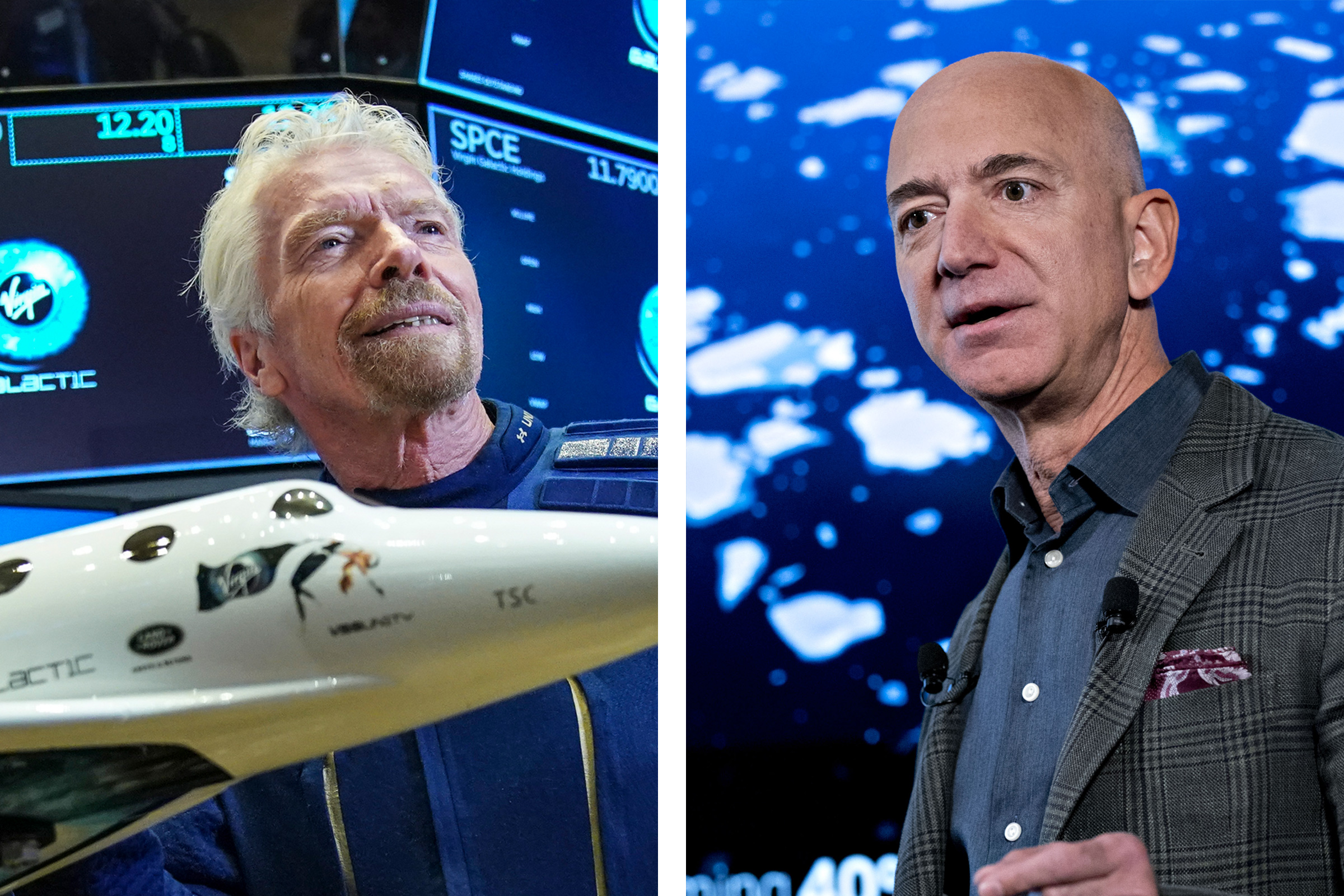
Billionaires Jeff Bezos and Richard Branson has set a new tone to how billionaires should spend. In fact, the two money men seem to be saying that they have conquered entertainment on the planet earth, and need to explore the outer space.

Consequently, and separately, the duo took a tour to the space, flying in million dollars spaceship. It was an experience that has opened to doors to holidaying in outer space, or creating a new world somewhere above the earth.

CBSNEWS.com captured the experience in the following piece. Read:

Two competing billionaires have launched successful trips to space in the race for commercial space travel. On Tuesday, Amazon and Blue Origin founder Jeff Bezos blasted off into space on the New Shepard spacecraft. Last week, Virgin Galactic’s Richard Branson rocketed into space on his own aircraft. Here are the differences between the two flights.

Bezos and three crewmates lifted off from the Blue Origin’s West Texas launch site and rocketed to an altitude of more than 62 miles above the Earth.

Branson, two pilots and three other crew members flew on the VSS Unity spaceplane. They lifted away from the company’s Spaceport America launch site July 11 near Truth or Consequences, New Mexico.

While the liftoff locations and methods are different, their goals for commercial space flights are similar, CBS News senior space analyst Bill Harwood reports.

“The bottom line is they’re selling the same thing. They’re selling about three minutes of weightlessness and flights out of the atmosphere,” Harwood told CBSN anchor Anne-Marie Green ahead of Bezos’ flight Tuesday. “How they get there, however, is different.”

Blue Origin chose a capsule mounted on top of a rocket. “I’m reminded of Alan Shepard and his first Mercury flight that was a rocket booster and a capsule,” Harwood said, referring to NASA astronaut Alan Shepard, the first person from the U.S. to travel to space, in 1961.

“This is the same philosophy, and just like that original Mercury flight, they have an abort system, so they can get away from the rocket if there is a malfunction,” Harwood said.

Blue Origin’s New Shepard booster, which carried the capsule holding Bezos and his crewmates, was named after Shepard.

The spacecraft traveled three times the speed of sound, and once it reached an altitude of about 45 miles, the booster’s company-designed BE-3 main engine shut down and the capsule was released to fly on its own, Harwood said.

Bezos and his crewmates were then able to enjoy three minutes of weightlessness, as the capsule reached a high point just above 62 miles.

That’s the internationally recognized “boundary” between the aerodynamically discernible atmosphere and space, a distinction recognized by the Fédération Aéronautique Internationale, a Switzerland-based organization that sanctions aerospace records.

The Virgin Galactic spaceplane flew slightly lower, but well above the 50-mile altitude recognized as the boundary of space by NASA and the Federal Aviation Administration, Harwood said.

Virgin Galactic’s spaceplane design is air launched, meaning another aircraft carries it about 45,000 feet and then releases it. A rocket engine then ignites and carries the plane to space.

For Virgin Galactic’s model, the rocket is an integral part of the spaceplane. “They can shut it down and then glide to a landing if there’s a problem, but you don’t get away from it in that sense. You can get away from your rocket with Blue Origin,” Harwood said.

Branson and his crew also enjoyed weightlessness and live-streamed their trip as they floated free from their seats. Only the audio from inside the Blue Origin capsule was streamed, and Bezos and his crew could be heard shouting “woo-hoo.”

Eight minutes after liftoff, three parachutes deployed on the Blue Origin crew capsule to slow it down for landing as it descended back to Earth. The flight lasted about 10 minutes.

Pilots guided the Virgin Galactic spaceplane through a spiraling descent, and landed on Spaceport America’s 12,000-foot-long runway. The flight lasted 59 minutes from takeoff to touchdown.

Both launches are complete — but the space race is not over. Blue Origin plans to launch two more passenger flights before the end of the year, but ticket prices have not been revealed.

Flights aboard Virgin Galactic’s spaceplane are believed to cost around $250,000. Both companies hope the market will support economies of scale and lower prices down the road.

Continue Reading
Click to comment

Leave a Reply

Your email address will not be published. Required fields are marked *

Middle East

Saudi Arabia Shuts Down One of World’s Largest Oil Refinery after Iran’s Drone Strike

Published

on

By

Saudi Aramco has halted operations at its Ras Tanura refinery in Saudi Arabia after a reported drone strike in the area, according to Reuters.

Ras Tanura, one of the largest oil refining and export facilities in the world, has a refining capacity of roughly 550,000 barrels per day and serves as the kingdom’s largest oil export terminal.

The facility handles approximately 6.5 million barrels of crude daily nearly 7% of global oil supply flows through this single site.

Reports indicate the attack was carried out by Iran amid rising regional tensions, affecting critical Aramco infrastructure.

Following the strike, a fire reportedly broke out in the refinery’s processing complex.

Authorities say the blaze has been contained, and no casualties were recorded.

A series of strikes by the US and Israel against Iran began last Saturday.

Continue Reading

World

Trump Claims 48 Iran Leaders Killed in US-Israeli Operations

Published

on

By

The United States President, Donald Trump, has claimed that over 48 Iranian leaders have been killed in ongoing U.S.-Israeli bombardments, describing the offensive as a major success.

“Nobody can believe the success we’re having, 48 leaders are gone in one shot. And it’s moving along rapidly,” Trump said in an interview with Fox News.

The military strike, launched Saturday, aims to dismantle the Islamic Republic’s leadership and degrade its military capabilities.

Iran has confirmed the death of its supreme leader, Ali Khamenei.

In a separate interview with CNBC, Trump reiterated his confidence in the operation’s progress.

“We’re doing our job not just for us but for the world. And everything is ahead of schedule,” he said. “Things are evolving in a very positive way right now, a very positive way.”

The interviews were conducted before the U.S. military announced its first casualties in the conflict. United States Central Command (CENTCOM) confirmed that three service members were killed, five seriously wounded, and several others sustained lighter injuries.

CENTCOM also said U.S. forces had sunk an Iranian warship at a dock in the Gulf of Oman as part of ongoing operations.

Continue Reading

Middle East

Iran Confirms Supreme Leader Ali Khamenei Dead after US-Israeli Attacks

Published

on

By

Iranian state media have confirmed that Supreme Leader Ayatollah Ali Khamenei was killed at his office in the Israeli-US attacks on Iran, following earlier reports of his killing by US and Israeli officials.

A 40-day mourning period for the longtime Iranian leader has been announced.

The Sunday confirmation comes after Iran’s Tasnim and Mehr news agencies initially reported that Khamenei remained “steadfast and firm in commanding the field”.

US President Donald Trump wrote in a post on his Truth Social platform earlier in the day that 86-year-old Khamenei was killed in the joint US-Israeli strikes, which began early on Saturday.

“He was unable to avoid our Intelligence and Highly Sophisticated Tracking Systems and, working closely with Israel, there was not a thing he, or the other leaders that have been killed along with him, could do,” Trump wrote.

“This is the single greatest chance for the Iranian people to take back their Country,” he said. “Hopefully, the IRGC [Islamic Revolutionary Guard Corps] and Police will peacefully merge with the Iranian Patriots.”

While Iranian authorities have long planned for the possible killing of Khamenei in the event of a war with the US and Israel, his assassination injects new uncertainty into an unfolding conflict that has already spurred concerns that fighting could escalate and expand further.

Israeli Prime Minister Benjamin Netanyahu had earlier also claimed that there were “growing signs” that Khamenei had been killed.

Additionally, the Reuters news agency, citing an unnamed senior Israeli official, had reported that Khamenei’s body had ⁠been located.

Khamenei has been Iran’s supreme leader since 1989, succeeding the founder of the post-shah Iran, Ayatollah Ruhollah Khomeini, who steered Iran’s 1979 revolution.

The supreme leader holds ultimate authority over all branches of government, the military and the judiciary, while also acting as the country’s spiritual leader.

Barbara Slavin, a distinguished fellow at the Stimson Center in Washington, DC, told Al Jazeera that Iran “has a plan” in place in the event that Khamenei’s death is confirmed.

“There will probably be a council that will be set up to run the country. It may already have been running the country, as far as we know,” she said.

Trump signals continued strikes

Saturday’s strikes on Iran targeted 24 provinces, killing at least 201 people, according to Iranian media reports, citing the Red Crescent.

Among the attacks, Israel struck two schools in Iran, killing at least 108 people at the Shajareh Tayyebeh girls’ elementary school in the southern city of Minab, and two others at a school east of the capital, Tehran.

Netanyahu said in his address that many “senior figures” had been “eliminated” in the wave of attacks targeting senior leaders, as Trump called for the government to be toppled.

Israel, Netanyahu said, had killed “commanders in the Revolutionary Guard and senior officials in the nuclear programme. And we will continue.”

Trump indicated on his Truth Social post that “heavy and pinpoint bombing” of Iran would go on “uninterrupted throughout the week or, as long as necessary”.

Iran’s counterattacks on Saturday triggered air-defence interceptions in several countries where airbases with US assets are hosted, including Kuwait, Qatar, the United Arab Emirates and Bahrain.

On Saturday evening, the Iranian Revolutionary Guard Corps (IRGC) said that the third and fourth waves of “retaliatory” strikes on US and Israeli positions were ongoing, according to a statement carried by the IRNA news agency.

Guterres calls for de-escalation

United Nations Secretary-General Antonio Guterres told an emergency meeting of the Security Council that he deeply regretted that an opportunity for diplomacy had been “squandered”.

“Military action carries the risk of igniting a chain of events that no one can control in the most volatile region of the world,” he told the 15-member body. “I call for de-escalation and an immediate cessation of hostilities”.

Addressing the Security Council, Iran’s UN ambassador, Amir Saeid Iravani, said the US and Israel had “initiated an unprovoked and premeditated aggression”, attacking “civilian populated areas in multiple large cities of Iran, where millions of people reside”.

“This is not only an act of aggression, it is a war crime, and a crime against humanity,” he said.

The US ambassador to the UN, Mike Waltz, insisted that the military action was lawful. “Iran cannot have a nuclear weapon,” he said. “That principle is not a matter of politics. It’s a matter of global security.”

China’s UN ambassador, Fu Cong, said Beijing was very concerned by “the sudden escalation of regional tensions”.

Russia’s ambassador, Vassily Nebenzia, condemned the US-Israeli air strikes, demanding that the US and Israel “immediately cease their aggressive actions”.

Source: Aljazeera

Continue Reading

Trending