By Eric Elezuo
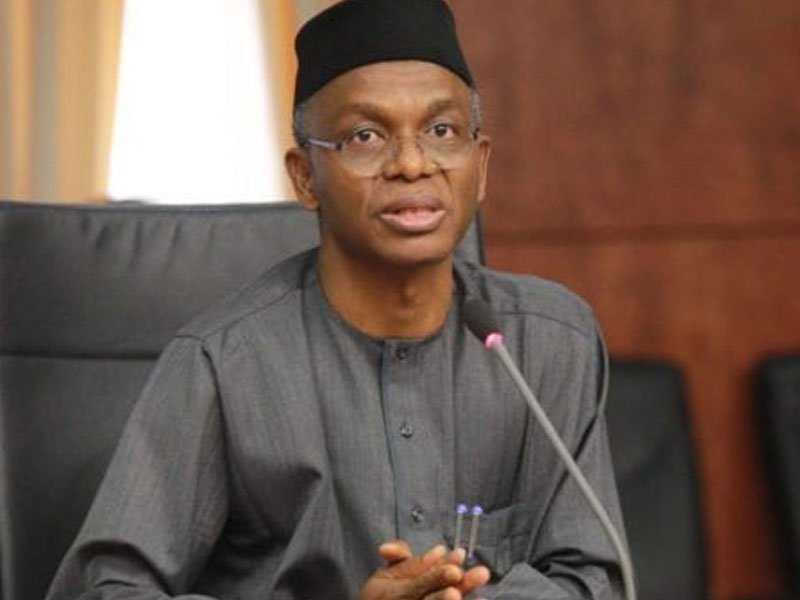
For 150 days and counting, a former Governor of Kaduna State, and one time Minister of the Federal Capital Territory, Mallam Nasir El-Rufai, has remained in the custody of various security agencies including the Department of State Services (DSS), the Economic and Financial Crimes Commission (EFCC) and the Independent Corrupt Practices and Other Related Offences Commission (ICPC) for alleged offences ranging from fund misappropriation, wiretapping and eavesdropping on security information among others. El-Rufai has not been found of any offence though he has spent over 150 days in custody.
The former governor’s plight was brought back to the fore weekend, when his wife, Asia Ahmad El-Rufai, made a passionate appeal to the international community to intervene over what she described as her husband’s prolonged detention and alleged denial of due process.
Mrs El-Rufai argued that the former governor’s continued incarceration amounted to “punishment before trial” and posed a threat to Nigeria’s democratic institutions. She noted that her husband has not been fairly treated even as she alleged that the former Director-General of the Bureau of Public Enterprise (BPE) may have taken ill in custody, bleeding from both nose and mouth. She wondered how someone, could made to undergo such severe punishment even when he is not undergone any trial, let alone being found guilty.
In a statement she signed herself, released his social media handles to mark what she described as the 150th day of El-Rufai’s detention, El-Rufai’s wife called on foreign governments, multilateral and multinational organisations and international human rights groups to closely monitor the legal proceedings involving her husband.
She acknowledged not speaking as a political actor but as a wife and mother seeking fairness for a member of her family.
The woman was of the opinion that the period of her husband’s incarceration without trial, has taken a significant emotional and physical toll on the former governor, members of his family and close associates.
“On the 150th day of Mallam Nasir El-Rufai’s detention, I ask readers outside Nigeria to pause over what that number means. One hundred and fifty days is not a legal phrase.
“It is five months of missed meals, missed prayers, missed proper mourning of his deceased mother, missed family conversations, interrupted medical care and moments we can never recover,” she said.
Acknowledging that her husband had been a controversial figure during his more than two decades in public service, as well as how rule of law and democracy should play out, she observed that “My husband is no stranger to controversy or public scrutiny. He has been praised, criticised, loved and opposed. That is democracy.
“But what is happening to him today is not democracy, and it is not accountability. It is punishment before trial,” she said.
Continuing and reflecting on the origin of the travails of her husband, Mrs El-Rufai traced his confrontation with the law to when am attempt was first made to arrest him at the airport on his way back from Egypt. The embarrassing situation at the airport culminated in his appearance for questioning, and ever since he has been allowed except when he was momentarily permitted to go and bury his dead mother.
She said, “There was the sudden invitation, his voluntary appearance before the authorities, and the promise of bail that existed on paper but not in freedom.
“There was the night he was moved between locations without warning and without the dignity of allowing his family to know where he was being taken,” she stated.
Asia also alleged that the former governor became seriously ill while in custody and experienced bleeding from his nose and mouth.
She claimed that officials were reluctant to provide him with adequate medical attention or allow his family to deliver his prescribed medication.
“I still remember the helplessness of hearing that he had fallen gravely ill in custody, bleeding from his nose and mouth, while those responsible for his welfare were reluctant to provide the care any person deserves.
“I remember the anxiety of trying to get his medication to him and wondering whether officials would accept it,” she said.
According to her, the detention had inflicted emotional distress on the family, which continued to wait for the legal process to take its course.
“These are not abstract violations. They are the moments that chip away at a family’s resolve and hope,” she added.
While not requesting that her husband be placed above the law, or escape investigation as a public officer, she insisted that such investigations must be conducted transparently, and in accordance with constitutional safeguards.
“If the state believes it has evidence, let it be presented before an impartial court, openly and fairly.
“But justice cannot be selective. It cannot be pursued through overlapping charges, repeated detention, impossible bail conditions and public humiliation designed to persuade the nation of guilt before a judge has heard the case,” she said.
She accused the government of the day of orchestrating the gory details of the situation, including stringent bail conditions to deprive her husband of freedom, even as the election approaches, stressing that Nigeria was drifting from legitimate accountability towards “lawfare,” which she described as the deployment of legal institutions and judicial procedures as political weapons. She believes that El-Rufai’s problems are the consequence of his disagreement with President Bola Tinubu, and his eventual decanting from the All Progressives Congress (APC).
“The concern is not whether former officials may be investigated; they can and should be.
“The concern is whether the law is being applied neutrally or deployed against those who have fallen out of political favour,” she said.
“His political rupture with President Bola Tinubu’s ruling All Progressives Congress and his refusal to surrender his independent voice should not make him a target for indefinite punishment or detention disguised as prosecution,” she said.
“The legal architecture”, she continued, “surrounding him is bewildering even to trained observers: multiple charges in different courts, overlapping allegations, shifting statutory theories and duplicated claims arising from the same alleged events.
“If one application for bail is made and the conditions are met, another accusation can be filed the next day. If one judge must consider freedom, another process can be used to delay it,” she alleged, querying why such procedures was allowed to turn the judicial process into a form of punishment before conviction.
In March 2026, the ICPC arraigned El-Rufai, alongside one Joel Adoga, before Honourable Justice A.I. Aikawa of the Federal High Court, Kaduna Division, on a 10-count charge bordering on abuse of office, money laundering and fraud.
According to the charge sheet marked FHC/KD/73/2026, the former governor was accused of unlawfully receiving multiple sums of money in naira and foreign currencies while serving as a public officer.
Specifically, the Commission alleged that El-Rufai, in September 2020 and January 2023, received the sum of N289,826,998.12 on each occasion as severance allowance, far exceeding the legally entitled sum of N20,013,245.00, being 300 percent of his annual basic salary.
The ICPC charge further revealed that between 2016 and 2023, the former governor allegedly took control of various sums in United States Dollars through his domiciliary account with Guaranty Trust Bank. These include $320,800 allegedly paid in tranches by Joel Adoga, as well as other deposits amounting to $155,800, $305,300, and several smaller sums from different individuals, all reasonably suspected to be proceeds of unlawful activities.
Joel Adoga was also accused of conspiring with the former governor in July 2019 to disguise the origin of $10,000 deposited into the said account.
One of the counts reads that both defendants, in July 2019 at Wuse, Abuja, allegedly conspired to disguise the origin of $10,000 paid into the former governor’s domiciliary account, knowing or reasonably ought to have known that the funds formed part of the proceeds of unlawful activity, contrary to and punishable under relevant provisions of the Money Laundering (Prevention and Prohibition) Act, 2022.
When the charges were read, both defendants pleaded not guilty to all counts, but they were ordered to be remanded in ICPC custody.
The ICPC further violated the court-ordered access to the former governor, saying that the order did not override the agency’s internal security rules.
In May 2026, the Federal High Court sitting in Abuja granted El-Rufai N100 million bail in the trial over the alleged unlawful interception of the phone communications of the National Security Adviser, Nuhu Ribadu. However, he was re-arrested right at the court premises by the DSS, prompting the family to raise alarm.
EL-RUFAI’S STRINGENT BAIL CONDITIONS
Much as the embattled former Kaduna governor was granted bail, the conditions have appeared too stringent and tough to meet, the situation that prompted the African Democratic Congress (ADC) among many other concerned Nigerians to react.
In its immediate reaction, the ADC accused the Federal Government of turning El-Rufai into a political prisoner, describing his ordeal as “political persecution dressed up as prosecution.”
El-Rufai’s family also condemned the re-arrest.
El-Rufai’s second wife, Hasiat, who addressed journalists outside the DSS facility, said the family was traumatised by the development and lived daily under the shadow of threats and surveillance.
“We now live in constant fear. Every day we get a threat — DSS is coming to raid your house, ICPC is coming to raid your house, police are coming to raid your house. You are being followed. Our phones are tapped,” she said.
As part of the bail conditions, the trial judge, Justice Joyce Abdulmalik ordered the defendant to produce a surety who must be a federal civil servant not below Grade Level 17.
According to the court, the surety must not only be resident in either Maitama or Asokoro highbrow districts of Abuja, but must also deposit the original Certificate of Occupancy of a landed property not valued below the bail sum.
It held that the surety must also provide evidence of receipt of salary for at least three months, with an authenticated letter from the manager of a bank within the jurisdiction of the court.
Furthermore, the court directed the surety to depose to an affidavit of means and equally submit a recent passport photograph to its registry.
It added that a verification letter from the surety’s immediate department must be submitted alongside a tax clearance certificate covering the last six months.
The defendant was further mandated to surrender his valid international passports and directed not to travel out of the country without permission.
Justice Abdulmalik ordered the defendant to report to the headquarters of the Department of State Services, DSS, every last Friday of the month by 10 a.m. to sign an attendance register, pending the determination of the case. The former governor was also directed to submit a letter of attestation from the Chairman of the Kaduna Traditional Council.
The trial judge warned that failure to comply with any of the conditions would lead to an automatic revocation of the bail.
Expressing its position on the travails of the former governor, the ADC, in a statement signed by its National Publicity Secretary, Mallam Bolaji Abdullahi, said “What is happening to Mallam El-Rufai confirms beyond all doubt that this detention is no longer about justice, it is about politics.
“It also confirms our fears that President Bola Ahmed Tinubu is deploying the instruments of state power to keep one of the leading opposition figures out of circulation. This is political persecution dressed up as prosecution.”
ADC also drew comparisons between El-Rufai’s case and those involving former Kogi State governor, Yahaya Bello, and former Delta State governor, Ifeanyi Okowa, both facing separate corruption allegations.
“When placed beside other high-profile cases, the contrast becomes stark and shameful. Yahaya Bello, former governor of Kogi State, has been accused in an alleged N80.2 billion money laundering case.
‘’Ifeanyi Okowa, former governor of Delta State, was arrested over the alleged diversion of N1.3 trillion in derivation funds. But today, they are walking around free, singing President Tinubu’s campaign song,” the ADC statement noted.
However, unconfirmed feelers reaching The Boss have it that El-Rufai’s incarceration has a lot to do with keeping him away from the face politics till after the 2027 General elections. The truth, or otherwise behind the postulation remains to be seen. Nigerians have to wait till the former governor’s next appearance in court by September 2026, to determine the direction of his freedom.