Connect with us

World

Trump Declares Trade War on Nations Imposing Digital Tax on US Tech Firms

Published

on

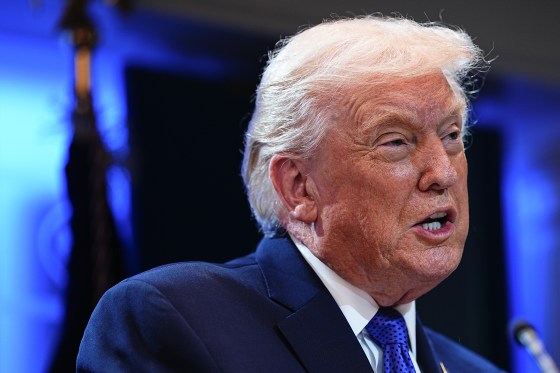
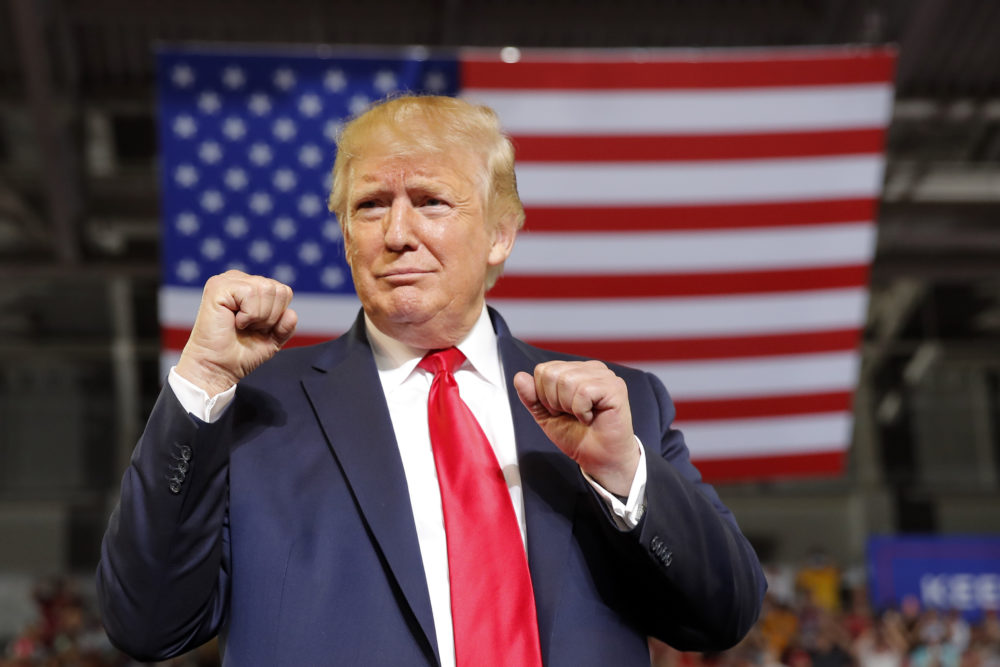
U.S. President, Donald Trump, has threatened to impose a 100 per cent tariff on imports from any country that introduces a digital services tax (DST) targeting American technology companies.

In a statement posted on his Truth Social platform on Friday, Trump warned that countries introducing or maintaining digital services taxes on U.S. tech firms would face immediate retaliatory tariffs on all goods exported to the United States.

“Any country that imposes such a Tax will immediately be met with a 100% TARIFF on any Goods sent to the United States of America,” Trump declared, insisting that digital services taxes unfairly single out American businesses and undermine U.S. economic interests.

The latest warning is aimed primarily at several European countries that have adopted or are considering digital services taxes on multinational technology companies such as Apple, Google, Meta, Amazon, and Microsoft.

Washington has long argued that such taxes disproportionately target U.S.-based firms while discriminating against American innovation.

Trump also asserted that the proposed 100 per cent tariff would supersede existing and future trade agreements, signalling a more confrontational trade policy if countries proceed with taxing revenues generated by U.S. technology giants within their borders.

France became the first major economy to introduce a digital services tax in 2019, prompting repeated threats of retaliatory tariffs from Washington.

Other countries, including the United Kingdom, Italy, Spain, Austria, and Canada, have either implemented or proposed similar measures while negotiations continue under the Organisation for Economic Co-operation and Development (OECD) to establish a global framework for taxing multinational corporations.

The OECD’s two-pillar international tax agreement was designed to reduce unilateral digital taxes by allocating a greater share of multinational profits to countries where earnings are earned while establishing a global minimum corporate tax.

Continue Reading
Click to comment

Leave a Reply

Your email address will not be published. Required fields are marked *

World

US Govt Releases Names of Terrorism Financiers Amid Growing Insecurity

Published

on

By

A fresh spotlight was cast on terrorism financing and security threats on Tuesday as the United States sanctioned a Lagos-based alleged ISIS (Islamic State of Iraq and Syria) financier.

This came as troops neutralised suspected ISWAP (Islamic State West Africa Province) operatives and the Federal Government deepened counterterrorism cooperation with international partners.

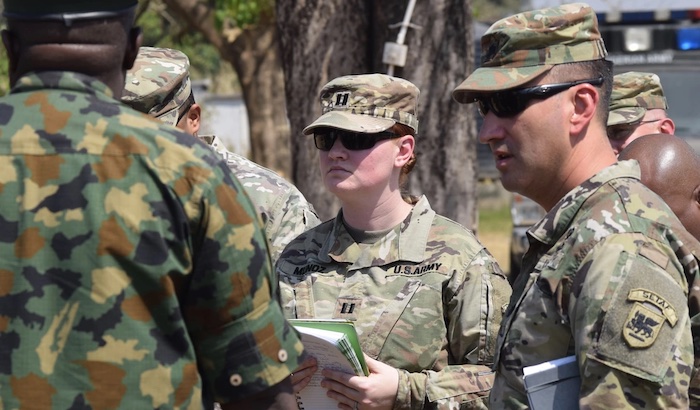
The United States imposed sanctions on Mukhtar Adamu Muhammad and three bureaux de change linked to him over accusations of facilitating funds for the terrorist group.

The sanctions, announced under Executive Order 13224, form part of a broader action targeting ISIS financial networks operating across Europe, the Middle East and West Africa.

Muhammad, 35, also known as Adamu Mukhtar and Muhammad Mukhtar, was identified as a key facilitator for ISIS-West Africa. He was listed with an address in Agege, Lagos State.

According to the U.S. Department of the Treasury’s Office of Foreign Assets Control (OFAC), Muhammad allegedly served as a conduit for ISIS financing through bureaux de change operating in Lagos and Kano states.

The three businesses sanctioned alongside him are Generation Currency Bureau De Change Limited and Nine to Nine Exchange Bureau De Change Limited, both based in Lagos State, as well as Manhattan Bureau De Change Limited in Kano State.

The U.S. authorities said the sanctions targeted a network spanning France, Turkiye, Syria and Nigeria that allegedly supports ISIS operations, finances attacks and assists the group’s affiliates.

According to OFAC, the network includes a France-based facilitator accused of providing information on explosives to ISIS supporters and a Syria-based operator who allegedly used cryptocurrency to transfer funds to ISIS associates in several countries, including the United States.

Announcing the sanctions, U.S. State Department spokesperson Thomas “Tommy” Pigott said the measures were aimed at disrupting the terrorist group’s financial operations worldwide.

“Under the leadership of President Trump, the United States is dismantling ISIS’s ability to finance terrorism around the world.

“We are cutting off the financial lifelines that enable ISIS to fund attacks, support its regional affiliates, and threaten civilians, including religious minorities,” Pigott said.

He added that the actions reflected sustained U.S. efforts to weaken ISIS, which he said had increasingly decentralised its operations and relied on financial intermediaries to sustain its global network.

The U.S. government also reaffirmed its security partnership with Nigeria, citing Abuja’s role in the May 16, 2026, operation that resulted in the killing of Abu-Bilal al-Minuki, described as the second-highest-ranking ISIS official.

Washington pledged to continue deploying diplomatic and legal measures against ISIS and its supporters.

“We will continue to use every diplomatic and legal tool available to hold ISIS and its supporters accountable wherever they operate and however they move money.

“We remain fully committed to protecting American lives, defending religious minorities, and working with international partners to eliminate the threat that ISIS poses to global peace and security,” the Department said.

The sanctioned individuals and entities have been added to OFAC’s Specially Designated Nationals list, a designation that freezes any assets under U.S. jurisdiction and prohibits American individuals and organisations from conducting transactions with them.

ISIS was designated a Specially Designated Global Terrorist organisation in 2004 and was later classified as a Foreign Terrorist Organisation by the United States in the same year.

The Guardian

Continue Reading

World

US Will Not ‘Rush into a Deal’ with Iran, Trump Declares

Published

on

By

President Donald Trump said on Sunday that he has told US negotiators “not to rush into a deal” with Iran, amid anticipation — and mounting criticism — of an agreement to end the war in the Middle East.

“The negotiations are proceeding in an orderly and constructive manner, and I have informed my representatives not to rush into a deal in that time is on our side,” Trump wrote on his Truth Social account.

“The Blockade will remain in full force and effect until an agreement is reached, certified, and signed.”

The United States has imposed a blockade of Iranian ports since April 13 after Tehran virtually halted traffic through the economically vital Strait of Hormuz in response to the US-Israeli attacks on Iran that began February 28.

“Both sides must take their time and get it right,” Trump wrote in the same Truth Social post, while slamming the 2015 nuclear deal that former president Barack Obama agreed with Iran.

“Our relationship with Iran is becoming a much more professional and productive one. They must understand, however, that they cannot develop or procure a Nuclear Weapon or Bomb,” Trump wrote.

While the White House has not released aspects of the deal, Iran Foreign Ministry spokesman Esmaeil Baqaei said Saturday on state television that the two sides were nearing a “a memorandum of understanding, a kind of framework agreement composed of 14 clauses,” in “a trend toward rapprochement.”

Several voices, notably among Republican lawmakers close to Trump, expressed fears of an agreement favorable to Iran as supposed aspects of the deal that began to leak.

According to news outlet Axios, a possible agreement would extend the current ceasefire by 60 days, during which the Strait of Hormuz would be reopened, Iran would freely sell oil, and negotiations would be held on Iran’s nuclear program.

The top Republican senator overseeing defense policy, Roger Wicker, said that agreeing to a “rumored 60-day ceasefire” with Iran would mean, “everything accomplished by Operation Epic Fury would be for naught!”

Fellow Republican senators Ted Cruz and Lindsey Graham also voiced opposition to Iran soon gaining benefits such as the ability to sell its oil freely.

“If the result of all that is to be an Iranian regime — still run by Islamists who chant ‘death to America’ — now receiving billions of dollars, being able to enrich uranium & develop nuclear weapons, and having effective control over the Strait of Hormuz, then that outcome would be a disastrous mistake,” Cruz, a Republican from Texas, wrote on X.

Thom Tillis, a Republican senator from North Carolina, said the deal “doesn’t make sense to me.”

“We were told about 11 weeks ago by (Secretary of Defense Pete) Hegseth and the Department of Defense that they had obliterated Iran’s defenses, and it was just a matter of time before we had the nuclear material. Now we’re talking about a posture where we may accept the nuclear material remaining in Iran. How does that make sense at all?” Tillis said on CNN’s “State of the Union” morning program.

AFP

Continue Reading

World

Again, Iran’s Military Closes Strait of Hormuz

Published

on

By

Iran’s military, on Saturday, declared the Strait of Hormuz closed again, hours after reopening it and with more than a dozen commercial ships passing through the vital waterway.

The toing and froing over the strait cast doubt on US President Donald Trump’s optimism the day before, that a peace deal to end the US-Israeli war with Iran was “very close”.

Tehran had on Friday declared the strait, which usually carries a fifth of the world’s oil and liquefied natural gas, open on Friday after a ceasefire was agreed in Lebanon to halt Israel’s war with Hezbollah.

That prompted elation in global markets and sent oil prices plunging, but with Trump insisting that a US naval blockade of Iranian ports would continue until a deal was concluded, Tehran threatened to shutter the strait once more.

Then, late on Saturday morning, citing a statement from military central command, Iranian state TV reported that “control of the Strait of Hormuz has returned to its previous status” and “is under strict management and control of the armed forces”, blaming the continued US blockade.

The announcement came as maritime tracking sites showed several ships making a dash through the narrow waterway, hugging close to Iranian territorial waters as instructed by Tehran and, for some, broadcasting their identity as Indian or Chinese in an apparent attempt to show their neutrality.

The same sites showed that late on Friday, a number of ships began heading for the strait before suddenly turning back amid the uncertainty.

By 0900 GMT on Saturday, several ships had fully transited the strait in both directions, but at least two tankers headed eastwards from the Gulf towards India after loading in UAE ports appeared to have turned around and aborted their journeys.

There are just four days remaining before the end of the two-week ceasefire in the US-Israeli war with Iran, launched by Washington and its ally on February 28.

Nevertheless, President Trump appeared convinced that a deal could be finished shortly.

He declared Friday “GREAT AND BRILLIANT,” and made a series of social media posts praising talks mediator Pakistan.

Islamabad’s powerful military chief, Field Marshal Asim Munir, on Saturday finished a three-day visit to Iran aimed at securing the peace deal, during which he met Iran’s top leadership.

While Munir was in Iran, Pakistani Prime Minister Shehbaz Sharif visited Saudi Arabia, Qatar and Turkey to push the peace process.

Islamabad has emerged as the lead mediator during the conflict, hosting a marathon round of direct peace talks last weekend attended by US Vice President JD Vance.

A second round of talks is expected in the Pakistani capital this coming week, with envoys hoping to end the war that was started by the US and Israel on February 28.

The allies launched a massive wave of surprise attacks on Iran, despite Washington and Tehran being engaged in diplomatic talks, that killed Iranian supreme leader Ali Khamenei and numerous senior leaders.

The war rapidly spread across the region, with Iran targeting US interests in the Gulf and Hezbollah dragging Lebanon into the conflict by launching rockets at Israel.

In a sign that the two-week ceasefire remained stable, Iran’s civil aviation agency declared its airspace was open again, with international flights able to transit Iran via the east of the country.

Nevertheless, two major sticking points in the peace talks — Iran’s stockpile of near-weapons-grade enriched uranium and the future of the Strait of Hormuz — appeared up in the air.

Speaking by phone with AFP on Friday, Trump said “we’re very close to having a deal,” adding that there were “no sticking points at all” left with Tehran.

Later the same day, at an event in Arizona, the president declared that Iran had agreed to hand over its 440 or so kilogrammes of uranium enriched to 60 percent — close to that needed for a bomb.

“We’re going to get it by going in with Iran, with lots of excavators,” he said.

But hours before, Iran’s foreign ministry had said its stockpile, thought to be buried deep under rubble by US bombing in last June’s 12-day war, was not going anywhere.

“Iran’s enriched uranium is not going to be transferred anywhere,” Iranian foreign ministry spokesman Esmaeil Baqaei told state TV.

“Transfer of Iran’s enriched uranium to the US has never been raised in negotiations.”

Ordinary Iranians, meanwhile, remained cut off from the international internet, with monitor netblocks announcing on Saturday that the blackout implemented at the start of the war had reached its 50th day.

AFP

Continue Reading

Trending