Opinion
Why GLO is the Gold Standard
Published
5 hours agoon
By
Eric
By Dr. Sani Sa’idu Baba
In every generation, there are brands that merely compete, and there are brands that redefine the standards by which others are measured. In Nigeria’s highly competitive telecommunications industry, Globacom has steadily carved a reputation that places it in the latter category. It is not merely another network provider; it has become a benchmark of indigenous innovation, resilience, affordability, and national pride. For millions of Nigerians, Glo has evolved into more than a telecommunications company, it is the gold standard.
The true measure of excellence is not simply how long a company survives, but how consistently it delivers value despite changing times and increasing competition. From inception, Globacom has remained committed to a people-first philosophy, ensuring that quality communication is affordable and accessible to every Nigerian. Guided by the visionary leadership of Dr. Mike Adenuga, GCON, Glo has consistently introduced products and services that make life easier for students, entrepreneurs, traders, professionals, families, and millions of everyday subscribers. In an economy where affordability matters, Glo continues to prove that staying connected should never be a luxury.
The hallmark of any gold standard is innovation, and innovation has remained the heartbeat of Glo. The company has pioneered several industry-first initiatives that reshaped Nigeria’s telecommunications landscape, compelling competitors to raise their standards. Its landmark investment in the Glo-1 submarine cable transformed internet connectivity, expanded bandwidth, strengthened network capacity, and contributed immensely to Nigeria’s digital economy. Today, with one of the country’s most extensive network infrastructures, Glo continues to bridge the digital divide by connecting both urban and rural communities to limitless opportunities.
Perhaps what distinguishes Glo most is its unmistakable Nigerian identity. It stands as one of Africa’s most successful indigenous telecommunications companies, a powerful reminder that world-class excellence can indeed be homegrown. Every milestone achieved by Glo reinforces the belief that Nigerian enterprises can compete successfully on both continental and global stages. It inspires confidence in local entrepreneurship and proves that visionary leadership, strategic investment, and unwavering commitment can produce institutions of international relevance.
Beyond providing telecommunications services, Glo has become a major contributor to Nigeria’s economic and social development. Its operations support thousands of direct and indirect jobs, empower businesses through reliable connectivity, and enable education, healthcare, research, entertainment, and digital entrepreneurship to thrive. Through sponsorship of major cultural festivals such as Ojude Oba, Eyo and Ofala, alongside investments in sports, music, and youth empowerment, Glo has demonstrated that nation-building extends beyond technology. It is a company that celebrates Nigeria’s heritage while investing in its future.
What truly sets Glo apart, however, is its humanity. Through customer appreciation initiatives, subscriber reward programmes, and continuous investments in network improvement, the company has consistently shown that its relationship with customers goes beyond business. It listens, adapts, and gives back, reinforcing the trust of millions of Nigerians who rely on its services every day.
Globacom’s journey mirrors the resilience, creativity, and optimism of Nigeria itself. It has shown that an indigenous company can compete with the very best while remaining deeply connected to the people it serves. Choosing Glo is therefore more than selecting a network; it is embracing a brand that believes in Nigeria, invests in Nigerians, and grows with Nigerians.
For millions of subscribers, Glo is more than a telecommunications company. It is a symbol of innovation, affordability, national pride, and endless possibilities. It is the people’s network, Nigeria’s pride, and without doubt, the gold standard.
Related
You may like
Opinion
The Wars of Ego: Leadership As the Architect of Collective Possibilities
Published
5 hours agoon
July 18, 2026By
Eric
By Tolulope A. Adegoke, PhD
“The ego builds monuments to its own memory.
Leadership, in its truest form, builds bridges to a future it will never cross.”
Introduction: The Invisible Battlefield
The most consequential wars of the twenty-first century are not fought with artillery, drones, or cyber-espionage. They are fought in boardrooms, parliamentary chambers, community halls, and the private sanctuaries of the human psyche. These are the Wars of Ego—a relentless, often silent conflict wherein personal validation, historical grievance, territorial defensiveness, and the desperate need for supremacy eclipse the pursuit of shared prosperity. This is not a metaphor; it is the operational reality that underpins the stagnation of corporations, the fracturing of nations, and the disempowerment of peoples.
Ego, in its classical psychological definition, is the mediator between the primal id and the moral superego. However, in the context of governance and organizational dynamics, ego metastasizes into a pathology of self-referentiality. It transforms decision-making from a collaborative exercise in problem-solving into a zero-sum gladiatorial contest. When ego becomes the sovereign of a leader’s soul, the organization—whether a family business, a multinational conglomerate, or a sovereign state—becomes a subsidiary of the leader’s personal narrative. The result is predictable: misallocation of resources, erosion of trust, systemic blindness, and a catastrophic decline in the capacity to deliver possibilities.
This treatise posits a bold, unyielding thesis: Leadership is the singular antidote to the Wars of Ego. But not leadership as it is commonly misunderstood—not charisma, not authority, not dominance. Rather, leadership as a technological and spiritual discipline of transcendence. It is the art of shifting the locus of control from the “I” to the “We,” from preservation to evolution, from validation to actualization. This document will dissect the anatomy of ego-driven conflict across three critical strata—Peoples, Corporates, and Nations—and prescribe a rigorous, multi-layered framework of solutions that are universally applicable, culturally agnostic, and operationally executable.
Part I: The Anatomy of the Ego-War – A Psychosocial Autopsy
To prescribe a cure, we must first understand the pathogen. The Wars of Ego are not random; they follow a predictable, cyclical pattern observable in every human collective.
1. The Narcissistic Cascade
Ego warfare begins with the leader’s internal dialogue. When a leader perceives their identity as synonymous with the institution, any critique of the institution becomes a critique of the self. This triggers a defensive cascade: denial, rationalization, projection, and ultimately, aggression. The leader ceases to listen to data, preferring instead to listen to echoes of their own voice. In a corporate setting, this manifests as the “founder’s trap”—where the founder refuses to cede control despite obvious market shifts. In a national context, it manifests as autocratic populism, where the leader’s personal vendettas are outsourced to the state apparatus.
2. The Tribalism of Proximity
Ego does not operate in isolation; it recruits allies. Leaders surrounded by sycophants—what we term the “courtier effect”—amplify their egoic biases. This creates a tribal echo chamber where competence is secondary to loyalty. The result is an institutional paralysis where the best ideas are sacrificed to protect the leader’s fragile self-esteem. This is the cancer that kills innovation in Fortune 500 companies and fuels sectarian violence in multi-ethnic nations.
3. The Temporal Myopia
Ego is inherently present-centric. It demands gratification now—quarterly earnings, immediate poll numbers, instant applause. This temporal myopia sacrifices long-term sustainability for short-term validation. Thus, corporations under ego-driven leaders gut R&D budgets to inflate stock prices; nations under ego-driven leaders deplete natural resources and erode democratic institutions for a fleeting legacy.
4. The Zero-Sum Fallacy
The most insidious weapon in the Wars of Ego is the belief that one person’s gain is another’s loss. This fallacy redefines collaboration as a threat. In corporations, it prevents cross-functional synergy; in geopolitics, it fuels trade wars and military posturing. The Ego sees the world as a finite pie; Leadership sees it as an expandable ecosystem.
Part II: The Cost of Ego-War – Quantifying the Destruction
The consequences are not philosophical; they are quantifiable.
· For Peoples: Ego-driven leadership leads to the erasure of agency. Citizens become subjects, not stakeholders. Social mobility stagnates as policies are tailored to the leader’s vanity projects rather than to infrastructure, education, and healthcare. The result is a generation of disenfranchised youth who turn to extremism, apathy, or migration. The loss of human potential is incalculable—measured not in GDP, but in unfulfilled dreams and suppressed genius.
· For Corporates: Ego kills agility. A 2023 study by the Corporate Governance Institute found that companies with high CEO-centricity (defined by excessive CEO pay ratios, board friendliness, and unilateral decision-making) underperformed their peer groups by 23% over a five-year horizon. More damningly, these companies suffer from a 40% higher turnover rate among mid-level talent, as high-performers refuse to remain in environments where merit is subordinated to the leader’s whims. Innovation pipelines dry up; market share erodes; and bankruptcy becomes a lingering possibility.
· For Nations: The geopolitical cost is profound. Ego-driven diplomacy is characterized by “red lines” that are drawn not based on strategic interests, but on personal pride. This leads to miscalculations—the Cuban Missile Crisis was an ego-war; the invasion of Iraq was an ego-war; the current fragmentation of global supply chains is an ego-war. Nations lose soft power, economic leverage, and moral authority. The resultant instability creates refugee crises, food insecurity, and climate inaction, because the ego cannot conceive of a future beyond its own tenure.
Part III: The Leadership Solution – A Comprehensive Framework for Transcendence
The solution is not the elimination of ego—that is impossible and undesirable, as ego provides the drive to achieve. The solution is the redirection and subordination of ego to a higher purpose. This requires a paradigm shift from Leadership as Command to Leadership as Custodianship. Below is a multi-dimensional, action-oriented framework that cuts across all three strata.
Solution 1: The Protocol of Institutionalized Humility (For Corporates and Nations)
Humility is not weakness; it is strategic intelligence. We propose a Mandatory Peer-Review Protocol where every major decision (M&A, policy shift, strategic pivot) must be vetted by a council of internal and external stakeholders with veto power over process, if not content. This does not dilute authority; it validates it. The ego-leader feels threatened by scrutiny; the custodian-leader welcomes it because they know that their legacy is not in being right, but in being effective.
· Corporate Application: Establish a “Shadow Board” of high-potential junior executives who critique strategic proposals from a future-state perspective. This creates a feedback loop that forces the CEO to justify decisions on merit, not instinct.
· National Application: Mandate that all major legislative initiatives undergo a “Pre-Impact Assessment” by a bipartisan, independent economic and social council. This insulates policy from the whims of a single administration.
Solution 2: The Institutionalization of “Succession by Design” (For All Levels)
Ego-warriors fear successors because successors imply mortality. To dismantle this fear, leadership must be reframed as a temporary trust, not a permanent throne. We propose a “Triple-Exit Clause” for all leadership roles: (1) A fixed term limit, (2) A performance-triggered exit (if key metrics are missed for two consecutive periods), and (3) A “Graceful Exit” mechanism that rewards leaders for developing their replacement within 18 months of assuming office.
· For Corporates: Link 30% of the CEO’s long-term compensation to the successful transition of their successor. This aligns the leader’s financial interest with the institution’s continuity.
· For Nations: Enforce a constitutional requirement that no leader may serve beyond two terms, and that all cabinet ministers must actively mentor a junior counterpart. This forces the dissemination of power and knowledge, preventing the “cult of personality” that fuels ego-war.
Solution 3: The Decentralization of Decision Rights (For Peoples and Corporates)
Ego thrives on concentration. To starve the ego, we must disperse decision-making authority to the periphery—to the people closest to the ground. This is not democracy for its own sake; it is functional optimization.
· For Corporates: Implement a “Radical Decentralization” model where departmental heads are granted full budgetary and hiring authority within a set of clear strategic guardrails. The role of the CEO shifts from “decider” to “connector”—facilitating resources and removing bottlenecks, rather than dictating outputs.
· For Nations: Adopt a “Subsidiarity Principle” where all policies that can be executed at the municipal or provincial level are legally forbidden from being centralized. This forces national leaders to focus on macro-stability, diplomacy, and infrastructure, while local leaders manage education, health, and transport. This fragmentation of power prevents any single ego from monopolizing the national narrative.
Solution 4: The “Mirror-Feedback” System for Self-Awareness
The most dangerous ego is the one that does not know it exists. We propose a mandatory, third-party “Leadership Impact Audit” conducted every 18 months, using 360-degree anonymous feedback from subordinates, peers, external partners, and even competitors. This audit is not a performance review; it is a distortion check. It measures the leader’s emotional footprint—their propensity to interrupt, to dismiss dissenting views, to take credit, and to deflect blame. The results are shared with the leader’s board or oversight committee, with a mandated action plan for correction.
· Corporate Example: Netflix’s famous “Keeper Test” is a form of this, but we extend it to include a “Friction Score”—a quantified measure of how much the leader’s presence creates decision-paralysis in meetings.
· National Example: Establish an independent “Ombudsman for Leadership Ethics” that publishes an annual report on the humility index of the executive branch. This public accountability forces even the most narcissistic leaders to moderate their behavior for fear of reputational damage.
Solution 5: The Recalibration of Incentive Structures (The Economic Cure)
The Wars of Ego are sustained by perverse incentives. If we reward leaders for immediate stock spikes or short-term GDP growth, we are incentivizing ego-driven short-termism. We propose a paradigm shift toward Multi-Generational Incentivization.
· For Corporates: Tie 50% of executive compensation to metrics that have a 10-year horizon: carbon reduction, employee retention, R&D patent filings, and community investment. This forces the leader to think like a steward, not a conqueror.
· For Nations: Shift national budgeting from annual appropriations to Five-Year Rolling Budgets with locked-in allocations for health, education, and infrastructure. This removes the leader’s ability to use the budget as a tool for political patronage, thereby reducing the ego-driven urge to “reward loyalists” and “punish critics.”
Solution 6: The Cultivation of “Anti-Fragile” Cultures (For Peoples)
Ultimately, the most potent solution is cultural. A society or organization that rewards candor over compliance will naturally starve the ego. We propose a formalized “Safe Dissent” protocol.
· Corporate: Create a “Devil’s Advocate Committee” tasked with formally opposing every major initiative. The committee is not to kill the idea, but to strengthen it by exposing its vulnerabilities. The CEO is required to respond in writing to all committee findings.
· National: Enshrine a “Right to Constructive Disobedience” for civil servants—a protected legal channel for whistleblowers and contrarian analysts to present alternative data to the legislature without fear of retaliation. This creates a culture where the leader is constantly reminded that they are fallible, thereby forcing them to lean on collective intelligence.
Part IV: The Synthesis – Delivering Possibilities Across the Board
When these solutions are applied concurrently, they create a virtuous cycle. The Leader becomes a servant of the system, not its master. The result is an explosion of possibilities.
For Peoples:
The decentralization of power and the institutionalization of feedback mean that the average citizen is no longer a passive recipient of policy; they become a co-creator of their destiny. Education systems pivot from rote memorization to problem-solving. Healthcare systems become preventive, not reactive. The narrative shifts from “What can my leader do for me?” to “What can we achieve together?” The ego-war is replaced by a peace of collective agency. Unemployment drops, as local economies are empowered to innovate. Crime reduces, as community trust rebuilds. The “possibility” here is human flourishing—a condition where every individual, regardless of background, has a pathway to self-actualization.
For Corporates:
The shift to multi-generational incentives and decentralized decision-making unlocks a level of agility that is impossible under ego-centric rule. Innovation cycles shorten from years to months. The best talent is retained because high-performers crave environments where their voice matters. Collaboration across silos becomes the norm, not the exception. Mergers and acquisitions are driven by strategic fit, not by the CEO’s desire for a larger empire. Profitability becomes a byproduct of purpose, not a singular obsession. The “possibility” here is sustainable market leadership—a company that outlasts its founder, adapts to every disruption, and serves as a pillar of community prosperity.
For Nations:
The application of humility protocols and independent oversight transforms diplomacy from a theater of posturing into a practice of pragmatic problem-solving. Geopolitical rivals find common ground in climate action, trade harmonization, and pandemic preparedness, because leaders are freed from the need to “save face” and are instead incentivized to “save lives.” The nation becomes a beacon of soft power, attracting investment, talent, and global respect. The “possibility” here is strategic immortality—a nation that remains relevant and prosperous for centuries, not merely for the tenure of a single leader.
Part V: The Deeper Dive – Addressing the Uncomfortable Truths
To be comprehensive, we must address the cynics who argue that these solutions are utopian. They will say: “You cannot change human nature.” This is a fallacy. We do not seek to change human nature; we seek to channel it. The ego is like a river—it will flow. Our task is to build levees, canals, and turbines that convert its destructive energy into productive force.
The Challenge of Implementation:
The primary obstacle to these solutions is that they require ego-wielders to voluntarily reduce their own power. This is the “Theater of the Absurd”: the very people who need these reforms the most are the least likely to adopt them. Therefore, we must rely on external catalysts:
1. Market Forces: Institutional investors must mandate ESG (Environmental, Social, and Governance) metrics that include leadership humility scores. When capital flows away from ego-centric companies, the market itself becomes the regulator.
2. Civil Society: Grassroots movements must demand transparency, using digital platforms to track and publish real-time decision-making data. For example, a “Leader’s Decision Log” can be made public, showing exactly who influenced which policy.
3. Intergenerational Contracts: Young employees and citizens must refuse to participate in ego-driven systems. The rise of the “Great Resignation” and the “Quiet Quitting” phenomenon are early indicators that the workforce is voting with its feet against narcissistic leadership. This is a powerful lever for change.
The Role of Technology:
Artificial Intelligence can be a neutral arbiter of ego. We propose an AI-driven “Bias Detection System” that analyzes meeting transcripts, decision memos, and budget allocations to flag patterns of personal favoritism, disproportionate credit-taking, and exclusionary language. This system acts as a silent, non-judgmental observer, providing data that the leader cannot refute. It removes the emotional charge from feedback, replacing it with cold, hard evidence. This is not surveillance; it is a mirror.
The Spiritual Dimension:
Finally, we must acknowledge the spiritual dimension. Leadership, at its highest echelon, is a form of karma yoga—selfless action. The leader must cultivate an internal practice of detachment: regular journaling, meditation, or executive coaching that focuses on the question: “If I were removed from this position tomorrow, what would remain?” If the answer is “nothing,” the leader is operating on ego. If the answer is “an enduring institution, a competent team, and a clear roadmap,” the leader is operating on vision. We recommend that every leader undergo an annual “Existential Audit” with a seasoned philosopher or spiritual counselor, to decouple their self-worth from their positional power.
Part VI: A New Lexicon for Leadership
To sustain this transformation, we must change our language. Words shape reality. We propose the adoption of a new vocabulary:
· Replace “My Strategy” with “Our Shared Horizon.”
· Replace “I Decided” with “We Converged.”
· Replace “My Legacy” with “Our Inheritance.”
· Replace “My Critics” with “Our Dialectical Partners.”
This linguistic shift is not cosmetic; it is neurocognitive. Repeated use of collectivist language rewires the brain’s default mode network, reducing the amygdala’s threat response to dissent and increasing the prefrontal cortex’s capacity for integrative thinking.
Part VII: The Ultimate Metric – The Possibility Index
We conclude with a proposal for a global standard: the Possibility Index (PI) . This is a composite metric that measures the aggregate potential of a people, a corporation, or a nation. It includes:
· The Ratio of Idea Generation to Idea Suppression (measured by the number of proposals submitted vs. rejected with valid rationale).
· The Trust Quotient (measured by employee/citizen engagement surveys and voluntary retention rates).
· The Generational Handover Score (the percentage of institutional knowledge successfully transferred to the next cohort).
· The Adaptability Velocity (the time taken to pivot strategy in response to external shocks).
When the PI rises, the Wars of Ego fall. This is not a utopian dream; it is a tangible, measurable reality. The data is clear: organizations with high PI consistently outperform their peers by every financial and social metric. The same applies to nations. The Nordic countries, Singapore, and New Zealand are not perfect, but their consistent investment in institutional humility, decentralized decision-making, and long-term incentivization places them at the pinnacle of global prosperity.
Conclusion: The Choice Before Us
The Wars of Ego are not inevitable. They are a choice—a collective choice to elevate the individual over the collective, the immediate over the enduring, and the self over the species. Leadership is the only force powerful enough to reverse this choice. But it requires a fundamental redefinition: Leadership is not the power to command; it is the courage to surrender—to surrender the need for credit, the need for control, and the need for validation.
When a leader steps back, the people step up. When the ego retreats, possibility advances. This is the central paradox of effective stewardship: The more a leader diminishes their own ego, the larger their impact becomes. They become a lens, not a source—focusing light, not emitting it. Through this lens, the challenges of the twenty-first century—climate change, inequality, geopolitical tension, technological disruption—become not existential threats, but engineering problems. They become solvable. They become opportunities.
The Peoples will no longer wait for a savior; they will become their own salvation. The Corporates will no longer chase quarterly glory; they will build century-spanning legacies. The Nations will no longer compete in a tragic zero-sum contest; they will collaborate in a magnificent win-win ecosystem.
This is the promise of Leadership. This is the end of the Wars of Ego. This is the beginning of a new epoch—not of kings, but of custodians; not of conquest, but of cultivation; not of ego, but of empathy. The door is open. The solutions are clear. The only question that remains is whether we—as individuals, as organizations, and as societies—have the wisdom to walk through it.
Let us choose wisely. Let us choose We. Let us choose Tomorrow. Let us choose Possibility.
Dr. Tolulope A. Adegoke, AMBP-UN is a globally recognized scholar-practitioner and thought leader at the nexus of security, governance, and strategic leadership. His mission is dedicated to advancing ethical governance, strategic human capital development, resilient nation building, and global peace. He can be reached via: tolulopeadegoke01@gmail.com, globalstageimpacts@gmail.com
Related
Opinion
The 1999 Constitution: The Blueprint for Chaos
Published
5 days agoon
July 13, 2026By
Eric
By Boma Lilian Braide Esq
There is a popular saying, repeated on the streets and across Nigerian social media, that perfectly captures our collective condition with uncomfortable precision. It says; “if you look at Nigeria and claim to understand how it works, you must be the one who has lost your mind”. It is perhaps the only phrase that adequately explains the disorienting reality of citizenship in this country, where survival itself often feels like a daily miracle.
Every morning, millions of Nigerians perform that miracle without applause. They navigate flooded roads that lead to shuttered factories, pay taxes to a government that cannot guarantee electricity, and hire private security to protect their families from roaming bandits. On the surface, we direct our frustration at the sitting President, at corrupt governors, or the different local government chairmen. We voice our anger across social media, demanding that those at the top change course. But we are, in large part, aiming at the wrong target.
The true villain in the Nigerian story is not a living person. It is a lifeless, heavy, fundamentally dishonest stack of paper bound together in Abuja. It is called the 1999 Constitution of the Federal Republic of Nigeria. This text is a democratic covenant in name only. It opens with a bold, theatrical declaration: “We the people of the Federal Republic of Nigeria… do hereby make, enact and give to ourselves the following Constitution.”
Who, precisely, are “the people”? Which Nigerian ancestor sat in the room where this text was drafted? The uncomfortable truth is that no citizen was present to debate its clauses, and none voted for its adoption. It was handed down like a conqueror’s edict. General Abdulsalami Abubakar and a small circle of military officers issued it as Decree No. 24 of 1999, mere days before transferring power to a civilian government. For nearly three decades, we have attempted to practise democracy using a blueprint designed for absolute military rule. The consequences of that historical error are visible across our collapsing national architecture, which functions less like a federal republic and more like a unitary state wearing federal clothing.
To understand why the country keeps faltering, we must stop treating our crises as mere failures of individual leadership and start recognising them as structural design flaws written directly into our supreme law. The 1999 Constitution is not simply outdated; it is an active engine of underdevelopment, insecurity and political paralysis.
Consider the foundational architecture of our federation. True federalism requires that constituent units generate their own resources, manage local security and remit an agreed share of their earnings to sustain shared national functions such as foreign policy and defence. The Nigerian constitution inverts this logic entirely. It strips states of economic initiative and reduces them to administrative dependents.
Section 162 establishes the Federation Account, a central pool into which all national revenue is deposited, then shared monthly among the 36 states and Abuja according to a fixed formula. This arrangement has systematically discouraged productivity across the country, turning governors into monthly supplicants in Abuja rather than builders of local economies. A state governor has little structural incentive to revitalise agriculture, attract industrial investment or expand employment, because political survival depends far more on the price of Brent crude oil in London than on the output of farmers in Benue or traders in Aba. The constitution effectively penalises resourceful states and rewards passivity, trapping the entire country in a cycle of dependency.
The most dangerous consequence of this military engineered document is the near total failure of our internal security architecture. Nigeria is currently under strain from every direction, as criminal networks, kidnappers and terrorist groups make routine travel between cities a genuine risk. Young Nigerians reasonably ask why their state governments cannot protect them, particularly given that governors routinely describe themselves as the Chief Security Officers of their states. That title, however, is largely symbolic.
Under Section 214, the constitution explicitly forbids the creation of any police force beyond the single, centrally controlled Nigeria Police Force, placing every officer under the command of an Inspector General based in Abuja. A governor in Zamfara or Oyo cannot deploy police to halt an unfolding attack in a local community without clearance from an office hundreds of kilometres away. The document names governors as Chief Security Officers while denying them the legal authority to command a single officer. This is not an oversight; it is a deliberate design choice intended to concentrate control among a small number of central actors. While the National Assembly delays meaningful reform, local communities are left exposed, forcing many states to rely on legally precarious vigilante groups simply to survive.
Thank God, the State Police Bill has now been passed by the National Assembly on June 11th, 2026 as the 6th Alteration Bill, 2026. But it is not yet fully law. We hope it will be approved by 2/3 of the State Houses of Assembly and receive the President’s signature in no time.
Until then, with the National Assembly’s delay in completing the process, local communities remain exposed. Many states are forced to rely on legally precarious vigilante groups just to survive.
Beyond security, this same centralising instinct has paralysed our judicial and local governance systems, undermining any real prospect of accountability. The National Judicial Council in Abuja holds near total control over the appointment and discipline of judges at both federal and state level. This bureaucratic bottleneck means that a straightforward commercial dispute between two traders in Calabar can take a decade to resolve, clogging a judicial pipeline that eventually reaches an overwhelmed Supreme Court. At the grassroots level, the picture is equally troubling. For decades, the constitutionally mandated State Joint Local Government Account allowed governors to divert funds intended for local councils, leaving rural communities without adequate healthcare, functioning schools or passable roads. Even recent Supreme Court interventions aimed at securing financial autonomy for local government have run up against the contradictory wording of the 1999 text, which continues to offer governors legal room to manoeuvre. The constitution does not facilitate justice or good governance; it manufactures structural gridlock that protects a ruling class while burdening ordinary citizens.
At present, the National Assembly is engaged in its familiar and costly ritual, the constitutional review process. Lawmakers hold public hearings, form committees and debate hundreds of minor amendment bills. This should not be mistaken for genuine reform. A cycle of piecemeal alteration cannot rescue a nation whose foundation is fundamentally unsound, in the same way that repainting a building does not repair a compromised structure beneath it.
Between 2007 and 2023, Nigeria conducted five separate rounds of constitutional amendment, consuming billions of naira in public funds. The return on that expenditure was largely cosmetic. Lawmakers readily support amendments that protect their own tenure, adjust election tribunal timelines or revise age requirements for office. Yet whenever structural, genuinely consequential proposals reach the floor, such as the devolution of policing powers, true fiscal federalism or a reduced exclusive legislative list, they are swiftly rejected by a conservative legislative majority unwilling to relinquish central privileges. The current review process is already losing momentum as attention shifts toward the 2027 electoral cycle. It is unrealistic to expect the political class to voluntarily surrender the very centralisation that sustains its comfort.
We must accept the difficult truth that the 1999 Constitution cannot be rescued through minor patches or periodic updates. A system whose core architecture is compromised cannot be repaired by adjusting its surface features. Nigeria does not need another modest amendment bill; it needs a genuine, comprehensive structural overhaul, undertaken without apology or hesitation.
This means substantially reducing the federal government’s authority by cutting the Exclusive Legislative List from more than sixty items to a lean core of perhaps ten, covering essential functions such as foreign affairs, national defence and monetary policy. Responsibilities including policing, resource control, electricity, rail transport, agriculture and education should be devolved to the states or regional blocs. States must be allowed to become genuine economic centres, retaining the majority of the wealth they generate and remitting a negotiated share to sustain the centre. Most importantly, any new constitutional framework must be subjected to a direct, transparent national referendum. The diverse nationalities that make up this country deserve the democratic right to negotiate the terms of their union and to vote on the supreme law that governs them. Sovereignty belongs to the people, not to a small circle of politicians in Abuja.
This is a serious and urgent call to action for every Nigerian citizen, professional body, civil society organisation and member of the diaspora. We must move beyond our preoccupation with the personalities of individual leaders and direct our collective attention to the structure of the state itself. We can no longer afford to watch passively while a fraudulent, military imposed document continues to constrain our economic future and expose our communities to preventable harm.
Constitutional restructuring must become a central condition for political engagement going forward. We must engage our representatives directly, challenge the elite consensus that protects the status quo, and demand a genuinely people driven constitution capable of unlocking the considerable potential this nation continues to hold in reserve.
The present course is unsustainable, and the cost of continued tolerance is national decline. We must summon the resolve to dismantle this blueprint for chaos, or accept that it will, in time, dismantle the country itself.
Related
Opinion
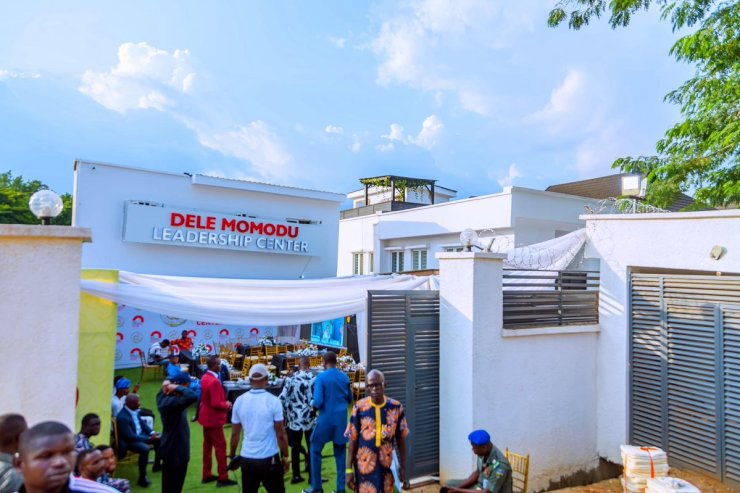
A Week of Inspiration at the Dele Momodu Leadership Centre: A Scholar’s Reflection
Published
7 days agoon
July 12, 2026By
Eric
By Sola Ojewusi
There are places one visits, and there are places that leave an enduring imprint on the mind. My one-week residency at the Dele Momodu Leadership Centre (DMLC), Ibadan, belongs firmly to the latter category. It was far more than a period of academic retreat; it was an enriching intellectual experience that reaffirmed my belief that scholarship flourishes best in an environment deliberately designed to nurture reflection, creativity, and excellence.
Nestled beneath the lush green hills of Alalubosa GRA in the ancient city of Ibadan—a city that proudly occupies a distinguished place in Nigeria’s educational history as the home of the nation’s first university—the Dele Momodu Leadership Centre stands as a remarkable investment in knowledge, leadership, and national development. The serenity of its location immediately sets it apart. Away from the incessant noise, congestion, and pressures of metropolitan life, the Centre offers a peaceful sanctuary where ideas are born, manuscripts are completed, and research receives the uninterrupted attention it deserves.
Before arriving, I had heard much about the Centre. Like many first-time visitors, I briefly wondered whether the winding access road, portions of which are currently under construction, would diminish the experience. Those concerns disappeared almost instantly upon entering the premises. The calm surroundings, beautiful landscaping, spotless facilities, and welcoming atmosphere quickly replaced every reservation with admiration.
The Dele Momodu Leadership Centre has successfully created what many scholars only dream of—a truly scholar-friendly environment. Every aspect of the Centre appears thoughtfully planned to encourage productivity. The quiet ambience allows for hours of uninterrupted reading, writing, and reflection. There are no unnecessary distractions, only the soothing silence that every serious researcher craves.
Equally impressive is the warmth and professionalism of the Centre’s staff. From the moment of arrival until departure, every interaction was characterised by courtesy, efficiency, and genuine hospitality. Their readiness to assist residents contributes significantly to the overall experience and creates an atmosphere in which scholars feel valued and appreciated.
The accommodation deserves special mention. Comparable to that of a first-class hotel, it combines elegance with comfort. Spacious rooms, reliable amenities, impeccable cleanliness, and carefully maintained facilities ensure that residents focus entirely on their scholarly pursuits rather than everyday inconveniences. The experience demonstrates that academic retreats need not sacrifice comfort in the pursuit of excellence.
For researchers who enjoy preparing their own meals, the Centre provides an exceptionally modern and fully equipped kitchen. This thoughtful provision gives residents the freedom to maintain familiar dietary routines while enjoying the comforts of home. Such attention to detail reflects a genuine understanding of the practical needs of long-hour researchers and writers.
Yet the Centre appreciates that scholarship is not sustained by work alone. After hours immersed in books, documents, and manuscripts, residents have several opportunities to relax and recharge. A refreshing swim in the well-maintained swimming pool provides welcome relief after an intensive day of research. From the lobby, one can gaze across the rolling green hills surrounding Alalubosa, drawing fresh inspiration from nature’s quiet beauty. Gentle walks around the beautifully paved premises offer another opportunity to clear the mind before returning to one’s writing with renewed energy.
Throughout my stay, I came to appreciate the vision behind the Centre. It represents more than an impressive physical structure; it is a practical demonstration of Chief Dele Momodu’s enduring commitment to intellectual development, leadership, journalism, and national progress. For decades, Aare Dele Momodu has projected Nigeria’s rich cultural heritage to global audiences, championed democratic ideals, amplified the voices of ordinary citizens, and consistently promoted excellence through journalism and public engagement. The establishment of the Dele Momodu Leadership Centre is yet another significant contribution to that remarkable legacy.
In creating a haven where scholars, writers, journalists, researchers, and intellectuals can think deeply, write freely, and engage meaningfully with ideas, he has added another commendable feather to an already distinguished cap. It is an investment not merely in infrastructure but in human capital, knowledge production, and the future of intellectual discourse in Nigeria.
One particularly remarkable aspect of the residency is the financial support extended to participants. Beyond providing outstanding accommodation and facilities, residents also receive a stipend during their stay. It is a generous gesture that reflects the Centre’s philosophy of encouraging scholarship rather than burdening it. In simple terms, scholars are given the rare privilege of concentrating fully on their research while enjoying world-class hospitality in an environment specifically designed for academic excellence.
As someone who has experienced the programme firsthand, I can confidently recommend it without reservation. Whether you are a university lecturer, postgraduate student, researcher, journalist, author, policy analyst, or creative writer searching for a peaceful environment in which to complete an important project, the Dele Momodu Leadership Centre offers an experience that is both intellectually rewarding and personally refreshing.
Applications for residency can be obtained free of charge through the Centre’s official social media platforms. Based on my own experience, the application process is straightforward, and responses are prompt.
A week at the Dele Momodu Leadership Centre is not merely a retreat from everyday life; it is an investment in scholarship, creativity, and personal renewal. It offers the rare opportunity to think without interruption, write without distraction, and grow without pressure.
My sincere appreciation goes to Aare Dele Momodu for this visionary initiative. The Dele Momodu Leadership Centre stands as a shining example of how private leadership can make a lasting contribution to education, research, journalism, and national development.
Nigeria needs more initiatives of this nature. Until then, scholars fortunate enough to spend time at the Dele Momodu Leadership Centre will continue to testify that it is one of the country’s most rewarding academic residency experiences.
Sola Ojewusi, Journalist, Author was recently at the DMLC as a PhD Research Scholar from the University of Lagos.
Related


Why GLO is the Gold Standard
The Wars of Ego: Leadership As the Architect of Collective Possibilities
Adding Value: Kill Worry Before It Kills You by Henry Ukazu
Investors at UBA Business Series Identify Africa’s Next Billion-Dollar Opportunities
The Oracle: The Independence of the Judiciary in a Democratic Dispensation (Pt. 5)
Friday Sermon: The Sociology of Aging: Olusegun Osoba at 87
Mary Habila’s Death: Tinubu Has Failed Comprehensively, Disgracefully – Atiku
Argentina Stun England with Two Late Goals to Reach 2026 World Cup Final
The 1999 Constitution: The Blueprint for Chaos
Spain Beat France 2-0 to Reach 2026 World Cup Final
Gunmen Attack Kogi School, Abduct Principal, NECO Staff, Students Writing Exams
Nigeria Doing Well Under My Watch – Tinubu
Court Orders Final Forfeiture of 48 Assets Linked to Ex-AGF Malami
Atiku Accuses INEC of Aiding Tinubu’s Alleged One-party State Agenda
Trending
-
Sports3 days agoArgentina Stun England with Two Late Goals to Reach 2026 World Cup Final
-
Opinion5 days agoThe 1999 Constitution: The Blueprint for Chaos
-
Sports4 days agoSpain Beat France 2-0 to Reach 2026 World Cup Final
-
Featured4 days agoGunmen Attack Kogi School, Abduct Principal, NECO Staff, Students Writing Exams
-
National3 days agoNigeria Doing Well Under My Watch – Tinubu
-
Featured3 days agoCourt Orders Final Forfeiture of 48 Assets Linked to Ex-AGF Malami
-
Headline5 days agoAtiku Accuses INEC of Aiding Tinubu’s Alleged One-party State Agenda
-
Headline5 days agoAppeal Court Upholds Judgment Ordering INEC to Derecognise Mark-led EXCO