Connect with us

Headline

ADC National Convention: To Be or Not to Be?

Published

on

By Eric Elezuo

On April 1, 2026, the Independent National Electoral Commission (INEC), led by its Law Professor Chairman, Joash Amupitan, threw a shocker at Nigerians, derecognising the David Mark and Rauf Aregbesola led-leadership of the hitherto main opposition party, the African Democratic Congress (ADC). The announcement has since generated chain reactions across board in the Nigerian body policy, creating divisive opinions for and against the electoral body.

Among other factors, the announcement put a question mark on the already planned April 14, 2026 National Convention of the ADC, prompting a question mark on whether or not the convention will hold as planned.

INEC had through its National Commissioner and Chairman of the Information and Voter Education Committee, Mohammed Haruna, announced the Commission’s decision to withdraw their recognition of the ADC leadership, with special emphasis to the Chairman, Senator David Mark and Secretary, Rauf Aregbesola, in a statement.

It hinged its decision on a court order which directed the commission to maintain the status quo pending the determination of a suit challenging the legality of David Mark’s leadership of the opposition party. But the maintenance of status quo was variously interpreted by interested parties to suit their various whims and caprice.

But the ADC has insisted on proceeding with its planned congresses and national convention despite the controversy surrounding its derecognition by INEC, a move the body said would amount to nullify if embarked upon.

ADC’s National Publicity Secretary, Bolaji Abdullahi, announced this while speaking on Arise Television’s Morning Show, citing the party’s current leadership struggle.

Abdullahi stated that the party had already given INEC the required 21-day notice for its operations and that the commission acknowledged receipt of the notice.

He maintained that the ADC would not halt its internal processes regardless of INEC’s position, stressing that the party remains committed to carrying out its congresses and convention as scheduled.

The spokesman also expressed concern over what he described as growing threats to Nigeria’s democracy, warning against attempts to limit political competition ahead of the 2027 general elections.

The electoral authority has also announced that it will not accept Nafiu Bala Gombe, who is seeking to be declared national chairman through the court.

He said, “If we’re in a military regime, we can understand it. We are finding ourselves in a situation where everything is being done to ensure that the election in 2027 is a fait accompli and that Nigerians will be left with no option or no choice. We’ve seen how this has ended in the past.

“So we are saying that we will go ahead with our congresses. We have given INEC 21 days’ notice. They have accepted the notice.

“So whether they come or not, we’ll continue with our congresses; we’ll continue with our convention.

“We are all Nigerians. We can see what is going on. We can see our democracy unravelling before our very eyes.”

Consequently, with only a few days left before the stipulated date for the convention, the ADC has gone ahead to set up a 361-man convention planning committee that would soon be inaugurated.

If hitches or changes do not occur in the coming moments, the former governor of Cross River State, Leyel Imoke will lead the 361-member National Convention Central Coordination Committee of the David Mark-led National Working Committee (NWC) of the ADC.

Aminu Waziri Tambuwal, former governor of Sokoto State, will serve as vice chairman of the committee, while Ajuji Ahmed has been appointed secretary. The party maintains the national convention day as April 14, 2026.

Sources within the party informed that preparations for the convention were in full swing, with several committees already constituted to handle key aspects of the event.

The speedy plans attached to the Convention is borne out of the fact that the Mark-led NWC has rejected INEC’s interpretation of the judgement and insisted that it would proceed with the planned national convention and other internal party processes.

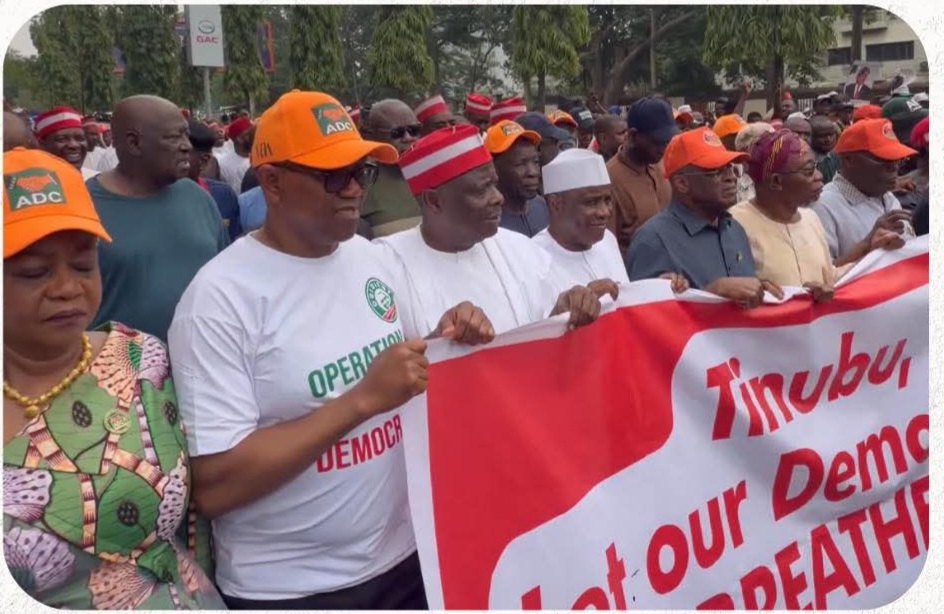
Prominent political figures backing the Mark camp including former Vice President Atiku Abubakar; formwr Anambra State governor, and Labour Party presidential candidate in the 2023 ele tions, Peter Obi; former Rivers State governor, Rotimi Amaechi; former Kano State governor, Rabiu Musa Kwankwaso; and former Osun State governor Rauf Aregbesola, had staged a protest to challenge INEC’s position.

Information reaching The Boss noted also that personalities like former governor of Imo State, Emeka Ihedioha; former Minister of State for Education, Emeka Nwajuba; FCT Senator, Ireti Kingibe and other prominent members of the ADC have been listed to play key roles in the planning of the convention.

But fresh evidence coming from several sources has noted that the state congresses sheduled for Saturday, April 11, 2026, have been stalled, no thanks to the leadership crisis rocking the party amid internal wrangling and legal hurdles.

As at today, crises have fragmented the party into three camps led by former Senate President David Mark, former deputy National chairman, Nafiu Gombe and a bloc spearheaded by some state ADC chairmen, and led by the party’s presidential candidate in the 2023 election, Dumebi Kachikwu. This fragmentation has been the major reason that for the consequent de-recognition of the Mark-led National Working Committee by the INEC.

While some states have announced the suspension of their congresses, a few states have vowed to proceed with the election ahead of the party’s convention.

On Thursday, a faction led by Gombe stormed the INEC headquarters in Abuja, demanding formal recognition.

Gombe, accompanied by a Rep member from Kogi State, Leke Abejide, and hundreds of supporters, accused the David Mark-led leadership of attempting to hijack the party’s leadership in defiance of its constitution and internal processes.

Addressing officials of the electoral body during the protest, a barely-able-to-express-himself Gombe insisted that due process must be followed in resolving the leadership dispute.

Reading a prepared text, he said, “We are here to urge INEC to follow due process. You cannot come to the ADC through the window and expect to overturn the owners of the ADC. As democrats, we don’t want any moneybags to come and destroy democracy. The ADC is for all Nigerians from wards, states, to the national level.”

Also speaking, Abejide, who had said he would quit the ADC if the Mark NWC is finally recognised, called on the commission to resist what he described as an attempted takeover of the party, stressing that the ADC constitution clearly outlines eligibility requirements for leadership positions.

“We are here to urge INEC to do the right thing and rescue democracy from the hands of usurpers. How do you come to a party and attempt to hijack the leadership on the same day? Which political platform is that done?

“The party constitution is clear about this. You have to spend at least two years in the ADC as an active member before you can aspire for any position. The commission has not erred. These people are hijackers, and INEC must follow through on reverting to status quo ante bellum by recognising Nafiu Bala Gombe as the national chairman of the party,” he said.

Abejide has also filed a case at the Federal High Court, Abuja, seeking the permanent removal of Mark and Aregbesola as leaders of the party. Hearing comes up on Monday, April 13.

Similarly, the ADC Director of Youths and Mobilisation, Mohammed Sahad, commended INEC for complying with a court order, but urged the commission to go further by affirming Gombe’s leadership.

“INEC has not erred in any way. In fact, we commend the commission for obeying the court order. But they need to recognise Nafiu Bala Gombe as the authentic national chairman of the ADC. INEC needs to do the right thing and do it now. That is why we are here,” he said.

Responding on behalf of the commission, INEC National Commissioner, Abdullahi Abdu Zuru, assured the protesters that their concerns would be reviewed.

“I am here on behalf of the chairman, and I believe INEC, as a commission, will look at your letter and give you feedback. Thank you for being orderly with your protest,” he said.

The protest comes barely 24 hours after a rival faction of the party, led by former Senate President David Mark, staged a large demonstration in Abuja under the banner of #OccupyINEC, accusing the electoral body of actions they claimed undermined democracy and the party’s internal leadership structure.

The back-to-back protests underscore the deepening rift within the ADC, raising concerns over the party’s stability ahead of future electoral contests.

In another development, Adamawa State chapter of the ADC has been barred from going ahead with the congress by a Yola High Court.

Justice Ahmed Isa, who presided over the case, ordered the suspension of the congresses, which was scheduled for Thursday until the determination of the case. The court subsequently adjourned the case to April 15, 2026, for continuation of the hearing, a day after the supposed National Convention.

The embattled ADC chairman in the State, Shehu Yohanna, had approached the court, seeking to stop the congresses due to alleged exclusion from the process.

Yohanna filed the suit against Sadiq Dasin, the state chairman of the transition committee.

According to a report on The PUNCH however, the North East Vice Chairman of the party and former Secretary to the Government of the Federation, Mr Babachir Lawal, denied knowledge of the court ruling.

“I’m in Abuja, so I don’t know about the case. Go and ask those who were in court today. I don’t know anything about the court case,” he told The Punch.

In Anambra State, the party chairman, Patrick Obianyo, disclosed that the party has suspended the proposed congresses until further notice.

Obianyo said the party’s decision underscores its unwavering commitment to the rule of law, due process, and respect for judicial authority.

He, therefore, called on all party members and stakeholders to remain calm, law-abiding, and peaceful throughout this period.

He also informed the INEC not to recognise anything done by those parading themselves as ADC leaders in the state.

“The African Democratic Congress, the Anambra State chapter, has announced the immediate suspension of all planned and proposed congresses across the state, until further notice.

“For the avoidance of doubt, the tenure of the current ADC Executive Committee in Anambra State, as well as in other states, remains constitutionally valid and duly recognised by INEC.

“Consequently, the general public is strongly advised to disregard any directives, announcements, or actions from unauthorised individuals falsely parading themselves as party leaders.

“The party will duly communicate new dates for congresses and conventions following the conclusion of ongoing national consultations and meetings.’’

Similarly, the Ondo ADC has announced the suspension of its earlier scheduled Congresses following the re-recognition of the national leadership of the party.

The party had earlier scheduled to hold its ward, local government and state congresses this month, but disclosed that the exercises had been suspended.

This was contained in a statement made available to our correspondent by the state chairman of the party, Mr Wole Ademoyegun.

It said the suspension was in line with the directive of the INEC, which asked the party to maintain the status quo ante bellum.

“We reaffirm our unwavering respect for INEC as the constitutionally constituted regulatory authority for political parties and our firm commitment to due process and institutional order.

BACK TO COURT AFTER PROTESTS

Meanwhile, the David Mark, factional has returned to court after its elaborate protests, where they called for the removal of INEC boss, Amupitan, asking the Federal High Court in Abuja to overturn the decision of the Independent National Electoral Commission (INEC) to derecognise his leadership of the party.

In a motion filed before Emeka Nwite, the presiding judge, Mark is seeking orders compelling INEC to restore his name and that of Rauf Aregbesola as national chairman and national secretary of the party, respectively.

The embattled chairman also sought an order of mandatory injunction directing INEC to forthwith restore and maintain the names of all ADC’s National Working Committee (NWC) in its records and portal, prior to the institution of the suit, and pending the hearing and determination of the substantive suit.

The motion on notice, dated and filed on April 7, was filed by Mark’s new lawyer, Sulaiman Usman, SAN.

The motion is in reaction to the March 12 Court of Appeal’s judgement in a suit instituted by Hon Nafiu Bala Gombe before Justice Nwite.

The motion, which sought three reliefs, was brought pursuant to Order 26, Rules 1, 2, 3 and 4 of the Federal High Court (Civil Procedure) Rules, 2019; the inherent jurisdiction of the court and under the equitable jurisdiction of the court to grant injunctive reliefs.

By every inch of explanation, all is not well with the ADC, and its quest to be on the ballot paper come 2027. The party has consistently blamed President Bola Tinubu for its woes, saying the president is muzzling opposition in a bid to be the only one contesting against himself; the only one on the ballot in 2027.

But will Nigerians allow the plot? Time will tell.

Continue Reading
Click to comment

Leave a Reply

Your email address will not be published. Required fields are marked *

Headline

Presidential Ambition: Is Donald Duke a Spoiler?

Published

on

By

By Eric Elezuo

With the collective intention of most political parties coming together to wrestle power from President Bola Tinubu-led All Progressives Congress (APC) at the centre, the defection of most political leaders from the coalition umbrella, the African Democratic Congress (ADC), has been viewed as a betrayal of the original course.

First, it was the presidential candidate of the Labour Party in the 2023 election, Mr. Peter Obi, and the presidential candidate of the New Nigeria People’s Party (NNPP), Senator Rabiu Kwankwaso defecting to the Nigerian Democratic Congress (NDC), and now following in their footsteps, is the former Governor of Cross River State, Mr. Donald Duke, who has found an awaiting presidential ticket with the Peoples Redemption Party (PRP).

According to reports, former governor Duke has officially joined Nigeria’s 2027 presidential race, becoming one of the latest politicians to declare interest ahead of the general elections.

Duke emerged as one of three cleared presidential aspirants of the Peoples Redemption Party ahead of the party’s primaries scheduled for 25th May in Abuja.

The party said the former governor agreed to submit his ambition to the decision of party members during the nationwide exercise.

In a statement issued by PRP National Publicity Secretary, Muhammed Ishaq, the party described the aspirants as committed to “democratic ideals and internal party unity.”

Duke, who governed Cross River State from 1999 to 2007, is widely known for promoting tourism and urban renewal projects, including the Tinapa Business Resort and the annual Calabar Carnival.

The former governor previously contested for president in 2019 under the Social Democratic Party, where he criticised both the ruling APC and the PDP.

At the time, he said the PDP had “lost its values and became a shadow of itself.”

The PRP says it remains committed to “credible, transparent and free primaries” as preparations continue for the 2027 elections.

Nigeria’s political space has already become increasingly active ahead of 2027, with more aspirants expected to declare interest in the coming months.

The statement quoted Duke, alongside Nnaoke Ufere from Abia State and Yakubu Kingsley from Edo State, are the candidates, who have unanimously agreed to submit their aspirations to the decision of party members during the nationwide primaries.

The party said the aspirants demonstrated commitment to democratic ideals and internal party unity by agreeing to abide by the outcome of the exercise.

“The PRP takes pride in the calibre of its aspirants, whose dedication to democratic principles and commitment to teamwork have further strengthened our party,” the statement said.

Duke, who was Cross River governor between 1999 and 2007, appears the only strong candidate among the three aspirants, and is likely to pick the ticket after the primaries. But the major concern is not in his decision to contest or stand for election, but the intention behind his decision to choose a different to test his presidential aspirations.

Across the political space, stakeholders, observers and analysts alike have said that given the consensus agreement built around and towards ending the administration of Bola Tinubu, the coalition ADC remains the viable option to all aspirants to test their strength and popularity, after which anyone who emerges as the candidate should be supported by all. They have argued that those leaving the coalition may have much more than presidential ambition behind their minds. And so the question, is Donald Duke a spoiler? Is he in the race to decimate the votes of the opposition?

Meanwhile, Duke, who was part of the coalition at the initial stage, have taken a bow out of the group, principally coordinated by former Vice President Atiku Abubakar, and chaired by a former Senate President, David Mark. He did not give reasons for his exit from the ADC though observers have insinuated that his exit, like Peter Obi, is hinged on the premise that the ADC allegedly has a hidden bias for Atiku, and so the presidential might be handed over to the former Vice President on the platter. The ADC has since denied the allegation with former two terms governor of Rivers State, Rotimi Chibuike Amaechi and Hayatudeen still in the race.

With the entrance of Duke in the presidential race, the number of southern aspirants, especially those sure to pick the tickets of their parties have swollen up. Others include include Peter Obi of the NDC, Rotimi Amaechi if he wins the ADC primaries ongoing across the nation, Oyo State Governor, Seyi Makinde representing the PDP and APM coalition among others.

Now, that almost all the political bigwigs are separately pursuing their political aspirations devoid of a collective platform, many have said that Tinubu is no longer fighting a coalition of likeminds, but against presidentially ambitious individuals, pursuing a different agenda. Many have also said that since Tinubu already has a political structure he can rely on, he is making sure all the fragmented giants did not come together to form an indivisible body capable of challenging his reelection in 2027.

“And that explains why he continually instigate both individuals and institutions to revolt against themselves thereby creating factions and very weak political centre to challenge his ambition,” an analyst told The Boss.

Meanwhile, whether there are intentions to be a spoiler or not; whether any institution or individual have been coerced into turning itself to a vessel of destruction on behalf of the ruling, ir us only the people that would decide who becomes in 2027.

Not Tinubu, not the APC, not any of the political bigwigs, not any of the presidential aspirants or candidates, but the Nigerian people in their totality.

The election is just eight months away.

Continue Reading

Headline

Insecurity: Why Tinubu Must Wake Up

Published

on

By

By Eric Elezuo

The common refrain and slogan across the nation is ‘Nigeria is bleeding’, and as the days turn into weeks and months, the wound gets larger. Then from bleeding, the blood is now flowing.

Across all strata of endeavours, all the regions and not a few communities, insecurity of the highest order has enveloped on a very large scale, a nation that once thrive in brotherliness, interstate movements without fear, and camaraderie. The fear of the unknown has completely eclipsed social life, excursions, traveling within the country, and funnily enough staying in your own house. In the Nigeria of today, nowhere is safe anymore; not event the comfort of one’s home; not even the sacredness of holy places; not even the respected academic environment. Terrorists and bandits attack anywhere and from anywhere. And with impunity.

In the Nigeria of today, everyone leaves in fear. No one knows who the next target is as terrorists, bandits, Fulani herdsmen and other miscreants have overran the nooks and crannies of the Nigerian existence, prompting the question, where’s Nigeria’s chief security officer? And the answer that he must wake up and face squarely the insecurity challenges that is fast tearing the nation to shreds.

With the 2027 election fast approaching, the Nigerian administrative apparatchnik led by President Bola Tinubu, appears to have completely lost focus of the security of the people. The country is been thoroughly run down by activities of terrorists, who are no longer hiding their nefarious and heinous activities as they boldly put on air the victims abducted and process of execution. This daring moves are a challenge to the government and security agencies, yet no criminal is in custody yet and victims are still unaccounted for with most of them cruelly deleted, and bodies mangled.

It is worthy of note that while the nation is still gambling with the rescue efforts for the teachers and pupils kidnapped from Oyo communities schools about 12 days ago, suspected bandits have reportedly struck again, invading the Yashikira community in Baruten Local Government Area of Kwara State, early on Monday morning, setting the Emir’s palace ablaze and abducting several residents, including women and children.

Reports gathered from Channels Television say that the attack occurred late at night when the heavily armed assailants stormed the community, firing sporadically.

The medium, quoting sources in the area, stressed that the gunmen attacked the palace during the invasion, setting parts of the royal residence on fire before whisking away multiple victims.

Residents said the attackers operated for hours without resistance, leaving behind destruction and fear in the border community.

Another local source described the incident as terrifying, noting that villagers were caught unaware as the gunmen invaded the town under the cover of darkness.

Sources say Security forces have launched immediate rescue operations to free victims of the Yashikira abduction, which occurred on Sunday night.

Military and police operatives have established a cordon in the area as part of the efforts to rescue about 10 persons who were reportedly taken from the community in an overnight attack on the palace of the Emir of Yashikira.

The attackers also sought to raid the local police stations but were reportedly repelled.

As at press time, the police were yet to issue an official statement on the incident.

The invasion is one development too many this 2026 alone, and has been a recurring decimal in the Tinubu-led administration.  This is taking for granted that the incident is following the heels of bandits, who on Saturday night invaded a prayer ground at Ori-Oke Ajaiye, on the outskirts of Ikiran village in Ekiti Local Government Area of the same Kwara State, killing three worshippers and abducting 15 others during a vigil.

The stories and tales of woe are inexhaustible. There’s no morning and no evening where Nigerians are not presented with gory narratives of one abduction and killing or another, creating fear and apprehension among the populace. The general notion is hinged on Tinubu’s control loss of the fabrics of the nation including the economy, power and every other mention-able sector.

It is worthy of note that like every other failure still staring Nigerians in the face, Tinubu also inherited insecurity. However, three years into his administration, and consequent upon available indices, the Nigerian leader seems to have tripled the effects of insecurity. This is counting the boldness with which the insurgents operate, the magnitude of each operation, the casualties involved, the deliberate bloodletting and the huge ransom paid in exchange. The circle has continually continued, and there seems to be no hiding place for Nigerians, especially the vulnerable masses.

On May 17, 2026, the world woke to the chilling news of the killing and beheading of the school teachers, abducted from Oyo communities. He was Michael Oyedokun.

Oyedokun was one of the teachers abducted from Community High School, Ahoro-Esinele in Oriire Local Council of Oyo State, a few days before his gruesome killing.

The killing threw residents of the area into mourning and heightened fears over worsening insecurity in the state, and the nation at large, which the government of President Bola Tinubu has found a herculean to handle.

In a video reportedly released by the captors on Sunday, May 17, 2026, the gunmen claimed responsibility for the killing of the Maths teacher, sparking panic across the community.

The incident followed a series of coordinated attacks launched by armed men on Friday, May 15, targeting multiple schools within the Ogbomoso axis, including Baptist Nursery and Primary School, Yawota; Community Grammar School; and L.A. Primary School, Esiele.

During the attacks, the assailants reportedly shot dead a classroom teacher and a commercial motorcyclist who resisted attempts to seize his motorcycle.

The attackers also abducted the school principal, vice-principal, another staff member, and an unspecified number of pupils before fleeing into the forest. Later reports put the number of abductors to 39.

Governor Seyi Makinde had earlier confirmed that seven students were abducted from Community Secondary School, while 18 pupils and seven teachers were kidnapped from First Baptist Primary and Nursery School.

He also confirmed that one person was killed during the attack, a school teacher, Joel Adesiyan. Further reports confirm that a bike rider was also killed, when he refused to let go of his motorcycle.

The incident triggered widespread panic in Ogbomoso and surrounding communities, with many parents rushing to schools to withdraw their children over fears of further attacks.

Some schools were also forced to shut down temporarily following rumours of bandits infiltrating the Ladoke Akintola University of Technology, an allegation the institution’s management later dismissed as false.

Reacting, the Amnesty International Nigeria accused the Federal Government of failing to adequately respond to Nigeria’s worsening wave of abductions targeting school children, rural communities and internally displaced persons, saying at least 1,100 people were kidnapped between January and April 2026.

The organisation made the allegation in a statement shared on its official X handle, amid renewed public concern over mass abductions in Oyo, Borno and other states, which left dozens of students, teachers and residents affected.

In the statement, Amnesty International said, “President Bola Tinubu and his government have failed to address the country’s shocking spate of abductions targeting school children, rural communities and internally displaced persons across the country.”

It added, “At least 1,100 people have been abducted – from January to April 2026,” describing the trend as a continuing failure of protection for vulnerable populations.

The group’s criticism comes days after gunmen abducted 39 students and seven teachers in an attack on schools in the Ahoro Esinele community in Oriire Local Government Area of Oyo State, an incident that also left teacher Michael Oyedokun reportedly beheaded.

Amnesty also referenced another attack in Borno State, where 42 students and pupils were abducted from Mussa Primary and Junior Secondary School in Askira/Uba Local Government Area during a Boko Haram assault.

Survivors of similar abductions, according to the rights group, have described being subjected to starvation and torture, including beatings, flogging and sexual violence, raising further concerns about the conditions victims face in captivity.

The organisation said the pattern of repeated school attacks shows a long-running crisis that authorities have yet to resolve, stressing that “over a decade is enough time for the Nigerian authorities to find a solution to this horrifying problem,” but insisting that “the reality shows the government has neither the will nor the commitment to end rampant abductions and attacks on children and their schools.”

It urged authorities to meet their obligations under both national and international law, particularly regarding the protection of children’s rights to education, safety, and protection from violence and ill-treatment.

The latest incidents have intensified national concern over school security, especially following the Oyo and Borno attacks, which occurred within the same period and involved the abduction of dozens of children and teachers.

Weeks earlier, there was a failed kidnapping attempt along the Ibadan-Ijebu road corridor, which reportedly left a traveller dead, raising fresh concerns over insecurity of great proportion hitting the southwest of the region.

According to Global Centre for the Responsibility to Protect report, between 2014 and March 2026, ‘over 2,000 children have been abducted or kidnapped, largely in mass abductions targeting schools. Armed extremist groups, including Boko Haram and ISWAP, as well as local bandits, are implicated in many cases, often using kidnappings to generate ransom or to recruit children.

The report noted that in 2024 alone, at least 580 civilians, primarily women and girls, were kidnapped across several states, noting that the figures might be higher. Not only are most victims killed during these attacks or while in custody, survivors live the rest of their lives in poverty, trauma, stigma and utter abandonment.

The funniest part, according to a social analyst, who crave anonymity, so-called repentant terrorists and bandits are treated with kid gloves, ‘rehabitated’ in luxury and given huge financial lifeline as they are released back into the sane society while their victims are left to wallow in neglect. It would be recalled that the National Security Adviser, Mallam Nuhu Ribadu, described the terrorists as ‘our brothers’, who should not be killed just as the Chief of Defence Staff, General Oluyede equated the rerrorists to the biblical ‘prodigal son’, who should welcomed with warmth and affection. These two national officers have silent on the treatment for their traumatized victims and their bereaved loved ones.

The question on the lips of majority of Nigerians, has remained what President Tinubu is doing about the extreme insecurity in the country beyond offering condolences and suggesting a now known refrain of ‘It won’t happen again’ while it continues to happen over and over again.

On two known occasions, President Tinubu was expected to visit victims and sites of violent killings and abductions in Benue and Plateau states. On the two known occasions, Tinubu fell short in the advertised visitations. He never made it to the locations.

Following the June, 2025 killings in Yelwata, Benue State, Tinubu was programmed to have an extensive state visit to site of massacre and the government house where a townhall meeting was scheduled.

It was agreed that upon his arrival, the President will first proceed to Yelewata in Guma Local Government Area, the epicentre of the attack that claimed over 100 lives.

He was scheduled to meet with families of victims, displaced persons and community leaders directly impacted by the violence.

From Yelewata, the President was supposed to visit the hospital where several persons injured from the attack were recuperating, and then proceed to the Benue State Government House Banquet Hall in Makurdi, where he would preside over a town hall meeting with critical stakeholders.
Much as the Benue State government under Hyacinth Alia commandeered very young pupils to wait unprotected for the President under a heavy rain, the President never made it to Yelwata nor interfaced with the victims and bereaved families. His journey ended in the comfort of the government house. Analysts observed that the townhall was turned into political jamboree.
Tinubu had blamed heavy rains, flooding and impassable roads for his inability to visit the scene of the crisis in Yelewata. Over 3000 residents were displaced in addition to tens of deaths recorded.
Also, following the April 2 Palm Sunday attack in Plateau State, Tinubu scheduled a visitation to commiserate with the victims and bereaved families, but like the Benue visit, Tinubu did not even enter the town, he ended his visit at the Jos Airport.
Consoling a mourning mother, identified as Mrs Rhoda, at the airport Tinubu said, “I know the pain. I see in the video how you buried your loved ones and the pain and agony in your heart.

“But it’s only God who can give you joy and hope. No amount of money can pay all of you back. Yes, as a government, we will try our best to comfort you, to work with you,” he said while directing security chiefs present, including the Inspector-General of Police, Chief of Defence Staff, and Minister of Defence, to unearth and apprehend those responsible for the killings.

Defending the President, his aides noted that Tinubu couldn’t his visit beyond the airport because of tight schedule and absence of navigational equipment for night movements. A statement by Bayo Onanuga, said it was difficult to reschedule a pre-arranged meeting with the Chadian Leader. This is even as the President had canceled an earlier visit to Ogun State for the Plateau visit.
But with the President concentrating more on his reelection in 2027, Nigerians are calling on his administration to take a further cursory of the insecurity status of the nation to prevent more deaths and displacement, and more importantly prevent his being booted out of office by very fed-up Nigerians, whose means of livelihood and other social engagements have been unapologetically cut off.
Nigeria is bleeding and Nigerians are angry at its leadership. Tinubu just have to wake up to his responsibilities beyond condolence messages.

Continue Reading

Headline

Fubara Withdraws from Rivers APC Governorship Primary

Published

on

By

Rivers State Governor, Siminalayi Fubara, has announced his withdrawal from the All Progressives Congress governorship primary election in the state.

Fubara made this known in a statement personally signed on Wednesday, saying he would support whoever emerges as the party’s candidate, The Nations reported.

The governor said his decision followed extensive consultations with his family, friends, and political associates.

“After deep reflection and extensive consultations with my family, friends, and associates, I have taken the difficult but necessary decision to withdraw from the APC governorship primaries. I do so with a full heart and with a firm commitment to support whoever emerges as the candidate of our great party,” Fubara said.

The development comes amid ongoing political realignments ahead of the 2027 general elections in Rivers State.

Fubara said although the decision was difficult, he remained committed to supporting whoever would emerge as the APC governorship candidate.

According to him, leadership demands sacrifice and personal ambition must sometimes give way to the collective interest of the people.

“Rivers State is bigger than any individual, and at this critical moment, the peace, stability, and unity of our dear state must take precedence over every personal interest,” he said.

Meanwhile, the embattled governor expressed appreciation to his supporters for their loyalty, prayers and sacrifices throughout the political process, acknowledging that many would feel disappointed by his withdrawal.

He said his silence in recent weeks was “deliberate and strategic,” adding that it was guided by the higher interest of the state.

Tone Cole, APC chieftain and 2027 governorship aspirant in Rivers State, also announced his withdrawal from the race, saying his decision was, among other reasons, in the interest of the party’s unity.

Continue Reading

Trending