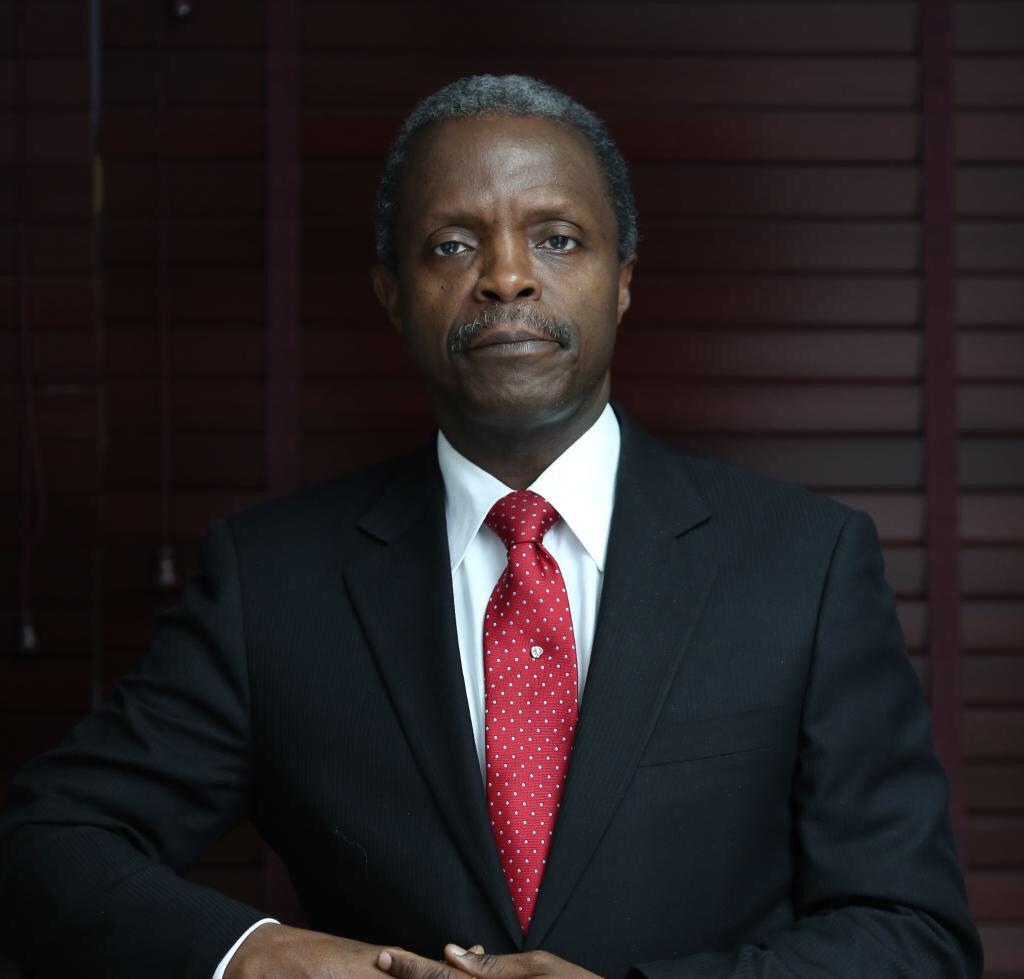
The Vice President of Nigeria, Prof Yemi Osinbajo, has celebrated success stories of several young Nigerians across the globe. He also called called for the Nigerian bridge to connect ethnic groups, dialects, religion, politics and generations.
“My point is that we can contribute in profoundly transformative ways to changing our society by just doing our bit with excellence,” the Vice President.
Prof Osinbajo’s call was made at the Workers’ Day lecture held at The Platform event of the Covenant Church, Iganmu, Lagos.
See below the full text of His Excellency’s speech:
Nation-building in its classical sense refers to the formal and informal processes by which political leadership attempts to build a national identity, a national ethos, a national spirit, especially in ethnically and religiously diverse societies.
But it is my thesis that while government’s role is in casting the vision and creating the environment for nationhood, the real building of nations is done and best seen through the efforts and accomplishments of many outside of political leadership.
Men and women in business, agriculture, education, entertainment and the arts, who by just doing their business diligently, or serving faithfully or making sacrifices contribute to building the economies and social systems that ultimately build the nation.
This afternoon I will share some of the stories of young people many of whom I have met who by just doing their own work faithfully have contributed to building our economy, increased our national pride and confidence, created opportunities for others, as well as, inspired others to be the best they can be.
My point is that we can contribute in profoundly transformative ways to changing our society by just doing our bit with excellence.
Let me begin with the exceptional role of young Nigerians in innovation and technology. On the 17th of April, I did a tour of technology businesses and hubs in Lagos.
Paystack was my first stop, here is a safe payment system, which offers seamless money transactions between businesses and their customers. It was established in 2016 by two young Nigerian alumni of Babcock University; Sola Akinlade and Ezra Olubi. Within the first three months of 2018 they have processed over N3billion and generate about N40billion annually for Nigerian businesses.
The company is today powering over 9,000 businesses that did not exist two years ago, creating over 25,000 jobs. Paystack has over 50 employees all under 35 years old.
I was also at Andela , a multinational company specializing in training software developers, co-founded by Nigerian born Iyin Aboyeji, & others like Ian Carnevale, Jeremy Johnson and Christina Sass. The company estimates that in the next 10 years there will be 1.3million software development jobs and only 40,000 computer science graduates to fill them.
The company’s vision is to change the future of Nigeria and the African continent by developing talent and potential in Nigeria. Today, the company has 1000 employees worldwide.
To enable that to happen government’s role is to mainstream technology startups to be able to benefit from the incentives of industry.
Kola Oyeneyin’s Venia Business/ Hub, is one of the earliest business hubs in Nigeria. Here, he has provided an effeicient environment for many startups. Most of who use each other’s skills and technology cooperatively.
But the pioneer of Nigerian hubs is clearly the Co-Creation Hub or CC Hub founded in 2010 by two young social entrepreneurs, Bosun Tijani and Femi Longe. It provides a platform for using innovative technology to solve social problems. Nearly 50 Nigerian tech driven businesses were incubated in CC hub. Some include now famous and dominant players like Budgit, Wecyclers, Genni Games, Lifebank, Gomyway, Vacantboards, Traclist, Autobox, Stutern, Gritsystems and Mamalette.
All these businesses were started by young men and women under thirty-five. One of the startups that came out of Venia Hub is Flutterwave founded” in May 2016 by Iyin Aboyeji and a team of engineers and former bankers. This is a payment technology company that has since processed $2billion worth of transactions on its payment platforms.
Tayo Oviosu‘s Paga, is in a class by itself. It is the leading mobile money transfer service in Nigeria. Paga has 11,000 agents across Nigeria and 6 million users. The company has a staff strength of 200. By facilitating payments for goods and services in this way, Paga has enabled several businesses and transactions.
In healthcare, many young people are solving huge problems with ease. Temi Giwa’s LifeBank and Ola Orekunrin’s Flying Doctors are two startups using technology and innovation to fill critical gaps in our healthcare industry. Lifebank works on the blood shortage problem in hospitals and save lives by speeding up blood donations and delivery to hospitals in Lagos. Their Lifebank app connects donors and hospitals and they ensure delivery of blood within 55 minutes.
Ola Orekunrin’s flying doctors, is the first air operated emergency medical service in West Africa. Her company provides air ambulances from a pool of 20 aircrafts and highly trained medical personnel for emergency evacuations.
The building of a self-reliant nation must mean that the Nation should at least be able to feed itself. The response of many young Nigerians to the President’s call to “grow what we eat, eat what we grow,” and also diversify our economy is responsible for the phenomenal growth we have experienced in the past three years in the Agricultural sector.
The transformation in productivity and increase in investment that Nigerian talent and entrepreneurship have brought to agriculture is truly remarkable.
Farmcrowdy is a digital agriculture portal that crowdsources funding for farms across Nigeria. Founded in 2016 by Onyeka Akumah and three other young Nigerians, it operates like a mutual fund; pooling together money from multiple investors to establish farms and hire smallholder farmers to cultivate them, and then paying the investors dividends from the harvests from these farms. In December 2017 it succeeded in raising US$1m in funding. From November 2016 till date, over 3000 rural farmers have been able to keep a job, expand their farm operations and increase their revenue as a result of intervention by Farmcrowdy.
Such farmers include Sunday Ohimai who is a cassava farmer in Edo State, Esther a maize farmer from Dorowa-Babuje, just outside Jos, who recently improved her small acreage to a hectare and Uka Eje ‘s Thrive Agric in Abuja, who uses the same business model as Farmcrowdy also,with great success.
Four years before Farmcrowdy, in 2012, Yemisi Iranloye founded Psaltry, a cassava processing company in the rural town of Ado- Awaye. The starch it produces from the processed cassava is now used by several leading Nigerian food manufacturing companies, including Nestle, Unilever and Nigerian Breweries – as they increasingly replace imported starch with locally-sourced varieties. Psaltry was one of the companies that found growth opportunities in the midst of the recession, as companies cut down on imports and explored locally available substitution. In 2015 its revenues grew three-fold, and in 2016 it began building a second production line.
Abdul Fatah Sadiq Murtala, 25, is from Batagarawa local government in Katsina state. He founded Brio Green Agro Nigeria in 2016. It builds greenhouses and hydrophonic systems. Hydroponics is a method of growing plants in the growth chambers without soil. Brio Green is producing Animal fodder feed in a climate-controlled facility year round using this technology,. Brio Green Agro supplies farms and ranches with fodder feed.
Kola Masha’s Babban Gona supports smallholder farmers in Northern Nigeria with financing, agricultural input, training and marketing. Masha is leveraging his experience in both the private and public sectors to deliver solutions that are changing the lives of thousands of struggling farmers like Umar Magaji, a 35-year-old farmer, who owns 1.5 hectares and, as of this year, leases another 2.5 hectares. He plans to lease a further 2 hectares next year.
Thanks to Babban Gona, he says, his yields are two to three times what they once were. He has refurbished his house, bought a motorcycle and enrolled his children in the village school. He is hopeful he can perform the pilgrimage to Saudi Arabia within the next two years.
Angel Adelaja, founder of Fresh Direct, has perfected an innovative approach to farming, in disused containers, without soil and with very little water. What she’s doing could very well be the start of an urban farming revolution in Nigeria.
Also while visiting the Workstation Hub in Victoria Island I had the pleasure of drinking Sola Ladoja’s fresh juice-‘Pick me up’ made by his start up Simply Green. Simply Green is a farm- to -bottle raw organic cold press juice company. Using organic and technologically harvested practices, meaning no chemicals or pesticides are used in growing their fruits and vegetables.
In beauty and high fashion, there is very little doubt that young Nigerians have captured and in some instances, dominating local and international imagination. So the ground breaking pioneering works of Deola Sagoe and Lisa Folawiyo has spawned a whole new generation of Nigerian designers confidently using Nigerian and African prints to make bold and unmistakable statements in high fashion. So today, Deola Sagoe has transformed the traditional Yoruba Iro and Buba, by using laser cut Aso-Oke to create the now famous Komole, the toast of brides across the country.
Lisa Folawiyo has on her part taken beaded African prints to new levels of creativity and both have inspired a new generation of designers like, Andrea Iyamah, and 31 year old Amaka Osakwe, Maki oh! (started at 23) is celebrated in Vogue magazine and last year in the New Yorker as West Africa’s most daring designer. Her use of adire in many collections is an intentional ploy to boldy redefine elements of culture.
Orange Culture, Mai Atafo are also literarily making waves in Men’s clothing.
In the beauty industry, Tara Fela-Durotoye, founder of the House of Tara and Banke Meshida, BM-PRO stand out as pioneers who have influenced a whole generation of beauty experts, and beauty products and opened a new vista in bridal make up. Tara’s training of hundreds of beauty experts and franchising of her House of Tara has created a whole new indigenously Nigerian beauty industry.
This has created thousands of jobs for beauty experts and retailers. So now we see more ladies with their contours and highlights popping (on fleek – trend for good make up) Shomaya, (Elaine Edozien Sobanjo) Joyce Jacob have also introduced Hollywood glamour to the Nigerian wedding make up industry.
By the way, what celebration today can beat the Nigerian wedding? from the make-up, dresses, to the decor, catering, cakes, party planning, and the photography; a whole new industry has developed by creative young people making an otherwise memorable event, even more memorable and linking ethnicities across the country in fashion and ceremony.
Today everyone Yoruba, Ibo, Hausa, many others from different ethnic groups wear Aso Ebi, and their wedding ceremonies are becoming increasingly similar, not by a uniformity that results in loss of culture or tradition, but by a creativity that brings a standard while accentuating tradition and culture. The whole nature of the moderation, yet preservation of the traditional engagement ceremony is such testament to the depth of thought and creativity that has promoted, perpetrated and internationalized our tradition and values.
The Nigerian wedding is becoming so popular that the film “Wedding Party” was a major international commercial success.
It is perhaps in the literary arts, especially the written and spoken word that we see the difficult issues of nation building most poignantly confronted by young people. A new generation of literary torchbearers has emerged. Talents like Chimamanda Adichie, Helon Habila, Teju Cole, Chika Unigwe, Chigozie Obioma, Chibundu Onuzo, Abubakar Ibrahim, Eghosa Imasuen, Ayobami Adebayo, Elnathan John and many more, poets like Titilope Sonuga, Dike Chukwumerije, picking up the baton from the Soyinkas and Achebes.
Their works expose the complications and the solutions to the issues associated with the mentality of persons in the post colonial state, a multi ethnic multi religious, society and underscore the question and process of emerging from these records and histories and building a nation therefrom. The reflection and introspection, their talents, boldness, precision, undiluted expressions and call to action invoke in us all is exactly what nation building and greatness is made of.
They are not timid, and represent a growing class of sophistication and confidence that confront lingering post-civil war and even post colonial aches and pains. They highlight the hypocrisy of ethno-religious barriers often set by the elite for selfish advantage and expose the underlying selfishness and failure of statesmanship that exploits fault lines for political and personal benefit. They highlight the cancer of systemic corruption and how it has eaten into the fabric of our society and cost us lives, years and retrogression.
These writers and poets explore, explain and humanize the difficult issues around social justice, the humiliation and delegitimization that poverty brings, and the failures of the rule of law.
In Chimamanda Adichie’s “Half of a Yellow Sun,” one of the main characters, a University Professor, tells his houseboy: “There are two answers to the things they will teach you about our land: the real answer and the answer you give in school to pass. You must read books and learn both answers. I will give you books, excellent books. They will teach you that a white man called Mungo Park discovered River Niger. That is rubbish. Our people fished in the Niger long before Mungo Park’s grandfather was born. But in your exam, write that it was Mungo Park.”
This reminds me of one of the proverbs that Chinua Achebe popularized: “Until the lions have their own historians, the history of the hunt will always glorify the hunter.” – an affirmation of the truth that nation-building is to a large extent about storytelling and the importance of telling our own stories and writing our own histories.
Aniete Isong’s “Radio Sunrise” is a scathing indictment of bribery in the Journalism profession. That the watchdogs of our democracy are sometimes mere captives of corrupt politicians and that news and its analysis may often be paid for. There is no doubt that grand corruption remains the most enduring threat to our economy.
Just to give an example, Three Billion US dollars was stolen in the so called Strategic Alliance contracts. Three Nigerians were responsible. Today 3 billion dollars is 1trillion Naira and our budget is 7 trillion! When oil was selling at 100-114 dollars a barrel, the government spent N99b Transport and Agric got N15b and N14b respectively in total three ministries got N139b. Today with oil prices between $60 and 70 per barrel, Power Works and Housing in a year got N415b, Transportation N80b, and N65b for Agriculture totaling N560b.
How come we can do more with less income?
We are investing in infrastructure: started Lagos-Kano standard gauge railway, the Mambilla Hydro, the second Niger Bridge and so on. If you control corruption you can do more with less.
Dike Chukwumerije, reminds us in his powerful poem the Revolution has no tribe that our destinies as Nigerians no matter our tribe or religion are inextricably tied together. What affects one affects all. Suffering neither knows tribe nor tongue.
He says:
“Do you not know that poverty is not an Ijaw man?
He will not spare the rest of us and afflict only the Ishan
He will step over the river and come across the border
So, when the drums sound let everybody answer
Do you not know that corruption is not from Nekede?
He will not hear that Ife had no dealings with Modakeke
He will wake up all of our children at night with hunger
So, when the drums sound, let everybody answer
Do you not know that our enemies have no face?
They are indigenes of no state, they come from no place
and, if this boat capsizes every one of us will go under
So, when the drums sound, let everybody answer
Do not say, “I am an iroko”, when the forest is burning
Do not say, “I am an obeche”, when the forest is burning as
Our differences will not prevent us from perishing together
So, when the drums sound, let everybody answer.”
Nations are also built by the contributions of public servants, those who work for governments despite the relatively poor remuneration.
Damilola Ogunbiyi was 28 when as the first female General Manager of the Lagos State Electricity Board, she supervised the building of the 5 independent power plants in Lagos State and was responsible for providing solar power to over 200 schools and primary health centers in the State. Today still under 40 years old, she is the first female Managing Director of the Rural Electrification Agency, REA, responsible for providing uninterrupted power to 37 Federal Universities and seven Teaching Hospitals.
She has started the project to provide power to Nigeria’s largest markets. Aready the first phase of the project has been completed in Sabongari market in Kano, and the construction phase has been completed for the Ariaria market in Aba.
Afolabi Imokhuede handles the Npower programme, a major feature of the Federal Government’s Social Investment Programme. The programme engages 200,000 graduates across all the States and the local governments . Its applications came through a portal developed by Softtcom, a company of young Nigerian engineers. The process is completely transparent and you don’t need to know anyone to be engaged.
Tochi Nwachukwu is the Special Assistant to the President on power privatization responsible for transmission, Ime Okon is a Senior Special assistant to the President advising on railways, roads, airports and other infrastructure projects,
Mariam Masha, a medical doctor, and Senior Special Assistant to the President on IDPs and Bisi Ogungbemi, both have been working with IDPs in Maiduguri since August 2015. Recently they have been managing a newly built learning Centre and home for 1500 orphans in Maiduguri. There is also Mohammed Brimah who works on the North East Humanitarian technolgy hub, where ground- breaking innovation to tackle humanitarian challenges are developed.
But often forgotten are the excellent teachers in primary and secondary schools. Take the wonderful ingenuity and dedication of Emeafor Roland Chigozie, a secondary school teacher in the FCT, who has earned several awards for extraordinary efforts in raising our next generation. This Micro- Biology and Chemistry graduate of the University of Nigeria, Nsukka, was named the best science teacher and recognized specially for exceptional performance in preparing FCT students in quiz and projects exhibitions. He also recently received another award for contributing to the 774 Young Nigerian Scientists Presidential Award competitions. As a chemistry teacher, the success rate of Emeafor’s students in the past 5 years of WAEC and NECO Exams ranged from 87% to 92%.
There is also Doreen Osarobo Omoregie, a school teacher from Edo State, currently working in the FCT. She is a graduate of Chemistry Education, and she deserves this mention just because she consistently goes beyond the call of service in discharging her responsibilities. Even as a youth corper serving in a primary school, she organized a workshop for teachers on the use of primary science kits. She was soon able to take her school towards winning the award for the first best state school in Nigeria in science. Miss Omoregie herself was best science teacher in her school for three consecutive years. Quite remarkably, she was able to use her knowledge in producing items like soap, sanitizer, disinfectants etc which were used to protect students and teachers during the Ebola crises.
I am amazed at the incredible work they do.
These are the true nation builders, teachers, farmers, entrepreneurs, public servants, who work in this country, pay taxes, bear the hardships, but remain focused. They are the determined ones who never lose hope that change even if slow is possible and the only option, even when painful and unpopular. They are prepared to do their own part day by day. Their own dreams of greatness and their hardwork are the building blocks of our Nation.
And how about the young men and women of the police and armed forces who lay their lives on the line daily to protect us ? The story of Late Colonel Muhammad Abu Ali, has been told often. As commander of the 272 Task Force battalion. His battalion was responsible for the recapture of Bama, Baga, Monguno and later Konduga in Borno State. He was decorated for bravery and excellence. He had become a terror to Boko Haram insurgents.
But he and four other soldiers were killed in an ambush. He was 36 years old, survived by his wife and three children.
The story of late Sergeant Chukwudi Igboko went viral when he confronted armed robbers in a daylight robbery at a Zenith bank in Owerri, Imo State. He killed one of the robbers, the robbery was foiled but he and another officer Sgt Sunday Agbo died of the gun shot injuries they sustained during the attack. Both left wives and children. It is to these men and women who fight to defend our nation from terrorism, and crime that we owe the preservation of our nationhood .
Some do not die but lose their limbs, their sight or hearing. The widows, widowers and children of these brave men and women bear the pain and anguish of loss by themselves for many years.
And then there is the entertainment sector, whose main advantage lies in how it transcends tribe, tongue and location to bring joy to the screens of millions of Nigerians. Think of how much bliss the music videos of Clarence Peters and the bestselling comedies of Ayo Makun, Basket mouth, Akpororo, Chioma Emeruwa( Chi gal) Falz the Bad guy, Funke Akindele (Jenifa), and the multi talented comedian singer Kenny Black have brought to audiences at home and abroad. They proudly fly our flag and make us proud. But one of our favourites at the villa is Senator MC Toguwaye, “his excellency the President.” His impersonations of the President has him nearly falling off his chair with laughter. And then there is the newest generation, emerging as we speak on Instagram and WhatsApp. Lasisi Elenu (‘Somun just happen right now!’), Williams Uchemba (“You know I don’t like what I hate”).
Stand up Comedy in Nigeria owes much to the pioneering efforts and mentor ship of Ali Baba. He literally created a whole industry. AY Ayo Makun is not just successful he has continually given a new generation of comedians a platform with his AY live shows.
As Dr. Martin Luther King Jr. said. “An individual has not started living until he can rise above the narrow confines of his individualistic concerns to the broader concerns of all humanity”.
Few will deny the incredible dividends that Nollywood has brought to Nigeria. Jason Njoku and his wife, Mary, owners of Iroko and Rock TV pioneered live streaming of Nollwood movies, taking Nollywood to the world. They have also provided opportunities for hundreds of production personnel and agents.
For a lot of these, it is to Mo Abudu, founder Ebonylife TV which airs in 49 countries, and a prolific creator of high quality Afro-centric entertainment content, that pride of place must be given. Mo Abudu has continuously sought to change the negative perceptions of Africa by telling Africa stories from an African perspective. Her project the “Wedding Party” became the highest grossing Nigerian movie.
Wherever you go in the world today, on airplanes or in department stores you can hear Nigerian music. The credit for taking Nigerian music to the world must go to stars like Tiwa Savage, Davido, Olamide, Wizkid, Waje and so many others. Their creativity and talent has benefited our nation’s image and put a spring to the steps of so many young and aspiring entertainers. The credit for the discovery, grooming and production of many world class Nigeria acts and records, and building true Nigerian brands is to the likes of DonJazzy (Marvin records), and Banky W’s E.M.E.
As government our business is to create the environment for entrepreneurs to do business, so we are working on access to cheap credit, and on providing infrastructure, especially power, greater broadband penetration.
But the task of nation building is never done. The builders confront new problems daily. Today we are confronted with the remnants of Boko Haram terrorism, with farmer/herdsmen clashes, and the potential of ethno religious conflict, we have to feed ourselves, provide millions of new jobs, as every day more people are added to our population. The job of the builder is not to complain or escape, but to confront and solve.
What can we do together to ensure that we don’t spend the rest of our days looking forward to the past, frozen by inaction, resolved to doing the same things over and over, and hoping for better results?
I believe the solution is in building the Nigerian bridge. This bridge will not be built of steel or bricks and mortar, but it must be made of the strongest materials of all, our will to excel, our commitment to build a new society, men and women of a new Nigerian Tribe.
This is a bridge that connects us across tribes, ethnicities and dialects, a bridge that connects us across religion, politics and generations. Every one can travel on this bridge, this strong and steady bridge, a bridge that rises from innovation and traditions that span the troubled waters of our past. A bridge that will withstand the powerful forces of fear, division and exclusion. A bridge that can take the traffic of our best ideas, our creativity, our human and material resources daily to the destination of our national dreams. The bridge will be built with the wisdom of the elderly and the strength of youth. All of us deserve some accolades!








 Opinion3 days ago