Connect with us

Economy

Why We Sealed NDDC Office in Rivers – FIRS

Published

on

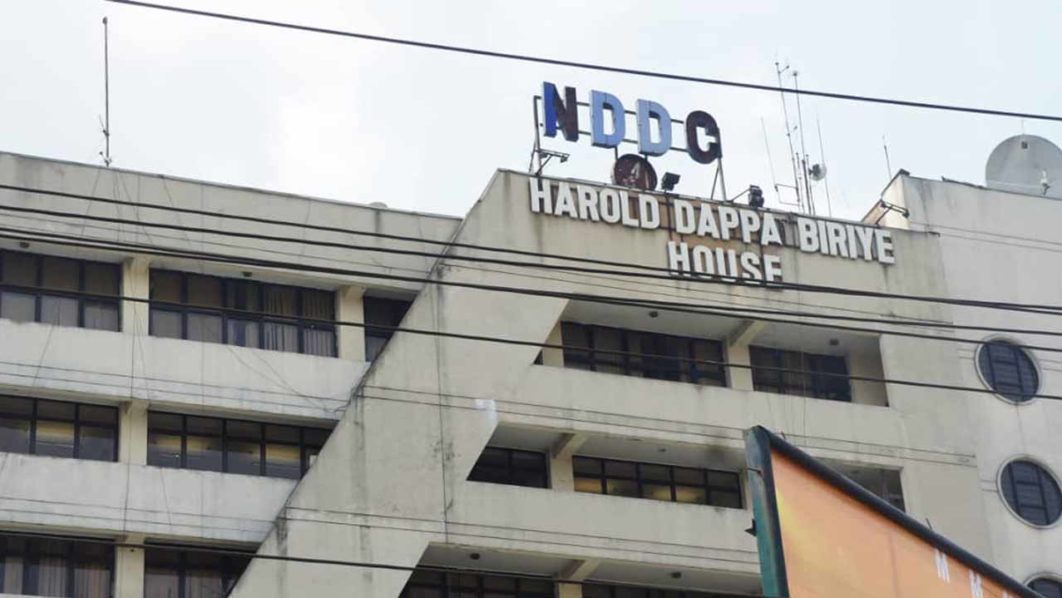
The Federal Inland Reve­nue Service (FIRS) says it sealed the Niger Delta Development Commission (NDDC) corporate headquarters in Port Harcourt, Rivers state, on Thursday over tax debt.

Muhammed Nami, FIRS chairman, said this in an interview with NTA on Friday.

Although, Nami did not state the specific amount, he said NDDC owes an “outstanding tax of N26 billion”.

This is not the first time the tax agency is carrying out the act. In 2018, the Rivers Inland Revenue Service (RIRS) sealed off the NDDC headquarters in the state due to withholding tax estimated at over N600 million.

After a year, the same was done over unpaid withholding tax to the tune of N50 billion.

In April 2021, the FIRS directed all ministries, departments and agencies (MDAs) to remit all outstanding tax liabilities to the service within 60 days.

It said failure to do will lead to the deduction of unremitted taxes from the budgetary allocation of the defaulting MDAs.

Nami said: “Tax debt is a priority all over the world. We’ve sent a signal to ministries, departments and agencies of government that business is not going to be usual in this country.

“You cannot keep government money and force the government, whether at local, state and federal level, to continue to borrow…because these monies (taxes) are used by the government to fund their budgetary requirement.

“We’ve discussed (FIRS and NDDC), even with some cabinet members, and we’ve reached an agreement which will be made known to Nigerians between now (Friday) and Monday.”

Meanwhile, Ibitoye Abosede, NDDC director of corporate affairs, said the development was due to a gap in communication between NDDC and the new management of FIRS.

“It is an ongoing thing. In 2018, this same happened. It is unremitted withholding tax for some years up to 2013. It is not a recent thing,” Abosede said.

“We have done reconciliation and they came with that amount. In 2018, when they sealed the place, we raised an agreement with them to seek ways to deduct at source from what the government is owing us so that we knock it off.

“I remembered that in 2018, we paid N1.5bn but since that 2018 we haven’t had a board and it hampered the efforts of deducting it at source. We don’t have regular subvention from the federal government.

“Efforts are ongoing to make sure the issues are resolved. We have a new chairman in FIRS and we are reaching out to him to let him understand our previous agreement.”


Continue Reading
Click to comment

Leave a Reply

Your email address will not be published. Required fields are marked *

Economy

Dangote Refinery Sacks All Nigerian Workers, Cites ‘Total Reorganization’ As Reason

Published

on

By

The management of Dangote Refinery has terminated the employment of all its Nigerian workers.

The statement to this effect was shared on X, Wednesday, by a political commentator, Imran Wakili.

“Dangote Refinery has officially laid off all of its Nigerian workers under the guise of “reorganization”, less than 24 hours after 90% of them joined PENGASSAN,” he wrote.

Wakili said the development comes less than 24 hours after 90 percent of them joined the Petroleum and Natural Gas Senior Staff Association of Nigeria, PENGASSAN.

According to a memo dated September 25, 2025, and signed by the Chief General Manager of Human Asset Management, Femi Adekunle, Wakili posted on X, the company said the decision was taken as part of a “total re-organisation” of the plant following reported cases of sabotage in different units of the refinery.

The notice directed affected staff to surrender all company property in their possession to their line managers and obtain exit clearance.

The finance department was also instructed to compute benefits and entitlements for payment in line with terms of employment.

The refinery’s management thanked the dismissed workers for their services while in its employment.

Dangote refinery and PENGASSN have been embroiled in a trade dispute over unionization issue.

DailyPost

Continue Reading

Economy

Tinubu’s Borrowing Strategic, Not Reckless – Presidency

Published

on

By

The Presidency has defended Nigeria’s rising debt levels, emphasising that borrowing is a necessary and strategic tool for economic development rather than a sign of financial imprudence.

Special Adviser to President Tinubu on Media and Public Communication, Sunday Dare, responded on his official X account @SundayDareSD to criticisms from former senator Dino Melaye, who labelled the government’s borrowing as excessive and reckless.

Dare dismissed Melaye’s claims as uninformed “noise”, clarifying that the increase in Nigeria’s reported public debt of N149.39 trillion as of March 31, 2025, is mainly due to the depreciation of the naira, not new borrowing.

“When the currency depreciates, the naira value of existing external debt rises even without fresh loans,” he explained.

He highlighted that Nigeria’s debt-to-GDP ratio currently ranges between 40 and 45 per cent, which is moderate compared to South Africa’s 70 per cent and Ghana’s over 90 per cent.

Dare argued that the greater issue lies in improving government revenue generation rather than blaming borrowing levels.

“Debt is a legitimate instrument for financing growth and reforms. The key consideration is sustainability, not empty rhetoric. Unfortunately, Dino prefers theatrics over facts,” the presidential aide said.

Dare also noted progress in government revenue collection, which enhances Nigeria’s ability to meet its debt obligations.

According to him, the Tinubu administration is committed to the Renewed Hope Agenda reforms aimed at broadening the revenue base, sustaining investments, and maintaining debt sustainability.

“Until Dino understands the fundamentals of economics, his commentary will remain entertainment, not enlightenment,” he concluded.

Continue Reading

Economy

NUPENG Strikes Deal with Dangote Refinery, Suspends Industrial Action

Published

on

By

The Nigeria Union of Petroleum and Natural Gas Workers (NUPENG) has suspended its strike following an agreement with the management of Dangote Refinery to recognise workers’ rights to unionise.

The deal was reached at a closed-door meeting convened by the Department of State Services (DSS) and attended by the Minister of Finance, Wale Edun and representatives of the Nigeria Labour Congress.

Acting NLC General Secretary, Benson Upah, confirmed the outcome, while the Ministry of Labour said it would issue a formal statement soon.

The resolution followed a conciliation meeting convened by the Federal Ministry of Labour and Employment on Monday, September 8, 2025, after NUPENG threatened to embark on strike over the company’s initial refusal to recognise workers’ union rights.

According to the Memorandum of Understanding (MOU) signed at the meeting, both parties agreed that unionisation is a right under extant labour laws, and employees of Dangote Refinery and Petrochemicals who wish to unionise would be allowed to do so.

The MoU further stated that the process of unionisation would begin immediately and be completed within two weeks (September 9 to September 22, 2025).

It also resolved that no employee of the refinery or petrochemical company would be victimised as a result of the strike notice.

In line with the agreement, NUPENG suspended its strike with immediate effect, while parties are expected to report back to the Minister of Labour a week after the conclusion of the exercise.

The memorandum was signed on behalf of the management by Managing Director Dangote Group, Sayyu Dantata, O.K. Ukoha for Nigerian Midstream and Downstream Petroleum Regulatory Authority (NMDPRA), Ojimba Jibrin, Dangote Group. It was also signed by representatives of labour unions: Benson Upah for Nigeria Labour Congress (NLC), N.A. Toro for Trade Union Congress (TUC), NUPENG President Akporeha Williams, and General Secretary of NUPENG, Afolabi Olawale.

The Federal Ministry of Labour and Employment was represented by: Amos O. Falonipe, Director, Trade Union Services & Industrial Relations, signing on behalf of the minister.

Continue Reading

Trending