
Headline
John Dramani Mahama: Administrator Par Excellence Bags Igbinedion University Doctorate Honours


By Eric Elezuo
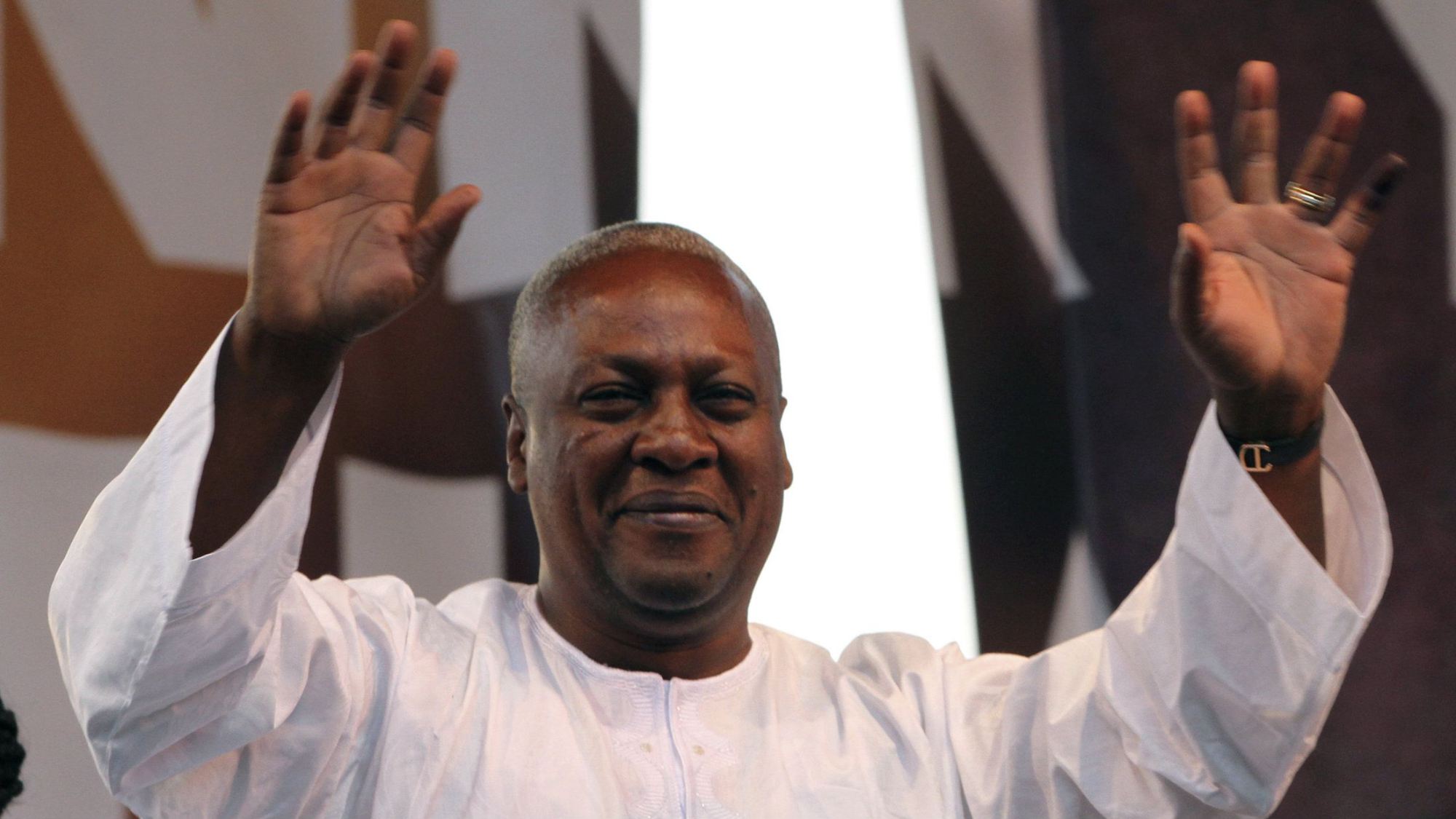
Former President of Ghana, Mr. John Dramani Mahama, is not a stranger when it comes to churning out people oriented programmes and initiatives. During his days as minister, vice president and subsequently, the president, Mahama’s landmark achievements have remained a reference to administrators and would-be administrators. His feats have not escaped the discerning minds and eyes, who have showered him with accolades from home and abroad. The latest in the avalanche of recognitions is the award of honours on his person by the premier private university in Nigeria, the Igbinedion University, Okada, Edo State.
All roads lead to the prestigious university on Saturday, November 24, 2018 where the ex-president will be confered with an honourary doctorate degree for his foresightedness, infrastructural development and general achievements which have affected humanity positively.
A politician of great repute, Mahama was born on November 29 1958, and has been privileged to serve in various civil and political capacities, culminating in holding the highest office in the land from July 24, 2012 to January 7, 2017.
Mahama started his primary education at the Accra Newtown Experimental School (ANT1) and completed his O’levels education at Achimota School and his A’levels education at Ghana Secondary School (Tamale, Northern region). He proceeded to the University of Ghana, Legon, receiving a bachelor’s degree in history in 1981 and a postgraduate diploma in communication studies in 1986. As a student, he was a member of Commonwealth Hall (Legon). He also studied at the Institute of Social Sciences in Moscow in the Soviet Union, specializing in Social Psychology; he obtained a postgraduate degree in 1988.

His catalogue of enviable services include serving as Vice President of Ghana from 2009 to 2012, and took office as President on July 24, 2012 following the death of his predecessor, John Atta Mills. He was also a Member of Parliament from 1997 to 2009 and Minister of Communications from 1998 to 2001. A communication expert, historian, and writer, Mahama is a member of the National Democratic Congress.
Though he was born in Damongo in the Damango-Daboya constituency of Northern region, he is a member of the Gonja ethnic group, and hails from Bole in the Northern region. His father, Emmanuel Adama Mahama, a wealthy rice farmer and teacher, was the first Member of Parliament for the West Gonja constituency and the first Regional Commissioner of the Northern Region during the First Republic under Ghana’s first president, Kwame Nkrumah.
After completing his undergraduate education, Mahama taught history at the secondary school level for a few years. Upon his return to Ghana after studying in Moscow, he worked as the Information, Culture and Research Officer at the Embassy of Japan in Accra between 1991 and 1995. From there he moved to the anti-poverty non-governmental organisation (NGO) Plan International’s Ghana Country Office, where he worked as International Relations, Sponsorship Communications and Grants Manager between 1995 and 1996.
In 1993, he participated in a professional training course for Overseas Public Relations Staff, organized by the Japanese Ministry of Foreign Affairs in Tokyo. He also participated in a management development course organized by Plan International (RESA) in Nairobi, Kenya.

A catalogue of achievements
Mahama’s first triumph in politics came in 1996 when he was elected to the Parliament of Ghana to represent the Bole/Bamboi Constituency for a four-year term. In April 1997, he was appointed Deputy Minister of Communications, and barely a year later, was promoted to the post of Minister of Communications, and served until January 2001. During the period under review, he also served as the Chairman of the National Communications Authority, in which capacity he played a key role in stabilising Ghana’s telecommunications sector after it was deregulated in 1997.
As a minister, he was a founding member of the Ghana AIDS Commission, a member of the implementation committee of the 2000 National Population Census and a deputy chairman of the Publicity Committee for the re-introduction of the Value Added Tax (VAT).

Mahama is a lover of education
In 2000, Mahama was re-elected for another four-year term as the Member of Parliament for the Bole/Bamboi Constituency. He was again re-elected in 2004 for a third term. From 2001 to 2004, Mahama served as the Minority Parliamentary Spokesman for Communications. In 2002, he was appointed the Director of Communications for the NDC. That same year, he served as a member of the team of International Observers selected to monitor Zimbabwe’s Parliamentary Elections. As an MP, he was a member of Standing Orders Committee as well as the Transport, Industry, Energy, Communications, Science and Technology Committee of Parliament.
Continuing to expand his interest and involvement in international affairs, in 2003 Mahama became a member of the Pan-African Parliament, serving as the Chairperson of the West African Caucus until 2011. He was also a member of European and Pan African Parliaments’ Ad-hoc Committee on Cooperation. In 2005 he was, additionally, appointed the Minority Spokesman for Foreign Affairs. He is a member of the UNDP Advisory Committee on Conflict Resolution in Ghana.
As Vice-President, he served as the Chairman of the National Economic Management Team, the Armed Forces Council of Ghana, the Decentralisation and Implementation Committee and the Police Council of Ghana in this capacity. Mahama is full of experience, having served at all levels of poltical office, and he brought them all to bear as President, giving out a sterling performance that could only compare with the very best. He was the first, and remains the only Ghana president to have been born after independence.
On 30 March 2014, he was elected to preside over ECOWAS. On 26 June 2014, he was elected Chairperson of the African Union’s (AU’s) High-Level African Trade Committee (HATC).

The Katoka Airport
On 21 January 2016 on the occasion of the World Economic Forum in Davos, Mahama became co-chair of the Sustainable Development Goals Advocates group which consists of 17 eminent persons assisting the UN Secretary-General in the campaign to achieve the Sustainable Development Goals (SDGs) that world leaders unanimously adopted in September 2015.
He honourably left office on January 7, 2018 after losing to main opposition leader, Nana Akufo-Addo, in the general election.
In December 2016, he was part of part of the ECOWAS mediation team to resolve the post-election political impasse in The Gambia between the defeated incumbent, Yahya Jammeh and declared winner, Adam Barrow.
Mahama, now a member of the Assemblies of God, is married to Lordina Mahama, and they are blessed with five children named Shafik, Shahid, Sharaf, Jesse and Farida.
Over the course of his career, Mahama has written for several newspapers and other publications both locally and internationally. Additionally, he is also a devotee of Afrobeat music, especially that of Fela Kuti.

The stadium project
Mahama is not new to awards and honours as his good works have paved a broad way for recognitions. He received an honorary doctorate in the field of Public Administration, from the Ekiti State University of Nigeria, formerly affiliated to the Obafemi Awolowo University in “recognition of his politico-socio economic development of Ghana and Africa at various stages of his political career. Later the same university passed a resolution to name its Faculty of Management Science after him.
He was also honoured by the Cuban government with the Friendship Medal for his relentless advocacy for the Cuban cause.
Also The General Council of Assemblies of God, Ghana has honoured him with its Daniel Award.
The Graduate School of Governance and Leadership also awarded him the African Servant Leadership Award while the Institute of Public Relations recognized Mahama with a prize for his leadership acumen and technocratic flair.
In 2013, the Forum for Agricultural Research in Africa (FARA) conferred on Mahama the Africa Award for Excellence in Food Security and Poverty Reduction.
In March 2016, University of Aberdeen held a special convocation to confer him an honorary degree of Doctors of Laws (LLD).
In December 2016, he was honoured with a Life time award by Ovation Media Group during its yearly Ovation Carol.

A Bill Gates Fellow, Mahama was awarded the Great Cross of the National Order of Benin, the highest award in Benin, by President Yayi Boni.
In February 2017, Mahama received the 2016 African Political Leader of the Year Award from the African Leadership Magazine in South Africa.
President John Dramani Mahama has touted the achievements of his government in the areas of power, roads, the economy, water and sanitation. While delivering his final State of the Nation Address to Parliament, he said the government had extended electricity coverage, increased water supply and improved roads.
As president, he deployed emergency plants and sped up the completion of ongoing plants resulting in the addition of more than 800 megawatts (MW) of power over an 18-month period. That, and many more had helped to stabilise the power situation in Ghana.
Working on the standard mantra of achieving “water for all by the year 2025”, Mahama put in extra effort to achieve the target well in advance of the set date by increasing investment in the provision of clean drinking water, citing of boreholes, small town water systems and major urban water treatment. Consequently, by the end of 2015, excess of 76 per cent of both rural and urban residents have access to potable water.
President Mahama contended that his tenure of office had seen some of the most massive investments in the road sector in the history of the country.
While he completed road projects he inherited, such as the Achimota-Ofankor, Awoshie-Pokuase, Sofoline and Tetteh Quarshie-Adenta, he also commenced and completed the Kwame Nkrumah Interchange, fast-tracked the construction and opening of the Kasoa overhead bridge, completed the Airport Hills/Burma Camp network of roads, as well as the 37-El Wak-Trade Fair road and a host of others.
His trail of achievements are endless. Mahama is just another name for administrative excellence!





Dele Momodu Proposes Atiku/Obi Ticket As ‘Best Bet’ to Unseat Tinubu in 2027

Supreme Court Fixes April 22 for Hearing in ADC Leadership Crisis

Ali Ndume Accuses FG of Insincerity in Fight Against Insecurity

Amid Denials, ADC Reportedly Secures Rainbow Event Centre As Venue for National Convention

America 2028: Kamala Harris Considers Throwing Hat in the Ring

Shettima Lacks Respect, I Won’t Engage Him, Atiku Responds to VP’s Challenge

2027: ADC Leaders Plan Massive Coalition Against APC, Tinubu

Dear CDS, NSA, Your Prodigal Sons, Brothers Have Killed General Braimah

Nation Building Reimagined: Integrated Principles and Strategies for Sustainable Growth

Ovation @30: A Triumph of Vision, Courage and African Excellence

Mahama, Macron Hold High-Level Bilateral Talks in France

FIFA Lists Six Females Among 52 Referees for 2026 World Cup

Israel Questions Pakistan’s Credibility in Mediating over US-Iran Ceasefire Agreement

200 Feared Killed As Military Airstrikes Hit Yobe Market
-
 Opinion4 days ago
Dear CDS, NSA, Your Prodigal Sons, Brothers Have Killed General Braimah
-
 Opinion4 days ago
Nation Building Reimagined: Integrated Principles and Strategies for Sustainable Growth
-
 Opinion5 days ago
Ovation @30: A Triumph of Vision, Courage and African Excellence
-
 World5 days ago
Mahama, Macron Hold High-Level Bilateral Talks in France
-
 Sports5 days ago
FIFA Lists Six Females Among 52 Referees for 2026 World Cup
-
 World5 days ago
Israel Questions Pakistan’s Credibility in Mediating over US-Iran Ceasefire Agreement
-
 National3 days ago
200 Feared Killed As Military Airstrikes Hit Yobe Market
-

 Headline5 days ago
ADC National Convention: To Be or Not to Be?