Connect with us

Economy

Labour Enforces Strike, Cripples Govt, Banks, Schools in Lagos

Published

on

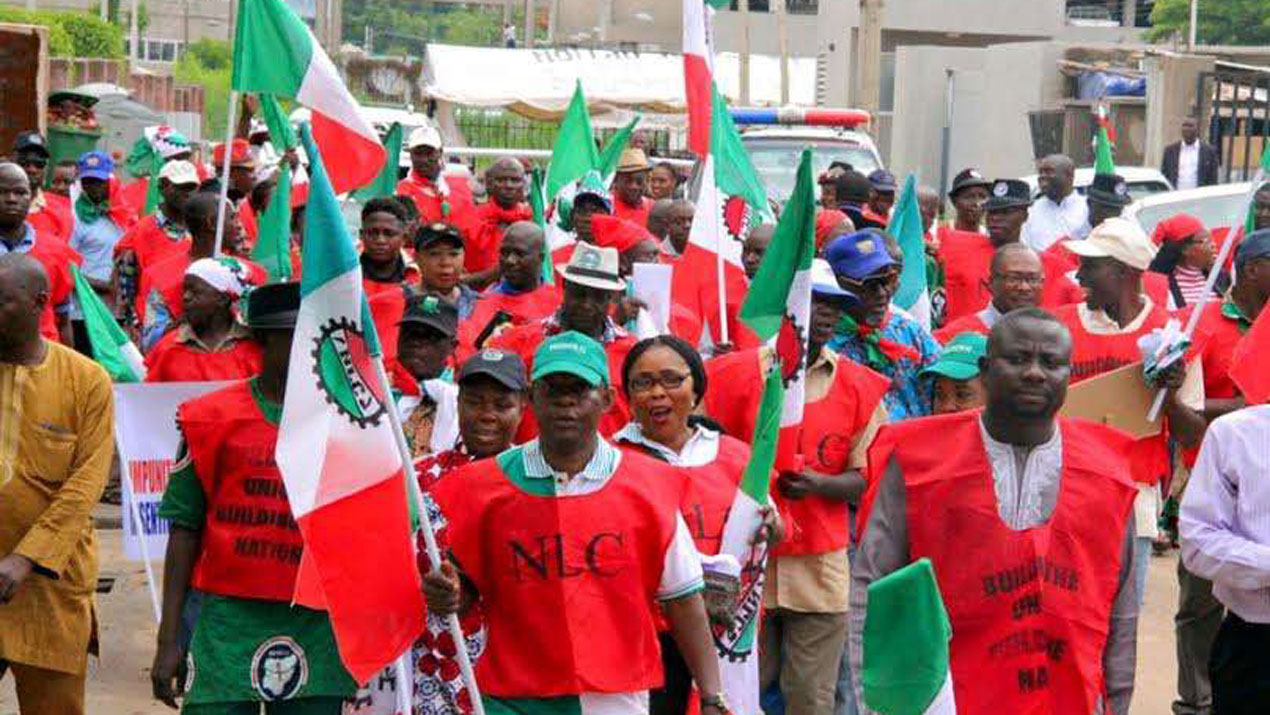
Government offices, banks and public schools were on Thursday closed in Lagos State as the organised labour began its strike over delay by Federal Government in concluding negotiation on a new minimum wage.

The enforcement teams of the organised labour set out from Ikeja to the State Secretariat, Alausa, at 7:20 am and workers who arrived for work were being turned back.

The News Agency of Nigeria correspondents who went round the Lagos metropolis reported that the United Bank for Africa on Lagos-Ibadan express way and Wema Bank in Alimosho were closed.

NAN reports that the enforcement team of the Association of Senior Staff of Banks, Insurance and Financial Institutions led by its President, Oyinkan Olasanoye prevented staff from gaining access to Stanbic IBTC Bank, Ikeja branch.

The ASSBIFI team stormed Polaris Bank (former Skye Bank) on Awolowo Way, Ikeja, as its gate was locked by the union, while workers and customers were prevented from accessing the premises.

Olasanoye said the enforcement was in compliance with the directive of the Trade Union Congress, which ASSBIFI was affiliated to.

She had on Wednesday at a news conference told journalists that ASSBIFI had dispatched letters to all its members in banks across the country, to join the strike.

However, Access Bank in Dopemu and First Bank in Iyana-Ipaja opened for business with many customers carrying out various transactions.

Meanwhile, fuel stations were seen attending to customers, while major roads, including Iyana-Ipaja to Ikeja and Ikorodu Road, were busy with the usual heavy traffic.

It will be recalled that labour demanded N65,000 national minimum, up from the current N18,000.

The wage was subject to negotiation by the 30-man tripartite National Minimum Wage Committee set up by the government in November 2017.

NAN reports that the Minister of Labour, Sen. Chris Ngige, said the tripartite committee would reconvene on October 4, 2018.

Ngige said the meeting would enable the committee continue the negotiation, assuring that the current administration was labour-friendly and would pay the minimum wage once agreed upon.

(NAN)

Continue Reading
Click to comment

Leave a Reply

Your email address will not be published. Required fields are marked *

Economy

Dangote Refinery Files Lawsuit Against FG, NNPC, Marketers over Petrol Import Licences

Published

on

By

Dangote Petroleum Refinery has filed a fresh lawsuit against the Nigerian National Petroleum Company Limited (NNPC) and several fuel marketers, seeking to overturn fuel import licences issued by the Nigerian Midstream and Downstream Petroleum Regulatory Authority (NMDPRA).

According to court documents filed at the Federal High Court in Lagos and cited by Reuters, the refinery is asking the court to nullify import permits recently granted or renewed by the regulator, arguing that the approvals violate an earlier directive ordering all parties to maintain the status quo pending the determination of the case.

The legal action comes at a time when Nigeria is recording a sharp decline in petrol imports due to rising domestic refining capacity, largely driven by output from the Dangote Refinery.

In its filing, Dangote Refinery argued that Nigerian law permits fuel importation only when local production is unable to meet national demand. The company maintained that continued issuance of import licences undermines its operations as it ramps up production from its multi-billion-dollar refinery located on the outskirts of Lagos.

Fuel marketers, however, have consistently defended importation, insisting that imports remain necessary to guarantee a stable supply and prevent shortages across the country.

This is not the first dispute between Dangote Refinery and fuel importers. In 2025, the company filed a similar suit against NNPC Ltd and several marketers, including AYM Shafa Ltd, A.A. Rano Ltd, T. Time Petroleum Ltd, 2015 Petroleum Ltd and Matrix Petroleum Services Ltd, while also seeking ₦100 billion in damages. The suit was later withdrawn without explanation.

Recent industry data showed petrol imports dropped to 965.52 million litres in Q1 2026 from 2.43 billion litres in the same period of 2025. Meanwhile, supply from local refineries rose to 3.18 billion litres, accounting for about 76.7 percent of Nigeria’s petrol supply during the quarter.

Continue Reading

Economy

World Bank Flags ‘Hidden Spending System’ Diverting N34.53trn of Nigeria’s Revenue

Published

on

By

The World Bank has raised concerns over Nigeria’s fiscal framework, revealing that more than N34.53 trillion was diverted from federation revenue over the past three years through pre-distribution deductions.

In its latest Nigeria Development Update obtained from its website, the global lender disclosed that although total federation revenue rose sharply to about N84 trillion between 2023 and 2025, about 41 per cent of the earnings did not reach the Federation Account for distribution to the federal, state and local governments.

According to the report, gross revenue increased from N17.08 trillion in 2023 to an estimated N37.44 trillion in 2025. However, deductions classified as “first-line charges” also rose significantly, from N6.22 trillion to nearly N15 trillion within the same period, reducing the pool of funds available for distribution.

The World Bank noted that the development has created a paradox in which rising revenues have not translated into improved public spending capacity, as a substantial portion is automatically retained by certain agencies before allocation.

It explained that reforms such as the removal of petrol subsidy and foreign exchange adjustments boosted nominal revenues, but much of the gains were offset by the structure of deductions tied to cost of collection and statutory transfers.

Agencies such as the Nigeria Customs Service, Nigerian National Petroleum Company Limited, and the Federal Inland Revenue Service account for a significant portion of these deductions. The report stated that their funding is based on fixed percentages of gross revenue, leading to higher allocations as revenues increase.

Describing the model as “pro-cyclical”, the Bretton Woods institution said it operates outside the conventional budgetary framework and weakens legislative oversight. In some cases, allocations to individual agencies exceed the revenues of several states and even the budgets of key federal ministries.

The report also highlighted the impact on public finances, noting a decline in capital expenditure from N5.5 trillion in 2024 to N4.5 trillion in 2025, with only about 25 per cent of the approved capital budget implemented. Meanwhile, the federal fiscal deficit remained elevated at N16.9 trillion, driven by debt servicing and recurrent expenditure.

The World Bank warned that the current arrangement undermines fiscal transparency and accountability, as significant portions of public revenue are spent outside the standard appropriation process.

Source: tribuneonline

Continue Reading

Economy

Dangote Refinery Raises Petrol Price to N1,275, Diesel Now N1,950

Published

on

By

The Dangote Petroleum Refinery has increased the gantry price of petrol and diesel, further tightening pressure on consumers and businesses across Nigeria. This is however, in response to the rising geopolitical tensions in the Middle East and their ripple effects on global energy markets.

A top official at the refinery, who confirmed the development to our correspondent on Tuesday night, said the facility adjusted its pricing in response to prevailing international crude oil benchmarks and market realities.

The new pricing template shows that petrol rose by N75 per litre to N1,275, representing an increase of about 5.02 per cent, while diesel jumped by N200 per litre to N1,950.

This marks a sharp increase from last month’s prices of N1,200 per litre for petrol and N1,750 for diesel, signalling that diesel is now on track to breach the N2,000 per litre mark at the pump, further intensifying cost pressures across the economy.

“The adjustment is in line with global market trends. You are aware of the ongoing tensions in the Middle East and how they have impacted crude oil prices. These are external factors that directly influence refined product pricing,” the official, who spoke in confidence due to the lack of authorisation to speak on the matter, stated.

He added, “Petrol has been reviewed upward by N75 to N1,275 per litre, which is about a five per cent increase, while diesel has increased more significantly by N200 to N1,950 per litre. These changes reflect the realities of the international market.”

Market data from Petroleumprice.ng corroborated the development, indicating that the latest petrol price reflects a 5.02 per cent increase at the gantry level.

The development comes at a time when stakeholders had hoped that increased local refining capacity would help stabilise domestic fuel prices. However, analysts say Nigeria remains exposed to global oil price volatility due to its reliance on international crude benchmarks for pricing.

The latest hike could trigger a fresh wave of increases in pump prices nationwide, with marketers expected to pass on the additional cost to consumers in the coming days.

Global oil markets have remained volatile in recent weeks due to escalating tensions in the Middle East, a region that accounts for a significant share of the world’s crude oil supply. Any disruption or perceived risk to supply routes often leads to price spikes, which in turn affect refined petroleum products globally.

Nigeria, despite being an oil-producing country, operates a deregulated downstream sector where fuel prices are largely determined by market forces. This means that local prices are influenced by international crude prices, exchange rates, logistics costs, and refinery operations.

The Dangote Petroleum Refinery, Africa’s largest, was expected to reduce Nigeria’s dependence on imported fuel and help stabilise prices. However, experts note that as long as crude oil pricing remains tied to global benchmarks, domestic fuel prices will continue to fluctuate in response to international developments.

The latest increase also comes amid concerns over affordability, with consumers already grappling with high energy and transportation costs. A sustained price increase could worsen inflationary pressures and slow economic recovery.

Continue Reading

Trending