Opinion
The APC Primaries: Winners and Losers, Sportsmanship and Democracy As the Ultimate Winner
Published
2 weeks agoon
By
Eric
By Prince Adeyemi Shonibare
Politics, like sports, produces winners and losers. Every competition cannot end with everyone carrying home a trophy, and every election cannot produce multiple winners for a single office. At the conclusion of every democratic contest, there will be celebrations in some camps and disappointment in others. What ultimately distinguishes a mature democracy is not the absence of defeat, controversy or disagreement, but the capacity of participants to display sportsmanship, accept outcomes with dignity, pursue legitimate grievances through lawful channels and place the collective interest of democracy above personal ambitions.
The recently concluded primaries of the All Progressives Congress (APC) have once again demonstrated both the beauty and complexity of democratic politics. Across Nigeria’s 8,809 wards, millions of party members participated in one of the most expensive and extensive internal democratic exercises ever undertaken by a political party on the African continent. The party conducted primaries for 993 State House of Assembly constituencies, 360 House of Representatives constituencies, 109 Senate seats, governorship positions in states due for elections and the presidential ticket of the party. In practical terms, more than 1,462 legislative positions alone were subjected to democratic contests, in addition to governorship and presidential elections.
The magnitude of the exercise was extraordinary. Thousands of aspirants campaigned simultaneously across the federation. Millions of party members participated in selecting candidates. Thousands of election officials, observers, journalists, consultants, agents, volunteers and security personnel were mobilized. Ward structures came alive from the creeks of the Niger Delta to the savannah of the North, from the commercial centres of Lagos and Kano to remote communities scattered across the federation. Results were collated, disputes addressed and appeal mechanisms activated.
Yet, despite the sheer scale of the exercise, Nigeria remained peaceful.
Markets remained open. Businesses continued trading. Schools remained in session. Commercial flights took off and landed as scheduled. Public institutions functioned normally. Citizens carried on with their daily activities. The nation did not descend into widespread unrest despite the enormous political activity generated by the primaries.
That achievement deserves recognition and commendation.
Perhaps the most remarkable feature of the APC primaries was the adoption of the direct primary system, a process many observers have compared to the participatory spirit of the famous Option A4 model introduced during the political transition programme of former military President Ibrahim Babangida. Through this mechanism, political power moved beyond governors, ministers, senators and political elites and was placed directly in the hands of ordinary party members at the grassroots.
For perhaps the first time on such a nationwide scale, APC members in villages, towns, cities and communities across Nigeria were given the opportunity to directly determine who would represent the party in future elections.
The message was unmistakable.
The party belongs to its members.
Not to governors.
Not to ministers.
Not to senators.
Not to political godfathers.
Not even to the President.
But to the ordinary men and women who constitute the foundation of the party.
That is the essence of democratic participation.
Direct primaries are expensive. There is no denying that reality. Conducting elections across 8,809 wards simultaneously requires enormous financial resources, manpower, logistics and administrative coordination. Results recording materials must be distributed. Officials deployed. Security arrangements made. Results collected and verified.
Yet democracy is rarely cheap.
Participation has a cost.
Inclusion has a cost.
Legitimacy has a cost.
The reward, however, is that power becomes decentralized and decision-making is transferred from a handful of influential actors to ordinary party members.
The direct primary system compels aspirants to return to the grassroots. It forces politicians to reconnect with ordinary members. It rewards political relationships built over years rather than influence exercised from air-conditioned offices.
Indeed, one of the major lessons from the APC primaries is that money alone cannot guarantee victory in a direct primary election.
Financial resources may facilitate campaigns. They may improve logistics. They may enhance visibility. But they cannot easily substitute for popularity, grassroots structures, credibility and sustained engagement with party members.
Several prominent political figures discovered this reality too late.
Some highly placed office holders failed to secure nominations despite their visibility and influence. Some former ministers who left executive positions in pursuit of elective offices discovered that occupying public office does not automatically translate into grassroots popularity. Some lawmakers who had become accustomed to political comfort zones found themselves confronted by party members eager to exercise independent judgment.
In several constituencies and districts, party members selected candidates they considered more suitable, available and accessible to represent their interests.
That is democracy at work.
The result may be painful for some aspirants, but democracy was never designed to guarantee victory and painless.
It was designed to guarantee opportunity.
It was designed to guarantee participation.
It was designed to guarantee free choice.
The beauty of direct primaries lies in their capacity to reflect the authentic mood of the grassroots. Political history repeatedly demonstrates that it is difficult to suppress a genuinely popular candidate when ordinary voters are given direct access to the ballot.
Nigeria’s democratic experience provides perhaps the most famous example. During the historic 1993 Nigerian presidential election, widely regarded as one of the freest elections in the nation’s history, Moshood Kashimawo Olawale Abiola secured victories across regional, ethnic and religious boundaries, including areas many analysts considered politically improbable against Bashir Tofa. The election demonstrated a timeless democratic truth: when citizens are genuinely allowed to express their preferences freely, popular candidates can transcend conventional political calculations.
That lesson remains relevant today.
It is difficult to defeat a candidate who genuinely enjoys overwhelming grassroots support when party members are given direct participation. The larger the electorate, the more difficult it becomes for narrow interests to impose outcomes contrary to popular sentiment.
The presidential primary itself was historic. President Bola Ahmed Tinubu emerged as the APC presidential candidate after securing an overwhelming majority of 10.9 Million votes cast by party members nationwide.
While a party primary should never be confused with a general election, the turnout demonstrated significant organizational strength and grassroots mobilization within the party.
Many political observers have interpreted the participation figures as a vote of confidence in President Tinubu’s leadership of both the party and the government.
Equally significant was the fact that the President himself faced a challenger.
The APC did not prevent the challenger from contesting.
It did not treat the aspiration as an act of rebellion.
It did not deny him access to the democratic process.
Instead, it allowed him to exercise his democratic right to test his popularity before party members nationwide.
That is democracy.
That is inclusion.
That is confidence in democratic institutions.
Following his victory, President Tinubu emphasized unity, democratic participation and inclusiveness. In acknowledging his challenger, he reinforced the principle that democratic competition should not create permanent enemies but strengthen democratic culture.
Every political giant was once unknown.
Every governor was once an aspirant.
Every senator once sought support.
Every president once requested votes.
Democracy creates opportunities where privilege alone cannot guarantee success.
The APC National Chairman also consistently emphasized party unity, reconciliation and internal democracy throughout the process. His repeated message was that while contests may produce winners and losers, the larger family of the party must remain united after the competition.
That message remains important.
Political contests are temporary.
Political institutions endure.
One notable development that generated political discussion was the decision of Siminalayi Fubara not to seek a second-term APC ticket. According to public statements from APC leaders, he successfully passed the party’s screening process. However, for reasons known principally to himself and those within his political circle, he ultimately did not proceed with the contest. As an old African proverb reminds us, a man does not inquire too deeply into the circumstances surrounding his father’s death until he possesses the strength and wisdom to confront the answers. Politics often contains dimensions visible only to those directly involved.
Beyond politics, the APC primaries generated substantial economic activity throughout Nigeria.
Campaign offices were rented and furnished. Hotels recorded increased occupancy. Vehicles were hired. Airlines transported campaign teams. Restaurants and caterers supplied food for meetings, consultations and rallies. Event centres hosted stakeholder engagements and political gatherings.
The advertising and communications sector experienced one of its busiest periods in recent years.
Political public relations professionals, media strategists, consultants, advertising agencies, printers, graphic designers and branding companies secured contracts worth millions of naira.
Campaign posters, banners, billboards, flyers and promotional materials decorated communities nationwide. Television stations benefited from paid interviews and sponsored political programmes. Radio stations hosted campaign discussions and special broadcasts. Newspapers carried advertisements and feature articles. Online media platforms generated substantial revenue through campaign-related content and digital advertising.
Social media became a major arena of political engagement. Facebook, Instagram, X, TikTok, YouTube and WhatsApp were transformed into platforms for persuasion, mobilization and voter outreach. Content creators, digital consultants and social media managers found themselves in high demand.
Experiential campaigns flourished.
Town hall meetings.
Stakeholder consultations.
Youth engagements.
Women mobilization programmes.
Community interactions.
Ward meetings.
Political rallies.
All these activities created opportunities for event managers, decorators, photographers, videographers, sound engineers, logistics providers and countless service professionals.
Campaign merchandise flooded communities nationwide. Thousands of T-shirts, face caps, umbrellas, notebooks, calendars, shopping bags and promotional souvenirs were produced by local manufacturers. Textile suppliers benefited. Tailors secured contracts. Embroidery companies expanded production.
Transportation providers moved supporters and campaign teams across communities.
From roadside printers in local government headquarters to major advertising agencies in Lagos and Abuja, countless businesses benefited from the circulation of campaign resources.
The APC primaries therefore became not merely a political exercise but also a significant contributor to economic activity and temporary employment generation.
Another issue that generated debate concerns aspirants facing investigations or court proceedings.
Here, constitutional principles must remain paramount.
An allegation is not a conviction.
An investigation is not a conviction.
A trial is not a conviction.
Under the rule of law, every citizen remains innocent until proven guilty by a court of competent jurisdiction.
Political parties are not courts of law.
They are not judicial tribunals.
They are not moral temples established to determine guilt or innocence.
Their constitutional responsibility is to facilitate political participation within the framework of the law.
Where the Constitution, electoral laws or final judicial pronouncements disqualify an individual, such provisions must naturally be respected. However, where no legal disqualification exists, the determination of guilt remains exclusively the responsibility of the courts.
To replace due process with suspicion would undermine the foundations of constitutional democracy.
As Nelson Mandela once observed, a critical, independent and investigative press is the lifeblood of democracy.
Criticism therefore has an important place in democratic society.
Complaints should be investigated.
Questions should be asked.
Transparency should be encouraged.
However, criticism must also be fair.
Achievements deserve recognition just as shortcomings deserve scrutiny.
At this point, one is reminded of the biblical admonition:
“Let him who is without sin cast the first stone.”
Before condemning an exercise involving millions of participants and thousands of contestants, critics should identify a democracy anywhere in the world that consistently conducts elections without disputes, petitions, appeals, disagreements or litigation.
Such perfection does not exist. Or it can be found in the graveyard only.
As Winston Churchill famously observed:
“Democracy is the worst form of government except for all those other forms that have been tried.”
Similarly, Barack Obama noted:
“The hallmark of a functioning democracy is not whether everybody agrees, but whether people can disagree peacefully.”
And Abraham Lincoln provided perhaps democracy’s most enduring definition:
“Government of the people, by the people, for the people.”
Even William Shakespeare understood the complexities of leadership and public judgment when he wrote:
“The fault, dear Brutus, is not in our stars, but in ourselves.”
Democratic societies succeed not because they are perfect but because they continually strive for improvement.
The APC primaries have also demonstrated a growing maturity within Nigeria’s democratic culture. Despite the enormous number of participants and contestants, democratic institutions continued to function. The republic endured. The political system absorbed disagreements without descending into widespread instability.
That is progress.
That is democratic consolidation.
At this stage, the wisdom of legendary Juju maestro Chief Ebenezer Obey becomes particularly relevant. In one of his memorable narratives, he tells the story of a father and son travelling with a donkey. When the father rode the donkey while the son walked, onlookers condemned him as heartless. When the father dismounted and allowed the son to ride while he walked, the same public condemned the son as disrespectful and the father as foolish. The lesson was profound: no matter what decision is taken, there will always be critics. Human beings are often difficult to satisfy completely.
Politics follows the same pattern.
No election will satisfy everyone.
No primary will please every aspirant.
No democratic process will escape criticism.
Leaders must therefore focus on fairness, participation, transparency and accountability, leaving posterity to render the final judgment.
However, every success story carries lessons and warnings.
The APC must not mistake success in internal primaries for guaranteed victory in the 2027 general elections.
A training session is not the same as a championship match against another formidable opponent.
Political strategists understand that internal party contests and national elections operate under entirely different dynamics. What succeeds within party structures may not automatically translate into victory against determined opposition parties in a general election.
The party must therefore avoid complacency.
It should pay close attention to voter sentiment in the South-West and other strategic regions. Political strongholds should never be taken for granted.
Loyalty grows when citizens feel respected, heard and rewarded through good governance.
The APC must also move swiftly to reconcile aggrieved aspirants and their supporters.
Politics is a game of addition, not subtraction.
Every disappointed aspirant represents supporters, associates, financiers and political structures.
Ignoring grievances can create opportunities for opponents.
That is why reconciliation is not merely desirable.
It is essential.
The leadership of the party at national, state and local levels should embark upon deliberate consultations, peace initiatives and confidence-building measures. Political bridges should be repaired before they become political fault lines.
A farmer who neglects his crops should not be surprised when another farmer harvests them.
Political parties must continually cultivate, encourage and retain their members.
Most importantly, governments at all levels must remain focused on governance.
Citizens want more security.
Citizens want more jobs.
Citizens want more stable prices.
Citizens want more quality healthcare.
Citizens want more better schools.
Citizens want more better roads and affordable mass transportation system.
Citizens want more electricity.
Citizens want more housing.
Citizens want more economic opportunities.
Citizens want more macroeconomic stability translated into better microeconomic prosperity for families, workers, traders, artisans, farmers and small businesses.
Politics is not an end in itself.
It is a means to improving the lives of the people.
In the final analysis, the APC primaries have demonstrated government of the people , by the people , for the people and that internal democracy is alive and evolving within Nigeria’s political system. They have empowered ordinary party members. They have strengthened grassroots participation. They have generated economic activity. They have reinforced democratic competition. They have highlighted the importance of sportsmanship .
Finally .
There were winners.
There were losers.
There were celebrations.
There were disappointments.
Yet above all else, one truth stands unmistakably clear.
Democracy was the ultimate winner.
Political victories are temporary.
Political defeats are temporary.
But democratic institutions endure when citizens and leaders alike respect the rules of the game.
The APC primaries have provided another opportunity for Nigeria to deepen democratic culture, strengthen internal party democracy and reinforce the timeless principle that political legitimacy ultimately flows from the people.
And in the final judgment of history—not emotion, bitterness or temporary political passions—the enduring verdict may well be that while individuals won and lost, democracy itself emerged victorious.
Prince Adeyemi Shonibare is a Public Affairs Analyst, and Media Consultant.
Related
You may like
The morning sun streamed through the stained-glass windows of the Anglican Church of Transformation Hall, casting patches of amber and gold across the gathered crowd. Mothers clutched small bouquets—it was Mother’s Day—and children fidgeted in their seats, unaware that history was about to be made in their midst.
At the podium stood Sunny Irakpo, his hands steady on the lectern, his voice carrying the weight of nearly two decades of quiet war. Not a war of soldiers or bombs, but one fought with pamphlets, school visits, rehabilitation talks, and now—something far greater.
Before him sat bishops in clerical collars, doctors in tailored suits, community leaders in colorful Nigerian attire, and ordinary men and women who had crossed oceans for a better life. They had come to witness the unveiling of the SILEC International Magazine (SIM)—the first global media platform dedicated exclusively to reporting drug-related issues across Africa, the United States, and beyond.
“Just like a SIM device is important to a phone,” Sunny began, his voice warm yet resolute, “imagine one with a sophisticated phone without a SIM. Such a phone will be useless. Therefore, SIM is a solution provider—an enabler designed to bring value, reset mindsets, and create a global platform bold enough to revolutionize the media ecosystem.”
The room leaned in.
Three hours earlier, Revd. Canon Paul Obike had opened the ceremony with a prayer and a smile. The anchor Venerable Shola Ogbedebi , He looked out at the sea of faces—mothers, especially, whom he thanked for their invisible labor of raising children in a world saturated with temptation.
“Sunny Irakpo,” Ogbedebi had said, “is a courageous young man with strong passion and zeal, championing a worthy cause that has taken the lives of many promising youth in Nigeria, the United States, and across the globe. He is a trailblazer. A strong voice that keeps shaping policy direction.”
The audience had applauded, some wiping tears. They knew the statistics. They had buried nephews, cousins, sons.
Now, as Sunny continued his address, he moved from metaphor to mission.
“SILEC International Magazine is not just a publication,” he said. “It will drive awareness, create employment opportunities for young people, and support underprivileged students—particularly in Nigeria, where more than twenty million children remain out of school due to financial hardship.”
He paused, letting the number settle.
“Twenty million.”
A murmur rippled through the hall.
Sunny spoke of the vision conceived years ago, held in his heart like a pregnancy carried through contraction and pain. “When a child eventually escapes the womb, the mother leaps for joy,” he said. “Today, I stand in solidarity as a mother—not by pregnancy, but by conception of ideas that could help proffer solutions to the many problems confronting mankind. This is my joy: that baby SIM is birthed to the world today, in a country where dreams come through.”
He invoked Habakkuk 2:2—write the vision and make it plain—and reminded the gathering that a child’s raising belongs not only to its parents but to the entire community. “So it is for this newborn, named SIM,” he said. “I call for your collective nurturing.”
The statistics he shared were stark.
A United Nations report from 2025 stated that 316 million people worldwide were affected by drugs. Nearly half a million deaths annually. Twenty-eight million healthy years of life lost. In 2023, only one in twelve people with drug use disorders received any treatment.
In the United States, over one million people between the ages of eighteen and forty-five had died from drugs.
But it was Africa that Sunny named as the emerging frontline. “The new market,” he said quietly. “Seventy percent of young people. In Nigeria, according to UNODC, 14.4 million people aged fifteen to sixty-four abused drugs and substances as of 2018—significantly higher than the global average. Those aged eighteen to thirty-nine remain the worst users today.”
He did not shout. He did not need to. The numbers screamed for themselves.
Then came the moment the room had been waiting for.
The Chairman of the occasion, The Rt. Revd. Dr. Augustine Unuigbe—Coordinating Bishop of the Church of Nigeria North America Mission and Managing Director of Rapha Medical Group—rose from his seat. He was a tall man with gentle eyes and the steady hands of a physician.
“As a medical doctor,” Bishop Unuigbe said, stepping to the podium, “I have seen firsthand cases of drug overdose. I have watched young people slip away on hospital beds, their parents wailing in corridors. The drug problem and overdose deaths in the United States are underreported—for reasons I cannot ascertain. But time has come for the message to be louder.”
He turned to look directly at Sunny.
“My path and Sunny Irakpo crossed on social media,” the bishop continued. “I did not know Sunny from Adam. What brought us together is divine connection. In 2021, met him physically when the Primate of All Nigeria, the Most Rt. Dr. Henry Chukwudum Ndukuba, invited Sunny to present a paper at the Standing Committee meeting—the highest decision-making body of the Church of Nigeria, Anglican Communion. His presentation on ‘The Monster of Drug Addiction: A Battle for the Future’ was educative, revealing, and commendable.”
The bishop’s voice deepened. “My association and endorsement of SILEC Initiatives is based on the credible platform and the carrier of the message—Sunny Irakpo—who has shown serious commitment for nearly two decades. This young man deserves all the support and encouragement to propagate the message farther.”
He placed his hand on a tablet connected to a large screen. “I now unveil the SILEC International Magazine—electronically, with Artificial Intelligence tools for the campaign ideology—to the glory of God and benefit of humanity.”
The screen flickered to life. The magazine’s website appeared: crisp, modern, alive with stories. A video montage played—interviews with recovered addicts, profiles of resilient entrepreneurs, reports from Nigerian villages where schoolrooms stood empty. The audience watched in rapt silence.
Then they rose. They clapped. Some wept.
Dr. Inua Momodu, President of the Nigerian Community in Atlantic County, New Jersey, seized the moment. “Drug abuse affects almost every household,” he said. “Everyone must be involved in this fight to save the lives of young people. The Nigerian community under my leadership will continue to support SILEC Initiatives with effective collaboration.”
Distinguished guests nodded firmly from the front row. Besides, Angels In Motion ably represented by Laura Rhodes whispered to a colleague: We need to partner with them.
Before closing, Sunny Irakpo turned to the mothers in the room. It was, after all, their day.
“Dear mothers,” he said, “your roles in family and nation-building cannot be overemphasized. Sadly, in the cause of my advocacy, I have seen women deeply engaged in drug abuse and illicit trafficking. The most despicable act is using their most revered private parts to conceal drugs. One out of four females is now a drug abuser.”
The room grew very still.
“We urge our mothers to hold firm the values that help shape society. Tighten the home front. Help prevent our wards from this destructive path.”
He paused, and his voice softened.
“In loving memory, I remember today the sacrifices of my late parents—Pa Christopher Ewomarevia and Mrs. Victoria Adiheji Irakpo—for the value of education and godly parenting they implanted in me. They started this vision of SILEC with me in 2010. It pleased God that they did not witness this very important occasion. But I give God all the glory. May their kind souls continue to rest in peace.”
The ceremony ended with Reverend Ohio Simire offering the vote of thanks, followed by closing prayers from Bishop Unuigbe. As the crowd filed out into the New Jersey afternoon, phones buzzed with notifications—the live stream had reached thousands across three continents.
Outside, a young woman approached Sunny Irakpo. She was perhaps twenty-two, her eyes red-rimmed.
“My brother overdosed last year,” she said quietly. “He was nineteen.”
Sunny placed a hand on her shoulder. “Then we do this for him,” he said. “And for all the others.”
She nodded, and for the first time that day, she smiled.
Somewhere, a SIM card connects a phone to the world. And somewhere else, a newborn magazine called SIM began connecting broken stories to hope—one page, one life, one truth at a time. Oh, what a magazine you must get with just a click from your phone at www.sim.silecinitiatives.org.ng . SILEC is rising, SILEC International Magazine, the global light.
Article contributed by Kwame Jamal
Related
Opinion
When Architecture of Policy Meets Architecture of Connection
Published
3 days agoon
June 9, 2026By
Eric
By Shakirat Akintola
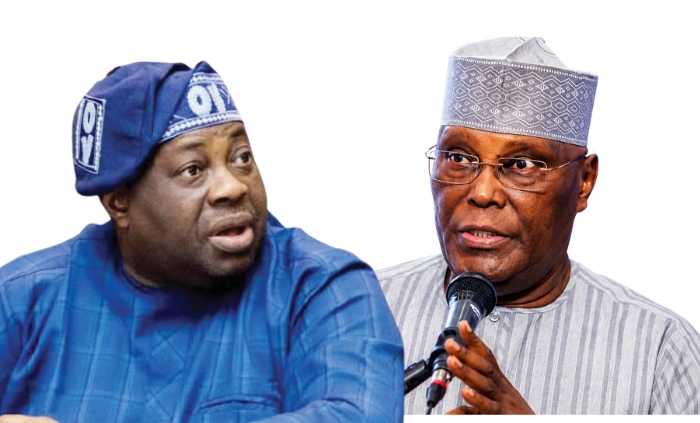
For many political observers, the proposition of an Atiku-Momodu ticket represents a fascinating answer to Nigeria’s complex governance puzzle. The conversation is rapidly moving past the two personalities involved, evolving into a broader debate about national cohesion, credibility, and the precise qualities required to steady a fractured nation.
Atiku Abubakar, having recently emerged as the presidential candidate for the African Democratic Congress (ADC) following a fiercely contested and highly scrutinized nationwide primary election, remains one of the most resilient figures in Nigeria’s democratic journey. His institutional memory is vast. As the Vice President who chaired the National Economic Council during one of Nigeria’s most consequential eras of economic restructuring and privatization, he understands the levers of state policy.
Yet, in a nation fractured along regional, religious, and generational lines, policy blueprints alone are no longer enough. The opposition faces a distinct hurdle: Nigerians already know who Atiku is. The challenge is not building recognition, but establishing a genuine, empathetic connection with the deep frustrations of the grassroots. This is precisely where Aare Dele Momodu enters the equation.
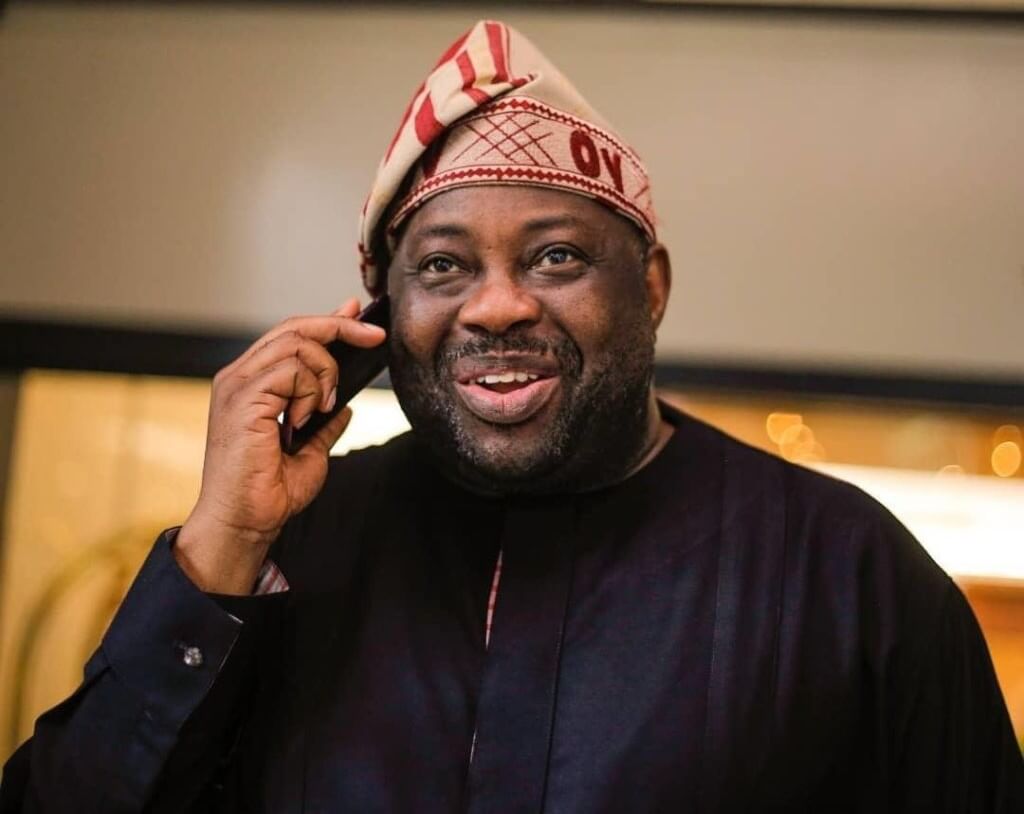
To view Momodu strictly through the glamorous lens of Ovation International is to misunderstand the deliberate philosophy behind his media empire. While critics might initially mistake his chronicling of high society for elite insulation, his career has actually functioned as a masterclass in breaking down walls. For decades, Momodu did not just document success; he demystified it, bringing the corridors of power and privilege directly to the gaze of the ordinary citizen. More importantly, this deep social capital was forged in the fires of grassroots defiance. Long before he was a celebrated publisher, Momodu was a pro-democracy activist who faced detention and forced exile during the dark days of the Abacha regime for standing with the masses. His ability to navigate corporate boardrooms today is not a sign of detachment from the struggle, but a powerful asset. It means the opposition gains a communicator who can walk into spaces of immense privilege, speak truth to power in their own language, and channel that access directly back into the service of Nigeria’s markets, classrooms, and farming communities.
A Referendum on Lived Realities
The ongoing security and economic trials illustrate exactly why a balance of institutional experience and cultural reach matters. For a parent deciding between school fees and healthcare, or a trader calculating the risks of interstate highways, governance is not a theoretical debate.
The next election will not be won by campaign slogans or aggressive social media strategies. It will be decided by trust. While the ruling party scrambles to convince a strained populace that their sacrifices will yield future rewards, the opposition must present a credible, steady, and comforting alternative.
Nigeria’s future will ultimately be shaped by leaders who look beyond political echo chambers and actively listen to the markets, classrooms, and farming communities. As the country continues its difficult search for stability, the political figures capable of building a bridge between sound policy and genuine human empathy will inevitably command the attention of a nation eager to move forward.
Related
Opinion
Why Dele Momodu May Be Atiku’s Smartest Running Mate Option Yet
Published
4 days agoon
June 9, 2026By
Eric
By Michael Abimboye
As the African Democratic Congress, ADC, gradually consolidates its coalition ahead of the 2027 presidential election, attention has inevitably shifted from the emergence of Atiku Abubakar as presidential candidate to the more delicate and strategic question of his running mate.
Several names have surfaced in political calculations and media speculation: Rotimi Amaechi, Emeka Ihedioha, and Dele Momodu, among them. Yet, beyond the noise of conventional political arithmetic lies a deeper electoral question: who among these options best expands Atiku’s coalition beyond traditional structures and into the modern political battlefield Nigeria has become?
Increasingly, the answer may well be Dele Momodu.
For years, Nigerian politics has operated under an outdated assumption that electoral victory is secured merely through governors, party leaders, and regional strongmen. The 2023 election disrupted that orthodoxy. The emergence of Peter Obi demonstrated that digital momentum, perception management, emotional resonance, and transregional appeal can significantly alter the political equation. Obi’s strongest weapon was not necessarily party structure. It was narrative dominance.
That reality has permanently changed Nigerian politics.
And in the current ADC coalition conversation, Dele Momodu may be one of the few figures who intuitively understands this new political environment.
Unlike many career politicians whose influence remains confined to state structures or elite caucuses, Momodu operates in multiple political ecosystems simultaneously: media, diplomacy, youth engagement, elite networking, pan-African influence, and digital communication. In modern electoral politics, that multidimensional relevance matters enormously.
One of Momodu’s most understated assets is his continental reach. Through decades of media work, political engagement, and elite interaction across Africa, he has cultivated relationships with presidents, former presidents, business leaders, diplomats, and intellectual figures across the continent. His network is not speculative mythology. It is publicly visible and historically documented through his long-running engagements as publisher of Ovation International and participant in high-level African political circles.
At a time when Nigeria seeks to reassert itself diplomatically and economically within Africa, such soft-power capital becomes politically valuable. A vice-presidential candidate today is no longer merely a ceremonial electoral appendage. He must also communicate competence, cosmopolitanism, and international legitimacy.
Momodu fits that profile more naturally than many conventional politicians. There is also the geographical intelligence behind his potential candidacy.
Though widely perceived nationally as a South-West figure because of his strong Yoruba cultural identity and media dominance in Lagos and the South-West, Dele Momodu is fundamentally from the South-South axis through his Edo roots. Politically, this creates a rare advantage. It allows the ADC to potentially tap into two strategic regions simultaneously without provoking the sharp regional anxieties that often accompany vice-presidential selections.
Amaechi, for instance, undoubtedly possesses political experience and administrative depth. But his polarising history in Rivers politics, coupled with his own presidential ambitions, complicates the chemistry required of a running mate. Indeed, reports have repeatedly suggested Amaechi has little interest in a vice-presidential role.
Ihedioha, meanwhile, brings stability and technocratic moderation, but lacks the national media visibility and emotional connection necessary for a fiercely competitive national election. Elections are not won only by competence. They are won by energy, narrative, symbolism, and visibility.
Dele Momodu possesses all four.
Then comes perhaps the most important factor of all: communication.
The 2027 election is unlikely to resemble previous Nigerian elections. It will be heavily digitised, media-driven, youth-influenced, and psychologically contested online. The political establishment still underestimates how profoundly social media has altered electoral mobilisation. The Obi movement in 2023 proved that online enthusiasm can shape national conversation, pressure traditional media, influence undecided voters, and energise urban youth demographics.
Momodu enters this terrain with an already established digital infrastructure.
Unlike many politicians who outsource communication to media aides, Dele Momodu himself is a communication institution. He understands headlines, optics, timing, public emotion, narrative construction, and audience psychology. His social media platforms command enormous engagement across demographics that traditional politicians often struggle to reach organically.
That matters.
In a coalition environment where ADC must unify disillusioned PDP voters, attract soft Obidients, retain Northern numerical strength, and penetrate urban youth constituencies, communication sophistication becomes central to survival.
Momodu also carries an outsider-insider advantage. He is politically experienced enough to understand power, yet sufficiently detached from the toxic baggage of conventional Nigerian political warfare. He has not governed a state, which critics may see as a weakness, but which supporters may frame as insulation from corruption controversies and governance fatigue associated with many old political actors.
In an anti-establishment electoral climate, that distinction could become useful.
Perhaps most importantly, Dele Momodu brings cultural elasticity. He can comfortably engage traditional rulers in Kano, intellectuals in Abuja, media elites in Lagos, young digital audiences in Port Harcourt, diaspora professionals in London, and political moderates in the South-East. Very few Nigerian political figures possess that adaptive national reach without appearing artificial.
And politics, ultimately, is the management of coalitions.
Atiku’s greatest challenge is not merely winning Northern votes. He already possesses substantial Northern recognition. His real challenge is rebuilding emotional trust across sections of Southern Nigeria while simultaneously energising younger demographics sceptical of establishment politics.
A conventional politician may help him consolidate structures.
Dele Momodu, however, may help Atiku reshape perception. And in modern politics, perception is often the first battlefield victory.
Related


Sowore ‘Slumps’ Amid Police Teargas During Abuja Protest
Friday Sermon: Terrorism the Curse of Islam 2
Senate Orders DSS, Police to Hunt Bandits Flaunting Crime on Social Media
Global Stage, Local Heart: Davido Champions Justice for Kidnapped Oyo Schoolchildren at FIFA Concert
June 12: Tinubu’s Govt Killing Democracy in Nigeria, Atiku Warns
Reps Pass State Police Bill
N210trn Audit Query: Senate Orders Arrest of NNPC Ex-GMD Mele Kyari
All White Service of Songs As Celebrities Bid Alex Ekubo Farewell
Lessons from 2019, 2023 Elections: Why Atiku Abubakar Needs Dele Momodu As Running Mate
UBA Foundation Marks World Environment Day 2026 with Tree-Planting Initiative
The Dark Link Between the Forest Cartels and the Ballot
Voice of Emancipation: Oyo Kidnapping: Another One Too Many
Why Dele Momodu May Be Atiku’s Smartest Running Mate Option Yet
Tech and Humanity: The Long Walk to School
Trending
-
Entertainment2 days agoAll White Service of Songs As Celebrities Bid Alex Ekubo Farewell
-
Opinion5 days agoLessons from 2019, 2023 Elections: Why Atiku Abubakar Needs Dele Momodu As Running Mate
-
Business5 days agoUBA Foundation Marks World Environment Day 2026 with Tree-Planting Initiative
-
Opinion5 days agoThe Dark Link Between the Forest Cartels and the Ballot
-
Voice of Emancipation6 days agoVoice of Emancipation: Oyo Kidnapping: Another One Too Many
-
Opinion4 days agoWhy Dele Momodu May Be Atiku’s Smartest Running Mate Option Yet
-
Tech and Humanity5 days agoTech and Humanity: The Long Walk to School
-
Opinion4 days agoThe Bridge Nigeria Needs: Reflections on Leadership, National Unity, and the Ati-Dele Conversation