Connect with us

Featured

IUO Alumnus, Damilola Olawuyi, Named Senior Advocate of Nigeria

Published

on

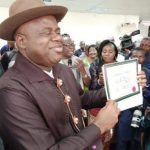
An Alumnus of Igbinedion University, Okada and a distinguished Professor of Law, Professor Sunday Damilola Olawuyi has been named as one of the 72 successful applicants for the prestigious rank of Senior Advocate of Nigeria (SAN).

Professor Sunday Damilola Olawuyi graduated with a First Class Degree from Oba Erediawa College of Law, Igbinedion University Okada in 2005. He bagged another First Class at the Nigerian Law School Bar examination in 2006 to become the first graduate of any private University in Nigeria to get a First Class at the Nigeria Law School.

Professor Sunday Damilola Olawuyi, 37, is currently Deputy Vice-Chancellor at Afe Babalola University, Ado-Ekiti an a Chancellor’s Fellow and Director at the Institute for Oil, Gas, Energy, Environment and Sustainable Environment (OGEES), Afe Babalola University, Ado Ekiti.

Professor Damilola Sunday Olawuyi holds two Master’s Degree in Law from University of Calgary, Canada and Harvard University, USA respectively. He also holds a Doctoral Degree in Law from Oxford University, United Kingdom.

He was formerly an International Energy Lawyer with Norton Rose FullBright Canada LLP where he served on the firm’s global committee on investment in Africa.

Professor Sunday Damilola Olawuyi SAN is Vice-Chair of the International Law Association and has served as a visiting Professor at Columbia Law School, New York,China University of Political Science and Law, IAS Vanguard Fellow at the University of Birmingham, and senior visiting research fellow at the Oxford Institute for Energy Studies. He was also a Herbert Smith Freehills visiting Professor at Cambridge University and has delivered lectures on energy law in over 40 countries.

In 2020, he was appointed as an Independent Expert on the African Union’s Working Group on extractive industries, environment and human rights.

Professor Damilola Sunday Olawuyi is a licensed member of the Bars of Nigeria, Alberta, Canada and Ontario, Canada.

Continue Reading
Click to comment

Leave a Reply

Your email address will not be published. Required fields are marked *

Featured

Xenophobia: Tinubu Orders Close Monitoring of Protests in South Africa

Published

on

By

President Bola Tinubuhas directed close monitoring of the ongoing anti-foreigner protests in South Africa, as the Federal government raises concerns over the safety of Nigerians and demands justice for victims of recent incidents.

The Minister of Foreign Affairs, Bianca Odumegwu-Ojukwu, disclosed this while presenting a situation report, noting that authorities are on alert ahead of another round of demonstrations scheduled for 4 to 8 May.

“There is heightened anxiety over the series of anti-foreigner protests. The priority at this time remains the safety of our citizens,” she said, adding that the President’s directive underscores Nigeria’s resolve to prevent further harm to its nationals.

Odumegwu-Ojukwu said images circulating across media platforms showing violence and xenophobic rhetoric have drawn global condemnation, describing the trend as “utterly condemnable and unacceptable.”

She, however, acknowledged that top South African officials, including President Cyril Ramaphosa, have publicly opposed xenophobia, extra-judicial killings and destruction of foreign-owned properties.

According to her, protests held between 27 and 29 April in Pretoria and Johannesburg were largely peaceful under heavy police presence, with no confirmed attacks on Nigerians during that period.

Despite this, she revealed that two Nigerians died earlier in separate incidents involving security personnel. Amamiro Chidiebere Emmanuel succumbed to injuries allegedly sustained after being beaten by members of the South African National Defence Force in Port Elizabeth, while Nnaemeka Matthew Andrew was reported dead following an encounter with metro police, with his body later found in a Pretoria mortuary.

“These incidents are utterly condemnable and unacceptable. Nigeria demands that justice be done,” the minister stated, noting that the Nigerian High Commission is closely tracking investigations.

She further confirmed that Nigeria has summoned South Africa’s High Commissioner in Abuja over the situation, as diplomatic engagements intensify to contain the fallout.

Odumegwu-Ojukwu added that Nigerian missions in South Africa are working with local authorities to minimise risks to citizens, while arrangements are ongoing for the voluntary repatriation of those willing to return home. About 130 Nigerians have so far registered for the exercise.

She also stressed Nigeria’s historical role in supporting South Africa’s liberation struggle, warning that recurring xenophobic attacks, often linked to political tensions, must be decisively addressed.

“Nigerian lives and businesses in South Africa must not continue to be put at risk,” she said, adding that both countries are engaging through existing frameworks, including an early warning mechanism, to prevent further escalation.

Continue Reading

Featured

How Regional Arithmetic Favours Atiku Abubakar in 2027

Published

on

By

By Dr. Sani Sa’idu Baba

Nigeria’s 2027 presidential contest is shaping up around a potentially decisive regional dynamic, though it remains contingent on the widely speculated exit of Peter Obi from the ADC to the NDC. Should that realignment materialize, the race could feature two formidable Southern candidates, Bola Ahmed Tinubu from the South-West and Peter Obi from the South-East against a single Northern heavyweight, Atiku Abubakar from the North-East. Such a configuration would significantly reshape the electoral map and redefine the path to victory.

Drawing inspiration from the wisdom and uncommon analytical depth of the former presidential candidate Chief Dele Momodu, it is worth recalling how he accurately predicted the outcome of the 2015 Nigerian presidential election, breaking it down zone-by-zone and state-by-state with remarkable precision. His October 2014 piece, “Buhari versus Jonathan: In Search of a Mathematician,” remains a testament to strategic political forecasting. While I may not claim such mathematical exactness, I will make a clear and reasoned case that the most viable path to defeating Tinubu in 2027 lies in rallying behind Atiku Abubakar.

President Tinubu’s post-2023 strategy appears to have shifted after an early realization that his relationship with the North had weakened, with growing discontent and opposition forces he could neither easily contain nor ignore. In response, he seems to have turned decisively toward consolidating the South, strengthening ties in the South-South, engaging political actors in the South-East, and reinforcing his natural base in the South-West in a bid to secure that region as a unified stronghold. This creates the impression that the South may lean toward continuity. However, should Peter Obi contest independently, that cohesion fractures. The Southern vote would likely split between Tinubu and Obi, opening space for Atiku Abubakar to gain footholds, especially if he secures a strategic running mate from the region.

In contrast, the North presents a different and potentially decisive equation. There is a growing perception across the region that the political moment favors consolidation behind Atiku Abubakar more than ever before. Several factors are often cited in this regard. First is the belief among many Northern voters that the current administration has exhibited ethnic bias in appointments and governance. Second is the widespread perception of imbalance in policy direction and project distribution, with flagship initiatives such as the Lagos-Calabar coastal highway seen by many as disproportionately favoring the South-West. Third, the religious sentiment that played a role in the 2023 elections appears to be losing its mobilizing power, with many voters signaling a shift away from identity-based considerations toward broader governance concerns.

Additionally, persistent insecurity and underdevelopment in many parts of the North continue to shape political expectations, with many citizens prioritizing leadership they believe can directly address these challenges. Finally, Atiku’s recent positioning of 2027 as his final presidential bid, alongside renewed emphasis on his policy proposals, appears to be resonating with the significant segments of the Northern electorate. Taken together, these dynamics suggest that Atiku is strongly positioned to secure a more unified and possibly expanded Northern mandate than in previous cycles.

The implication is straightforward: a divided South versus a relatively unified North could tilt the balance. In such a scenario, Atiku’s path to victory becomes more viable, not despite Obi’s participation, but partly because of it. The 2027 election, therefore, may be less about religious alignments, as seen in 2023, and more about regional calculations.

While outcomes remain uncertain, this emerging structure suggests that the opposition’s most realistic chance against an incumbent lies in leveraging regional arithmetic effectively and in that equation, Atiku Abubakar appears strategically advantaged…

Dr. Sani Sa’idu Baba writes from Kano, and can be reached via drssbaba@yahoo.com

Continue Reading

Featured

Supreme Court Verdict: ADC Chieftain Advises Tinubu to Kiss Aso Rock Goodbye

Published

on

By

A chieftain of the African Democratic Congress (ADC), Eze Chukwuemeka Eze, has declared that it is over for the President Bola Tinubu administration following the Supreme Court ruling that restored the David Mark-led National Working Committee (NWC) of the opposition party.

Eze, in a statement on Friday, criticized the Attorney General of the Federation, Lateef Fagbemi (SAN) and the INEC chairman, Prof Joash Amupitan, asserting that they should be ashamed for acting as obstacles to the survival of democracy in Nigeria.

He said: “The government led by President Bola Tinubu has tarnished the judiciary. Certain judges and courts are reportedly being systematically employed to undermine the leadership of political parties in anticipation of the 2027 general elections.

“Even when all seemed lost, given the recent court rulings in political cases, particularly those involving opposition parties, Thursday’s Supreme Court judgment was a divine intervention.

“We express our gratitude to God Almighty for prompting the Supreme Court to overturn that disgraceful, distorted, and anti-democratic ruling issued by the Federal High Court, the Court of Appeal, and the misguided interpretation and decision of INEC regarding our party, the ADC.”

He stressed that the time has come for Tinubu and his alleged undemocratic associates in Aso Rock to return to Lagos.

“With Thursday’s ruling saving the ADC from destruction, it is time for Tinubu to begin drafting his handover notes and prepare for his return to Lagos State,” Eze stated.

Eze advised the ADC to concentrate on its primary function as a prominent opposition party in the upcoming 2027 general elections, as that the leadership dispute has been resolved.

He emphasized that stability at the upper levels of the party will result in improved organization, clearer communication, and enhanced participation in Nigeria’s political arena.

Notably, he asserted that the ruling will add to Nigeria’s expanding collection of case laws regarding political party governance, and urged the ADC to stay focused on its objective of reclaiming power from the APC due to poor governance.

“It highlights the judiciary’s role in interpreting party constitutions and ensuring adherence, which may affect how future conflicts are resolved,” Eze stated.

He praised the panel for upholding justice, remarking that any opposing decision regarding the ADC’s alleged leadership issue would have further entangled the Judiciary in the murky waters of arbitral corruption.

“Clearly, this ruling has set the stage for cohesion, unity, stability, and effective leadership within the ADC.

“With this issue now definitively settled, even though it should not have been justiciable ab initio, as it pertains to an internal matter of a political party, we urge all our members, stakeholders, and supporters to unite behind the David Mark-led leadership of the ADC to collectively reposition the party for greater national significance, viability, and visibility,” Eze said.

Continue Reading

Trending