Connect with us

Opinion

Trailblazing Recognition of Professional Competence by Omniversity, USA

Published

on

By Ayo Oyoze Baje

“Our vision is to create platforms where knowledge, leadership, and practical experience converge to inspire excellence” – Prof. Tokunbo Akeredolu-Ale

Call it the paradox of pedigrees, if you like and you may not be far from the truth. Yet, it remains an interesting situation for instance, to find the connecting chord amongst the global icons of information technology made up of geniuses such as Bill Gates, Mark Zuckerberg, Evan Williams, Michael Bell, Richard Branson and Steve Jobs( of blessed memory). And what could that be? Despite their high level of creative ingenuity they are not graduates of Harvard, Oxford universities or any other one for that matter! Simply put, their outstanding academic achievements were fashioned outside the four walls of the citadel of great knowledge.

As it is with them out there, so it has been with our own world -renowned, multiple award-winning icon of African art, Nike Morica Okundaye.The Ogidi-Ijumu, Kogi state-born Owner/Curator of Nike Art Gallery currently boasts of attention – grabbing art galleries in Oshogbo, Abuja,Lagos and Ogidi where she has empowered over 200 women in the skill of making Aso-Oke. All these and more she has achieved without a university degree. And it is interesting to also note that another globally – recognized Nigerian literary giant,Prof. Wole Soyinka the Nobel Laureate earned the honour strictly based on his remarkable creative works of writing away from a doctoral program. Both deserve all the accolades, plaudits and honours they have received so far, do they not? Of course, they do.

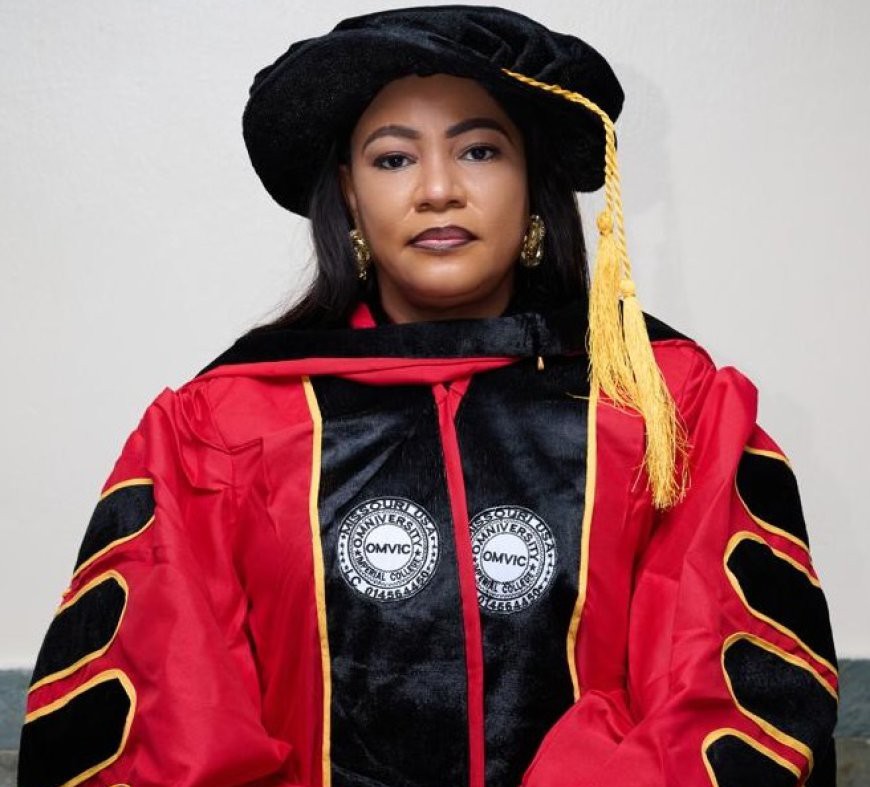
Of great significance therefore, is the redefinition of what education truly entails for the 21st century by the wave-making Omniversity Imperial College,LLC, Missouri,USA. As the world’s first and only ISO-certified private institution it issues ISO-certified practice qualifications to eminently qualified professionals from different fields of human endeavour. By so doing, it is bridging professional practice, innovation, and academic validation with qualifications that reflect real world excellence.

To match words with action, it recently made history in Nigeria’s decades of chequered academic landscape, with the game-changing conferment of Doctor of Practice and Professor of Practice degrees on some multi-talented, highly resourceful, erudite and impact -making innovators.
The landmark event which took place on October 3, 2025 at the De Rembrandt Hotel and Suites, in Ikeja, Lagos was tagged: ‘2025 African Education Roundtable and Qualifications Conferment’. It
had as its thought-provoking and telling theme: ‘Recognizing Competence: Practice -Based Qualifications, Accreditation of Prior Experimental Learning ( APEL ),Skill Recognition ( SR ) & ISO-Certified Credentials (ICC) as Tools for African & Economic Revamp.’.

In his welcome speech, the highly distinguished Prof. Akeredolu -Ale who happens to be a professor of artificial intelligence powered marketing communications, leadership, organization and risk management highlighted the vision of the University as that of creating platforms where knowledge, leadership and practical experience converge to inspire excellence. The event therefore,goes beyond a mere gathering of intellectuals to that of a call to action for educational reform, economic advancement and the recognition of Africa’s unique contribution to global development.

That brings to the public sphere the importance and imperative of the new narrative of what true knowledge should entail, outside the four walls of theoretical knowledge to that its practical demonstration. And more so, the impact such makes on the human development index ( HDI )or the quality of life of the beneficiaries and eventually the Nigerian nation and the society at large.

Incidentally, these defined the core values and prime objectives of the Omniversity which includes to promote the recognition of competence and experiential learning. Others encapsulate the advancement of ISO-certified educational practices across Africa, fostering discussions on leadership, certification and of course, innovation in education. Not left out are that of creating opportunities for professional recognition through honorary awards and practice based titles, as was brilliantly done on that day. And the larger picture is to contribute to Africa’s economic and educational revamp through competence validation.

Interestingly, all the awardees successfully went through a rigorous evaluation process as conducted by the Accreditation Committee that verified the educational quality and equivalency, through the required framework for quality evaluation and assessment assurance. And good enough, they were able to defend their new qualifications with brilliant submissions and empirical evidence.

For instance, once Dr. (. but now Prof.) Francis Toromade, with over 35 years experience of Senior Leadership, including being Group Head, Policy and Strategy,Amo Byng Nigeria Ltd and Director General Agribusiness Acadeyand FIPAN has left indelible footprints in the world of academic. Apart from teaching Strategic Management, Logistics, Supply Chain and Agribusiness Innovation to Masters degree students at Rome Business School, Italy he also leads Nigeria Poultry and Soybean Value Chain Analysis and directed USSOY programs. In fact, he has trained over 300,000 farmers and improved agricultural infrastructure, demonstrating the research, policy and practical execution,; aligning with Omniversty’s mission
was deservedly honored with Professor of Practice in Strategic Management.

In a similar vein, others who bagged Professor of Practice include Dr. Anthony Abiola Allen in Forensic Criminology and Investigation, Dr. Happiness Ndidi Obioha in Cybersecurity,, Dr. Priscilla Ndu in Management Finance, and Ladi Akeredolu-Ale in Broadcast Journalism.

On their part, Celestine Achi bagged Doctor if Practice in AI-powered Public Relations; Samson Sokoya in Integrated Marketing Communications; Oginaike Adedayo in Security Administration and Management; Adedamola Olubode in Environmental Management and Water Innovation Jerome Obada in AI ,Data Science, Enterprise Systems and Strategic IT Management and Daisy Ibalafa Jaja in Global Business Leadership and Decision Making.

In all of these, Omniversity has turned out to be a trailblazer not only in changing the narrative in the field of academics but de-emphasizing classroom certificate in favour of experimental learning. The education emphasis is therefore, shifting to skills acquisition, increasing learning ability and the willingness to learn new things in tandem with academic dynamics as the likes of Elon Musk, Bill Gates, Mark Zuckerberg have done globally outside the classroom. Worthy of note is that our own Akeredolu-Ale, Francis Toromade, Abiola Allen, Ndidi Obioha and Priscilla Ndu as the bright beacons in the long, dark tunnel of ignorance and apathy.

As Prof. Akeredolu -Ale rightly noted, for Nigeria in particular and Africa at large to convert demographic potential into sustainable economic development, an integrated system combining Accreditation of Prior Experiental Learning ( APEL ), competency based evaluations, practice oriented qualifications are needed to accelerate workforce inclusion,firm productivity and regional mobility.

Big kudos to Omniversity, the true game-changer in the global sphere of practical demonstration of knowledge.

Continue Reading
Click to comment

Leave a Reply

Your email address will not be published. Required fields are marked *

Opinion

Faith, Power, and the Art of Diplomacy: Nigeria Must Respond to Trump’s Threat with Strategy, Not Emotion

Published

on

By

By Joel Popoola

Nigeria’s President Bola Tinubu has never worn religion as a badge and never been defined by religious identity. Though a Muslim, married a Christian Pastor, he has long been known for his ability to balance Nigeria’s complex religious landscape. As former governor of Lagos State, he founded the Lagos State Annual Thanksgiving Service, a remarkable initiative that became one of the largest Christian gatherings in the Southwest Region. That gesture was not political theatre; it was an act of statesmanship that celebrated Nigeria’s diversity. He attended as a servant leader of all people, Christian, Muslim, and otherwise setting a tone of unity that our federation still needs today.

Today, that inclusive spirit, and legacy of tolerance faces, a renewed wave of external scrutiny, and a new kind of test- one not from within, but from abroad. The U.S. President Donald Trump’s decision to designate Nigeria as a “Country of Particular Concern” over alleged Christian persecution was more than a foreign policy statement. It was a calculated political signal. His subsequent threat to “use the military to defend Christians in Nigeria” crossed a dangerous line, suggesting that America could unilaterally intervene in our internal affairs based on a distorted interpretation of Nigeria’s religious dynamics.

A Complex Reality Misunderstood
There is no denying that Nigeria faces violent flashpoints where religion is entangled with ethnicity and poverty. But it is intellectually lazy and diplomatically reckless to label these crises as “Christian persecution.” Successive Nigerian governments, both Muslim- and Christian-led, have condemned extremism and taken act against those who inflame division. Trump’s posture, however, ignored the facts. It reframed Nigeria’s domestic challenges as a global crusade, inviting a moral panic that oversimplifies and endangers. The real tragedy is that such mischaracterizations can embolden extremists, fracture communities, and damage Nigeria’s reputation on the world stage.

Diplomacy Is Strength, Not Submission
As a corporate diplomacy expert, I have seen how scenario-based-strategy, not outrage determines outcomes. Whether in global business negotiations or international relations, power is not exercised only through might; it is asserted through credibility, alliances, and skilful communication. Nigeria must resist the temptation to respond defensively and instead deploy smart diplomacy to reframe the narrative. History offers compelling evidence of how diplomacy can avert even the gravest conflicts. During the 1962 Cuban Missile Crisis, the world stood seconds away from nuclear war. Yet, through quiet negotiation between U.S. President John F. Kennedy and Soviet Premier Nikita Khrushchev, a peaceful resolution emerged: the Soviet Union withdrew missiles from Cuba, and the U.S. reciprocated by removing its own from Turkey. Dialogue, not force, saved the world.

Nigeria can apply the same principle today. The path forward lies in strategic engagement, leveraging bilateral relations, regional blocs like ECOWAS and the African Union, and international platforms to clarify its realities. Nigeria must lead the conversation, not react to it.

A Lesson from Leadership

When a Muslim governor created a Christian thanksgiving celebration, he embodied what diplomacy looks like at home: listening, inclusion, and respect. Nigeria’s leaders must now display those same qualities abroad. We cannot control how others view us, but we can control how we present ourselves. That is the essence of diplomacy, proactive communication grounded in national dignity. Trump’s rhetoric may have been provocative, but Nigeria’s best response is composure, not confrontation. Power is never just about weapons or wealth; it is about narrative, legitimacy, and alliances.

The Diplomat’s Way Forward

Nigeria stands at a defining moment. The challenge is not to prove that Christians are safe, Muslims are fair, or that America is wrong, it is to prove that Nigeria is capable of solving its own problems with balance and foresight. True diplomacy is not silence; it is strategic communication. It is the ability to turn political provocation into an opportunity for partnership. If Nigeria channels its response through professionalism, restraint, and intelligent diplomacy, it will not only protect its image, but it will also strengthen its global standing.

As someone who has studied and practiced the intersection of corporate influence and international relations, I know these same principles that sustain global brands, trust, transparency, and consistency, also sustain nations.

And in this moment, Nigeria must choose those principles, not fear, and not anger- to defend its sovereignty and its soul.

Joel Popoola, a Corporate Diplomacy Expert, and Managing Partner at Anchora Advisory, specialising in corporate diplomacy and internationalisation, writes from United Kingdom 

Continue Reading

Opinion

Beyond the Headlines: R2P, Sovereignty, and the Search for Peace in Nigeria

Published

on

By

By Tolulope A. Adegoke, PhD

“In the face of complex crises, true leadership is measured not by the clarity of one’s critique, but by the courage to enact responsible solutions that bridge the gap between sovereign duty and our global responsibility to protect” – Tolulope A. Adegoke, PhD

If you follow global news, you have likely encountered alarming headlines about Nigeria. Terms like “religious violence” and even “genocide” are often used to describe a complex and devastating crisis. But beyond the headlines lies a critical international dilemma: when a state struggles to protect its own people, what is the world’s responsibility?

This is not a new question. It lies at the heart of a global principle adopted after the horrors of Rwanda and Srebrenica (Town in Bosnia and Herzegovina): The Responsibility to Protect (R2P).

Let us break down what R2P means, why it is so relevant in Nigeria, and what proposed international responses—like those from the United States—reveal about the difficult pursuit of peace in a complicated world.

R2P in a Nutshell: A Three-Pillar Promise

Imagine R2P as a three-legged stool, with each leg representing a fundamental obligation:

  1. Pillar I: The State’s Primary Duty. Every sovereign nation has the foremost responsibility to shield its populations from genocide, war crimes, ethnic cleansing, and crimes against humanity.
  2. Pillar II: International Assistance. The global community has a duty to assist states in building this protective capacity through aid, training, and diplomatic support.
  3. Pillar III: The Decisive Response. If a state is “manifestly failing” to protect its people, the international community must respond decisively—first through peaceful means like sanctions and diplomacy, and only as an absolute last resort, with authorized military force.

The protracted crisis in Nigeria tests this very framework to its limits.

The Nigerian Labyrinth: It’s More Complex Than It Seems

Labeling the situation in Nigeria as a simple religious war is a profound misunderstanding. The reality is a tangled web of several overlapping conflicts:

  • Jihadist Insurgency: Groups like Boko Haram and ISWAP in the Northeast target both Muslims and Christians who oppose their rule. However, Christian communities have endured specific, brutal attacks on churches and schools, marking them for violence based on their faith.
  • Clashing Livelihoods: In the fertile Middle Belt, competition over dwindling land and water resources has ignited violent clashes between predominantly Muslim Fulani herders and Christian farmers. Climate change and desertification have intensified this struggle, layering economic desperation over religious and ethnic identities.
  • Criminal Banditry: Widespread kidnappings and violence in the Northwest, often driven by profit, exploit the fragile security situation, further destabilizing the region.

This intricate complexity is why the term “Christian genocide” is so hotly debated. While there is undeniable, systematic violence against Christians, the legal definition of genocide requires proof of a specific intent to destroy the group. Many analysts point to the confluence of political, economic, and criminal motives, arguing that the situation, while atrocious, may not meet this strict legal threshold.

The R2P Test: Is Nigeria “Manifestly Failing”?

A widespread perception holds that the Nigerian government is failing in its Pillar I responsibility. Despite possessing a powerful military, issues of corruption, a slow institutional response, and allegations of bias have left millions of citizens vulnerable.

This failure activates the world’s role under Pillar II. The United States, United Kingdom, and other partners have provided significant aid, military training, and intelligence sharing. Yet, it has not been enough. The persistent violence pushes the necessary conversation toward the more difficult Pillar III: the “Responsibility to Respond.”

The U.S. Proposition: A Case Study in Coercive Care

What does a “timely and decisive response” entail? Proposed U.S. actions offer a clear case study. Focusing on coercive measures short of force, they include:

  • Targeted Sanctions: Visa bans and asset freezes against specific Nigerian officials accused of corruption or atrocities.
  • Diplomatic Pressure: Officially designating Nigeria as a “Country of Particular Concern” for religious freedom.
  • Conditioned Aid: Linking further military assistance to verifiable improvements in human rights and accountability.

The Pros and Cons: A Balanced View

  • The Upside: These actions send a powerful message of solidarity to victims, potentially deter perpetrators, and uphold the global norm that national sovereignty entails a responsibility to protect, not a license for atrocity.
  • The Downside: These measures are fiercely rejected by the Nigerian government and many within the country as a violation of sovereignty. There is a risk that cutting military aid could weaken the fight against Boko Haram and ISWAP, and a narrow focus on the religious dimension could oversimplify the conflict’s root causes, potentially inflaming tensions further.

Key Takeaways for a Global Audience

This situation is not merely a problem for politicians; it offers critical lessons for all of us:

  • For Global Citizens: Seek nuanced understanding. Effective advocacy requires moving beyond simplistic labels to grasp the underlying root causes—such as climate change, governance failures, and economic despair—that fuel the violence.
  • For Businesses Operating Abroad: You have a vital role to play. Conduct human rights due diligence and use your economic influence to support stability, conflict resolution, and ethical practices within your operations and supply chains.
  • For the International Community: This case exposes R2P’s greatest weakness: its reliance on a UN Security Council often paralyzed by geopolitics. The future demands more robust and empowered regional leadership from bodies like the African Union.

Conclusion: An Unfinished Conversation for Lasting Peace

The crisis in Nigeria and the proposed international responses are not about easy answers. They represent the difficult, ongoing work of making the promise of “Never Again” a tangible reality.

R2P remains an unfulfilled ideal, caught between the urgent need to protect human life and the complex realities of national sovereignty. The conversation it forces is itself a constructive step forward. It challenges Nigeria to reclaim its primary duty to protect all its citizens, challenges the world to move beyond rhetoric to meaningful action, and challenges us all to remember that our common humanity is the most important border we share. The demand for peace, both within Nigeria and beyond, requires nothing less than our collective and unwavering commitment.

Dr. Tolulope A. Adegoke, AMBP-UN is a Doctor of Philosophy (PhD) in History and International Studies, Fellow Certified Management Consultant & Specialist, Fellow Certified Human Resource Management Professional, a Recipient of the Nigerian Role Models Award (2024), and a Distinguished Ambassador For World Peace (AMBP-UN). He has also gained inclusion in the prestigious compendium, “Nigeria @65: Leaders of Distinction”.

Continue Reading

Opinion

From Chibok Girls to Christian Genocide: How 2015’s U.S Script is Replaying in 2027

Published

on

By

By Dr. Sani Sa’idu Baba

In my own opinion, history is on the verge of repeating itself, this time, in a more dangerous and manipulative form. When U.S. President Donald Trump recently made his provocative remarks about “Christian genocide” in Nigeria, many around the world interpreted them as a moral call to defend persecuted Christians. But to the politically conscious, Trump’s words are not just about faith, they are about power, influence, and attention seeking.

Trump’s sudden interest in Nigeria’s internal affairs is neither noble nor spontaneous. It mirrors a familiar conspiracy, one that Nigeria painfully witnessed in 2014/2015, when then U.S. President Barack Obama and his administration turned world opinion against the innocent President Goodluck Jonathan under the emotional shadow of the Chibok girls’ abduction. That global outrage was cleverly used to weaken a sitting government and shape Nigeria’s political direction.

Today, the same playbook is being dusted off, but with a new slogan. In 2015, the rallying cry was “Bring Back Our Girls.” In 2027, it’s “Stop Christian Genocide.” Different words, same machinery and the same foreign interest in controlling Nigeria’s political outcome.

At the center of this new narrative lies Nigeria’s Muslim–Muslim presidential ticket, a decision that has stirred deep unease among many Christians. For a nation long divided by religion and ethnicity, having both the president and vice president share the same faith inevitably triggered distrust, especially among Christians who form the country’s second-largest population bloc. This sentiment, amplified through social media and Western lenses, has given birth to the idea of an orchestrated “Christian persecution” under the current administration.

However, what many foreign commentators fail or refuse to acknowledge is that both Christians and Muslims are victims of terrorism in Nigeria. Research and on-ground realities have shown that Muslim communities in the North-East, North-West and parts of North-Central have actually suffered even more from terrorist attacks, displacement, and loss of livelihood. The killing fields of Borno, Yobe, Zamfara, Katsina, Niger, parts of Sokoto and Plateau States all in the North are filled with innocent Muslims who have lost everything to the same extremists who disguised as Muslims and now being branded as “defenders of Islam.”

Let’s be clear: terrorism has no religion. Those who kill in the name of any faith are not followers of that faith. Terrorism is not the monopoly of Islam, Christianity, or any religion, it is a global cancer that thrives on hatred, poverty, and manipulation. Around the world, from the Middle East to Europe, Asia to Africa, criminals and terrorists exist in every society. They have no true religious identity, only political and ideological motives. Linking terrorism with Islam is not only misleading, it is blackmail, and it fuels further division in a world that desperately needs understanding.

And this is where Trump’s rhetoric becomes politically dangerous. By invoking religion, he taps into global sympathy while subtly positioning himself as the “defender of Christians”, a role that serves his conservative political base in the United States and simultaneously destabilizes Nigeria’s government ahead of the 2027 elections. His statement, therefore, is not just moral posturing; it’s a strategic geopolitical move disguised as compassion.

Let me be clear: I am not defending the Tinubu administration. I am not a member of the ruling APC, nor am I blind to the country’s economic challenges, insecurity, and social discontent. But as a Nigerian who leans more toward the opposition, I cannot pretend not to see the dangerous manipulation of our nation’s religious fault lines by foreign interests for political gain.

When Obama’s America turned against Jonathan in 2015, it claimed to stand for human rights and accountability. But what followed that “moral intervention”? The Chibok girls were not rescued. Insecurity spread across new regions. The country became more polarized. And yet, the world simply moved on.

Now, Trump’s America seems to be rebranding the same agenda. The “Christian genocide” narrative has become the new international weapon used to portray Nigeria as a failed state and its government as morally illegitimate. The risk is enormous: such a narrative not only undermines Nigeria’s sovereignty but could ignite new religious tensions between Muslims and Christians, who have coexisted, however imperfectly for decades.

What’s even more troubling is the deafening silence of the African Union (AU).
Where is the AU’s collective voice in defense of Nigeria, one of its largest and most influential member states? Why is there no statement condemning Trump’s reckless rhetoric? Africa cannot afford to sit idly by while its most populous nation is once again drawn into the web of Western political manipulation.

The AU’s silence is not neutrality, it is complicity. It sends a dangerous message that Africa’s sovereignty can still be traded cheaply on the altar of Western approval.

Nigerians must remember the lessons of 2015.
The Chibok tragedy was real, but it was also exploited. The world’s sympathy helped unseat a president, but it did not solve Nigeria’s problems. Today, the “Christian genocide” narrative risks repeating that same cycle using religion as a weapon of influence and elections as collateral damage.

We must be wiser this time.
Whether you stand with Tinubu or the opposition, Nigeria’s dignity and independence must come first. The African Union must break its silence. African leaders must speak with one voice to reject any external interference under the guise of humanitarian concern.

Because if history repeats itself in 2027 as it is beginning to do, the consequences will not only be political. They could shatter the fragile threads that hold this nation together.

Dr. Sani Sa’idu Baba can be reached via drssbaba@yahoo.com

Continue Reading

Trending