Headline
Charles III Crowned King of England in History, Tradition Filled Coronation
Published
3 years agoon
By
Eric
King Charles III has been crowned at London’s Westminster Abbey at a solemn Christian coronation steeped in 1,000 years of history and tradition, but adapted to reflect 21st-century Britain.
The build-up to the ceremony — the religious confirmation of Charles’s accession after the death of his mother Queen Elizabeth II last September — has been mostly celebratory.
Thousands of people turned central London red, white and blue on Saturday, with a sea of Union Jack flags lining the streets for the coronation of King Charles III.
But even before Charles, 74, and Queen Camilla, 75, left Buckingham Palace aboard the Diamond Jubilee State Coach for a rainy procession to the abbey, police arrested dozens of protesters using new powers rushed onto the statute book to crack down on direct action groups.
The anti-monarchy movement Republic — which wants an elected head of state — said six of its organisers were detained, while climate activists Just Stop Oil said 19 of its number were held.
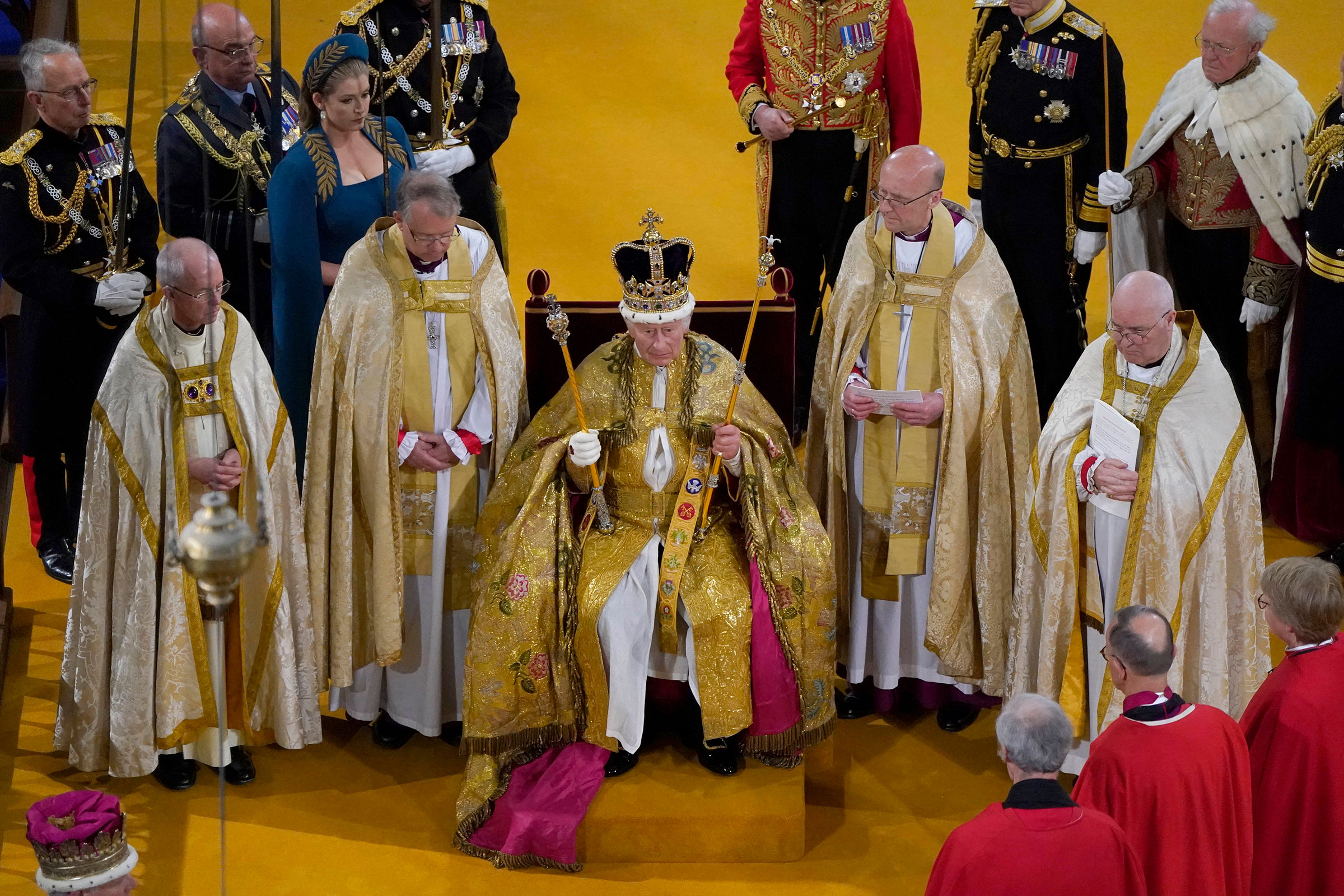
CNN reports that Britain’s King Charles III has been crowned in a once-in-a-generation royal event that is being witnessed by hundreds of high-profile guests inside Westminster Abbey, as well as tens of thousands of well-wishers who have gathered in central London despite the rain.
The intricate coronation service followed a traditional template that has stayed much the same for more than 1,000 years.
The King took the Coronation Oath and became the first monarch to pray aloud at his coronation. In his prayer he asked to “be a blessing” to people “of every faith and conviction.”
The anointment, considered the most sacred part of the ceremony, took place behind a screen.
The King was presented with the coronation regalia, including the royal Robe and Stole, in what is known as the investiture part of the service.
He was then crowned with the 360-year-old St. Edward’s Crown, the most significant part of the coronation ceremony. After crowning the King, Welby declared: “God Save the King.”
Wearing the crown, the King was seated on the throne, after which the Archbishop of Canterbury invited the British public, as well as those from “other Realms,” for the first time, to recite a pledge of allegiance to the new monarch and his “heirs and successors.”
Ahead of the event, some parts of the British media and public interpreted the invitation as a command, reporting that people had been “asked” and “called” to swear allegiance to the King. In the face of such criticism, the Church of England revised the text of the liturgy so that members of the public would be given a choice between saying simply “God save King Charles” or reciting the full pledge of allegiance.
Once the King was crowned, his wife, Queen Camilla, was crowned in her own, shorter ceremony with Queen Mary’s Crown — marking the first time in recent history that a new crown wasn’t made specifically for this occasion — and presented with the Sceptre and Rod.
While Charles became King on the death of his mother, Queen Elizabeth II in September last year, the coronation is the formal crowning of the monarch and is a profoundly religious affair, reflecting the fact that aside from being head of state of the United Kingdom and 14 other countries, Charles is also the Supreme Governor of the Church of England.
However, it has been modernized in certain key ways. The archbishop acknowledged the multiple faiths observed in the UK during the ceremony, saying the Church of England “will seek to foster an environment in which people of all faiths may live freely.”
By early Saturday, the London Metropolitan Police Service announced that all viewing areas along the procession route were full and closed off to new arrivals.
The Met said ahead of time that Saturday would be the largest one-day policing operation in decades, with more than 11,500 officers on duty in London. Security around the event came into focus earlier this week when a man was arrested just outside Buckingham Palace after he allegedly threw suspected shotgun cartridges into the palace grounds.
The ceremony was expected to last two hours — about an hour shorter than Elizabeth II’s coronation in 1953. It began with the recognition and oath, followed by a reading from the Bible by UK Prime Minister Rishi Sunak and — in a coronation first — gospel music.
The congregation, while including some 2,300 people, is much smaller than it was in 1953 when temporary structures had to be erected within the abbey to accommodate the more than 8,000 people on the guest list.
The doors to the abbey opened just before 8 a.m. local time, with the first guests taking their seats a full three hours before the ceremony began.
Among the first people to arrive were singer Lionel Richie, musician Nick Cave, actresses Emma Thompson, Joanna Lumley and Judi Dench, composer Andrew Lloyd Webber, UK Labour Party leader Keir Starmer, and broadcaster Stephen Fry.
Top British officials, faith leaders and international representatives followed in their steps. They all took their seats in the vast church with more than an hour to go — reflecting the huge logistical challenges presented by an event attended by hundreds of VIPs.
All Sunak’s living predecessors as prime minister were there: Liz Truss, Boris Johnson, Theresa May, David Cameron, Gordon Brown, Tony Blair and John Major. Mayor of London Sadiq Khan, UK opposition leader Keir Starmer and Chancellor of the Exchequer Jeremy Hunt were also in attendance.
First Lady of the United States Jill Biden and the US Special Presidential Envoy for Climate John Kerry were there, as was the Chinese Vice President Han Zheng.
Canadian Prime Minister Justin Trudeau, French President Emmanuel Macron and numerous other world leaders were also present.
Last to arrive, just before the King and Queen, were the most senior members of King Charles’ family, his siblings and children, including Prince Harry who traveled to the UK from the US without his wife, Meghan, the Duchess of Sussex and their two young children. Saturday is also Prince Archie’s 4th birthday.
Music is playing a central part in the ceremony, and five new compositions have been commissioned for the main part of the service, including an anthem by Lloyd Webber, who is better known for West End musicals.
Charles’ consort Camilla will also be crowned in a shorter, simpler part of the ceremony.
Once done with the formalities, the newly crowned King and Queen will ride back in a much larger parade to Buckingham Palace, where they will be greeted by a royal salute.
The pomp and pageantry will conclude with the customary balcony appearance by the King and his family as they join the crowds below in watching a flypast of more than 60 aircraft.
Source: CNN
Related
You may like
Headline
Presidential Ambition: Is Donald Duke a Spoiler?
Published
19 minutes agoon
May 25, 2026By
Eric
By Eric Elezuo
With the collective intention of most political parties coming together to wrestle power from President Bola Tinubu-led All Progressives Congress (APC) at the centre, the defection of most political leaders from the coalition umbrella, the African Democratic Congress (ADC), has been viewed as a betrayal of the original course.
First, it was the presidential candidate of the Labour Party in the 2023 election, Mr. Peter Obi, and the presidential candidate of the New Nigeria People’s Party (NNPP), Senator Rabiu Kwankwaso defecting to the Nigerian Democratic Congress (NDC), and now following in their footsteps, is the former Governor of Cross River State, Mr. Donald Duke, who has found an awaiting presidential ticket with the Peoples Redemption Party (PRP).
According to reports, former governor Duke has officially joined Nigeria’s 2027 presidential race, becoming one of the latest politicians to declare interest ahead of the general elections.
Duke emerged as one of three cleared presidential aspirants of the Peoples Redemption Party ahead of the party’s primaries scheduled for 25th May in Abuja.
The party said the former governor agreed to submit his ambition to the decision of party members during the nationwide exercise.
In a statement issued by PRP National Publicity Secretary, Muhammed Ishaq, the party described the aspirants as committed to “democratic ideals and internal party unity.”
Duke, who governed Cross River State from 1999 to 2007, is widely known for promoting tourism and urban renewal projects, including the Tinapa Business Resort and the annual Calabar Carnival.
The former governor previously contested for president in 2019 under the Social Democratic Party, where he criticised both the ruling APC and the PDP.
At the time, he said the PDP had “lost its values and became a shadow of itself.”
The PRP says it remains committed to “credible, transparent and free primaries” as preparations continue for the 2027 elections.
Nigeria’s political space has already become increasingly active ahead of 2027, with more aspirants expected to declare interest in the coming months.
The statement quoted Duke, alongside Nnaoke Ufere from Abia State and Yakubu Kingsley from Edo State, are the candidates, who have unanimously agreed to submit their aspirations to the decision of party members during the nationwide primaries.
The party said the aspirants demonstrated commitment to democratic ideals and internal party unity by agreeing to abide by the outcome of the exercise.
Duke, who was Cross River governor between 1999 and 2007, appears the only strong candidate among the three aspirants, and is likely to pick the ticket after the primaries. But the major concern is not in his decision to contest or stand for election, but the intention behind his decision to choose a different to test his presidential aspirations.
Across the political space, stakeholders, observers and analysts alike have said that given the consensus agreement built around and towards ending the administration of Bola Tinubu, the coalition ADC remains the viable option to all aspirants to test their strength and popularity, after which anyone who emerges as the candidate should be supported by all. They have argued that those leaving the coalition may have much more than presidential ambition behind their minds. And so the question, is Donald Duke a spoiler? Is he in the race to decimate the votes of the opposition?
Meanwhile, Duke, who was part of the coalition at the initial stage, have taken a bow out of the group, principally coordinated by former Vice President Atiku Abubakar, and chaired by a former Senate President, David Mark. He did not give reasons for his exit from the ADC though observers have insinuated that his exit, like Peter Obi, is hinged on the premise that the ADC allegedly has a hidden bias for Atiku, and so the presidential might be handed over to the former Vice President on the platter. The ADC has since denied the allegation with former two terms governor of Rivers State, Rotimi Chibuike Amaechi and Hayatudeen still in the race.
With the entrance of Duke in the presidential race, the number of southern aspirants, especially those sure to pick the tickets of their parties have swollen up. Others include include Peter Obi of the NDC, Rotimi Amaechi if he wins the ADC primaries ongoing across the nation, Oyo State Governor, Seyi Makinde representing the PDP and APM coalition among others.
Now, that almost all the political bigwigs are separately pursuing their political aspirations devoid of a collective platform, many have said that Tinubu is no longer fighting a coalition of likeminds, but against presidentially ambitious individuals, pursuing a different agenda. Many have also said that since Tinubu already has a political structure he can rely on, he is making sure all the fragmented giants did not come together to form an indivisible body capable of challenging his reelection in 2027.
“And that explains why he continually instigate both individuals and institutions to revolt against themselves thereby creating factions and very weak political centre to challenge his ambition,” an analyst told The Boss.
Meanwhile, whether there are intentions to be a spoiler or not; whether any institution or individual have been coerced into turning itself to a vessel of destruction on behalf of the ruling, ir us only the people that would decide who becomes in 2027.
Not Tinubu, not the APC, not any of the political bigwigs, not any of the presidential aspirants or candidates, but the Nigerian people in their totality.
The election is just eight months away.
Related
By Eric Elezuo
The common refrain and slogan across the nation is ‘Nigeria is bleeding’, and as the days turn into weeks and months, the wound gets larger. Then from bleeding, the blood is now flowing.
Across all strata of endeavours, all the regions and not a few communities, insecurity of the highest order has enveloped on a very large scale, a nation that once thrive in brotherliness, interstate movements without fear, and camaraderie. The fear of the unknown has completely eclipsed social life, excursions, traveling within the country, and funnily enough staying in your own house. In the Nigeria of today, nowhere is safe anymore; not event the comfort of one’s home; not even the sacredness of holy places; not even the respected academic environment. Terrorists and bandits attack anywhere and from anywhere. And with impunity.
In the Nigeria of today, everyone leaves in fear. No one knows who the next target is as terrorists, bandits, Fulani herdsmen and other miscreants have overran the nooks and crannies of the Nigerian existence, prompting the question, where’s Nigeria’s chief security officer? And the answer that he must wake up and face squarely the insecurity challenges that is fast tearing the nation to shreds.
With the 2027 election fast approaching, the Nigerian administrative apparatchnik led by President Bola Tinubu, appears to have completely lost focus of the security of the people. The country is been thoroughly run down by activities of terrorists, who are no longer hiding their nefarious and heinous activities as they boldly put on air the victims abducted and process of execution. This daring moves are a challenge to the government and security agencies, yet no criminal is in custody yet and victims are still unaccounted for with most of them cruelly deleted, and bodies mangled.
It is worthy of note that while the nation is still gambling with the rescue efforts for the teachers and pupils kidnapped from Oyo communities schools about 12 days ago, suspected bandits have reportedly struck again, invading the Yashikira community in Baruten Local Government Area of Kwara State, early on Monday morning, setting the Emir’s palace ablaze and abducting several residents, including women and children.
Reports gathered from Channels Television say that the attack occurred late at night when the heavily armed assailants stormed the community, firing sporadically.
The medium, quoting sources in the area, stressed that the gunmen attacked the palace during the invasion, setting parts of the royal residence on fire before whisking away multiple victims.
Residents said the attackers operated for hours without resistance, leaving behind destruction and fear in the border community.
Another local source described the incident as terrifying, noting that villagers were caught unaware as the gunmen invaded the town under the cover of darkness.
Sources say Security forces have launched immediate rescue operations to free victims of the Yashikira abduction, which occurred on Sunday night.
Military and police operatives have established a cordon in the area as part of the efforts to rescue about 10 persons who were reportedly taken from the community in an overnight attack on the palace of the Emir of Yashikira.
The attackers also sought to raid the local police stations but were reportedly repelled.
As at press time, the police were yet to issue an official statement on the incident.
The invasion is one development too many this 2026 alone, and has been a recurring decimal in the Tinubu-led administration. This is taking for granted that the incident is following the heels of bandits, who on Saturday night invaded a prayer ground at Ori-Oke Ajaiye, on the outskirts of Ikiran village in Ekiti Local Government Area of the same Kwara State, killing three worshippers and abducting 15 others during a vigil.
The stories and tales of woe are inexhaustible. There’s no morning and no evening where Nigerians are not presented with gory narratives of one abduction and killing or another, creating fear and apprehension among the populace. The general notion is hinged on Tinubu’s control loss of the fabrics of the nation including the economy, power and every other mention-able sector.
It is worthy of note that like every other failure still staring Nigerians in the face, Tinubu also inherited insecurity. However, three years into his administration, and consequent upon available indices, the Nigerian leader seems to have tripled the effects of insecurity. This is counting the boldness with which the insurgents operate, the magnitude of each operation, the casualties involved, the deliberate bloodletting and the huge ransom paid in exchange. The circle has continually continued, and there seems to be no hiding place for Nigerians, especially the vulnerable masses.
On May 17, 2026, the world woke to the chilling news of the killing and beheading of the school teachers, abducted from Oyo communities. He was Michael Oyedokun.
Oyedokun was one of the teachers abducted from Community High School, Ahoro-Esinele in Oriire Local Council of Oyo State, a few days before his gruesome killing.
The killing threw residents of the area into mourning and heightened fears over worsening insecurity in the state, and the nation at large, which the government of President Bola Tinubu has found a herculean to handle.
In a video reportedly released by the captors on Sunday, May 17, 2026, the gunmen claimed responsibility for the killing of the Maths teacher, sparking panic across the community.
The incident followed a series of coordinated attacks launched by armed men on Friday, May 15, targeting multiple schools within the Ogbomoso axis, including Baptist Nursery and Primary School, Yawota; Community Grammar School; and L.A. Primary School, Esiele.
During the attacks, the assailants reportedly shot dead a classroom teacher and a commercial motorcyclist who resisted attempts to seize his motorcycle.
The attackers also abducted the school principal, vice-principal, another staff member, and an unspecified number of pupils before fleeing into the forest. Later reports put the number of abductors to 39.
Governor Seyi Makinde had earlier confirmed that seven students were abducted from Community Secondary School, while 18 pupils and seven teachers were kidnapped from First Baptist Primary and Nursery School.
He also confirmed that one person was killed during the attack, a school teacher, Joel Adesiyan. Further reports confirm that a bike rider was also killed, when he refused to let go of his motorcycle.
The incident triggered widespread panic in Ogbomoso and surrounding communities, with many parents rushing to schools to withdraw their children over fears of further attacks.
Some schools were also forced to shut down temporarily following rumours of bandits infiltrating the Ladoke Akintola University of Technology, an allegation the institution’s management later dismissed as false.
Reacting, the Amnesty International Nigeria accused the Federal Government of failing to adequately respond to Nigeria’s worsening wave of abductions targeting school children, rural communities and internally displaced persons, saying at least 1,100 people were kidnapped between January and April 2026.
The organisation made the allegation in a statement shared on its official X handle, amid renewed public concern over mass abductions in Oyo, Borno and other states, which left dozens of students, teachers and residents affected.
In the statement, Amnesty International said, “President Bola Tinubu and his government have failed to address the country’s shocking spate of abductions targeting school children, rural communities and internally displaced persons across the country.”
It added, “At least 1,100 people have been abducted – from January to April 2026,” describing the trend as a continuing failure of protection for vulnerable populations.
The group’s criticism comes days after gunmen abducted 39 students and seven teachers in an attack on schools in the Ahoro Esinele community in Oriire Local Government Area of Oyo State, an incident that also left teacher Michael Oyedokun reportedly beheaded.
Amnesty also referenced another attack in Borno State, where 42 students and pupils were abducted from Mussa Primary and Junior Secondary School in Askira/Uba Local Government Area during a Boko Haram assault.
Survivors of similar abductions, according to the rights group, have described being subjected to starvation and torture, including beatings, flogging and sexual violence, raising further concerns about the conditions victims face in captivity.
The organisation said the pattern of repeated school attacks shows a long-running crisis that authorities have yet to resolve, stressing that “over a decade is enough time for the Nigerian authorities to find a solution to this horrifying problem,” but insisting that “the reality shows the government has neither the will nor the commitment to end rampant abductions and attacks on children and their schools.”
It urged authorities to meet their obligations under both national and international law, particularly regarding the protection of children’s rights to education, safety, and protection from violence and ill-treatment.
The latest incidents have intensified national concern over school security, especially following the Oyo and Borno attacks, which occurred within the same period and involved the abduction of dozens of children and teachers.
Weeks earlier, there was a failed kidnapping attempt along the Ibadan-Ijebu road corridor, which reportedly left a traveller dead, raising fresh concerns over insecurity of great proportion hitting the southwest of the region.
According to Global Centre for the Responsibility to Protect report, between 2014 and March 2026, ‘over 2,000 children have been abducted or kidnapped, largely in mass abductions targeting schools. Armed extremist groups, including Boko Haram and ISWAP, as well as local bandits, are implicated in many cases, often using kidnappings to generate ransom or to recruit children.
The report noted that in 2024 alone, at least 580 civilians, primarily women and girls, were kidnapped across several states, noting that the figures might be higher. Not only are most victims killed during these attacks or while in custody, survivors live the rest of their lives in poverty, trauma, stigma and utter abandonment.
The funniest part, according to a social analyst, who crave anonymity, so-called repentant terrorists and bandits are treated with kid gloves, ‘rehabitated’ in luxury and given huge financial lifeline as they are released back into the sane society while their victims are left to wallow in neglect. It would be recalled that the National Security Adviser, Mallam Nuhu Ribadu, described the terrorists as ‘our brothers’, who should not be killed just as the Chief of Defence Staff, General Oluyede equated the rerrorists to the biblical ‘prodigal son’, who should welcomed with warmth and affection. These two national officers have silent on the treatment for their traumatized victims and their bereaved loved ones.
The question on the lips of majority of Nigerians, has remained what President Tinubu is doing about the extreme insecurity in the country beyond offering condolences and suggesting a now known refrain of ‘It won’t happen again’ while it continues to happen over and over again.
On two known occasions, President Tinubu was expected to visit victims and sites of violent killings and abductions in Benue and Plateau states. On the two known occasions, Tinubu fell short in the advertised visitations. He never made it to the locations.
Following the June, 2025 killings in Yelwata, Benue State, Tinubu was programmed to have an extensive state visit to site of massacre and the government house where a townhall meeting was scheduled.
It was agreed that upon his arrival, the President will first proceed to Yelewata in Guma Local Government Area, the epicentre of the attack that claimed over 100 lives.
He was scheduled to meet with families of victims, displaced persons and community leaders directly impacted by the violence.
“But it’s only God who can give you joy and hope. No amount of money can pay all of you back. Yes, as a government, we will try our best to comfort you, to work with you,” he said while directing security chiefs present, including the Inspector-General of Police, Chief of Defence Staff, and Minister of Defence, to unearth and apprehend those responsible for the killings.
Related
Headline
Fubara Withdraws from Rivers APC Governorship Primary
Published
5 days agoon
May 20, 2026By
Eric
Rivers State Governor, Siminalayi Fubara, has announced his withdrawal from the All Progressives Congress governorship primary election in the state.
Fubara made this known in a statement personally signed on Wednesday, saying he would support whoever emerges as the party’s candidate, The Nations reported.
The governor said his decision followed extensive consultations with his family, friends, and political associates.
“After deep reflection and extensive consultations with my family, friends, and associates, I have taken the difficult but necessary decision to withdraw from the APC governorship primaries. I do so with a full heart and with a firm commitment to support whoever emerges as the candidate of our great party,” Fubara said.
Fubara said although the decision was difficult, he remained committed to supporting whoever would emerge as the APC governorship candidate.
According to him, leadership demands sacrifice and personal ambition must sometimes give way to the collective interest of the people.
Meanwhile, the embattled governor expressed appreciation to his supporters for their loyalty, prayers and sacrifices throughout the political process, acknowledging that many would feel disappointed by his withdrawal.
He said his silence in recent weeks was “deliberate and strategic,” adding that it was guided by the higher interest of the state.
Tone Cole, APC chieftain and 2027 governorship aspirant in Rivers State, also announced his withdrawal from the race, saying his decision was, among other reasons, in the interest of the party’s unity.
Related


How I Made Buhari President in 2015 – Amaechi
Presidential Ambition: Is Donald Duke a Spoiler?
Insecurity: Why Tinubu Must Wake Up
The Stockholm Syndrome in the Delta
Bandits Invade Kwara Community, Abduct Scores, Set Emir’s Palace Ablaze
US Will Not ‘Rush into a Deal’ with Iran, Trump Declares
Adding Value: Responding to Life Challenges by Henry Ukazu
Tech and Humanity: The Tribunal Ruling That Should Change How Africa Thinks About AI
A Familiar Kind of Tragedy by Adeoye Inioluwa
Car Crashes into Port Harcourt Family Residence, Kills Three Children
Leadership in Africa: Forging a New Era of Self-Reliance, Unity and Global Relevance (Pt. 3)
Fubara Withdraws from Rivers APC Governorship Primary
Ijebuland Holds Grand Farewell Reception for Late Awujale Oba Sikiru Kayode Adetona
Glo Celebrates Oba Adetona’s Legacies at Ojude Oba 2026
Trending
-
Tech and Humanity2 days agoTech and Humanity: The Tribunal Ruling That Should Change How Africa Thinks About AI
-
Opinion3 days agoA Familiar Kind of Tragedy by Adeoye Inioluwa
-
News4 days agoCar Crashes into Port Harcourt Family Residence, Kills Three Children
-
Opinion2 days agoLeadership in Africa: Forging a New Era of Self-Reliance, Unity and Global Relevance (Pt. 3)
-
Headline5 days agoFubara Withdraws from Rivers APC Governorship Primary
-
Events2 days agoIjebuland Holds Grand Farewell Reception for Late Awujale Oba Sikiru Kayode Adetona
-
News22 hours agoGlo Celebrates Oba Adetona’s Legacies at Ojude Oba 2026
-
Sports3 days agoRonaldo Celebrates Saudi Pro League Win with Al-Nassr