Connect with us

Islam

Friday Sermon: Of Fear, Ignorance and Truth

Published

on

By Babatunde Jose

They will reject the truth and chase after myths. 2 Timothy 4:4

Abd al-Rahmān ibn ‘Awf said: “I heard the Messenger of Allāh (PBUH) say: “If you hear that (the plague) is in a land, do not go there, and if it breaks out in a land where you are, do not leave, fleeing from it.”

There is fear in the land: Fear of the raging and rampaging virus, its lethality and duration. All is not well with us, children are out of school and we know not when they will go back; jobs are already on the line and many are billed to join the already long unemployment queue when this is over; fathers are groaning and mothers are wriggling their hand for they know not where the next meal cometh from; the rich are crying as they are marooned, no more business travels or holidays, while some are stranded abroad; life is increasingly becoming cheap, nasty and brutish; like the sword of Damocles, Koro, Coronavirus, COVID-19, that dreaded virus is daily increasing its strength in our country and there is fear that it would soon pick up speed and gain the strength of a gale force wind; then it would be a great humanitarian disaster of calamitous proportion. So far we have been lucky and still counting the victims in hundred; but it started this way in other climes: February 21, Italy had only 21 cases which became 86,480 by March 27, 2020; United States also had 16 cases on February 21 and it climbed to 100,037 by March 27 and rose to 419,975 0n April 8, 2020.  These are countries that possess better healthcare facilities than us: And they do not have the sort of slums that are common in Africa: There are no Makokos, Tembisa, Rainbow Towns, Ajegunles and Ijeguns. Here, there are too many vulnerable communities that elicit fear in case the Pandemic make its catastrophic landfall. The dreaded Pandemic is no respecter of age, sex or position; neither does it exhibit racial or ethnic bias. It has visited prime ministers, ministers and plenipotentiary extraordinaire. It therefore elicits fear.

There is growing apprehension that the government’s effort in asking people to stay at home might not produce the desired effect as most people are observing the lockdown in the breech. This is particularly true of the communities in the urban conurbation and old tenements where the ubiquitous ‘face me I face you’ dwellings are common. Ordinarily, these are places where space is at a premium and only the strong survive. But most importantly, most live on a day by day basis. No daily work, no food on the table. Koro either kills them or they die of starvation. Words are oozing out from such places that they feel being punished by being lockdown for a disease they know nothing about and which was imported by the affluent who travel all over the world. This is where ignorance becomes a disease in itself.

The disease of ignorance of Covid-19 is not only among the poor, unenlightened and rural dwellers, it is worse among many of our elite who are supposed to be the beacon of education for the masses. It is particularly worrisome when an Oxford educated young man, former minister and legal practitioner (it’s doubtful if he is in practice) comes out openly to say that the Coronavirus is a machination of the Illuminati or such nonsense; hallmark of conspiracy theory about world domination. Whatever such books the fellow must have been reading and believing has lain to waste all the expensive education his parents gave him. If Covid-19 is product of conspiracy of man and Satan, what would they make of SARS2 and other viruses that have plagued man in recent past? If our former minister were alone, we could have discounted his ranting but when supposedly ministers of God preach the same type of unreason, then there is danger ahead.

In his Open Society and Its Enemies (1945) Karl Popper heralded an era of conspiracy. This mode of political thought and literary activity has flourished and budded to unprecedented proportions during the years following the Second World War, becoming richer and more imaginative, than its previous, predominantly political incarnations. These contemporary postmodern narratives are quite often imbued with extra-terrestrial and religious undertones and, like the gods of Homeric Greece, the modern-day conspirators are felt, but rest unseen, their presence more inferred than properly corroborated, and their motives always transcendent and sublime. “The gods are abandoned. But their place is filled with powerful men, or groups.”  It is this substrate which the contemporary conspiracy discourse blossoms from. Most of them can no longer be divorced from the political and spiritual. The Marxian axiomatic of the class struggle is particularly well suited to be incorporated into the conspiracy discourses, as the antagonism between the oppressors and the oppressed forms the basic binary framework around which contemporary conspiracy narratives are woven. Furthermore, the informational disorientation plaguing the western world in the post-modern era, only exacerbated with the launching of the internet (an integrally participatory medium) and the ubiquitous social media has only further destabilized the semiotic field in which the individual finds herself. The latter half of the twentieth century all the way until the present day has been rife with talk of conspiracy. From McCarthy’s ‘Red Scare’ politics, through to the assassination of JFK, up until the recent past events, like 9/ 11 or the earthquakes in Haiti; next o the official narrative there winds the alternate narrative of the conspiracy discourse. The claims of these partisan trains of thought are often chaotic, highly contentious, and improbable; and yet, they manage to garner an audience which becomes fascinated with its grandiose claims. A creeping tendency towards a paranoid, conspiracist view of global events has become somewhat of a pop phenomenon. There is therefore an immediate need for mass education and sensitization of our people on the debacle of this Koro lest they are misled by these unscrupulous ‘conspiracists’.

We have a serious problem on our hands dictated by geography and economic conditions but importantly from our so-called intelligentsia who behave not too intelligently. There have been all sorts of conspiracy theories on the social media concerning the current Pandemic, the worst of them is that linking Coronavirus to the coming 5G mobile network currently being tested all over the civilized world. Unfortunately people are so gullible into believing most information on the social media that they accept them as gospel. The latest is that people who move near the mast of 5G networks would collapse and die; Haba! Unfortunately for the harbingers of fake news, the 5G network will not be using the same type of masts that we are used to because of its peculiarities. There is too much false information being peddled on the social media concerning the Coronavirus pandemic.  This is where the government information machinery needs to be put into gear 6; even to the point of disseminating it on social media to counter a lot of the misinformation going on.

Finally there is the issue of distribution of palliatives in form of foodstuff and money to the less privileged. The miserliness of what is being distributed calls for a rethink of the whole exercise. “We should also be mindful of the social conditions in our society and the level of deprivation many have had to endure. Care should be taken to ensure that the economic pressures that necessitate the growing resistance to the lockdown do not graduate into anti-poverty uprisings which will be harder to suppress”, wrote Segun Adeniyi. There are talks that some smart officials are making brisk business with it. There is also the matter of some unscrupulous politicians making political mileage out of the exercise; like the Speaker of a State House of Assembly distributing bread with his name printed on the bread label or rice bag. Unfortunately, this is not the time or place for political shenanigan. There is danger ahead and who knows who will be available to reap the political dividend in the end.

“The fear and unfounded conspiracy theories being peddled on WhatsApp are our near and present danger, not 5G,” said Ifedayo Olarinde Aka Daddy Freeze.

Barka Juma’at and Happy Easter

PostScript: It happened two thousand and twenty years ago in Palestine when a young itinerant preacher and faith healer was dubbed a trouble maker and accused of calling himself the ‘son of God’, was summarily crucified by the Romans outside the gates of Jerusalem. That man, today is the central figure of one of the biggest religions in the world; Christianity. His name was Yeshua but he is better known as Jesus. In 325 AD The Council of Nicaea convened by Roman Emperor Constantine, decreed that Easter should be observed on the first Sunday following the first full moon after the Spring Equinox; that was three hundred and twenty-five years after the crucifixion, resurrection and ‘accession’ to heaven and his subsequent deification.

The documentation of the new religion was completed 68 years after the Council of Nicaea, going by a letter written by Athanasius, Bishop of Alexandria listing the 27 books of the New Testament. The New Testament was first formally canonized during the Councils of Hippo (393) and later Council of Carthage (397).

Today as we celebrate Good Friday let us remember the Ultimate act of  Forgiveness when Jesus was hanging on the cross, bloody and bruised; humiliated, flesh ripped open as he was beaten and mocked with the crown of thorns.  Completely drained, he was finally nailed to the cross, alive.  After all of these, Jesus called out to God saying, “Father, forgive them, for they do not know what they are doing.” (Luke 23:34).  If there was ever a moment in history where someone deserved a “free-pass” on forgiveness, this was it.  May we all strive to forgive everyone as we pray to God to forgive us.

Happy Easter!  

+2348033110822

Continue Reading
Click to comment

Leave a Reply

Your email address will not be published. Required fields are marked *

Islam

Friday Sermon: Prof Hakeem Olumide Danmole 1946 – 2026: Departure of a Comrade

Published

on

By

By Babatunde Jose

Let us reflect and contemplate. “Death is the only appointment none of us will miss. It does not check our age. It does not consider our plans. It does not wait for us to finish building, marrying, studying, traveling, or raising our children. It arrives exactly when Allah has decreed.

“Many of us live as though we have plenty of time. We postpone repentance. Delay forgiveness. Hold grudges. Neglect our prayers. And keep telling ourselves, “I will change tomorrow.” But how many people woke up expecting tomorrow and never reached the evening? How many left their homes never knowing it would be the last time? The frightening reality is that death is not far away—it is simply unseen.

“The grave is closer to us than many of the plans we are making. And when that moment comes, our wealth will stay behind. Our titles will stay behind. Our arguments and competitions will stay behind. Only our deeds will accompany us. The prayer you delayed. The repentance you postponed. The kindness you withheld. The Qur’an you neglected. The heart you broke. Everything will matter.

“So let us return to Allah before we are returned to Him. Let us repent before we wish for one more chance. Let us pray before others stand over us in prayer. Let us remember Allah today, before the day comes when people remember us only in their duʿā. May Allah grant us a beautiful ending, forgive our shortcomings, and make our last words in this world a testimony of faith. Ameen Yaa Hayyu, Yaa Quyyum, Yaa Dhul Jallal Wal Ikram” – Anonymous

We are all inexorably, marching closer to our grave. For every minute, hour, day, week, month, and year that we add, there is a corresponding movement towards the grave. “Every soul shall have a taste of death: And only on the Day of Judgement shall you be paid your full recompense. Only he who is saved far from the Fire and admitted to the garden will have attained the object (of Life): For the life of this world is but goods and chattels of deception.” (Quran 3:185)

What lesson do we get from this realization? In the not too distant future, we would leave all our amazing wealth, results of our accumulation and gathering and descend into the grave or rise up to heaven or hell alone without any accompaniments. Remember the gold, ornaments and other worldly goods buried with the Egyptian and Aztec kings, none left the earth with them.

We search the world for the renowned men of old like Mughal emperor, Shah Jahan (1628 to 1658) who built the Taj Mahal, one of the seven wonders of the world, commissioned in 1632, to house the tomb of his favorite wife, Mumtaz Mahal. People don’t even remember him anymore.

As the years roll by, one day, one after the other, we will take our exit from this earthly plane. What is expected of each human being, where does his path lead him after the sojourn on earth?

The answer to this is exemplified in Ecclesiastes 3, the third chapter of the Book of Ecclesiastes in the Hebrew Bible or the Old Testament of the Christian Bible. The book contains philosophical speeches by a character called ‘Qoheleth’ “the Teacher”; composed probably between the fifth and second centuries BC. Targum, and Talmud attribute the authorship of the book to King Solomon.

As for the grave, we are told the life of the deceased in the grave is different from his life in this world. It is a special kind of life in al-barzakh (the interval between death and the Day of Resurrection) which is not like life in this world. To this end we often pray for our dead to be spared the punishment of the grave.

Two important concerns of a good Muslim are his legacy and the grave. There is always the fear that his progeny would obliterate whatever good he has spent his life to build. It is a real and founded fear. May Allah give us children who will preserve our legacies. Amen.

“O Prophet! Truly We have sent thee as a Witness, a Bearer of Glad Tidings, and a Warner, And as one who invites to Allah’s (Grace) by His leave, and as a Lamp spreading Light. (Quran 33:45-46) 

The Prophet (SAW) left a legacy of a political system that was the embodiment of guardianship and care of the people and whose distinctive qualities were justice and accountability in governance as acknowledged by Muslims and non-Muslims alike.

A system fashioned upon the words of Allah in Surah an-Nisa: “O ye who believe! Stand out firmly for justice, as witnesses to Allah, even as against yourselves, or your parents, or your kin, and whether it be (against) rich or poor: For Allah can best protect both. Follow not the lusts (of your hearts), lest ye swerve, and if ye distort (justice) or decline to do justice, verily Allah is well acquainted with all that ye do.” (Quran 4:135)

The prophet (SAW) said: “Each of you is a guardian and each of you is questioned over his subjects, the Imam is responsible over the people and he is questioned over his responsibility.”

Leaders such as Khalifah Umar bin Al Khattab who during the famine in Medina refused to eat anything but coarse food, saying; “If I don’t taste suffering, how can I know the suffering of others?”   

Can we say these about our leaders? Do they even understand what it means to leave a legacy of service? Legacy is fundamental to what it is to be human. Being reminded of death is a good thing because death informs life. It gives you a perspective on what is important.

Stephen Grellet 1773–1855 said famously: “I shall pass this way but once; any good that I can do or any kindness I can show to any human being; let me do it now. Let me not defer nor neglect it, for I shall not pass this way again.”

Inna lillah wa ina ilehi rajiun. On the 1st of June 2026, we lost a friend, brother and quintessential gentleman; Professor Hakeem Olumide Danmole, (HOD), historian, academic, administrator; born June 17, 1946; University of Ibadan, 1970-1974; University of Birmingham England, 1975-80; Prof. History, 1992.

According to Professor Toyin Falola, “But perhaps the most enduring aspect of Professor Danmole’s intellectual contribution was his insistence on how African Muslim societies must be studied. He rejected the colonial assumptions and challenged the myopic point of views with which African Islamic history had been interpreted. He wrote against the reduction of Islam in West Africa to mere expansionism and positioned the spread of the religion through a deeply rooted socio-economic and intellectual force that shaped institutions, promoted literacy, influenced diplomacy, birth new identities and social organization across centuries.

“His works on the Sokoto Jihad, Yoruba Muslim communities, Islamic scholarship in Southwestern Nigeria, and the continuity of indigenous intellectual traditions shows his commitment in reframing the complexities in African history. He understood the profound damage caused by colonial historiography that put Africans as passive recipients of civilization, rather than active participants in building institutions, ideas and a flourishing society. His writings largely dispelled the wrong colonial narratives. The esteemed scholar, like others who shared his views, saw history as liberation. To help recover African memory was, for him, a step in recovering its dignity. He understood the implications of cultural dependency and intellectual insecurity as products of being stripped of one’s historical confidence.”

As part of the activities marking the 50th Anniversary of Lagos State in 2017, Professor Danmole gave a classic lecture: “Lagos: Yesterday, Today and Tomorrow” which touched incisively on various aspects of the history of Lagos State including the contentious “no man’s land” claim. It is however a fact of life and death that the erudite historian left without taking any of his research notes, hundreds of publications and mimeographs with him to the grave. That is the lesson of life. We come with nothing and depart with nothing.

I was opportune to meet late HOD at Ijebu Muslim College in 1969 where we were both art students in the HSC class. He was an ambitious student who was in a hurry to get his A Level and proceed to the university. I must confess, he infected me with this bug, which is one of the reasons I pursued my studies with vigor. He introduced me to what his erstwhile tutor at Jubril Martin, Baba Bamgbose, aka Bamgbosa, taught him; the art of short-cut to reading and preparation for examinations, called ‘pagbonje’. He nearly made me attempt the A ‘Level in lower six.

At the University of Ibadan where both of us took history, HOD was a diligent student, he branched off into Arabic and Islamic history, which led him to spend a year in Sudan which made him graduate in 1974. He would later berth in 1975 at the Center for West African Studies, University of Birmingham where he bagged his Masters’ and Doctorate.

Like we Joses, he was an Agarawu son. This would account for his lifelong relationship with late Professor Lateef Hussein (another Agarawu son), former Vice Chancellor of LASU who influenced Danmole’s transfer to LASU from the University of Ilorin.

I remember our escapades in their Olatilewa family home in Surulere and the antics of Hakeem’s brother, Taju, a colleague in the Daily Times and a prolific sports writer. TJD as he was popularly called was at Adeola Odutola Comprehensive when we were at Muslim College. A great guy and rascal. TJD preceded his brother to the grave. Inna lillahi wa inna ilehi rajiun.

Their father, Alhaji Danmole was a very great father, who indulged our youthful peccadilloes and rascality. May all their souls rest in peace.

Going back to the issue of death, there is no doubt it is a sound warning and reminder to us all that it’s a debt that we all owe and must pay anytime the giver of life decides to take it back.

We read in Surah Al-Imran, verse 185 (3:185): “Every soul shall taste death.” (Quran 3:185)

This verse is often cited to reflect on mortality, accountability, and the importance of preparing for the afterlife, serving as a central reminder in Islamic teachings about the fleeting nature of worldly existence and the certainty of death.

Every living being, regardless of status or power, will experience death. This emphasizes the transient nature of worldly life.

True recompense for deeds will be given only on the Day of Resurrection. Human efforts and rewards in this world are incomplete without divine judgment

Those who are saved from Hellfire and admitted to Paradise achieve ultimate success. This highlights the spiritual goal beyond worldly pursuits.

The verse reminds believers that the pleasures of this world are temporary and deceptive, urging focus on eternal life, hence the opening paragraph of this elegy.

May Allah SWT, in His infinite mercies, obliterate the shortcomings of HOD and with him that of his brother Taju and his late wife Professor Taibat Danmole, an accomplished scholar and former Commissioner for Education in Oyo State, and of course his late father. Inna lillahi wa ina ilehi rajiun.

Foolish is the man who shows pride & arrogance on earth due to his wealth, not realizing that none of it will be of use in his grave.” Dr. Abu Bilal Philips

“Our Lord! Give us in this world (that which is) good and in the Hereafter (that which is) good & protect us from the punishment of the Fire.”(Quran 2:201)

Barka Juma’at and happy weekend

Continue Reading

Islam

Friday Sermon: Facing Mount Arafat 3: A Prophet’s Final Admonition

Published

on

By

By Babatunde Jose

Khutbatul Wada’ or Prophet Muhammad’s (SAW) ‘last sermon’ was delivered on the 9th of Zulhijjah 10 A.H (632 C.E) on Mount ‘Arafat, Makkah.

Prophet Muhammad (SAW) is an example for all of humanity. He was always a remarkable man. He excelled in all walks of life by being a prophet, ruler, statesman, orator, soldier, husband, friend, father and a grandfather. He was a man of love, patience, courage, wisdom, generosity, intelligence and exemplary character who inspires over a billion lives throughout the world.

Allah says in the Quran that he was sent as a mercy for the people of the world: And We sent thee only as a mercy for all mankind. وَمَٓا اَرْسَلْنَاكَ اِلَّا رَحْمَةً لِلْعَالَم۪ينَ; Wama arsalnaka illa rahmatanlilAAalameen. (Surah Al Anbiya, Quran 21:107)

Shortly before his death, Prophet Muhammad (SAW) delivered a sermon during the Hajj, which came to be known as his “Final Sermon”. This sermon was not only a reminder to his followers, but also the ‘final admonition’; it also heralded the end of his Prophetic Mission. Historically, the Farewell Sermon of Prophet Muhammad (SAW) occupies an important place in Islam.

The sermon consisted of summarized exhortations reflecting some of the core teachings of the Quran and Sunnah. The sermon exemplifies the Quran’s assertion that the prophet was but a Warner: This was mentioned 57 times in the Quran.

Prophet Muhammad (SAW) undertook his farewell and only pilgrimage in the year 10 A.H. and it has since been the model for performing the fifth pillar of Islam, the Hajj.

The Final Sermon:

“O People, lend me an attentive ear, for I know not whether after this year, I shall ever be amongst you again. Therefore, listen to what I am saying to you very carefully and take these words to those who could not be present here today.

“O People, just as you regard this month, this day, this city as Sacred, so regard the life and property of every Muslim as a sacred trust. Return the goods entrusted to you to their rightful owners.

“Hurt no one so that no one may hurt you. Remember that you will indeed meet your Lord, and that He will indeed reckon your deeds. God has forbidden you to take usury (interest), therefore all interest obligation shall henceforth be waived. Your capital, however, is yours to keep. You will neither inflict nor suffer any inequity.

“God has Judged that there shall be no interest, and that all the interest due to Al-Abbas ibn Abd’el Muttalib shall henceforth be waived… Beware of Satan, for the safety of your religion. He has lost all hope that he will ever be able to lead you astray in big things, so beware of following him in small things.

“O People, it is true that you have certain rights with regard to your women, but they also have rights over you. Remember that you have taken them as your wives only under a trust from God and with His permission. If they abide by your right, then to them belongs the right to be fed and clothed in kindness. Do treat your women well and be kind to them for they are your partners and committed helpers. And it is your right that they do not make friends with any one of whom you do not approve, as well as never to be unchaste.

“O People, listen to me in earnest, worship God, perform your five daily prayers, fast during the month of Ramadan, and offer Zakat. Perform Hajj if you have the means. All mankind is from Adam and Eve. An Arab has no superiority over a non-Arab, nor does a non-Arab have any superiority over an Arab; a white has no superiority over a black, nor does a black have any superiority over a white; [none have superiority over another] except by piety and good action. Learn that every Muslim is a brother to every Muslim and that the Muslims constitute one brotherhood. Nothing shall be legitimate to a Muslim which belongs to a fellow Muslim unless it was given freely and willingly. Do not, therefore, do injustice to yourselves. Remember, one day you will appear before God and answer for your deeds. So beware, do not stray from the path of righteousness after I am gone.

“O People, no prophet or apostle will come after me, and no new faith will be born. Reason well, therefore, O people, and understand words which I convey to you. I leave behind me two things, the Quran and my example, the Sunnah, and if you follow these you will never go astray. All those who listen to me shall pass on my words to others and those to others again; and it may be that the last ones understand my words better than those who listen to me directly. Be my witness, O God, that I have conveyed your message to your people.”

Thus the beloved Prophet (SAW) completed his Final Sermon, and upon it, near the summit of Arafat, the revelation came down: “…This day have I perfected your religion for you, completed My Grace upon you, and have chosen Islam for you as your religion…” (Quran 5:3)

Perhaps it is more appropriate to present this ayat in proper context: “Forbidden to you (for food) are: dead meat, blood, the flesh of swine, and that on which hath been invoked the name of other than Allah; that which hath been killed by strangling, or by a violent blow, or by a headlong fall, or by being gored to death; that which hath been (partly) eaten by a wild animal; unless ye are able to slaughter it (in due form); that which is sacrificed on stone (altars); (forbidden) also is the division (of meat) by raffling with arrows: that is impiety. This day have those who reject faith given up all hope of your religion: yet fear them not but fear Me. This day have I perfected your religion for you, completed My favour upon you, and have chosen for you Islam as your religion. But if any is forced by hunger, with no inclination to transgression, Allah is indeed Oft-forgiving, Most Merciful.” (Quran Surah Al Ma’idah Verse 3)

Indeed the meanings found in this sermon are astounding and it could rightly be described as the Prophet’s last Admonition.

But how have we as his followers kept to his admonitions? We have kept to them in the breach: An incorrigible generation, hell bent on disobedience and trenchant iniquities, we kill our fellow men, we enslave our women in the name of Sunnah, we persecute people of other faiths and engage in terrorism and are unjust to peoples of other races and ethnic persuasions, we are intolerant and intemperate in our manners and speech and we are bigots and fanatical in our ways. We have gone against all the things in the admonitions. We are unjust, nepotic and consume usury; we even export hard drugs to the ‘House of God; child abuse, prostitution and other forms of iniquities that make Sodom and Gomorrah pale into insignificance.

What will we not do for money? We dispossess the orphans and maltreat the widows. Sexual inequality which the Prophet preached against is still the order of the day in most Islamic countries and Muslim communities; 1,387 years after the Prophet, the Arabs and their cohorts still treat women as chattels.

The Admonition talks about equality of men but the Arab Muslims did not remember that when they came to enslave Africans, especially from East Africa. A generation of vile men and human anacondas, we even attempt to bribe God, but He refused to be mocked. On the Day of Qiyamah they will reap their just recompense. Walahi! There will be much weeping and gnashing of teeth, but it will be too late.

Let us reflect on ourselves, take a step back, and revive the core teachings of our Prophet (SAW) in achieving an ethical and moral society, wherever we are, where no one inflicts harm or injustice upon others.

May Allah grant us the strength to become better Muslims and better human beings.

LA ILAHA ILLA ANTA SUBHANAKA INNI KUNTU MINAZ ZALIMEEN: “None has the right to be worshipped but You (O Allah)), Glorified (and Exalted) are You (above all that (evil) they associate with You). Truly, I have been of the wrong-doers.”(Quran 21:87)

Barka Juma’at, happy weekend and Eid Mubarak and Barka da Sallah.

Continue Reading

Islam

Friday Sermon: Facing Mount Arafat 2: The Pilgrims Progress

Published

on

By

By Babatunde Jose

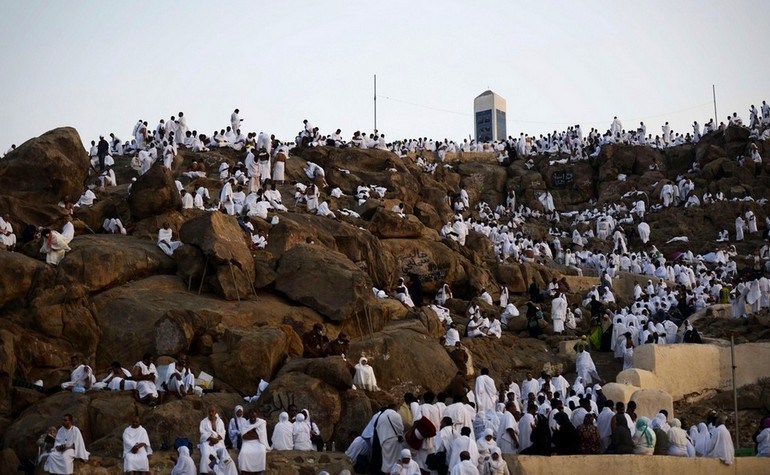
On Monday 25th May, the 9th day of Dhul Hijjah, the last month of the Islamic calendar, over 1.8 million pilgrims will converge on Mount Arafat for the annual Hajj festival.

Based on historical trends from 2023 to 2025, for 2026, Saudi authorities anticipate around 1.8 million pilgrims, maintaining a similar scale to recent years despite ongoing regional security concerns. This includes both domestic pilgrims and international arrivals from over 170 countries.

Gathering  on the plains of Arafat is an important highpoint of the Hajj. Day of Arafat is the day Hajj is consummated. Pilgrims spend the afternoon there praying and supplicating to Allah to wash away their sins and make them whole again: Failure to be present on the Day of Arafat invalidates the Hajj: 15 years ago, my late sister, Dupe who was on admission in Mecca was conveyed to Arafat in a hospital ambulance in order to allow her fulfill the requirement of Hajj.

The Day of Arafat is therefore an essential part of Hajj, and Aisha (RA) reported that the Messenger of Allah (SAW) said: “There is no day on which Allah sets free more slaves from Hell than He does on the Day of Arafat”.  (Muslim) It was on this special day in the afternoon of the Day of Arafat during his first and only Hajj that the Prophet (SAW) made his famous farewell speech to a crowd of over 120,000 Companions.

Hajj is mentioned in several ayahs in the Quran: ““And proclaim the Pilgrimage among men: they will come to thee on foot and (mounted) on every kind of camel, lean on account of journeys through deep and distant mountain highways;”(Quran 22:27) See also (Quran 2:125), (Quran 2:158), (Quran 2:189), (2:196-203) and (Quran 3:96-97)

Hajj attracts a very diverse multitude from all over the world, but it is important to clarify the largeness of the gathering as there has been a misconception on the part of many Muslims. Hajj is the second largest annual religious gathering.

Arba’een Pilgrimage is the world’s largest annual religious gathering that is held every year in Karbala, Iraq, at the end of the 40-day mourning period following Ashura, the religious ritual for the commemoration of martyrdom of the grandson of Prophet Mohammad (SAW) and the third Shia Imam, Husayn ibn Ali. The number of participants in the annual pilgrimage reached 25 million or more in 2026.

The Arba’een pilgrimage is non-obligatory compared to Hajj which is obligatory for those who can afford it. Secondly, the spiritual significance of the Arba’een trek is of limited Islamic significance as it is restricted to Shiites who are for all intents and purposes renegades in the mainstream of Islam. Thirdly, Islam recognizes only the Hajj as a fundamental pillar of Islam.

There is however a Nigerian connection to this Shia event. Pilgrims in West Africa who are unable to go to Karbala instead head toward Zaria in Nigeria to be addressed by the Shia leader Ibrahim Zakzaky. These include pilgrims from Nigeria as well as Ghana, Chad, Cameroon, Benin and Togo. The Shiite problem has since developed into a political conundrum with its leadership under detention and Zakzaky’s Islamic Movement of Nigeria proscribed and declared a terrorist organization.

However, the largest religious gathering of all time is the Kumbh Mela festival of the Hindus in India. According to the Economist, the attendance figures “implausibly imply that half of all Indians made the pilgrimage”. Attendance numbers were computed from a mix of manual counts, train arrivals, satellite imagery and camera footage. It is considered the largest peaceful gathering in the world, with devotees bathing in the sacred confluence of the Ganges, Yamuna, and Saraswati rivers to cleanse sins and seek spiritual liberation.

The Maha Kumbh 2025 witnessed millions of devotees participating making it the largest human congregation in history. The temporary city set up for the Mela covered 4,000 hectares, with 150,000 tents and extensive infrastructure to accommodate pilgrims.

The Uttar Pradesh government invested heavily in infrastructure, including: Roads and bridges: Over 450 km of roads and 30 pontoon bridges. 150,000 toilets, 10,000 sanitation workers, and river cleaning teams. 40,000 police officers, surveillance cameras, and underwater drones for safety. Medical facilities: Over 2,000 medical personnel deployed across the Mela area.

This leads to the contentious issue of government involvement in pilgrimage, its organization and logistics. This has been an issue in our religiously charged political firmament. It, however, need not be so as there are historical and contemporary facts to suggest that governments all over the world have always been involved in the affairs of their citizens who embark on pilgrimage in their tens of thousands.

In Britain, for instance, the Foreign and Commonwealth Office in 2000 helped fund the British Hajj Delegation to provide consular support and medical services for its citizens on the ground in Saudi Arabia.

Despite being officially secular, the French government posts a consul in Jeddah to help French nationals making the hajj.

Russia, which has over 14 million Muslim citizens; the largest population of any European country, has perhaps done the most to support its citizen-hajj pilgrims. Since the early 2000s, under the Putin government, Russia’s Muslims have enjoyed discounted flights to Jeddah during hajj season on Aeroflot, the state airline.

A state-created hajj liaison office arranges visas and transportation. And in another twist, after annexing Crimea from Ukraine, Russia offered Crimean Tatars generous Hajj subsidies ($1000 per person, about a third of the cost of an economy package tour).

Having inherited a hajj tradition with their colonial conquests, Europe’s imperial powers had to decide what to do with it. In the mid-nineteenth century, as hajj traffic between European colonies and Mecca began to grow, colonial officials nursed anxiety and fears of the hajj as a spreader of cholera and other infectious diseases; some even suggested banning the hajj.

This was especially true after 1865, the year a massive cholera outbreak in Mecca became a global epidemic, spread far and wide by dispersing crowds of hajj pilgrims. After this epidemic—which killed more than 200,000 people worldwide in cities as far away as New York—the European powers convened the first in a series of conferences that identified the hajj as a sanitary and security threat. But attempts to ban the hajj proved impossible: as a pillar of Islam, and a duty for Muslims, the hajj could not be easily banned or stopped.

By the end of the nineteenth century, and for various reasons all of the European powers began to sponsor the hajj. They subsidized travel between their colonies and Arabia during hajj season, opened foreign consulates along routes to Mecca, and passed new laws to protect pilgrims from physical harm and financial scams.

In order to ease transportation, the Ottoman Caliph organized the construction of the Hejaz Railway from Damascus to Medina in 1906; though it stopped operations after the First World War when the Ottoman Empire was defeated and its colonies divided among the victorious European powers.

In Jeddah, the Dutch had set up a multi-service “Hajj Bureau.” The British ran a medical dispensary out of their consulate: And European doctors and nurses staffed the two main quarantine facilities set up to screen hajj pilgrims in El Tor (at the bottom of the Sinai Peninsula) and on Kamaran Island (in the Red Sea). By sponsoring the hajj, European colonial powers were simply trying to control or contain the problems created by a mass, annual movement of people.

It is however very clear to all observers that the Nigerian State does not underwrite the pilgrimage of Muslims to Mecca: But our excesses in all things and proclivity for corruption often mar the good intentions. However, the government has a duty and responsibility in offering Consular service, medical aid and welfare to pilgrims and being involved in the logistics of moving over 100,000 of its citizens to a foreign land for pilgrimage: This is not strange or unknown to international best practice.

But sponsoring state officials, their wives, girlfriends, concubines, children, and friends of the state on a junket to the Holy Land is not only condemnable but spiritually sinful.

We therefore wish our pilgrims which include my favorite cousin Abdul Fatai Akintota Kekere-Ekun and his amiable wife, Justice Kudirat Olatokunbo Kekere-Ekun, CJN, Hajj Mabrur. May Allah accept their Hajj as acts of Ibadah.

Barka Juma’at and Happy weekend

Continue Reading

Trending