Connect with us

National

Strike: ASUU Declares Solidarity with SSANU, NASU

Published

on

The Academic Staff Union of Universities (ASUU) has thrown its weight behind the Senior Staff Union of Nigerian Universities (SSANU) and the Non-Academic Staff Union (NASU), whose members are currently on nationwide indefinite strike.

SSANU and NASU, under the aegis of Joint Action Committee (JAC), had declared indefinite strike on Friday, May 1, 2026, protesting the Federal government’s delay in signing a new agreement with them.

The two unions, after repeated ultimata given to the Federal Government to finalise their long-standing 2009 Agreement renegotiation and come up with a new agreement and its immediate implementation, accused the Federal Government of using delay tactics to, among others, punish members for rejecting the once controversial IPPIS payment platform.

Speaking at a monthly impact dialogue organised by the Education Writers’ Association of Nigeria (EWAN) held virtually, ASUU President, Prof Christopher Piwuna, said the body language of the Federal Government delaying the signing of the new agreement with other unions in the university system called for serious concern.

He spoke on the theme “Delayed Salaries, FG Workers’ Agreement: Averting Impending Crisis in Nigerian Universities.”

The dialogue also featured the National President of SSANU, Muhammed Ibrahim, and his vice in charge of the South Zone, Dr. Abdulsobur Abdulsalam.

The Accountant General of the Federation, Dr Shamseeden Ogunjimi, as well as the Director of Tertiary Education in the Federal Ministry of Education, Joel Samuel Ojo, who were equally billed as panelists, were unable to attend.

Speaking further, Piwuna said the Federal Government should realise that industrial harmony in the university system does not mean one union is working, rather working together of all unions is required to move the entire system forward.

He noted that even though the Federal Government had already signed an agreement with ASUU and that its implementation has “remained at best rudimentary and haphazard,” leaving SSANU, NASU, and NAAT in the cold is unacceptable.

He explained why ASUU is taking that stand, saying salaries of lecturers and other workers in the system are being prepared by SSANU and NASU members and not the ASUU members.

“So, it is very unkind and unfair for the government to keep SSANU, NASU, and NAAT in the cold for four months after signing our own agreement.

“It will be very demoralizing for me, for example, to continue to prepare salaries for my colleagues in the university when I don’t even know whether my own agreement is going to be signed or not.

“And so ASUU would want to state in very clear terms and, in the clearest terms possible, that we stand with SSANU, we stand with NASU, we stand with NAAT to ensure that their collective bargaining process is ended on the table that it started.

“Even though, this position is not part of our agreement, it’s not part of what we signed with the government, I think for fairness and justice, it is very important for government to conclude with other unions without further delay.”

Piwuna, however, also expressed displeasure over the delay in salaries that ASUU members have been experiencing in the last four months, even with the signing of the agreement, declaring that ASUU is totally against such practice.

He explained that a standing resolution by ASUU is that any month salaries of members get delayed beyond the third day of a new month in any of its branches nationwide, the lecturers there should withdraw their service until their salaries are paid.

He noted, “That was the case in January when some universities sought permission from the national leadership to embark on an action, and we pacified them based on what the Minister of Education, Dr Tunji Alausa, told us then.

“The Minister told us that the delay in the full implementation of our agreement, especially salaries, was a result of the non-passage of the 2026 national budget.

“And we have stated this many times before that we don’t know which budget Nigeria operates.

“This is because recently, the government publicly claimed that some aspects of the 2024 and 2025 budgets were still in operation even at a time when passing the 2026 budget, and that part of the 2025 budget will remain operational until June or July.

“So, we don’t have a clear-cut budget cycle as a country, and this is very unfortunate.

“We were all taught, even in elementary school, that the annual budget starts and ends within one year.

“But it appears that the operators of our economy now seem to have an argument for any bad thing that they want to do.

“So, the salaries have not been consistent even though the budget has been passed.”

Piwuna, who equally accused the Federal Government of taking the issue of education development with levity, said there are lots of issues pressing for government attention to address.

He pointed out that ASUU would certainly take a concrete and comprehensive stance on each of those issues when the leadership of the union meets either on May 9 or 10.

He mentioned parts of the issues to include, but not limited to, delay in salaries payment and the establishment of the National Research Council that will be financing research and development, not setting aside the Stabilisation fund, infractions by some pro-chancellors and chairmen of governing councils, accused of interfering in the normal day-to-day running of universities, as well as a proposal to remove some academic courses from curriculum.

He said these issues are critical to the development of university education in the country and therefore need to be addressed by the government.

He declared that “ASUU is going to respond to all these issues and any other ones that may emerge before the NEC meeting.”

In his own contribution, President of SSANU, Mohammed Ibrahim, also expressed displeasure over what he described as insincerity of government in addressing challenges faced by the public universities and their workers, which the “pending new agreement is aimed to address.

According to him, university workers are supposed to be treated well to enable them to put in their best to solve part of Nigeria’s problems.

“But these delays in payment of salaries is like cancer, dampening the morale of members and generality of workers in the universities,” he stressed.

Giving insights into why JAC declared the nationwide strike, SSANU’s Vice President, Western Zone, Dr. Abdulsobur Abdulsalam, said it was simply because government had pushed them to the wall.

He accused the government of a lack of respect for collective bargaining with the unions, stating that the renegotiation process that has been taking place for more than two years could be addressed within two weeks if there is genuine intention and willingness on the part of the government.

Abdulsalam said JAC had given the government more than enough time to conclude the renegotiation process and commence implementation, but it was still delaying the process with no timeline in sight, and instead, introducing wage awards.

“So, our last ultimatum to government was till the end of April and there is nothing we can do again than to embark on strike as our last instrument to react and the action is going to be total and comprehensive,” he stressed.

Giving welcome remarks, Chairman of EWAN, Mr. Mojeed Alabi, said the move by SSANU and NASU to go on strike is not unexpected, noting that the signs were very visible for more than five months.

He, however, noted that the essence of EWAN’s monthly dialogue is to brainstorm on a workable solution to any pressing national issues as related to education with a view to moving the sector forward.

He said there is no country that can attain true economic prosperity without quality education in place.

Continue Reading
Click to comment

Leave a Reply

Your email address will not be published. Required fields are marked *

National

June 12: Tinubu’s Govt Killing Democracy in Nigeria, Atiku Warns

Published

on

By

The presidential candidate of the opposition African Democratic Congress (ADC), Alhaji Atiku Abubakar, on Thursday, declared that the actions of the Bola Ahmed Tinubu-led All Progressives Congress (APC) administration contradicts the spirit, sacrifice, and legacy of June 12.

In a statement he personally signed and released to commemorate another Democracy Day on June 12, the former Vice President charged the citizens to stand up against bad governance, reject the politics of intimidation, and resist every manifestation of democratic backsliding.

He stressed that Nigerians must once again summon the courage of those who marched, protested, resisted, suffered, and sacrificed for freedom for June 12 to retain its meaning.

The Waziri Adamawa said over the past three years, Nigerians had witnessed a deliberate and coordinated effort to weaken, fragment, and neutralise opposition political parties ahead of the 2027 general elections.

He added that through manufactured leadership crises, orchestrated defections, political intimidation, and the abuse of state institutions, every credible opposition platform had come under sustained attack.

Atiku said institutions that ought to serve the Nigerian people impartially had increasingly been transformed into instruments of partisan warfare, adding that financial crimes agencies, the police, the National Assembly, and even segments of the judiciary have been deployed to harass, intimidate, and coerce opposition voices into submission or defection.

Part of the statement titled ‘June 12: On The March, Again’ read: “As Nigerians prepare to commemorate another Democracy Day on June 12, we do so under the darkening shadow of a systematic assault on the democratic space by the Bola Ahmed Tinubu-led APC administration.

“What ought to be a celebration of freedom, popular sovereignty, and constitutional governance has instead become an occasion for sober reflection on the steady dismantling of the very ideals that inspired our struggle against military dictatorship….

“The Electoral Act 2026 has further entrenched provisions that disproportionately favour the ruling party, while freedom of speech, freedom of association, and media independence have come under relentless assault.

“These actions strike at the very heart of democracy and stand in direct contradiction to the spirit, sacrifice, and legacy of June 12,” the former Vice President said.

The Waziri Adamawa, who said he spoke not as a distant observer but as one who paid a personal price in the struggle to enthrone democratic governance in our country, stressed that he resisted every attempt to be co-opted into military rule.

He said: “Alongside other patriots, I stood firmly against dictatorship and paid dearly for that conviction. My businesses were confiscated. An assassination attempt was launched against me and my family in Kaduna. Several police officers lost their lives in that attack, and I was forced into exile.

“In the historic June 12, 1993 presidential election—the foundation upon which this Democracy Day rests—I stepped aside for the late Chief Moshood Kashimawo Olawale Abiola to emerge as the presidential candidate of the Social Democratic Party and the eventual winner of that epochal election.

“The democracy we enjoy today was not gifted to us by benevolent rulers. It was won through sacrifice, courage, resistance, and blood. Politicians, pro-democracy activists, patriotic military officers, labour leaders, civil society organisations, students, journalists, and ordinary Nigerians united to confront military tyranny. Many paid the ultimate price. Chief MKO Abiola and Kudirat Abiola laid down their lives. So did Pa Alfred Rewane, Shehu Musa Yar’Adua, scores of journalists, students, activists, and countless unnamed heroes whose sacrifices paved the way for the democratic order we now risk taking for granted.”

He, therefore, expressed concern that Nigeria found itself confronted by a different but equally dangerous threat 27 years after the military returned to the barracks with what he called the emergence of an increasingly authoritarian civilian order.

He said: “Unlike military dictatorship, which ruled by decrees and brute force, this new authoritarianism seeks legitimacy through institutions it has steadily captured and weakened. Its methods may be more sophisticated, but its objective is the same: the concentration of power, the silencing of dissent, and the subversion of the will of the people.

“The warning signs are everywhere. A shrinking civic space. A compromised electoral environment. The intimidation of opposition figures. The weaponisation of poverty. The weakening of democratic institutions. The growing perception that the ruling party is more interested in retaining power at all costs than in governing for the benefit of Nigerians.

“This is why June 12 must remain more than a public holiday. It must remain a living reminder that democracy is never permanently won; it must be continually defended.”

Atiku underscored the need to ensure that the sacrifices of June 12 were not in vain, stressing that “We cannot celebrate the defeat of military dictatorship while tolerating the rise of civilian autocracy. We cannot honour the heroes of democracy while remaining silent as democratic institutions are weakened and captured.”

The presidential candidate of the ADC expressed his commitment to working with all Nigerians of goodwill—across political parties, civil society organisations, labour unions, professional bodies, youth groups, and the broader public—to resist these authoritarian tendencies and defend our constitutional democracy.

“Once again, Nigerians are called upon to stand up in defence of the Republic. The hard-won gains of democratic rule are being steadily eroded, and there is a growing and legitimate concern that the Tinubu administration is determined either to manipulate the outcome of the 2027 elections or undermine the democratic process itself if it cannot secure victory through the ballot….

“The task before us transcends partisan politics. It is a national duty….The struggle continues. And just as we marched before, we must be prepared to march again,” he further advised citizens.

Continue Reading

National

Reps Pass State Police Bill

Published

on

By

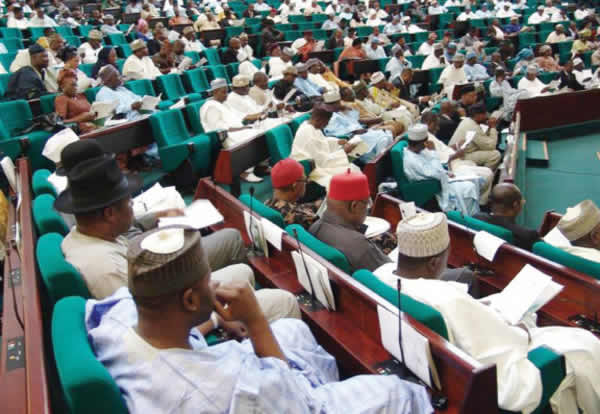
The House of Representatives has passed the state police bill, effectively making way for the decentralisation of the Nigerian policing architecture.

The resolution followed the voting by 289 lawmakers in favour of state police during Thursday’s plenary session presided over by the Speaker, Tajudeen Abbas.

Recall that the House committed Thursday’s plenary to voting on the State Police Bill following the spike in killings, kidnappings, and banditry in the past few months.

The session was not without its fair share of drama, as shortly after the lawmakers settled down for the business of the day, Kaduna lawmaker, Bashir Zubairu, moved a point of order, explaining that the document on the proposed state police put together by the House Committee on Constitution Review got to the lawmakers only on Thursday afternoon.

Recognised to speak by the speaker, Zubairu said, “Mr Speaker, this document was only made available to lawmakers in the chambers, and we are yet to go through it. We cannot do justice to it because we have not gone through it.”

Zubairu, a member of the African Democratic Congress, was ruled out of order, allowing the process to proceed.

While the Speaker took members through the clauses, voices shouting “Point of Order” could be heard, but the presiding officer ignored them.

Before the voting began, Abbas announced that the electronic voting system was faulty, noting that the exercise would be conducted based on attendance.

Out of the 290 members in attendance, 289 voted in favour of state police while one voted against. The Speaker abstained from voting.

The Punch

Continue Reading

National

N210trn Audit Query: Senate Orders Arrest of NNPC Ex-GMD Mele Kyari

Published

on

By

The Senate Committee on Public Accounts has ordered the arrest of former Group Chief Executive Officer of the Nigerian National Petroleum Company Limited (NNPCL), Mele Kyari, following his failure to appear before the committee investigating audit queries relating to NNPCL’s finances between 2017 and 2023.

The directive was issued during an investigative hearing chaired by Senator Ibrahim Dankwambo (PDP, Gombe North) in Abuja.

The committee is probing audit queries raised by the Office of the Auditor-General for the Federation concerning NNPCL’s financial records during the period under review.

Kyari’s absence from the hearing sparked heated debate among committee members, with some senators calling for his immediate arrest, while others urged the panel to grant him another opportunity to appear.

Senators Saliu Mustapha (APC, Kwara Central) and Tony Nwoye (LP, Anambra North) informed the committee that Kyari was reportedly receiving medical treatment in Germany and should be given another chance to honour the invitation.

However, several lawmakers opposed the suggestion.

Senator Abdul Ningi (PDP, Bauchi Central) argued that any claim of illness should be supported by documentary evidence rather than verbal explanations.

Senator Victor Umeh (LP, Anambra Central) subsequently moved a motion for the issuance of a warrant for Kyari’s arrest, which was seconded by the committee’s deputy chairman, Senator Peter Nwaebonyi (APC, Ebonyi North).

Nwaebonyi said the committee had repeatedly invited Kyari without success and stressed the need to conclude its assignment.

“This is the ninth time this committee is meeting on the 19 audit queries raised against NNPCL by the Office of the Auditor-General for the Federation,” he said.

Following a voice vote, the committee adopted the motion and directed that Kyari be brought before it to answer questions relating to the audit issues under investigation.

During the hearing, former NNPCL Chief Financial Officer, Umar Ajiya Isa, rejected claims that N210 trillion was missing or unaccounted for in the company’s records.

Ajiya argued that the figure being discussed exceeded the company’s total revenue during the period in question.

“NNPCL’s total revenue for the period under review was about N54.5 trillion before deducting production costs. It is therefore impossible for N210 trillion to be missing or unaccounted for,” he told the committee.

He maintained that the publication of audited financial statements by the company demonstrated transparency and accountability.

According to him, if such a huge sum had been missing, the company would not have been able to publish audited accounts.

Ajiya also dismissed allegations that N5.8 billion was spent on the registration of NNPC Limited, describing the claim as inaccurate and urging the committee to verify the matter with the Corporate Affairs Commission and the Federal Inland Revenue Service, now known as the Nigeria Revenue Service.

He warned that unverified allegations could damage the reputation of both the company and the country, noting that international rating agencies often rely on publicly available information in assessing investment risks and sovereign ratings.

The former CFO further called on relevant agencies, including the Nigerian Financial Intelligence Unit and the Economic and Financial Crimes Commission, to investigate the claims and establish the facts.

The committee subsequently directed Ajiya and former Chief Upstream Investment Officer, Bala Wunti, to reappear before it in two weeks as the investigation continues.

The Senate panel is expected to submit its findings after concluding its review of the audit queries raised against the national oil company.

Continue Reading

Trending