Connect with us

National

How Yahaya Bello Used Kogi’s $720k to Pay Children’s School Fees in Advance – EFCC Chairman

Published

on

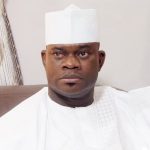
Chairman of the Economic and Financial Crimes Commission (EFCC), Ola Olukoyede, has revealed that the now embattled former Governor of Kogi State, Yahaya Bello, withdrew $720,000 from the State government’s account to pay his child’s school fee.

The EFCC boss disclosed this to journalists in Abuja.

The former governor was last week declared wanted by the commission for alleged N80.2 billion fraud.

EFCC operatives, during the period, stormed Bello’s residence in Abuja to arrest him, but were stopped by his security aides.

Two courts of coordinate jurisdiction also issued conflicting rulings on the matter. While the Kogi State High Court in Lokoja restrained the EFCC from arresting the former governor, the Federal High Court gave the commission the go-ahead to arrest Bello preparatory to his arraignment for alleged fraud.

Olukoyede said: “A sitting governor, because he knows he is going, moved money directly from government to bureau de change, used it to pay the child’s school fee in advance, $720,000 in advance, in anticipation that he was going to leave the Government House.

“In a poor State like Kogi, and you want me to close my eyes to that under the guise of ‘I’m being used.’ Being used by who at this stage of my life?

“I didn’t initiate the case; I inherited the case file. I called for the file, and I said there are issues here.

“On my own, I called him, which I am not supposed to do, just to honour him as an immediate past governor. ‘Sir, there are issues. I’ve seen this case file. Can you just come let us clarify these issues?

“He said, ‘Ha! Thank you, my brother. I know, but I can’t come. There’s one lady that has surrounded EFCC with over 100 people to come and embarrass me and intimidate me.

“I said if that is the issue, I’m going to pass you through my own gate, and you will come to my floor. We will accord you that respect. I will invite my operatives; they will interrogate and interview you in my own office. What could be more honourable than that to allay the fear?

“You know what he said: ‘Thank you, sir, but can’t they come to my village? “

Continue Reading
Click to comment

Leave a Reply

Your email address will not be published. Required fields are marked *

National

FG Expels US Missionary Alex Barber

Published

on

By

The Federal government has expelled American missionary, Alex Barber, citing concerns over statements it says could inflame tensions and worsen divisions, especially in Plateau State.

The decision follows growing controversy surrounding his activities in Nigeria’s North-central region, where authorities allege his comments are capable of inciting unrest.

Abiodun Essiet, Senior Special Assistant to President Bola Tinubu on Community Engagement (North Central), confirmed the development during an appearance on TVC.

Discover more
political
Politics

“Yeah, so we’ve realised what Alex Barber has done, so I must inform that Alex Barber is no longer in Nigeria,” she said.

“He has been, we can say, removed and sent out of the country because of the work he’s doing, which is creating division.”

Essiet further linked his remarks to violence in Jos, claiming:
“Immediately after he made his speech in Jos, a lot of people didn’t know that two people, two Muslims, were killed immediately after his speech.

“Because of the impact of this provocative speech, which he has been making, he was sent out of the country and is no longer in Nigeria.”

Barber, a former American football player turned missionary, gained attention for humanitarian efforts in conflict-affected communities in Benue and Plateau states.

Through his initiative, Building Zion, and in collaboration with a US-based NGO, he participated in rebuilding homes and supporting displaced residents.

At Yelwata in Benue State, he reportedly helped reconstruct dozens of houses destroyed during attacks. During a project event in January 2026, he said, “So far, we have rebuilt 35 housing units… The joy among the people is overwhelming.”

Community leaders and some residents praised the intervention.

Julius Joor, the traditional ruler of Yelwata, said, “For the first time, private individuals have come to our aid in such a massive way. You have restored hope and happiness to our people.”

Similarly, legal practitioner Franc Utoo noted, “You have done what both the federal and state governments have failed to do.”

Despite the humanitarian work, Barber’s public statements increasingly drew criticism. In interviews and online posts, he described violence in the Middle Belt as organised and systematic.

Speaking to News Central Television, he said: “This is not just some random criminality… This is a war being waged on people.”

He also questioned official positions, asking: “If there’s no war in Nigeria, what is happening?”

His remarks, including criticism of government institutions and handling of the crisis, amplified his global profile but sparked backlash locally.

Critics argue his framing oversimplifies a complex situation involving banditry, farmer-herder clashes, and insurgency.

Some also accused him of presenting the conflict largely along religious lines, warning such narratives could heighten tensions.

A former presidential aide, Bashir Ahmad, urged authorities to investigate his activities, saying they could “threaten public peace,” while cleric Ahmad Gumi also raised concerns about his rhetoric.

In a petition to security agencies in Plateau State, Aliyu Naziru alleged Barber was present at a violence scene under unclear circumstances and called for a probe. However, there is no confirmed evidence linking him to any criminal act.

Supporters insist Barber was drawing attention to neglected crises. Religious figures, including COCIN priest Ezekiel Dachomo, defended his efforts and cautioned against attempts to silence him.

Responding to criticism, Barber said: “They haven’t talked about me rebuilding villages… but when I speak out… then all of a sudden [they react].”

He maintained that victims across religious groups have suffered attacks, citing incidents in several northern states.

Analysts note that while freedom of expression is recognised, Nigerian laws restrict speech capable of inciting violence or public disorder, particularly in sensitive regions. Authorities also retain the power to deport foreigners whose actions are considered against national interest.

Essiet said the government acted to prevent further division, drawing a comparison with past global conflicts.

“That’s what the government has done, because we don’t want individuals to come and create division,” she said.

“I’ve been to Rwanda a couple of times… As simple as this whole narrative of what Alex Barber was saying is what some foreign actors did in Rwanda… and that led to a massive genocide.”

“Based on our experience, we don’t want Nigeria to follow that path… We must not allow people who do not understand the history of our crises to divide us.”

Barber denied allegations linking his statements to violence.

In a Facebook post, he said: “Let it be known that if Abiodun Essiet… made this statement, they are directly lying to the Nigerian and international community.

I’ve never heard of this person, nor had conversation with them.”

Continue Reading

National

Eid-el- Fitr: Interior Minister Announces Thursday, Friday As Public Holidays

Published

on

By

The Federal Government has declared Thursday, March 19, and Friday, March 20, 2026, as public holidays to mark the celebration of Eid-ul-Fitr, the end of the holy month of Ramadan.

This was disclosed in a statement signed by the Permanent Secretary of the Ministry of Interior, Dr Magdalene Ajani, on Tuesday in Abuja.

The declaration was made by the Minister of Interior, Dr Olubunmi Tunji-Ojo, on behalf of the Federal Government.

The minister extended warm greetings and congratulations to Muslim faithful on the successful completion of the Ramadan fast.

Tunji-Ojo urged Muslims to sustain the virtues of love, generosity, peace, tolerance, and sacrifice emphasised during the holy month.

He also called on Nigerians to use the festive period to pray for the continued peace, unity, and prosperity of the country.

“The federal government remains committed to fostering national unity and peaceful coexistence among all Nigerians,” he said.

The minister encouraged citizens to celebrate responsibly and extend acts of kindness to the less privileged in society.

He noted that Eid-ul-Fitr represents a period of reflection, gratitude, and compassion, urging Nigerians to uphold these values beyond the festive season.

The Federal Government also reaffirmed its commitment to promoting unity and strengthening peaceful coexistence across the country.

Continue Reading

National

Nine Senators Announce Defection to ADC

Published

on

By

Nine senators on Thursday announced their defection from their various parties to the African Democratic Congress (ADC).

Five of the senators dumped the Peoples Democratic Party (PDP), three left the Labour Party (LP), and one from the All Progressive Grand Alliance (APGA).

The defectors from PDP are Senators Dauda Yaroe, Lawal Usman, Ogochi Onawe, Aminu Tambuwal and Austin Akubondu.

The LP defectors are Senators Ireti Kingibe, Victor Umeh and Tony Nwoye.

Eight of the senators who dumped the PDP and LP cited leadership crises in their parties for their defection.

However, Senator Eyinnaya Abaribe said he dumped APGA because the party sacked him in September 2025.

Continue Reading

Trending