Connect with us

Business

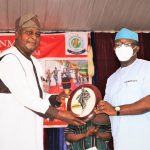
FirstBank CEO, Others Laud, Empower Women at FirstGem 4.0

Published

on

By Eric Elezuo

The Chief Executive Officer, First Bank of Nigeria Ltd and Subsidiaries, Dr. Adesola Adeduntan, has lauded the qualities of African women, saying a woman who knows how money works is in a vantage position to change the world for the better.

Dr Adeduntan made this assertion while delivering his speech at the First Gem Annual Conference 4.0 with the theme, “The Art of Negotiation”, held both on location and via the web.

This year’s event, which fell into the month of March appears symbolic as it represents two wonderful occasions including the celebration of the International Women Day, which provides opportunity to discuss and proffer solutions to gender parity issues and women empowerment challenges, and the 127th anniversary of the bank, FirstBank of Nigeria Limited. Of more importance is the fact that the 4.0 edition took place on the very day the company marked its birthday.

In his speech, Adeduntan paid glowing tributes to women, citing the fact that First Gem is tailor-made to suit the financial inclinations of women in business. He reiterated that “FirstBank, through the FirstGem initiative, is committed to supporting the contemporary woman’s financial services needs across the various stages of her life,” adding that “Our FirstGem value proposition provides real solutions to challenges faced by female entrepreneurs and working professionals.”

The FirstBank’s CEO eulogised the enterprising African woman, using an African proverb, which says, “If you educate a man you educate an individual, but if you educate a woman, you educate a family (nation)” stressing that “If you teach a woman how money works, provide her with the right products and funding support; she can transform the world.”

Further in his narrative, Adeduntan went down memory, bringing to the presence the moments that birth FirstGem as a preferred platform for the empowerment of women financially and numerous achievements recorded overtime.

He said: “In the last five years, our FirstGem initiative has served to foster the empowerment of women across the socio-economic strata with implementation across three pillars.

“The FirstGem platform for women (access to leadership programs/ workshops/trainings on women empowerment, business skills on wealth management and investment plans) Value proposition including capacity building, affordable finance, access to infrastructure, market visibility for women MSMEs

“A strong commitment as a financial institution to support women by leveraging the Bank’s resources in developing unique and mutually rewarding solutions.

“Today, our work is more important and impactful than ever! A review of the performance of the FirstGem initiative shows the effectiveness of our efforts to elevate and empower the Nigerian woman. In 2020, we gave out loans of NGN 58 billion to over 81,000 female entrepreneurs and professionals.
Empowering women via agent banking proposition is one of the outcomes of the FirstGem initiative. Across our agent banking network – the largest verified bank-led agent banking network in Nigeria – , we have about 24,500 female agents representing 28 percent of the agents in our network. It gives us much joy to see that more women are embracing this proposition and getting empowered.

“The FirstGem Initiative takes an inclusive approach to empowering women to make confident and sound decisions with respect to their business, family, and future. Whether you are the primary financial decision maker, a partner or financially independent, the time is now to power your own financial success by being part of the FirstGem Initiative – Open a FirstGem account and join the FirstGem community!

“Finally, as we close out on the activities that celebrate women folks, this March, I would like to restate that, at FirstBank, we remain committed to providing products and services that will allow our female customers and employees to thrive and attain their maximum potentials in business and career. Let us work together to make 2021 count for women, everywhere!

He advised women entrepreneurs to take advantage of the opportunities the FirstGem offers, noting that “we are leveraging the Agent banking proposition to close the gender gap and tap into the rich and overlooked base of the pyramid customer segment (that is predominantly women) with the realization that failure to fully harness women’s productive potential represents a missed opportunity to drive accelerated global economic growth.”

Recognising that the post- COVID-19 pandemic economic indices do not in any way favour women, Adeduntan informed that FirstBank has devised a veritable approach to support women’s wealth creation and financial independence.

“It has become imperative to match the scale and urgency of this challenge with financial products that address the lifecycle financial needs of women. The products should holistically address the needs of women by providing them with integrated access to savings as well as short and long-term credit, capacity building, and wealth management advisory. This suite of products will improve the earning capacity and reduce poverty levels amongst the women folk, in the medium to long term. Success will be dependent on everyone playing a part!” The FirstBank CEO said.

Firstgem is an exclusive FirstBank initiative to inspiresl and empower women to take charge of their financial future through the provision of access to resources and interactive workshops and advisory that help women to make informed financial decisions and build wealth management competences.

Other speakers at the event were the Chairman Board of Directors, First Bank of Nigeria Limited, Mrs. Ibukun Awosika, who spoke on the theme of the International Women’s Day, “Choose to Challenge”, Professor of Economics at IESE Business School, Prof Pedro Videla, who spoke on the current state of the Global Economy and how it Impacts Business Decisions, and Senior Lecturer, IESE Business School, Prof Mehta Kandarp, who lectured on Negotiation as a Tool for Winning in Business and Career.


Continue Reading
Click to comment

Leave a Reply

Your email address will not be published. Required fields are marked *

Business

Why MTN, Airtel Suspended Airtime, Data Borrowing Services + the FCCPC Connection

Published

on

By

Nigeria’s largest telecom operators are temporarily suspending airtime and data loan services, a once-sticky feature for prepaid users, as new consumer lending rules force them into full regulatory compliance.

On Thursday, MTN Nigeria, the country’s largest telco, temporarily suspended its airtime and data lending product, Xtratime, and Airtel Nigeria, the second-largest provider, followed suit on Friday, citing the need to align with “evolving requirements.” Both companies say customers can still purchase airtime and bundles through standard channels.

“MTN Nigeria Communications PLC (MTN Nigeria or the Company) hereby notifies the Nigerian Exchange Limited and the investing public that the Company has temporarily suspended its airtime and data credit advance service (“Xtratime”),” the telco said in its filing. “This relates to the implementation of processes under the Digital, Electronic, Online or Non-Traditional Consumer Lending Regulations, 2025, which introduced a new compliance and licencing framework for entities providing digital or non-traditional consumer credit services.”

Nigerian telecom providers are reviewing their digital lending services to consumers following new rules by the Federal Competition and Consumer Protection Commission (FCCPC), passed in July 2025. Those guidelines apply to any entity involved in the provision, facilitation, or administration of digital or non-traditional consumer lending, bringing airtime and data advances into scope and requiring operators to obtain licences and meet the compliance requirements before continuing the services.

“Airtel Nigeria remains committed to the highest standards of compliance, transparency, and consumer protection, while continuing to innovate responsibly within Nigeria’s digital ecosystem,” said Ismail Adeshina, the company’s director of marketing, in the statement released Friday.

However, in a statement issued on Friday, the FCCPC pushed back against claims that it ordered the suspension of airtime lending services, stating that it “has not prohibited airtime borrowing or data advance services, and no directive was issued preventing consumers from accessing lawful telecom value-added services.”

The regulator framed the disruptions as a consequence of operators’ failure to comply with existing rules within the stipulated timelines.

The FCCPC’s Digital, Electronic, Online, or Non-Traditional Consumer Lending (DEONCL) Regulations and Guidelines apply to entities involved in digital consumer lending, including services tied to repayable monetary value. Products, such as MTN’s Xtratime, fall within the scope of the framework.

The FCCPC said the rules were introduced following “a deluge of consumer complaints” involving opaque charges, unexplained deductions, aggressive recovery practices, and poor disclosure standards across digital lending services.

According to the consumer protection watchdog, affected digital lending operators, including telcos, were initially given a 90-day compliance window in 2025, later extended to January 5, 2026, yet relevant operators failed to meet the necessary compliance steps.

“In the telecom sector, our findings indicated that some operators engaged in exclusionary third-party technical arrangements in clear disobedience to the provisions of the Federal Competition and Consumer Protection Act, 2018. The Regulations sought to unlock the market to allow local participants alongside foreign partners, in line with free market principles. These measures benefit Nigerians by reducing abusive practices, improving transparency, strengthening consumer choice, and encouraging responsible innovation by legitimate operators,” the regulator said on Friday.

Any temporary suspension, restriction, or operational change introduced by service providers, including telcos, should therefore be understood as a business or compliance decision by those operators, not a ban imposed by the FCCPC, the statement read.

Securing approval under the framework requires service providers to apply to the FCCPC, submit corporate and ownership documents, and disclose their lending models, including interest rates, charges, and default fees. Applicants must also declare all digital lending applications and interfaces used to issue credit, and provide evidence that these systems meet data protection and security standards under Nigerian law.

The rules further require formal consumer lending or service-level agreements (SLAs) for any partnerships with banks or fintechs. The FCCPC charges approval and renewal fees under the regulations, including an additional ₦500,000 ($372) for each lending application beyond the initial five permitted under a single approval.

While it is usually not reported separately, airtime lending contributes a sizable amount to telcos’ revenue.

In 2025, MTN Nigeria’s fintech revenue reached ₦191.3 billion ($142.5 million), growing by 80% from the previous year. About ₦10.9 billion ($8.1 million) accounted for its core fintech revenue, while the rest significantly came from airtime lending and other value-added services.

In Airtel’s case, the telco reports airtime credit service under its mobile services revenue segment, and according to how it defined this product in its 2025 financial year, it treats airtime credit as a value‑added service (VAS) classified as a mobile services product rather than a mobile money product.

In the nine months to December 2025, Airtel Nigeria’s mobile services revenue grew by 50% to $1.12 billion from $738 million year‑on‑year in constant‑currency terms. Data brought in $576 million; voice contributed $432 million, and “other” revenue—the bucket where airtime and data credit earnings sit—reported $113 million, up by about 44% from the previous year.

By comparison, Airtel Nigeria’s mobile money product, SmartCash, earned only $6 million over the same period, underscoring how small its fintech line still is relative to core mobile services income.

Airtime and data lending are high-margin businesses for telcos, since they keep the interest on advances, while incurring little to no procurement costs. Airtime credit is also critical for Nigeria’s credit-starved market, where increased telecom tariffs have pushed up the cost of staying online.

Other telecom operators operating in Nigeria, including Globacom and T2, are yet to announce similar moves. Both MTN Nigeria and Airtel Nigeria said the suspension is temporary and that the services will resume once they meet the requirements.

Source: Tech Cabal

Continue Reading

Business

Fuel Importation Ban: Dangote Tackles NMDPRA over Continuous Issuance of Import Licences

Published

on

By

President of Dangote Industries Limited, Aliko Dangote, has raised concerns that Nigeria’s downstream regulator, the Nigerian Midstream and Downstream Petroleum Regulatory Authority (NMDPRA), is still issuing licences for petrol importation despite public assurances to the contrary, warning that the practice could undermine the operations of his refinery and threaten the country’s energy security.

Speaking in an exclusive interview with THISDAY, Dangote said the continued importation of refined petroleum products into Nigeria was hurting the Dangote Petroleum Refinery, which he insisted has the capacity to meet the country’s fuel demand.

“They are still issuing licences despite that we can meet the demand. They are still killing us with importation. They are importing and we are exporting. Yes, we can do 75 million litres, but they are still back-loading,” Dangote said.

According to the billionaire businessman, the refinery can produce up to 75 million litres of petrol daily, but some market participants are still bringing imported products into the country, a development he said could distort the domestic fuel market.

Dangote said the persistence of import licences contradicts earlier assurances by the Nigerian Midstream and Downstream Petroleum Regulatory Authority (NMDPRA) that fuel imports would be restricted once domestic refining capacity improved.

His comments came against the backdrop of a statement by the NMDPRA indicating that it had stopped issuing new licences for petrol importation because domestic refining was now meeting a significant portion of Nigeria’s demand.

The regulator said the decision aligns with provisions of the Petroleum Industry Act, which allows import licences to be issued only when local production cannot meet national consumption needs.

According to the agency, no new petrol import licences were issued in 2026 as supply from domestic refineries, particularly the Dangote refinery, was considered sufficient to support the local market.

However, NMDPRA data for January 2026 showed that about 24.8 million litres of imported petrol were still consumed daily in Nigeria, although the figure dropped significantly to about three million litres per day in February.

Dangote further alleged that many of the companies importing petrol into Nigeria do not operate retail outlets or filling stations, suggesting that some of the imported volumes may be diverted or smuggled after arriving in the country.

He warned that the trend could mirror challenges previously faced by Nigeria’s rice industry, where local producers struggled to compete with imported products.

Nigeria has historically relied on imported refined petroleum products due to the poor performance of its state-owned refineries. However, expectations have risen with the start of operations at the Dangote refinery, which has a processing capacity of 650,000 barrels per day and is regarded as the largest single-train refinery in the world.

The facility is seen as a major step in Nigeria’s efforts to end decades of dependence on imported fuel.

Meanwhile, Nigeria’s minister of foreign affairs, Yusuf Tuggar, has said the ongoing tensions in the Middle East highlight the need for stronger energy partnerships with countries like Nigeria.

He noted that disruptions in oil shipments through the Strait of Hormuz, a key global oil corridor, underscore the importance of diversifying supply sources.

Tuggar said Nigeria’s untapped oil and gas reserves present an opportunity for Gulf states to partner with the country in expanding production and stabilising global energy supply.

Nigeria currently produces about 1.7 million barrels of oil per day, up from around 1.4 million barrels when President Bola Tinubu assumed office in 2023, with the potential for further growth through increased investment in fields and pipelines.

He added that while Nigeria still imports significant volumes of refined petroleum products, expanding domestic refining capacity could help the country better withstand global energy shocks in the future.

Continue Reading

Business

UBA Unveils Diaspora Platform to Connect Global Africans with Investment Opportunities

Published

on

By

Africa’s Global Bank, United Bank for Africa (UBA) Plc, has unveiled a diaspora banking and investment platform designed to serve Africans living and working across the world and within the continent.

The platform, launched in collaboration with leading ecosystem partners including United Capital, Africa Prudential, UBA Pensions, Afriland Properties, Heirs Insurance Group, and Avon Healthcare Limited — represents a major step in redefining diaspora banking beyond remittances toward structured wealth creation and long-term investment.

At the unveiling, which took place at UBA’s global headquarters in Lagos under the theme: “Beyond Banking: Powering the Global African Lifestyle, all the company representatives were on hand to showcase a seamless platform that goes beyond remittances, wealth creation, protection, and long-term prosperity.

Speaking at the event, UBA’s Head of Diaspora Banking, Anant Rao, described the initiative as a strategic shift in how Africa engages its global citizens.

“For decades, Africa’s engagement with its diaspora has focused largely on remittances. Today, we are moving beyond that. This platform represents a transition from simple money transfers to a financial ecosystem where Africans globally can bank, make payments, invest, protect their families, and build long-term wealth seamlessly,” he said.

Rao noted that African diaspora remittance flows exceed $100 billion annually, making them one of the most resilient and consistent sources of capital into the continent.

“Diaspora capital is not just a flow of funds — it is a strategic growth partner for Africa.
Our role is to provide a trusted platform that converts capital into structured investment and shared prosperity across the continent.”

The objective is to provide a platform that brings together offerings across the numerous needs of the Global African, including Banking and payments, Investments, securities services, asset management, Insurance, Pensions, real estate and Pensions.

Through this coordinated ecosystem, diaspora customers can access financial solutions across multiple sectors through a single trusted platform, enabling them to manage their financial lives and family commitments across borders with ease and transparency.

UBA’s Group Head, Marketing and Corporate Communications, Alero Ladipo, emphasised the importance of collaboration in delivering a seamless diaspora experience.

“The modern African is a global citizen — mobile, ambitious, and deeply connected to home. Whether living in Africa, Europe, the Americas, or the Middle East, there must be a structured and secure financial connection back home. This platform ensures that Africans everywhere can remain economically connected to the continent with confidence and transparency.”

Partners within the ecosystem highlighted growing demand among diaspora Africans for structured investment opportunities, secure property ownership, insurance protection, and long-term financial planning.

United Capital showcased globally accessible investment products designed to deliver professionally managed and transparent wealth creation opportunities.

Afriland Properties emphasised structured and well-governed real estate investment pathways for diaspora clients.

Heirs Insurance highlighted protection solutions for life, and assets, while Avon Healthcare Limited demonstrated healthcare access and insurance solutions for families across borders.

Africa Prudential and UBA Pension reinforced digital investment management and long-term pension savings solutions designed to support diaspora participation in African capital markets.

Together, the partners underscored a shared commitment to providing diaspora Africans with credible, transparent, and professionally managed financial pathways.

Rao also reiterated the guiding philosophy of Africapitalism, championed by UBA’s Founder and Chairman, Mr. Tony O. Elumelu, CFR.

He explained that Africapitalism is the belief that Africa’s private sector must play a leading role in the continent’s development by making long-term investments that generate both economic returns and social impact.

As Africa continues to position itself as one of the world’s most dynamic growth frontiers, UBA believes mobilising diaspora capital through trusted financial institutions will be central to shaping the continent’s next phase of development.

“Africa will increasingly be financed by Africans themselves, including Africans abroad.

“Our responsibility is to build the trusted financial infrastructure that makes this possible.

“When Africa’s global citizens invest back into Africa, growth becomes inevitable,” he concluded.

Continue Reading

Trending