Connect with us

National

Akpabio Admits Deleting ‘Real-Time’ from Electoral Act, Proffers Defence

Published

on

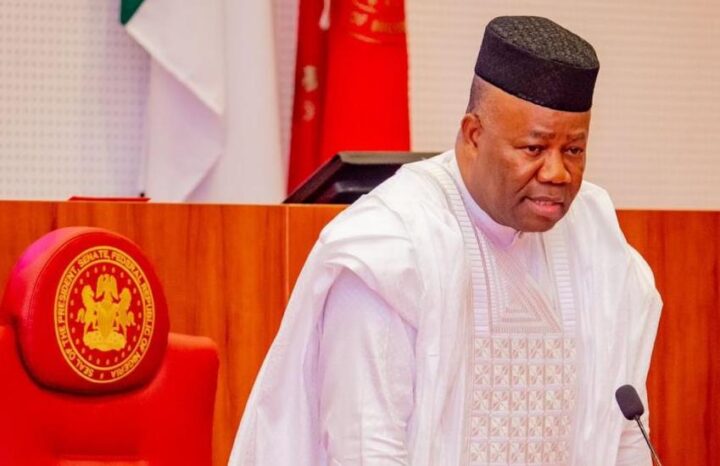
President of the Senate, Godswill Akpabio, on Saturday, admitted that the Senate deliberately deleted the provision for “real-time” transmission of election results from the Electoral Bill, 2026.

Akpabio said the Senate took the decision because it believed that “technology must save and not endanger democracy.”

He spoke in Abuja at the unveiling of a book titled “The Burden of Legislators in Nigeria”, authored by Senator Effiong Bob.

The Senate President likened the issues raised in the book to the challenges faced by lawmakers in the course of their duties, including the controversy and alleged “abuses” directed at the Senate following the passage of the electoral bill.

Defending the removal of real-time electronic transmission from the bill, Akpabio argued that the entire country could be thrown into chaos if, for instance, network or power failure affected the uploading of results.

He insisted that Form EC8A and other official election records should remain the most reliable means of declaring results.

“All we said was to remove the word ‘real-time’ to allow INEC decide the mode of transmission. If you make it mandatory and there is a system failure, there will be a serious problem,” Akpabio told the gathering, further confirming that the bill, as passed, excluded real-time electronic transmission of results.

He gave another example: “Real-time means that if there are nine states where there is no network, does it mean elections will not take place there?

“Or in any part of the country where there is a grid breakdown, does it mean there will be no election?

Reacting to the outrage that trailed the Senate’s action, the Senate President said the legislature would not be “intimidated” into passing a faulty law simply to please opposition political parties, civil society groups and non-governmental organisations (NGOs).

Akpabio criticised NGOs for insisting that because they organised retreats for lawmakers – where ideas were exchanged on the electoral bill – the Senate must adopt their positions, even if such positions did not align with the interests of all segments of the country.

“Why are people setting up panels on television stations and abusing senators? I leave them to God.

“We will not be intimidated but will do what is right for Nigeria, not what one NGO says. A retreat is not law-making.

“Why do you think that the paper you agreed to in Lagos must be what we must approve?” he asked.

Akpabio, who noted that many Nigerians had turned themselves into authorities on legislative matters despite being ignorant of the law-making process, however, softened his stance, promising that there was still a window of opportunity for amendments to the bill.

He cited the Votes and Proceedings of the day’s sitting, explaining that as long as they had not been approved, the bill could still be corrected if the majority of senators supported such changes.

“We have not even completed it until we look at the votes and proceedings. When we bring out the votes and proceedings, any senator has the right to rise and amend it.

“We can amend anything before we approve the votes and proceedings. Why abuse the Senate when what we have is incomplete?

“I can’t talk until they tell me to drop the gavel. In this case, we are yet to complete the process,” he said.

The Senate President also stated that attacks on the Senate were uncalled for, noting that any provision rejected by the Senate could be reinstated by the Conference Committee of the Senate and the House of Representatives. He said there was therefore no need to hastily criticise senators.

However, the National Chairman of the African Democratic Congress (ADC) and former President of the Senate, Senator David Mark, who chaired the occasion, immediately responded, cautioning Akpabio against speaking for the Independent National Electoral Commission (INEC).

“What the ADC is saying is: pass the law and let INEC decide whether it can implement real-time electronic transmission or not. Don’t speak for INEC.

“The position of the ADC is clear: pass the bill and let INEC decide what it will do with it,” Mark insisted.

Several speakers at the event, including Akwa Ibom State governor, Pastor Umo Eno, and the book reviewer, Professor Maxwell Gidado, praised Senator Bob’s courage in writing the book, describing it as a bold effort to highlight the challenges faced by Nigerian legislators in the course of their duties.

The author also outlined some of these challenges, listing electoral battles, conflicts with governors and political godfathers, judicial annulment of electoral victories, addressing private concerns of constituents, and self-inflicted challenges.

“The courage to defend democracy is in the legislature and the legislators,” he said.

Continue Reading
Click to comment

Leave a Reply

Your email address will not be published. Required fields are marked *

National

Xenophobia: Stranded Nigerians in South Africa Cry Out, Says We Are Hungry, Homeless

Published

on

By

Hundreds of Nigerians awaiting evacuation from South Africa have raised alarm over worsening hardship, as delays in the Federal Government’s repatriation process leave many stranded without food, shelter, or financial support.

Several affected Nigerians, including women, children and elderly persons, are reportedly battling severe conditions after exhausting their savings while waiting for evacuation flights back to Nigeria.

The stranded citizens had travelled from different provinces in South Africa for registration and screening after responding to the government’s evacuation programme. However, many now say they have been left abandoned as uncertainty continues over the next batch of flights.

President of the Nigerian Citizens Association South Africa (NICASA), Rev. Frank Onyekwelu, raised the concern on Friday, calling on the Federal Government to urgently intervene and speed up the evacuation process.

According to him, many Nigerians who complied with official directives are now sleeping in harsh conditions with no clear timeline for their return home.

“Several have exhausted their limited resources after travelling long distances in good faith, believing arrangements had been adequately concluded for their departure.”

Onyekwelu said the prolonged delay has pushed many families into desperate conditions.

“Many of these citizens travelled from distant provinces across South Africa after being instructed to report for registration and screening. Today, numerous families, including women and children, are stranded without shelter, food, transportation or the financial means to sustain themselves.”

He also expressed concern over reports of poor communication and alleged mistreatment during the registration process.

“Of grave concern are reports from affected citizens alleging humiliation, insensitive treatment and poor communication from certain officials during the registration and screening exercise.”

He stressed that Nigerians who followed government instructions deserve protection and humane treatment, not additional suffering.

“Our citizens are not merely statistics. They are fathers, mothers, children, students, workers and entrepreneurs who have found themselves in desperate circumstances. Their cries for help must not go unanswered.”

The NICASA president further appealed to the Ministry of Foreign Affairs and other relevant agencies to immediately deploy emergency support for stranded Nigerians pending their departure.

He also called for urgent arrangements to conclude the evacuation process.

“We also urge relevant government agencies to urgently facilitate the remaining four evacuation flights so that all registered citizens can be safely returned home without further delay.”

Onyekwelu also said the Nigerian community in South Africa has not felt adequately supported by the country’s diplomatic mission, especially at a time when many citizens are facing growing uncertainty and fear.

Meanwhile, anxiety has continued to rise among undocumented migrants in South Africa over the June 30 deadline issued by anti-immigration groups.

A Nigerian resident, who spoke anonymously, described the situation as tense and frightening, revealing that many Nigerians have gone into hiding while waiting for evacuation.

“Things are not easy here, my brother. There is a lot of fear about that deadline, though some groups are trying to prevent South Africans from joining the protest. Right now, I am hiding in a friend’s house, and he generously gave us shelter.”

The source added that the humanitarian situation is becoming more severe as many migrants remain stranded at consulates or in temporary shelters.

“Many of our people are stranded at the consulate awaiting evacuation to Nigeria, while others are temporarily staying with friends and acquaintances across different towns. It is not easy. There are many other nationalities too, with their luggage in consulates, sleeping in the open in the freezing weather. It is a sorry sight.”

He said many Nigerians became homeless after losing jobs that previously came with accommodation.

“Many of us became homeless at the same time, particularly those who worked in factories, stores and farms where accommodation was provided. We were thrown out after the South African president announced that employers who hire undocumented immigrants would be arrested. But we hope to leave before the June 30 deadline.”

Another Nigerian, Nze Akumezienwata, also urged fellow citizens to remain cautious and prioritize their safety amid rising tensions.

In a Facebook post, he wrote, “Please, I urge all Nigerians in South Africa, especially those sleeping on the streets, to leave the country. To those who still have businesses here, let us be careful about our movements. Try to prepare and leave this country for them.”

The latest development comes amid renewed xenophobic tensions in parts of South Africa, where anti-immigrant protests have triggered fears among foreign nationals.

Foreign-owned businesses and migrant communities have increasingly come under pressure, with undocumented migrants being blamed for rising unemployment, crime and pressure on public services.

The Nigerian community has suffered repeated attacks over the years. The Nigerian Union South Africa previously documented at least 118 deaths linked to xenophobic violence, including recent incidents involving Nigerians.

Despite the growing concerns, the Federal Government has assured citizens that evacuation efforts remain ongoing.

Minister of Foreign Affairs, Ambassador Bianca Odumegwu-Ojukwu, disclosed that the first batch of 258 Nigerians arrived in Lagos on June 11 after being evacuated from South Africa.

She said nearly 1,000 Nigerians had registered for evacuation, leaving more than 742 still awaiting transportation back home.

Odumegwu-Ojukwu explained that President Bola Tinubu approved the evacuation exercise following reports of harassment, intimidation and attacks against Nigerians and other African migrants living in South Africa.

For many stranded Nigerians, however, the immediate concern remains survival as they wait for government assistance and a safe return home.

Source: Politicsnigeria

Continue Reading

National

June 12: Tinubu’s Govt Killing Democracy in Nigeria, Atiku Warns

Published

on

By

The presidential candidate of the opposition African Democratic Congress (ADC), Alhaji Atiku Abubakar, on Thursday, declared that the actions of the Bola Ahmed Tinubu-led All Progressives Congress (APC) administration contradicts the spirit, sacrifice, and legacy of June 12.

In a statement he personally signed and released to commemorate another Democracy Day on June 12, the former Vice President charged the citizens to stand up against bad governance, reject the politics of intimidation, and resist every manifestation of democratic backsliding.

He stressed that Nigerians must once again summon the courage of those who marched, protested, resisted, suffered, and sacrificed for freedom for June 12 to retain its meaning.

The Waziri Adamawa said over the past three years, Nigerians had witnessed a deliberate and coordinated effort to weaken, fragment, and neutralise opposition political parties ahead of the 2027 general elections.

He added that through manufactured leadership crises, orchestrated defections, political intimidation, and the abuse of state institutions, every credible opposition platform had come under sustained attack.

Atiku said institutions that ought to serve the Nigerian people impartially had increasingly been transformed into instruments of partisan warfare, adding that financial crimes agencies, the police, the National Assembly, and even segments of the judiciary have been deployed to harass, intimidate, and coerce opposition voices into submission or defection.

Part of the statement titled ‘June 12: On The March, Again’ read: “As Nigerians prepare to commemorate another Democracy Day on June 12, we do so under the darkening shadow of a systematic assault on the democratic space by the Bola Ahmed Tinubu-led APC administration.

“What ought to be a celebration of freedom, popular sovereignty, and constitutional governance has instead become an occasion for sober reflection on the steady dismantling of the very ideals that inspired our struggle against military dictatorship….

“The Electoral Act 2026 has further entrenched provisions that disproportionately favour the ruling party, while freedom of speech, freedom of association, and media independence have come under relentless assault.

“These actions strike at the very heart of democracy and stand in direct contradiction to the spirit, sacrifice, and legacy of June 12,” the former Vice President said.

The Waziri Adamawa, who said he spoke not as a distant observer but as one who paid a personal price in the struggle to enthrone democratic governance in our country, stressed that he resisted every attempt to be co-opted into military rule.

He said: “Alongside other patriots, I stood firmly against dictatorship and paid dearly for that conviction. My businesses were confiscated. An assassination attempt was launched against me and my family in Kaduna. Several police officers lost their lives in that attack, and I was forced into exile.

“In the historic June 12, 1993 presidential election—the foundation upon which this Democracy Day rests—I stepped aside for the late Chief Moshood Kashimawo Olawale Abiola to emerge as the presidential candidate of the Social Democratic Party and the eventual winner of that epochal election.

“The democracy we enjoy today was not gifted to us by benevolent rulers. It was won through sacrifice, courage, resistance, and blood. Politicians, pro-democracy activists, patriotic military officers, labour leaders, civil society organisations, students, journalists, and ordinary Nigerians united to confront military tyranny. Many paid the ultimate price. Chief MKO Abiola and Kudirat Abiola laid down their lives. So did Pa Alfred Rewane, Shehu Musa Yar’Adua, scores of journalists, students, activists, and countless unnamed heroes whose sacrifices paved the way for the democratic order we now risk taking for granted.”

He, therefore, expressed concern that Nigeria found itself confronted by a different but equally dangerous threat 27 years after the military returned to the barracks with what he called the emergence of an increasingly authoritarian civilian order.

He said: “Unlike military dictatorship, which ruled by decrees and brute force, this new authoritarianism seeks legitimacy through institutions it has steadily captured and weakened. Its methods may be more sophisticated, but its objective is the same: the concentration of power, the silencing of dissent, and the subversion of the will of the people.

“The warning signs are everywhere. A shrinking civic space. A compromised electoral environment. The intimidation of opposition figures. The weaponisation of poverty. The weakening of democratic institutions. The growing perception that the ruling party is more interested in retaining power at all costs than in governing for the benefit of Nigerians.

“This is why June 12 must remain more than a public holiday. It must remain a living reminder that democracy is never permanently won; it must be continually defended.”

Atiku underscored the need to ensure that the sacrifices of June 12 were not in vain, stressing that “We cannot celebrate the defeat of military dictatorship while tolerating the rise of civilian autocracy. We cannot honour the heroes of democracy while remaining silent as democratic institutions are weakened and captured.”

The presidential candidate of the ADC expressed his commitment to working with all Nigerians of goodwill—across political parties, civil society organisations, labour unions, professional bodies, youth groups, and the broader public—to resist these authoritarian tendencies and defend our constitutional democracy.

“Once again, Nigerians are called upon to stand up in defence of the Republic. The hard-won gains of democratic rule are being steadily eroded, and there is a growing and legitimate concern that the Tinubu administration is determined either to manipulate the outcome of the 2027 elections or undermine the democratic process itself if it cannot secure victory through the ballot….

“The task before us transcends partisan politics. It is a national duty….The struggle continues. And just as we marched before, we must be prepared to march again,” he further advised citizens.

Continue Reading

National

Reps Pass State Police Bill

Published

on

By

The House of Representatives has passed the state police bill, effectively making way for the decentralisation of the Nigerian policing architecture.

The resolution followed the voting by 289 lawmakers in favour of state police during Thursday’s plenary session presided over by the Speaker, Tajudeen Abbas.

Recall that the House committed Thursday’s plenary to voting on the State Police Bill following the spike in killings, kidnappings, and banditry in the past few months.

The session was not without its fair share of drama, as shortly after the lawmakers settled down for the business of the day, Kaduna lawmaker, Bashir Zubairu, moved a point of order, explaining that the document on the proposed state police put together by the House Committee on Constitution Review got to the lawmakers only on Thursday afternoon.

Recognised to speak by the speaker, Zubairu said, “Mr Speaker, this document was only made available to lawmakers in the chambers, and we are yet to go through it. We cannot do justice to it because we have not gone through it.”

Zubairu, a member of the African Democratic Congress, was ruled out of order, allowing the process to proceed.

While the Speaker took members through the clauses, voices shouting “Point of Order” could be heard, but the presiding officer ignored them.

Before the voting began, Abbas announced that the electronic voting system was faulty, noting that the exercise would be conducted based on attendance.

Out of the 290 members in attendance, 289 voted in favour of state police while one voted against. The Speaker abstained from voting.

The Punch

Continue Reading

Trending