
World
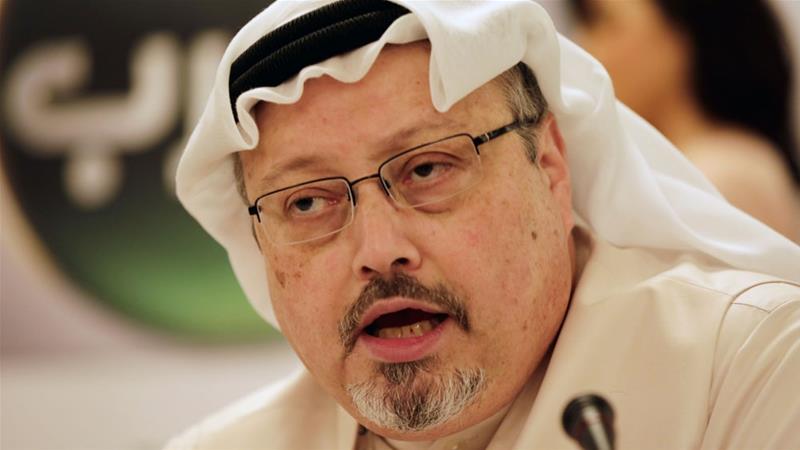
Jamal Khashoggi: The Story Behind the Stories


By Eric Elezuo
On October 2, 2018, Saudi Arabia born critical journalist resident in Washington DC, United States of America, Jamal Khashoggi, had visited the Saudi Embassy in Istanbul Turkey, apparently to obtain promised papers to authenticate his divorce, but never came out. Turkish authories, which raised the alarm, claim that the journalist must have been murdered inside the consulate in what they describe as “premeditated murder”, and his body dismembered and disposed.
However, Saudi officials have rebuffed the theory, claiming that the journalist left the building before his disappearance
French President Emmanuel Macron said he was “extremely worried” about the Saudi journalist’s disappearance.
“I am waiting for the truth and complete clarity to be established,” Macron said in an interview with France 24. “What’s being mentioned is serious, very serious […] France wants everything to be done so that we have all the truth on this case of which the first elements are extremely worrying.”
Macron said he will take a final stance once fact are established and would discuss the matter with leaders from Turkey and Saudi Arabia.
Also, France’s foreign ministry said on Friday that it had asked Saudi Arabian authorities to provide detailed answers over the question of what happened to Khashoggi.
“The disappearance of Jamal Khashoggi in Istanbul … has raised serious questions about his fate. France asks that the facts be clearly established and that all those who can contribute to the truth fully contribute to it,” Agnes Von der Muhll, a foreign ministry spokeswoman said in a statement.
With the Saudi authority denying any complicity in the disappearance of Khashoggi, Turkey has maintained that it has incontrovertible evidence to prove that the journalist has been killed, alleging involving of the Saudi Crown Prince.
As an aftermath, foremost media outfits are beginning to stear clear of Saudi authorities. On Friday, CNN and The Financial Times dropped out of a Saudi investment conference.

A protester displays Khashoggi’s poster
They join journalists from The Economist, CNBC and The New York Times, who pulled out of the Future Investment Initiative conference in Riyadh earlier amid growing concerns over Khashoggi’s disappearance.
Economist Editor-In-Chief Zanny Minton Beddoes will not participate in the Future Investment Initiative conference in Riyadh, spokeswoman Lauren Hackett said in an email.
Andrew Ross Sorkin, a CNBC anchor and New York Times business journalist, tweeted he was not attending the conference, saying he was “terribly distressed by the disappearance of journalist Jamal Khashoggi and reports of his murder”.
The New York Times also decided to pull out of the event as a media sponsor, spokeswoman Eileen Murphy said.
The Financial Times said in a statement that it was reviewing its involvement as a media partner.
In the wake of the accusations and counter-accusations, a delegation from Saudi Arabia arrived in the Turkish capital, Ankara, for an investigation into the mysterious disappearance, according to two Turkish sources cited by the country’s Anadolu news agency, quoted Aljazeera.
The visit follows an announcement on Thursday that Turkey had accepted a Saudi proposal to launch joint investigations into Khashoggi’s disappearance.
Meanwhile, the US and Turkish officials have disclosed that there are audio and video recordings proving Khashoggi was tortured and murdered inside the Saudi consulate in Istanbul. How they laid their hands on such classified information is still unknown.
It was revealed that video recordings show a Saudi assassination team seizing the journalist after he walked in on October 2. He was then killed and his body dismembered, the officials told the Washing Post – the newspaper that Khashoggi wrote for as a columnist.

Saudi Crown Prince accused of ordering the operation
The Source, who claimed that the audio was particularly gruesome, narrated:
“The voice recording from inside the embassy lays out what happened to Jamal after he entered.
“You can hear his voice and the voices of men speaking Arabic. You can hear how he was interrogated, tortured, and then murdered.”
Another unnamed official confirmed men could be heard beating Khashoggi on the recording.
From the way Turkey has been vocal against Saudi, it is clear that they have verifiable evidence relating to the disappearance. Security expert, David Katz, CEO of Global Security Group, told Al Jazeera the intelligence officials quoted by The Washington Post likely have audio and video that clandestinely recorded Khashoggi’s killing.
“There is clearly tension between the Saudis and the Turkish government, so that suggests Turkey is going to be directing its very considerable intelligence apparatus at everything to do with the Saudi government in Turkey for sure,” said Katz.
“So it’s very possible that they do in fact have audio and video recordings of things that have gone on inside the consulate, whether that was bugs planted or electronic intercepts. So you wouldn’t really need full forensics if you have evidence of that nature. And if the report in The Washington Post is correct, that’s apparently what they have.”
Katz said spies have “robust electronic devices” that can allow them to listen to what’s going on inside buildings from outside.
“You’ll actually hear what happened, you’ll hear the voices. There was a suggestion there was an interrogation followed by a very brutal murder. If that’s the case – and if that’s on audio and/or videotape – you don’t need anything else. That’s the case right there.”
However, most people have reasoned that if Turkey has such incontrovertible evidence, what is keeping them from making it public so as to get the matter and done with in good time.
On the other hand, strong allegations point at the Saudi Crown Prince as the biggest suspect in the cruelty that befell Khashoggi.
Khaled bin Farhan al-Saud, a Saudi prince living in exile in Germany, alleged Saudi officials plotted to abduct him days before he vanished, adding it’s part of plan by Crown Prince Mohammed bin Salman to keep adversaries quiet.
“Over 30 times the Saudi authorities have told me to meet them in the Saudi embassy, but I have refused every time,” Saud told a UK newspaper.
“I know what can happen if I go into the embassy. Around 10 days before Jamal went missing they asked my family to bring me to Cairo to give me a cheque. I refused.”
He said at least five Saudi royals last week approached the leadership in Riyadh about Khashoggi’s disappearance, and they were detained.
“Just five days ago a group tried to visit King Salman saying they were afraid for the future of the al-Saud family. They mentioned Mr Khashoggi’s case. They were all put in jail,” said Saud.
Everyone is “scared”, he added.
More troubles remain in wait for Saudi as more governments are threatening diplomatic review should the news of the murder turns accurate. and in the private business enterprise, British billionaire, Richard Branson said his Virgin Group would suspend its discussions with Saudi Arabia’s Public Investment Fund over a planned $1bn investment in the group’s space ventures.
“What has reportedly happened in Turkey around the disappearance of journalist Jamal Khashoggi, if proved true, would clearly change the ability of any of us in the West to do business with the Saudi government,” Branson said in a statement.
Branson also said he would suspend his directorship in two Saudi tourism projects around the Red Sea, citing Khashoggi’s disappearance.
Jamal Ahmad Khashoggi was a Saudi journalist and Washington Post opinion columnist, author and the former general manager and editor-in-chief of Al-Arab News Channel. He also served as editor for Saudi newspaper Al Watan. Born on October 13, 1958, in Medina, Khashoggi would have been 60 if he had lived 11 more days.
He was born into a very rich, powerful and well-known family in Saudi Arabia. His grandfather, Muhammad Khashoggi, who was from a family of Ottoman origin, married a Saudi woman and served as personal physician to King Abdulaziz Al Saud, the founder of the kingdom Saudi Arabia. Jamal Khashoggi is the nephew of late, high-profile Saudi arms dealer Adnan Khashoggi, known for his part in the Iran-Contra scandal, estimated to have had a net worth of $4 bn in the 1980s. Jamal Khashoggi’s cousin, Dodi Fayed, was dating Britain’s Princess Diana when the two were killed in a car crash in Paris.
A vocal critic of the Saudi government, he received his elementary and secondary education in Saudi Arabia and obtained a bachelor’s degree in business administration from Indiana State University in the United States in 1982.
He is believed to have been killed and dismembered on October 2 or thereabout by the Saudi government after he walked into their consulate in Turkey.


Court Vacates Order for Arrest of Fubara’s CoS, Says It’s Mere Academic Exercise

Rivers: Wike’s Men Reject Reployment, Resign from Fubara’s Govt

Tinubu Approves Credit Scheme Takeoff to Facilitate Purchase of Cars, Houses

Group Celebrates Gov Umo Eno at 60 with Visits to Hospitals, Prisons, Empowerment of 60 Persons

Again, DStv, Gotv Jack Up Subscription Rates

Dr. Ogbonnaya Onu: One Death Too Many

How Yahaya Bello Used Kogi’s $720k to Pay Children’s School Fees in Advance – EFCC Chairman

Nigerian Engineer Wins $500m Contract to Build Monorail Network in Iraq

WORLD EXCLUSIVE: Will Senate President, Bukola Saraki, Join Presidential Race?

World Exclusive: How Cabal, Corruption Stalled Mambilla Hydropower Project …The Abba Kyari, Fashola and Malami Connection Plus FG May Lose $2bn

Rehabilitation Comment: Sanwo-Olu’s Support Group Replies Ambode (Video)

Pendulum: Can Atiku Abubakar Defeat Muhammadu Buhari in 2019?

Fashanu, Dolapo Awosika and Prophet Controversy: The Complete Story
Pendulum: An Evening with Two Presidential Aspirants in Abuja

Who are the early favorites to win the NFL rushing title?
Boxing continues to knock itself out with bewildering, incorrect decisions
Steph Curry finally got the contract he deserves from the Warriors
Phillies’ Aaron Altherr makes mind-boggling barehanded play
The tremendous importance of owning a perfect piece of clothing
-
 News6 years ago
Nigerian Engineer Wins $500m Contract to Build Monorail Network in Iraq
-
 Featured6 years ago
WORLD EXCLUSIVE: Will Senate President, Bukola Saraki, Join Presidential Race?
-
 Boss Picks6 years ago
World Exclusive: How Cabal, Corruption Stalled Mambilla Hydropower Project …The Abba Kyari, Fashola and Malami Connection Plus FG May Lose $2bn
-
 Headline6 years ago
Rehabilitation Comment: Sanwo-Olu’s Support Group Replies Ambode (Video)
-
 Headline6 years ago
Pendulum: Can Atiku Abubakar Defeat Muhammadu Buhari in 2019?
-
 Headline5 years ago
Fashanu, Dolapo Awosika and Prophet Controversy: The Complete Story
-
Headline6 years ago
Pendulum: An Evening with Two Presidential Aspirants in Abuja
-

 Headline6 years ago
2019: Parties’ Presidential Candidates Emerge (View Full List)