Connect with us

Opinion

2019 Polls: ‘Atikulating’ the Atiku Option

Published

on

By Nkannebe Raymond

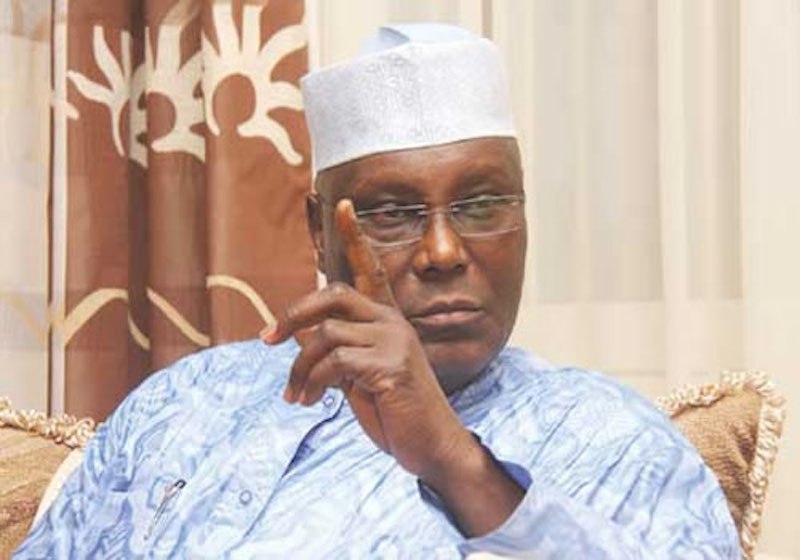
When it became clear that Alhaji Atiku Abubakar would emerge the candidate of the opposition Peoples Democratic Party (PDP) at the just concluded National Convention of the party, as I watched from the comfort of my apartment yesterday (Sunday) morning, I was overtaken by emotions. Late Saturday night, as I followed the exercise on screen, I had told a group of friends whom I had a conversation with (on the chances of each of the twelve aspirants), that this was Atiku’s last shot at the presidency considering the odds his declining age would pose to any further aspirations come 2023 in the event he loses the ticket this time. And more so, as it would be hard to think that the cracks that occurred both in the APC and the PDP in the race to 2019, would repeat itself in a manner such as would come with a basket of opportunity for the man.

And so when it was eventually announced that he has emerged the candidate of the PDP after an electoral process that would make a Yakubu Mohammed rethink his appropriateness for the office he occupies, after garnering a whopping 1532 votes with his closest rival scratching a distant 693 votes, I took pity on a man whose political road in the words of that great Educationist, Tai Solarin, has been rough.

At the same time, I was happy for him for having stepped up to the threshold of history this time, as in all his five attempts at clinching the number 1 political office in the Country which began in 1991, never has he stood in a position that saw him more close to its actualization as now. All previous attempts have not quite seen him become a candidate under a platform with the structure to give life to what critics might call vaulting ambitions. When he emerged the candidate of the defunct Action Congress (AC) in 2007 after a bare knuckled political warfare with his erstwhile boss, he came a distant third at the general election, garnering supposedly only 7% of the votes in an election that stands out today as the worst in the nation’s chequered history. 2011 was ‘a no-go-area’ of sorts given the peculiar nature of the political environment at the time, while 2014 saw him lose out at the primaries to the incumbent president.

And so when he took that historical walk from where he sat at the VIP section of the Adokiye Amiesimaka Stadium in Port Harcourt ─venue of the convention, up to the podium to deliver his acceptance speech for what he acknowledges as a privilege to serve, I was literally overtaken by goose bumps brought about by a solemn retrospection into the tortuous political journey of a man whose success story is the prototypical tale of unflinching determination and doggedness towards the actualisation of a noble cause. And I like to think that the emotional weight of all these, must have operated in no small measure to force the tears down his plum cheeks while he picked the party’s presidential ticket months ago─ tears which must have been informed by his innermost acknowledgment of the fact that this was his last chance at the presidency that so fits his carriage and body frame after repeated trials that must have come with huge financial, emotional and psychological costs at each occasion. In many ways, his journey to the current position he occupies, mirrors the circumstances that also dogged incumbent president Muhammadu Buhari’s aspirations to the presidency, which eventually found manifestation three years ago.

Atiku’s ambitions all along must have suffered from the damage wrought on his person by former President Olusegun Obasanjo who for reasons best known to him, has sworn not to forgive his former deputy for “sins” that have not been effectively communicated to Nigerians. While the Ota farmer’s influence across the Nigerian political firmament remained intact, they operated to frustrate the emergence of an Atiku Presidency. And on many occasions, the former president had come out to say that “while he lives, Atiku would not be President”. This ‘damage’ as it appeared, soon became a sing-song and many Nigerians in their typical uncritical manner bought whatever was said of him by the ‘Chief Watcher of the Federation’ of the presidential library infamy.

Across Nigeria, people who knew little or nothing of the antecedents of the man─particularly as relates to the foundations of his wealth which dates back to many years before his becoming a vice-president, were given to react dismissively of him, on grounds amongst others that he “is corrupt”. On several occasions I have been buffeted by critics who are never tired of describing the man as a Robin hood of sorts. You’d think that they would be generous enough to give flesh to these very outlandish allegations, but all you’ll get are recitations of conspiracy theories that would make a script for a blockbuster motion picture.

For many of these traducers visibly suffering from acute “pull-him-down-syndrome”, they were only relaying or repeating what they heard that was said of the man. Indeed, the story of Atiku’s ugly perception amongst many Nigerians as aided by the media, lends credence to the gobbelian propagandist philosophy that when you consistently repeat falsehood it somehow graduates into truth. But the fact remains that these allegations are mere hogwash, and calculated attempt to tarnish the man’s hard earned reputation.
With his emergence yesterday as the PDP’s candidate, there seem to have been a resurgent of this well lubricated propaganda that tars the waziri Adamawa with the brush of corruption. A ‘corruptness’, if I might use that word, that has not been substantiated by any court of competent jurisdiction many years after he left public service. The rave of the moment however, is the petty insinuation making the rounds that Atiku cannot be issued with an American Visa, having been banned from entry into that country on allegations bordering on corruption as though a visit to the United States were a condition precedent to qualify to the exalted office of the Nigerian president─a campaign launched and funded by a section of the political Mafioso that rue the emergence of an Atiku Presidency.

But the tables are looking set to be turned with the popular mandate he received yesterday. For all the outright falsehood that have been peddled against the person of Atiku Abubakar, the good news as far as one could gather, is that many Nigerians are beginning to see through the ruse having witnessed the oversized ‘integrity’ of president Muhammadu Buhari and his ‘lifeless’ superintendence. Many persons are beginning to ask critical questions of these blatant allegations that resemble those of a Christine Blassey Ford against, a very fine Judge in the United States, which cries to the heavens for substantiation. More enlightened Nigerians are no longer willing to lend themselves to be used as a fodder to propagate sheer falsehood against a man who have built businesses across the length and breadth of this country, and have created wealth more than any other politician of his ranking. Nigerians are now more disposed to pointing naysayers to the numerous accomplishments of the man in the business world that speak eloquently of his often scrutinised wealth.

But even more importantly, all through social media, commentators have not ceased calling attention to the fact that the 2019 election is not a referendum on the integrity or otherwise of Atiku Abubakar. They have reiterated that it remains a referendum on Buhari’s performance in the core areas of Economy, Corruption and Security, in the last three and a half years he has been in the saddle. The sentiment out there is that Nigeria must not be led by a saint for it to make progress. On the contrary, Nigerians seem to be asking for a competent hand and a quality-head who understands the Nigerian problem and most importantly can engineer solutions out of them. And the consensus out there is that incumbent President Muhammadu Buhari, cannot deliver on that score, lacking in the main, the intellectual capacity and innovation of mind to rejig the extant comatose ship of state.

Having acknowledged that at the core of the progress of modern nation states is the function of how they revolutionize their economy to position it for profits in an international market that has become too competitive, the public sentiment seem to be that having built from the scratch very successful businesses that today provide thousands of direct and indirect jobs to many Nigerians, an Atiku Presidency, can only draw from these sterling credentials to turn around the deplorable state of the Nigerian economy that saw the country ignominiously become the world’s poverty capital as per the Brookings Institution reports released some four months ago. This, more than anything else remains the selling point of the Atiku option.

With what has been described as a one sided war against corruption; increasing insecurity in the North East, Northwest and middle belt regions of the country, that the current administration has failed to deliver on the minimum standards it set for itself at inception is no longer open to debate. While it cannot be seriously canvassed that Nigerians are now safer than they used to be, the overbanked crusade against corruption remain for the most part a sensational warfare targeted at opposition party members─this much, finds context in the testimonies of international economic institutions, ala HSBC and The Economist Report. Little wonder why the atmosphere from the North to the East and down to the South today, is: “give us anything but Buhari”─ a similar situation that played out in 2015 to the political milage of the current administration.

As though committed to making true his declaration in the early days of his government that constituencies that gave him 97 per cent votes in the 2015 elections would be more accommodated as against those which gave a paltry 5 per cent votes, the instant administration has unwittingly ran a government that makes nonsense of inclusivity and the constitutionally sanctioned Federal Character principle; thus overruling himself on his famous “I belong to everybody, I belong to nobody” declaration. If there is one area where Nigerians have achieved consensus on the Buhari presidency, it is indeed in his tribalist, nay nepotistic tendencies that have operated to qualify only northern Muslims for choice positions in his government. The ugly consequence of this, is the division today in the polity across ethnic and religious lines; a division exacerbated by a president’s proclivity to see the Country only through the prism of the grasslands of the savannah.

But the point in all this is that an Atiku presidency would contrast this condemnable political behaviour in many ways. Whereas a devout Muslim from the Fulani stock, Atiku Abubakar without any intent to be hyperbolic, could pass for the most detribalised of Nigerians. A veritable instance of this came to full throttle 25 years ago when he shelved his presidential ambitions by stepping down for M.K.O Abiola, a Southerner, against a fellow Northerner, Babagana Kingibe in the June 12, 1993 election. His extensive public service years that saw him crisscross different parts of the Country, with a large chunk of that in the oil rich Rivers State; and his successful business background must have operated to bring about his libertarian persona that looks for the best in people without ethnic or sectarian prejudice. Indeed to be able to bring about a transformative leadership with the ability to unite Nigerians around a pan-Nigerian vision for global competitiveness among the committee of well managed states, the Nigerian leader must not only be detribalised, but seen to be detribalised so as to be able to galvanize the peoples of Nigeria around a common cause with vistas of improvement in their overall wellbeing. With a close circle of associates, family ties and extensive business dealings, Atiku indeed typifies a united Nigeria that is at home with all, and all is at home with. And this can be seen in his consistently demonstrated commitment to the unity and cohesion of Nigeria at important times in its history.

With an unapologetic belief in restructuring as a key panacea to our arrested development, Nigerians are assured of a president

who will be ready to take the bulls by the horn in order to set the nation on the path of sustainable growth and development. To be sure, restructuring, as far as the present realities of Nigeria goes, is a project that can no longer be dismissed with a wave of the hand or made obscure by the writ of governmental quangos, a vice president, inclusive. If indeed Nigerians desire a fiscal restructuring of the Country, then an Atiku presidency, would surely give life to those desires as he has not wavered from reiterating the need for a restructured Nigeria. And his proposals around this, is not in the least vague. Restructuring would simply be achieved by tinkering with the Constitution in some respect to depopulate the exclusive legislative list, and return some items on the concurrent list to the states, he argues. And this, he has said, is achievable in six months.

At a function at the University of Nigeria Nsukka few months ago, he threw more light on this campaign thus: Restructuring would mean devolving more powers to the federating units with the accompanying resources. It means greater control by the federating units of the resources in their areas. It would mean, by implication, the reduction of the powers and roles of the federal government so that it would concentrate only on those matters that could best be handled by the centre and fiscal policies, immigration, customs and excise, aviation as well as setting and enforcing national standards on such matters as education, health and safety….I believe that the benefits accruing from these first steps will help us move towards changes that require amendments to our constitution”. One cannot agree more.

Beyond all these, Atiku comes across as a quintessential manager of men and resources. As a successful business man whose enterprise run more on capacity than contact, he is unarguably equipped with the requisite skills and knowledge of practical economic management to lead Nigeria’s economic renaissance. As a business owner with operations in sensitive areas of the economy, he obviously understands the need of creating an enabling economic environment that would attract investors, and catalyse economic growth. As a major player in critical sectors of the economy with a distinction for massive job creation, it is without a doubt that Atiku is better positioned to be entrusted with a nation in economic doldrums as against a professional politician whose only claim to economic success is in animal husbandry in the remote corners of Daura, Katsina state that couldn’t buy a presidential nomination form. With his vast economic experiences and contacts both within and without, Atiku can leverage on all of these positives in developing economic blueprints that would create jobs, expand the economy and pull out millions of Nigerians from a biting and excruciating poverty. And finally, as the success of his numerous businesses cannot be divorced from the quality of heads and hands managing them, it is beyond debate that Atiku has an eye for the best of professionals. And by the same token, Nigerians can rest assured that his presidency would bring together the finest of brains who would help in driving the Getting Nigeria Working Again, policy thrust of his campaign.

The Choice before Nigerians as 2019 approaches therefore is not much: it is one between a president that has shown repeatedly not to be armed with the basic tools and intellectual component of leading a nation in the 21st century, and a man who has consistently proven to be innovative, technologically inclined and consistently elevating the discourse around the Nigerian question on occasions as against calling for dogs and baboons to be enmeshed in war. It is a choice between a leap away from the current state of economic quagmire, to one with vistas of economic prosperity for all and sundry; for it could be argued that if Atiku could do it with his numerous businesses, he is more likely to do so with Nigeria; in the same way a Donald Trump who rode to power in the United States on the wings of his successful business background in 2016, is today turning around the economic fortunes of the country. Nigerians therefore, must resist the temptation to obfuscate the real issues in the days to come by hired hands of the incumbent administration with the dissipation of energy over a phantom trip to the United States or an unsubstantiated criminal indictment.

For all the hoopla that would be made of these in the days to come, Nigerians must not forget that the fact remains that “Atiku’s incontestable nationalist credentials and business acumen stands him in good stead to unite Nigerians of all ethnic nationalities around a purposeful pan-Nigerian economic agenda that will transform the Country from its current status of a political wasteland to that of economic opportunities and successful competitive modern economy which can grow its wealth base by securing an increased share of global resources through improved external trade and overseas investment” as one fine commentator put it.

If our choices by 2019 are calibrated along these lines, then the Atiku option would be an easy one.

Raymond Nkannebe ─ a legal practitioner and public affairs analyst writes from Lagos and can be reached through raymondnkannebe@gmail.com

Continue Reading
Click to comment

Leave a Reply

Your email address will not be published. Required fields are marked *

Opinion

Why GLO is the Gold Standard

Published

on

By

By Dr. Sani Sa’idu Baba

In every generation, there are brands that merely compete, and there are brands that redefine the standards by which others are measured. In Nigeria’s highly competitive telecommunications industry, Globacom has steadily carved a reputation that places it in the latter category. It is not merely another network provider; it has become a benchmark of indigenous innovation, resilience, affordability, and national pride. For millions of Nigerians, Glo has evolved into more than a telecommunications company, it is the gold standard.

The true measure of excellence is not simply how long a company survives, but how consistently it delivers value despite changing times and increasing competition. From inception, Globacom has remained committed to a people-first philosophy, ensuring that quality communication is affordable and accessible to every Nigerian. Guided by the visionary leadership of Dr. Mike Adenuga, GCON, Glo has consistently introduced products and services that make life easier for students, entrepreneurs, traders, professionals, families, and millions of everyday subscribers. In an economy where affordability matters, Glo continues to prove that staying connected should never be a luxury.

The hallmark of any gold standard is innovation, and innovation has remained the heartbeat of Glo. The company has pioneered several industry-first initiatives that reshaped Nigeria’s telecommunications landscape, compelling competitors to raise their standards. Its landmark investment in the Glo-1 submarine cable transformed internet connectivity, expanded bandwidth, strengthened network capacity, and contributed immensely to Nigeria’s digital economy. Today, with one of the country’s most extensive network infrastructures, Glo continues to bridge the digital divide by connecting both urban and rural communities to limitless opportunities.

Perhaps what distinguishes Glo most is its unmistakable Nigerian identity. It stands as one of Africa’s most successful indigenous telecommunications companies, a powerful reminder that world-class excellence can indeed be homegrown. Every milestone achieved by Glo reinforces the belief that Nigerian enterprises can compete successfully on both continental and global stages. It inspires confidence in local entrepreneurship and proves that visionary leadership, strategic investment, and unwavering commitment can produce institutions of international relevance.

Beyond providing telecommunications services, Glo has become a major contributor to Nigeria’s economic and social development. Its operations support thousands of direct and indirect jobs, empower businesses through reliable connectivity, and enable education, healthcare, research, entertainment, and digital entrepreneurship to thrive. Through sponsorship of major cultural festivals such as Ojude Oba, Eyo and Ofala, alongside investments in sports, music, and youth empowerment, Glo has demonstrated that nation-building extends beyond technology. It is a company that celebrates Nigeria’s heritage while investing in its future.

What truly sets Glo apart, however, is its humanity. Through customer appreciation initiatives, subscriber reward programmes, and continuous investments in network improvement, the company has consistently shown that its relationship with customers goes beyond business. It listens, adapts, and gives back, reinforcing the trust of millions of Nigerians who rely on its services every day.

Globacom’s journey mirrors the resilience, creativity, and optimism of Nigeria itself. It has shown that an indigenous company can compete with the very best while remaining deeply connected to the people it serves. Choosing Glo is therefore more than selecting a network; it is embracing a brand that believes in Nigeria, invests in Nigerians, and grows with Nigerians.

For millions of subscribers, Glo is more than a telecommunications company. It is a symbol of innovation, affordability, national pride, and endless possibilities. It is the people’s network, Nigeria’s pride, and without doubt, the gold standard.

Continue Reading

Opinion

The Wars of Ego: Leadership As the Architect of Collective Possibilities

Published

on

By

By Tolulope A. Adegoke, PhD

“The ego builds monuments to its own memory.

Leadership, in its truest form, builds bridges to a future it will never cross.”

Introduction: The Invisible Battlefield

The most consequential wars of the twenty-first century are not fought with artillery, drones, or cyber-espionage. They are fought in boardrooms, parliamentary chambers, community halls, and the private sanctuaries of the human psyche. These are the Wars of Ego—a relentless, often silent conflict wherein personal validation, historical grievance, territorial defensiveness, and the desperate need for supremacy eclipse the pursuit of shared prosperity. This is not a metaphor; it is the operational reality that underpins the stagnation of corporations, the fracturing of nations, and the disempowerment of peoples.

Ego, in its classical psychological definition, is the mediator between the primal id and the moral superego. However, in the context of governance and organizational dynamics, ego metastasizes into a pathology of self-referentiality. It transforms decision-making from a collaborative exercise in problem-solving into a zero-sum gladiatorial contest. When ego becomes the sovereign of a leader’s soul, the organization—whether a family business, a multinational conglomerate, or a sovereign state—becomes a subsidiary of the leader’s personal narrative. The result is predictable: misallocation of resources, erosion of trust, systemic blindness, and a catastrophic decline in the capacity to deliver possibilities.

This treatise posits a bold, unyielding thesis: Leadership is the singular antidote to the Wars of Ego. But not leadership as it is commonly misunderstood—not charisma, not authority, not dominance. Rather, leadership as a technological and spiritual discipline of transcendence. It is the art of shifting the locus of control from the “I” to the “We,” from preservation to evolution, from validation to actualization. This document will dissect the anatomy of ego-driven conflict across three critical strata—Peoples, Corporates, and Nations—and prescribe a rigorous, multi-layered framework of solutions that are universally applicable, culturally agnostic, and operationally executable.

Part I: The Anatomy of the Ego-War – A Psychosocial Autopsy

To prescribe a cure, we must first understand the pathogen. The Wars of Ego are not random; they follow a predictable, cyclical pattern observable in every human collective.

1. The Narcissistic Cascade

Ego warfare begins with the leader’s internal dialogue. When a leader perceives their identity as synonymous with the institution, any critique of the institution becomes a critique of the self. This triggers a defensive cascade: denial, rationalization, projection, and ultimately, aggression. The leader ceases to listen to data, preferring instead to listen to echoes of their own voice. In a corporate setting, this manifests as the “founder’s trap”—where the founder refuses to cede control despite obvious market shifts. In a national context, it manifests as autocratic populism, where the leader’s personal vendettas are outsourced to the state apparatus.

2. The Tribalism of Proximity

Ego does not operate in isolation; it recruits allies. Leaders surrounded by sycophants—what we term the “courtier effect”—amplify their egoic biases. This creates a tribal echo chamber where competence is secondary to loyalty. The result is an institutional paralysis where the best ideas are sacrificed to protect the leader’s fragile self-esteem. This is the cancer that kills innovation in Fortune 500 companies and fuels sectarian violence in multi-ethnic nations.

3. The Temporal Myopia

Ego is inherently present-centric. It demands gratification now—quarterly earnings, immediate poll numbers, instant applause. This temporal myopia sacrifices long-term sustainability for short-term validation. Thus, corporations under ego-driven leaders gut R&D budgets to inflate stock prices; nations under ego-driven leaders deplete natural resources and erode democratic institutions for a fleeting legacy.

4. The Zero-Sum Fallacy

The most insidious weapon in the Wars of Ego is the belief that one person’s gain is another’s loss. This fallacy redefines collaboration as a threat. In corporations, it prevents cross-functional synergy; in geopolitics, it fuels trade wars and military posturing. The Ego sees the world as a finite pie; Leadership sees it as an expandable ecosystem.

Part II: The Cost of Ego-War – Quantifying the Destruction

The consequences are not philosophical; they are quantifiable.

·         For Peoples: Ego-driven leadership leads to the erasure of agency. Citizens become subjects, not stakeholders. Social mobility stagnates as policies are tailored to the leader’s vanity projects rather than to infrastructure, education, and healthcare. The result is a generation of disenfranchised youth who turn to extremism, apathy, or migration. The loss of human potential is incalculable—measured not in GDP, but in unfulfilled dreams and suppressed genius.

·         For Corporates: Ego kills agility. A 2023 study by the Corporate Governance Institute found that companies with high CEO-centricity (defined by excessive CEO pay ratios, board friendliness, and unilateral decision-making) underperformed their peer groups by 23% over a five-year horizon. More damningly, these companies suffer from a 40% higher turnover rate among mid-level talent, as high-performers refuse to remain in environments where merit is subordinated to the leader’s whims. Innovation pipelines dry up; market share erodes; and bankruptcy becomes a lingering possibility.

·         For Nations: The geopolitical cost is profound. Ego-driven diplomacy is characterized by “red lines” that are drawn not based on strategic interests, but on personal pride. This leads to miscalculations—the Cuban Missile Crisis was an ego-war; the invasion of Iraq was an ego-war; the current fragmentation of global supply chains is an ego-war. Nations lose soft power, economic leverage, and moral authority. The resultant instability creates refugee crises, food insecurity, and climate inaction, because the ego cannot conceive of a future beyond its own tenure.


Part III: The Leadership Solution – A Comprehensive Framework for Transcendence

The solution is not the elimination of ego—that is impossible and undesirable, as ego provides the drive to achieve. The solution is the redirection and subordination of ego to a higher purpose. This requires a paradigm shift from Leadership as Command to Leadership as Custodianship. Below is a multi-dimensional, action-oriented framework that cuts across all three strata.

Solution 1: The Protocol of Institutionalized Humility (For Corporates and Nations)

Humility is not weakness; it is strategic intelligence. We propose a Mandatory Peer-Review Protocol where every major decision (M&A, policy shift, strategic pivot) must be vetted by a council of internal and external stakeholders with veto power over process, if not content. This does not dilute authority; it validates it. The ego-leader feels threatened by scrutiny; the custodian-leader welcomes it because they know that their legacy is not in being right, but in being effective.

·         Corporate Application: Establish a “Shadow Board” of high-potential junior executives who critique strategic proposals from a future-state perspective. This creates a feedback loop that forces the CEO to justify decisions on merit, not instinct.

·         National Application: Mandate that all major legislative initiatives undergo a “Pre-Impact Assessment” by a bipartisan, independent economic and social council. This insulates policy from the whims of a single administration.

Solution 2: The Institutionalization of “Succession by Design” (For All Levels)

Ego-warriors fear successors because successors imply mortality. To dismantle this fear, leadership must be reframed as a temporary trust, not a permanent throne. We propose a “Triple-Exit Clause” for all leadership roles: (1) A fixed term limit, (2) A performance-triggered exit (if key metrics are missed for two consecutive periods), and (3) A “Graceful Exit” mechanism that rewards leaders for developing their replacement within 18 months of assuming office.

·         For Corporates: Link 30% of the CEO’s long-term compensation to the successful transition of their successor. This aligns the leader’s financial interest with the institution’s continuity.

·         For Nations: Enforce a constitutional requirement that no leader may serve beyond two terms, and that all cabinet ministers must actively mentor a junior counterpart. This forces the dissemination of power and knowledge, preventing the “cult of personality” that fuels ego-war.

Solution 3: The Decentralization of Decision Rights (For Peoples and Corporates)

Ego thrives on concentration. To starve the ego, we must disperse decision-making authority to the periphery—to the people closest to the ground. This is not democracy for its own sake; it is functional optimization.

·         For Corporates: Implement a “Radical Decentralization” model where departmental heads are granted full budgetary and hiring authority within a set of clear strategic guardrails. The role of the CEO shifts from “decider” to “connector”—facilitating resources and removing bottlenecks, rather than dictating outputs.

·         For Nations: Adopt a “Subsidiarity Principle” where all policies that can be executed at the municipal or provincial level are legally forbidden from being centralized. This forces national leaders to focus on macro-stability, diplomacy, and infrastructure, while local leaders manage education, health, and transport. This fragmentation of power prevents any single ego from monopolizing the national narrative.

Solution 4: The “Mirror-Feedback” System for Self-Awareness

The most dangerous ego is the one that does not know it exists. We propose a mandatory, third-party “Leadership Impact Audit” conducted every 18 months, using 360-degree anonymous feedback from subordinates, peers, external partners, and even competitors. This audit is not a performance review; it is a distortion check. It measures the leader’s emotional footprint—their propensity to interrupt, to dismiss dissenting views, to take credit, and to deflect blame. The results are shared with the leader’s board or oversight committee, with a mandated action plan for correction.

·         Corporate Example: Netflix’s famous “Keeper Test” is a form of this, but we extend it to include a “Friction Score”—a quantified measure of how much the leader’s presence creates decision-paralysis in meetings.

·         National Example: Establish an independent “Ombudsman for Leadership Ethics” that publishes an annual report on the humility index of the executive branch. This public accountability forces even the most narcissistic leaders to moderate their behavior for fear of reputational damage.

Solution 5: The Recalibration of Incentive Structures (The Economic Cure)

The Wars of Ego are sustained by perverse incentives. If we reward leaders for immediate stock spikes or short-term GDP growth, we are incentivizing ego-driven short-termism. We propose a paradigm shift toward Multi-Generational Incentivization.

·         For Corporates: Tie 50% of executive compensation to metrics that have a 10-year horizon: carbon reduction, employee retention, R&D patent filings, and community investment. This forces the leader to think like a steward, not a conqueror.

·         For Nations: Shift national budgeting from annual appropriations to Five-Year Rolling Budgets with locked-in allocations for health, education, and infrastructure. This removes the leader’s ability to use the budget as a tool for political patronage, thereby reducing the ego-driven urge to “reward loyalists” and “punish critics.”

Solution 6: The Cultivation of “Anti-Fragile” Cultures (For Peoples)

Ultimately, the most potent solution is cultural. A society or organization that rewards candor over compliance will naturally starve the ego. We propose a formalized “Safe Dissent” protocol.

·         Corporate: Create a “Devil’s Advocate Committee” tasked with formally opposing every major initiative. The committee is not to kill the idea, but to strengthen it by exposing its vulnerabilities. The CEO is required to respond in writing to all committee findings.

·         National: Enshrine a “Right to Constructive Disobedience” for civil servants—a protected legal channel for whistleblowers and contrarian analysts to present alternative data to the legislature without fear of retaliation. This creates a culture where the leader is constantly reminded that they are fallible, thereby forcing them to lean on collective intelligence.


Part IV: The Synthesis – Delivering Possibilities Across the Board

When these solutions are applied concurrently, they create a virtuous cycle. The Leader becomes a servant of the system, not its master. The result is an explosion of possibilities.

For Peoples:

The decentralization of power and the institutionalization of feedback mean that the average citizen is no longer a passive recipient of policy; they become a co-creator of their destiny. Education systems pivot from rote memorization to problem-solving. Healthcare systems become preventive, not reactive. The narrative shifts from “What can my leader do for me?” to “What can we achieve together?” The ego-war is replaced by a peace of collective agency. Unemployment drops, as local economies are empowered to innovate. Crime reduces, as community trust rebuilds. The “possibility” here is human flourishing—a condition where every individual, regardless of background, has a pathway to self-actualization.

For Corporates:

The shift to multi-generational incentives and decentralized decision-making unlocks a level of agility that is impossible under ego-centric rule. Innovation cycles shorten from years to months. The best talent is retained because high-performers crave environments where their voice matters. Collaboration across silos becomes the norm, not the exception. Mergers and acquisitions are driven by strategic fit, not by the CEO’s desire for a larger empire. Profitability becomes a byproduct of purpose, not a singular obsession. The “possibility” here is sustainable market leadership—a company that outlasts its founder, adapts to every disruption, and serves as a pillar of community prosperity.

For Nations:

The application of humility protocols and independent oversight transforms diplomacy from a theater of posturing into a practice of pragmatic problem-solving. Geopolitical rivals find common ground in climate action, trade harmonization, and pandemic preparedness, because leaders are freed from the need to “save face” and are instead incentivized to “save lives.” The nation becomes a beacon of soft power, attracting investment, talent, and global respect. The “possibility” here is strategic immortality—a nation that remains relevant and prosperous for centuries, not merely for the tenure of a single leader.


Part V: The Deeper Dive – Addressing the Uncomfortable Truths

To be comprehensive, we must address the cynics who argue that these solutions are utopian. They will say: “You cannot change human nature.” This is a fallacy. We do not seek to change human nature; we seek to channel it. The ego is like a river—it will flow. Our task is to build levees, canals, and turbines that convert its destructive energy into productive force.

The Challenge of Implementation:

The primary obstacle to these solutions is that they require ego-wielders to voluntarily reduce their own power. This is the “Theater of the Absurd”: the very people who need these reforms the most are the least likely to adopt them. Therefore, we must rely on external catalysts:

1.     Market Forces: Institutional investors must mandate ESG (Environmental, Social, and Governance) metrics that include leadership humility scores. When capital flows away from ego-centric companies, the market itself becomes the regulator.

2.     Civil Society: Grassroots movements must demand transparency, using digital platforms to track and publish real-time decision-making data. For example, a “Leader’s Decision Log” can be made public, showing exactly who influenced which policy.

3.     Intergenerational Contracts: Young employees and citizens must refuse to participate in ego-driven systems. The rise of the “Great Resignation” and the “Quiet Quitting” phenomenon are early indicators that the workforce is voting with its feet against narcissistic leadership. This is a powerful lever for change.

The Role of Technology:

Artificial Intelligence can be a neutral arbiter of ego. We propose an AI-driven “Bias Detection System” that analyzes meeting transcripts, decision memos, and budget allocations to flag patterns of personal favoritism, disproportionate credit-taking, and exclusionary language. This system acts as a silent, non-judgmental observer, providing data that the leader cannot refute. It removes the emotional charge from feedback, replacing it with cold, hard evidence. This is not surveillance; it is a mirror.

The Spiritual Dimension:

Finally, we must acknowledge the spiritual dimension. Leadership, at its highest echelon, is a form of karma yoga—selfless action. The leader must cultivate an internal practice of detachment: regular journaling, meditation, or executive coaching that focuses on the question: “If I were removed from this position tomorrow, what would remain?” If the answer is “nothing,” the leader is operating on ego. If the answer is “an enduring institution, a competent team, and a clear roadmap,” the leader is operating on vision. We recommend that every leader undergo an annual “Existential Audit” with a seasoned philosopher or spiritual counselor, to decouple their self-worth from their positional power.


Part VI: A New Lexicon for Leadership

To sustain this transformation, we must change our language. Words shape reality. We propose the adoption of a new vocabulary:

·         Replace “My Strategy” with “Our Shared Horizon.”

·         Replace “I Decided” with “We Converged.”

·         Replace “My Legacy” with “Our Inheritance.”

·         Replace “My Critics” with “Our Dialectical Partners.”

This linguistic shift is not cosmetic; it is neurocognitive. Repeated use of collectivist language rewires the brain’s default mode network, reducing the amygdala’s threat response to dissent and increasing the prefrontal cortex’s capacity for integrative thinking.


Part VII: The Ultimate Metric – The Possibility Index

We conclude with a proposal for a global standard: the Possibility Index (PI) . This is a composite metric that measures the aggregate potential of a people, a corporation, or a nation. It includes:

·         The Ratio of Idea Generation to Idea Suppression (measured by the number of proposals submitted vs. rejected with valid rationale).

·         The Trust Quotient (measured by employee/citizen engagement surveys and voluntary retention rates).

·         The Generational Handover Score (the percentage of institutional knowledge successfully transferred to the next cohort).

·         The Adaptability Velocity (the time taken to pivot strategy in response to external shocks).

When the PI rises, the Wars of Ego fall. This is not a utopian dream; it is a tangible, measurable reality. The data is clear: organizations with high PI consistently outperform their peers by every financial and social metric. The same applies to nations. The Nordic countries, Singapore, and New Zealand are not perfect, but their consistent investment in institutional humility, decentralized decision-making, and long-term incentivization places them at the pinnacle of global prosperity.


Conclusion: The Choice Before Us

The Wars of Ego are not inevitable. They are a choice—a collective choice to elevate the individual over the collective, the immediate over the enduring, and the self over the species. Leadership is the only force powerful enough to reverse this choice. But it requires a fundamental redefinition: Leadership is not the power to command; it is the courage to surrender—to surrender the need for credit, the need for control, and the need for validation.

When a leader steps back, the people step up. When the ego retreats, possibility advances. This is the central paradox of effective stewardship: The more a leader diminishes their own ego, the larger their impact becomes. They become a lens, not a source—focusing light, not emitting it. Through this lens, the challenges of the twenty-first century—climate change, inequality, geopolitical tension, technological disruption—become not existential threats, but engineering problems. They become solvable. They become opportunities.

The Peoples will no longer wait for a savior; they will become their own salvation. The Corporates will no longer chase quarterly glory; they will build century-spanning legacies. The Nations will no longer compete in a tragic zero-sum contest; they will collaborate in a magnificent win-win ecosystem.

This is the promise of Leadership. This is the end of the Wars of Ego. This is the beginning of a new epoch—not of kings, but of custodians; not of conquest, but of cultivation; not of ego, but of empathy. The door is open. The solutions are clear. The only question that remains is whether we—as individuals, as organizations, and as societies—have the wisdom to walk through it.

Let us choose wisely. Let us choose We. Let us choose Tomorrow. Let us choose Possibility.

Dr. Tolulope A. Adegoke, AMBP-UN is a globally recognized scholar-practitioner and thought leader at the nexus of security, governance, and strategic leadership. His mission is dedicated to advancing ethical governance, strategic human capital development, resilient nation building, and global peace. He can be reached via: tolulopeadegoke01@gmail.comglobalstageimpacts@gmail.com

Continue Reading

Opinion

The 1999 Constitution: The Blueprint for Chaos

Published

on

By

By Boma Lilian Braide Esq

There is a popular saying, repeated on the streets and across Nigerian social media, that perfectly captures our collective condition with uncomfortable precision. It says; “if you look at Nigeria and claim to understand how it works, you must be the one who has lost your mind”. It is perhaps the only phrase that adequately explains the disorienting reality of citizenship in this country, where survival itself often feels like a daily miracle.

Every morning, millions of Nigerians perform that miracle without applause. They navigate flooded roads that lead to shuttered factories, pay taxes to a government that cannot guarantee electricity, and hire private security to protect their families from roaming bandits. On the surface, we direct our frustration at the sitting President, at corrupt governors, or the different local government chairmen. We voice our anger across social media, demanding that those at the top change course. But we are, in large part, aiming at the wrong target.

The true villain in the Nigerian story is not a living person. It is a lifeless, heavy, fundamentally dishonest stack of paper bound together in Abuja. It is called the 1999 Constitution of the Federal Republic of Nigeria. This text is a democratic covenant in name only. It opens with a bold, theatrical declaration: “We the people of the Federal Republic of Nigeria… do hereby make, enact and give to ourselves the following Constitution.”

Who, precisely, are “the people”? Which Nigerian ancestor sat in the room where this text was drafted? The uncomfortable truth is that no citizen was present to debate its clauses, and none voted for its adoption. It was handed down like a conqueror’s edict. General Abdulsalami Abubakar and a small circle of military officers issued it as Decree No. 24 of 1999, mere days before transferring power to a civilian government. For nearly three decades, we have attempted to practise democracy using a blueprint designed for absolute military rule. The consequences of that historical error are visible across our collapsing national architecture, which functions less like a federal republic and more like a unitary state wearing federal clothing.

To understand why the country keeps faltering, we must stop treating our crises as mere failures of individual leadership and start recognising them as structural design flaws written directly into our supreme law. The 1999 Constitution is not simply outdated; it is an active engine of underdevelopment, insecurity and political paralysis.

Consider the foundational architecture of our federation. True federalism requires that constituent units generate their own resources, manage local security and remit an agreed share of their earnings to sustain shared national functions such as foreign policy and defence. The Nigerian constitution inverts this logic entirely. It strips states of economic initiative and reduces them to administrative dependents.

Section 162 establishes the Federation Account, a central pool into which all national revenue is deposited, then shared monthly among the 36 states and Abuja according to a fixed formula. This arrangement has systematically discouraged productivity across the country, turning governors into monthly supplicants in Abuja rather than builders of local economies. A state governor has little structural incentive to revitalise agriculture, attract industrial investment or expand employment, because political survival depends far more on the price of Brent crude oil in London than on the output of farmers in Benue or traders in Aba. The constitution effectively penalises resourceful states and rewards passivity, trapping the entire country in a cycle of dependency.

The most dangerous consequence of this military engineered document is the near total failure of our internal security architecture. Nigeria is currently under strain from every direction, as criminal networks, kidnappers and terrorist groups make routine travel between cities a genuine risk. Young Nigerians reasonably ask why their state governments cannot protect them, particularly given that governors routinely describe themselves as the Chief Security Officers of their states. That title, however, is largely symbolic.

Under Section 214, the constitution explicitly forbids the creation of any police force beyond the single, centrally controlled Nigeria Police Force, placing every officer under the command of an Inspector General based in Abuja. A governor in Zamfara or Oyo cannot deploy police to halt an unfolding attack in a local community without clearance from an office hundreds of kilometres away. The document names governors as Chief Security Officers while denying them the legal authority to command a single officer. This is not an oversight; it is a deliberate design choice intended to concentrate control among a small number of central actors. While the National Assembly delays meaningful reform, local communities are left exposed, forcing many states to rely on legally precarious vigilante groups simply to survive.

Thank God, the State Police Bill has now been passed by the National Assembly on June 11th, 2026 as the 6th Alteration Bill, 2026. But it is not yet fully law. We hope it will be approved by 2/3 of the State Houses of Assembly and receive the President’s signature in no time.
Until then, with the National Assembly’s delay in completing the process, local communities remain exposed. Many states are forced to rely on legally precarious vigilante groups just to survive.

Beyond security, this same centralising instinct has paralysed our judicial and local governance systems, undermining any real prospect of accountability. The National Judicial Council in Abuja holds near total control over the appointment and discipline of judges at both federal and state level. This bureaucratic bottleneck means that a straightforward commercial dispute between two traders in Calabar can take a decade to resolve, clogging a judicial pipeline that eventually reaches an overwhelmed Supreme Court. At the grassroots level, the picture is equally troubling. For decades, the constitutionally mandated State Joint Local Government Account allowed governors to divert funds intended for local councils, leaving rural communities without adequate healthcare, functioning schools or passable roads. Even recent Supreme Court interventions aimed at securing financial autonomy for local government have run up against the contradictory wording of the 1999 text, which continues to offer governors legal room to manoeuvre. The constitution does not facilitate justice or good governance; it manufactures structural gridlock that protects a ruling class while burdening ordinary citizens.

At present, the National Assembly is engaged in its familiar and costly ritual, the constitutional review process. Lawmakers hold public hearings, form committees and debate hundreds of minor amendment bills. This should not be mistaken for genuine reform. A cycle of piecemeal alteration cannot rescue a nation whose foundation is fundamentally unsound, in the same way that repainting a building does not repair a compromised structure beneath it.

Between 2007 and 2023, Nigeria conducted five separate rounds of constitutional amendment, consuming billions of naira in public funds. The return on that expenditure was largely cosmetic. Lawmakers readily support amendments that protect their own tenure, adjust election tribunal timelines or revise age requirements for office. Yet whenever structural, genuinely consequential proposals reach the floor, such as the devolution of policing powers, true fiscal federalism or a reduced exclusive legislative list, they are swiftly rejected by a conservative legislative majority unwilling to relinquish central privileges. The current review process is already losing momentum as attention shifts toward the 2027 electoral cycle. It is unrealistic to expect the political class to voluntarily surrender the very centralisation that sustains its comfort.

We must accept the difficult truth that the 1999 Constitution cannot be rescued through minor patches or periodic updates. A system whose core architecture is compromised cannot be repaired by adjusting its surface features. Nigeria does not need another modest amendment bill; it needs a genuine, comprehensive structural overhaul, undertaken without apology or hesitation.

This means substantially reducing the federal government’s authority by cutting the Exclusive Legislative List from more than sixty items to a lean core of perhaps ten, covering essential functions such as foreign affairs, national defence and monetary policy. Responsibilities including policing, resource control, electricity, rail transport, agriculture and education should be devolved to the states or regional blocs. States must be allowed to become genuine economic centres, retaining the majority of the wealth they generate and remitting a negotiated share to sustain the centre. Most importantly, any new constitutional framework must be subjected to a direct, transparent national referendum. The diverse nationalities that make up this country deserve the democratic right to negotiate the terms of their union and to vote on the supreme law that governs them. Sovereignty belongs to the people, not to a small circle of politicians in Abuja.

This is a serious and urgent call to action for every Nigerian citizen, professional body, civil society organisation and member of the diaspora. We must move beyond our preoccupation with the personalities of individual leaders and direct our collective attention to the structure of the state itself. We can no longer afford to watch passively while a fraudulent, military imposed document continues to constrain our economic future and expose our communities to preventable harm.

Constitutional restructuring must become a central condition for political engagement going forward. We must engage our representatives directly, challenge the elite consensus that protects the status quo, and demand a genuinely people driven constitution capable of unlocking the considerable potential this nation continues to hold in reserve.

The present course is unsustainable, and the cost of continued tolerance is national decline. We must summon the resolve to dismantle this blueprint for chaos, or accept that it will, in time, dismantle the country itself.

Continue Reading

Trending