Connect with us

USA

US Election: Kamala Harris Gets 82 Nobel Prize Winners’ Endorsement

Published

on

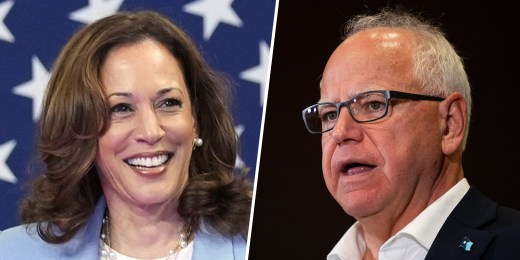
No fewer than 80 Nobel Prize winners have endorsed Kamala Harris for the presidency, warning that Donald Trump  would “jeopardize any advancements in our standards of living” given his earlier proposals for enormous cuts to science funding.

In an open letter, a copy of which was obtained by The New York Times, 82 Nobel prize winners from the US in the fields of physics, chemistry, economics and medicine, said “this is the most consequential presidential election in a long time, perhaps ever, for the future of science and the United States”.

The letter, which commends Harris for recognizing that “the enormous increases in living standards and life expectancies over the past two centuries are largely the result of advances in science and technology”, called Trump a potential threat to progress who could “jeopardize any advancements in our standards of living and impede our responses to climate change”.

The Nobel laureates range from a physicist involved in the discovery of remnant light from the Big Bang, to an immunologist instrumental in the development of a specific type of COVID-19 vaccine.

They includes signatories who won Nobels this month such as the molecular biologist Gary Ruvkun, the chemist David Baker, the physicist John Hopfield and the economist Daron Acemoglu.

Driven by concerns over the significant cuts to science funding proposed during Trump’s tenure, coupled with what he perceives as the former president’s adversarial stance toward science and academia, Joseph Stiglitz, an economist at Columbia University who won the Nobel memorial prize in economic sciences in 2001, said he was motivated by the “enormous cuts in science budgets” that Trump proposed during his presidency, as well as former president’s “anti-science” and “anti-university” stances.

“I hope it’s a wake-up call for people,” Stiglitz told the New York Times about the letter. “A consequence of this election is the really profound impact that his agenda has on science and technology.”

The letter also lauds Harris for her understanding of the invaluable contributions immigrants make to scientific progress on a national and global scale.

On Thursday, in a separate letter obtained by CNN, 23 living US recipients of the Nobel prize in economics, have expressed their endorsement of Harris’s economic agenda, deeming it “vastly superior” to the economic strategies proposed by Trump.

“While each of us has different views on the particulars of various economic policies, we believe that, overall, Harris’s economic agenda will improve our nation’s health, investment, sustainability, resilience, employment opportunities, and fairness and be vastly superior to the counterproductive economic agenda of Donald Trump,” they wrote.

Continue Reading
Click to comment

Leave a Reply

Your email address will not be published. Required fields are marked *

USA

Alleged Christian Genocide: US Lawmakers Fault Tinubu’s Govt

Published

on

By

United States of America lawmakers have sharply contradicted the Nigerian government’s position on the ongoing massacres in the country, describing the violence as “escalating,” “targeted,” and overwhelmingly directed at Christians during a rare joint congressional briefing on Tuesday.

The closed-door session – convened by House Appropriations, Vice Chair Mario Díaz-Balart, as part of a Trump-ordered investigation – examined recent killings and what Congress calls Abuja’s deeply inadequate” response.

President Trump has asked lawmakers, led by Reps. Riley Moore and Tom Cole, to compile a report on persecution of Nigerian Christians and has even floated the possibility of U.S. military action against Islamist groups responsible for the attacks.

At the briefing, Vicky Hartzler, chair of the U.S. Commission on International Religious Freedom, warned that “religious freedom [is] under siege” in Nigeria, citing mass abductions of schoolchildren and assaults in which radical Muslims kill entire Christian villages [and] burn churches.” She said abuses were rampant” and “violent,” claiming Christians are targeted “at a 2.2 to 1 ratecompared with Muslims.

While acknowledging Nigeria’s recent move to reassign 100,000 police officers from VIP protection, Hartzler said the country is entering a “coordinated and deeply troubling period of escalated violence.” She urged targeted sanctions, visa bans, asset freezes and tighter conditions on U.S. aid, insisting Abuja must retake villages seized from Christian communities so displaced widows and children can return home.

The strongest rebuke came from Dr. Ebenezer Obadare of the Council on Foreign Relations, who dismissed Abuja’s narrative that the killings are not religiously motivated. He called the idea that extremists attack Muslims and Christians equally a “myth,” stressing the groups operate “for one reason and one reason only: religion.” Higher Muslim casualty figures, he argued, reflect geography, not equal targeting.

Obadare described Boko Haram as fundamentally anti-democratic and accused the Nigerian military of being “too corrupt and incompetent” to defeat jihadist networks without external pressure. He urged Washington to push Nigeria to disband armed religious militias, confront security-sector corruption and respond swiftly to early warnings.

Sean Nelson of ADF International called Nigeria “the deadliest country in the world for Christians,” claiming more Christians are killed there than in all other countries combined and at a rate “five times” higher than Muslims when adjusted for population. He said extremists also kill Muslims who reject violent ideologies, undermining Abuja’s argument that the crisis is driven mainly by crime or communal disputes.
He pressed for tighter oversight on U.S. aid, recommending that some assistance be routed through faith-based groups to avoid corruption. Without “transparency and outside pressure,” he said, “nothing changes.”

Díaz-Balart criticised the Biden administration’s reversal of Trump’s designation of Nigeria as a “country of particular concern” in 2021, saying the decision had “clearly deadly consequences.” Lawmakers from the Appropriations, Foreign Affairs and Financial Services committees signaled further oversight actions as they prepare the Trump-directed report.

Hartzler pointed to recent comments by Nigeria’s Speaker of the House acknowledging a “coordinated and deeply troubling period of escalated violence,” calling it a rare moment of candor. She also welcomed the redeployment of police officers as “a promising start after years of neglect.”

But she stressed that these gestures are far from sufficient, insisting the Nigerian government must demonstrate a real commitment to “quell injustice,” act swiftly on early warnings, and embrace transparency.

The Nigerian Embassy did not immediately respond to a request for comment, according to source.

Continue Reading

USA

US Lawmakers Meet Today over Reported Christian Genocide

Published

on

By

The US House of Appropriation Committee will today lead a joint congressional briefing addressing allegations of Christian genocide in Nigeria.

A notice shared on X by US Congressman Riley Moore, shows that the House Appropriations Committee Vice Chair and National Security Sub-committee Chairman Mario Díaz-Balart will convene the briefing, alongside other Appropriators and members of the Foreign Affairs and Financial Services Committees.

The notice notes that representatives from the US Commission on International Religious Freedom and other experts will be part of the meeting.

“President Trump asked me and @HouseAppropsGOP to investigate the persecution of Christians in Nigeria,” he wrote.

Moore said that the briefing aimed “to spotlight the escalating violence and targeted persecution of Christians in Nigeria.”

He added that the roundtable would collect testimony for a comprehensive report directed by President Trump on the alleged massacre of Nigerian Christians and the steps Congress could take to support the White House’s efforts to protect vulnerable faith communities worldwide.

“As part of this investigation, the committee is hosting a roundtable to continue building on the work we’ve done so far. We will never turn a blind eye to our brothers and sisters in Christ who suffer for their faith,” he stated.

The briefing comes as part of US efforts to deepen security cooperation with Nigeria amid allegations of a Christian genocide in the country.

President Bola Tinubu recently cleared Nigeria’s delegation for the new US–Nigeria Joint Working Group, launched to make commitments from high-level talks in Washington, led by the National Security Adviser, Nuhu Ribadu.

The group, made up of top ministers and security officials, seeks to strengthen counterterrorism operations, improve intelligence sharing, bolster border security, and enhance coordination on humanitarian and civilian protection issues.

The initiative comes amid growing concerns over terrorism, banditry, and targeted attacks on Christians in Nigeria, drawing heightened US scrutiny and renewed warnings on safeguarding vulnerable communities.

Trump added Nigeria to countries on watchlist for Christian genocide on October 31.

He referenced alleged grave violations of religious freedom, including the persecution of Christians.

He alleged that Christianity faced an existential threat in Nigeria, with thousands of Christians reportedly killed by radical Islamist groups.

He also warned that the US could take action including the possibility of military intervention if Nigeria failed to address the issue.

Nigeria was first designated a CPC by President Donald Trump in 2020, but his successor, President Joe Biden, removed the country from the list after assuming office.

Continue Reading

USA

Trump Signs Spending Bill to End Longest Government Shutdown

Published

on

By

US President Donald Trump has signed a federal spending bill, officially ending the longest government shutdown in American history.

The legislation, passed by the House of Representatives in a 222–209 vote, followed narrow approval in the Senate just two days earlier. The bill restores funding to federal agencies after 43 days of closure, bringing relief to millions of government employees and citizens affected by halted services.

Speaking after signing the measure on Wednesday night, Trump described the deal as a political victory, asserting that Democrats unnecessarily prolonged the shutdown.

“They didn’t want to do it the easy way. They had to do it the hard way, and they look very bad,” he said.

The temporary funding bill maintains government operations only through 30 January, creating a new deadline for lawmakers to negotiate a long-term budget solution.

As part of the agreement, Senate leaders committed to an early December vote on Obamacare subsidies, a key priority for Democrats during the shutdown standoff.

In addition to reopening federal offices, the bill provides full-year funding for the Department of Agriculture, military construction projects, and several legislative branch offices.

It also ensures retroactive pay for federal workers affected by the shutdown and allocates funding to the Supplemental Nutrition Assistance Program, SNAP, which helps about one in eight Americans access food.

The shutdown, which began in October, forced the suspension of many government services, leaving an estimated 1.4 million federal employees either furloughed or working without pay. It also disrupted food assistance programmes and caused widespread delays in domestic air travel.

With federal operations now resumed, attention in Washington has turned to whether Congress and the White House can reach a longer-term funding agreement before the new deadline at the end of January.

Continue Reading

Trending