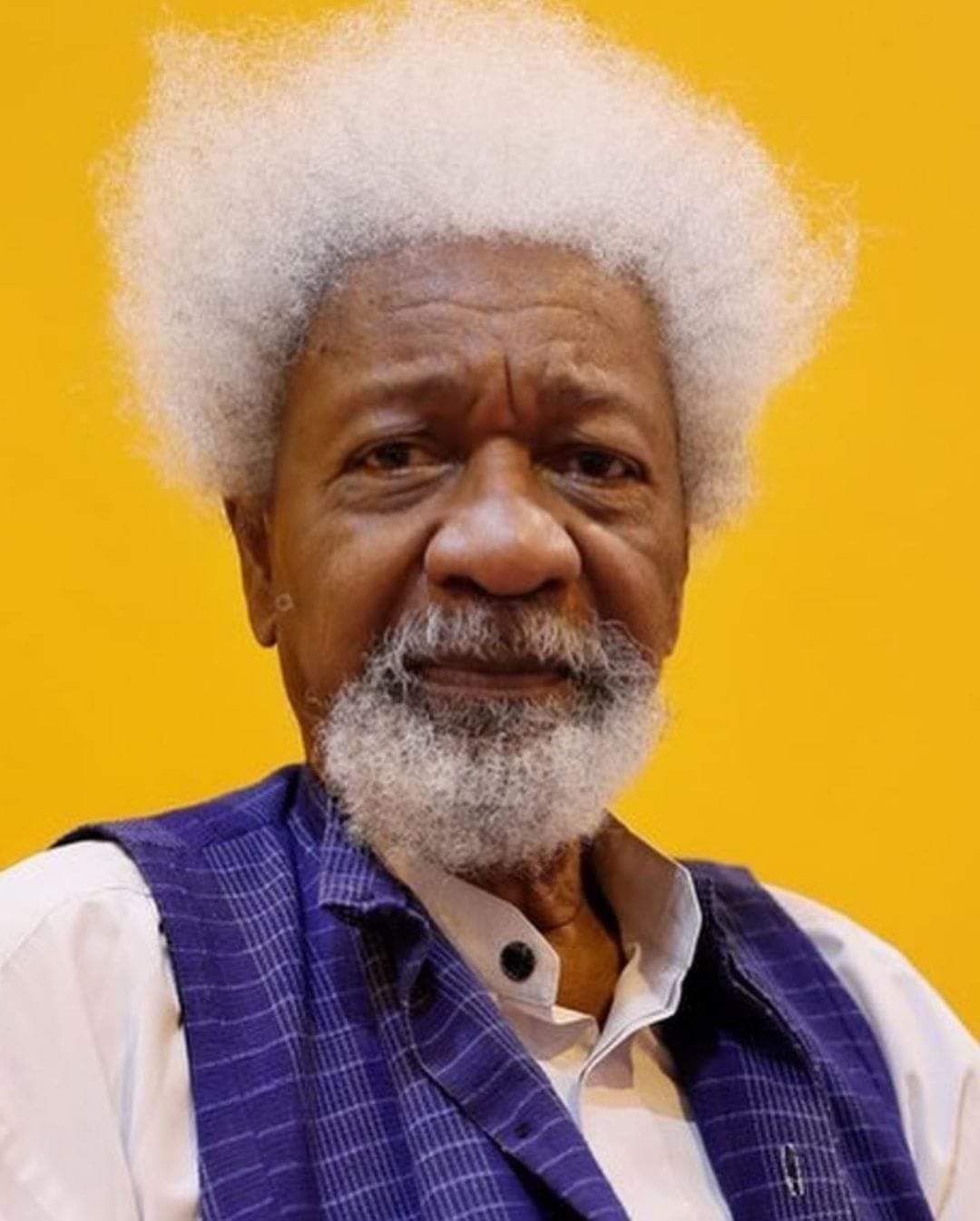
“Wole Soyinka would like to have lunch with you”, the book publisher Bankole Olayebi, CEO of Bookcraft Africa Ltd, told me one bright day in Lagos sometime in 2018. I was startled. “Really, why?” I replied. “He read your book, BIG”, Bankole replied. “He liked it, and I think he would like to discuss the ideas you expressed in it and get to know you more”. BIG, for the uninitiated, is the acronym for Build, Innovate and Grow, my fourth book that was published in February 2018 and in which I set out a bold vision for Nigeria and how to actualize it. I had offered that vision to my compatriots as I launched an intrepid, “Third Force” bid for the Office of the President of Nigeria ahead of the 2019 general elections. That seems like such a distant memory now!
I certainly was honored to receive an open invitation from a literary giaint whose work I had first encountered in the poem “Telephone Conversation” as a teenager in secondary school. The Recipient of the 1986 Nobel Prize for Literature and the first African to win the prize, Wole Soyinka CFR is both prodigy and enigma. I remembered how the world watched – millions of us in Nigeria glued to the screens of good old Nigerian Television Authority (NTA) – the grand ceremony in far-away Oslo, Norway as Soyinka received the prize, with our country represented by a high-level delegation from the very military government with which he was so frequently at odds.
Primarily a playwright and dramatist, WS is the versatile author of more than 60 books of prose (the novel), drama, poetry, essays, satire, and memoir. From The Swamp Dwellers to The Trials of Brother Jero, from Madmen and Specialists and Kongi’s Harvest to Mandela’s Earth and Other Poems, from Ake: The Years of Childhood to his latest major work, Chronicles from the Land of the Happiest People on Earth, the great writer has impacted generations of readers around the world in multiple literary genres. While his works have addressed various subjects, geographies and cultures, his plays in particular have often been an exploration of his native Yoruba culture and mythology, in the same way his great contemporary, Chinua Achebe, depicted the Igbo culture to the world via the novel, most notably in his trilogy Things Fall Apart, Arrow of God, and No Longer at Ease.
The memoir Ibadan: The Penkelemes Years, set between 1946-1965, is my all-time favorite among Soyinka’s literary works, and he was pleasantly surprised when I told him so. In the foreword, WS describes the book as “faction, that much abused genre which attempts to fictionalize facts and events, the proportion of fact to fiction being totally at the discretion of the author”.
Soyinka is perhaps unique in his combination of a long, distinguished literary career with an equally tumultuous one as a political activist. His literature and his political dissidence cannot, in fact, be separated. The former was his prime vehicle for the latter. The idea that justice is the ultimate value in human existence lies at Soyinka’s core.
Back to that lunch – the first of many other lunches and dinners to come. We met at one of his favorite Chinese restaurants in Lagos. I was accompanied by a couple of associates. He, by Bankole. It was a pleasant and not particularly political affair. We discussed Nigeria broadly, but more pointedly the specific solutions I had proffered in BIG to our national problems – the economy, nationhood, security, foreign policy, the brain drain, etc. He was especially impressed, he said, with my proposals for how a constitutional redesign of Nigeria, popularly termed “restructuring” in our polity, could improve Nigeria’s frayed nationhood, stability, and inclusive prosperity.
As the electoral cycle progressed, we met another couple of times I think, and more frequently after the elections, and grew to be friends. He would arrive at our lunch and dinner meetings with his own preferred bottle of wine, which would promptly be buried in an ice bucket for him by attentive, awe-struck restaurant waiters. He would then instruct them: “get some water or tea for this boring fellow”, pointing to teetotalling me with mock disgust on his face!.
Soyinka cares deeply about Nigeria. He has done some very controversial things in his political-activist career, and paid the price of imprisonment, near-death at the hands of military dictators, and exile. In the 1960s, as the Nigerian political crisis degenerated, he condemned the military coups of 1966, the killings of Prime Minister Tafawa Balewa and the Northern Region Premier, Ahmadu Bello, and the pogrom of tens of thousands of Igbos in Northern Nigeria. After Col. Emeka Odumegwu Ojukwu, then Military Governor of the Eastern Region, announced the region’s seccession as the Republic of Biafra, Soyinka visited the region in an effort to broker peace. For his pains, and for speaking up against the plight of the Igbo, the Nigerian authorities imprisoned Soyinka without charges in solitary confinement for two years. His famous memoir, The Man Died, was written during his time in jail.
A couple of weeks to the 2019 elections, WS and the Citizens Forum, a civic group he convened, announced their formal endorsement of my presidential candidacy in a well reasoned public statement. Soyinka’s endorsement created a loud buzz at home and around the world, and surprised many observers. “Soyinka Stuns Bookmakers, Endorses YPP Candidate, Moghalu, for President ”, Thisday’s front-page banner headline screamed. “Wole Soyinka Endorses Moghalu for President”, reported The Guardian in its headline. The endorsement was not necessarily going to decide the election, given the uniqueness of Nigeria’s political terrain. But, coming from him, it was historically and symbolically powerful, supporting as it did a candidate outside of the two main political parties.
One has since turned one’s back on partisan politics and electoral ambitions, whether of the local government councilman or presidential variety – not just because I did not win in what was essentially at the time a trial balloon, but rather because my brief foray into Nigerian politics opened my eyes to just how soullessly rigged our system is, especially with an umpire institution that has made a mockery of the word “democracy” and turned “vote” and “count” into an oppositional relationship. But I will always consider the Nobel Laureat’s endorsement, coveted by many without success, a big win. In politics, there are many kinds of victories even beyond the polls. Changing the political narrative in our country was, for me, a source of satisfaction. .
I can also say on the record that, although my candidacy was nationalistic and not anchored on ethnic identity – which meant, in the NIgerian context, that I really wasn’t a politician in the first place because understanding root causes of national problems and how to fix them isn’t exactly the whole point – Soyinka believed that Nigeria needed to have a President of Igbo extraction, with a nation-binding vision, if our country was to truly heal from the wounds of the civil war. But he was clear that such a candidate, for him, had to have other transformational attributes other than simply a particular ethnic identity. To that extent, he was disappointed, but understood my reasons, when I withdrew from the 2023 presidential election and later announced my complete departure from the political terrain and a return to full-time professional life. He had planned to renew his endorsement of my candidacy had I been on the ballot in the 2023 elections.
Soyinka has, unfortunately in my view, been the subject of sustained attacks from some quarters recently over some of his comments about the 2023 elections. WS has taken responsibility for his comments and needs no help in standing up for or reconsidering them. My only angle of interest in the controversies is that, from what I know, emotional, knee-jerk charges of “Igbophobia” or clannishness attributed to WS by some netizens on social media (which he does not use) are thoroughly misplaced. Now, you don’t have to like the man. His greatness notwithstanding, he is a mere mortal, and not above criticism – which he himself can dish out generously and articulately when he is moved to. Nevertheless, such disagreement and criticism should be civil and not uncivil. Any charge of ethnic prejudice, in particular of an anti-Igbo hew, must necessarily collapse in the face of objective facts. First, and an obvious point – he so dislikes the part of the country that he spent two years of his life in prison standing up for their rights? That’s a non-sequitur!
Second, WS cut his teeth in political activism as a student at the University of Ibadan in the early 1950s through his support for the Dynamic Party leader Chike Obi, the renowned Professor of Mathematics and one of the towering political figures of the time. Chike Obi hailed from Onitsha in today’s Anambra State. Four decades later, as military dictatorship wound down in 1998 and a return to democracy loomed, WS led a group that, unsolicited (remember the surprising lunch invite?), quietly and discreetly attempted to broker an elite consensus that would see Chief Emeka Anyaoku, the Secretary-General of the Commonwealth of Nations at the time, adopted as a broad-based consensus candidate for President of Nigeria in the 1999 transition to civilian rule. A nationalist, internationalist, and revered elder statesman, Anyaoku is a proud Igbo red-cap chief, the Ichie Adazie of Obosi Kingdom in Anambra State. The military generals, however, settled on ex-General and former military Head of State Olusegun Obasanjo in order to assuage Yoruba resentment against the cancellation of the 1993 presidential election won by Chief M.K.O. Abiola, who died in detention in 1998.
At the ripe old age of 90 years in a life of renown and colossal distinction, now is not the time to nail WS to the stake. We must be a bit more forgiving of each other as Nigerians, even when we disagree. Wole Soyinka is an inspirational global icon who brought great pride to our country with his contributions to literature and the arts in the world. I am proud to call him, with humility, my friend. And so, to WS, occupied in recent years as the Arts Professor of Theatre at New York University Abu Dhabi (NYUAD), 90 cheers on his 90th birthday. With my glass of water, or fruit juice. Boring!
Kingsley Moghalu is the President of the Institute for Governance and Economic Transformation