Connect with us

National

Senate Passes Electoral Act Amendment Bill 2026

Published

on

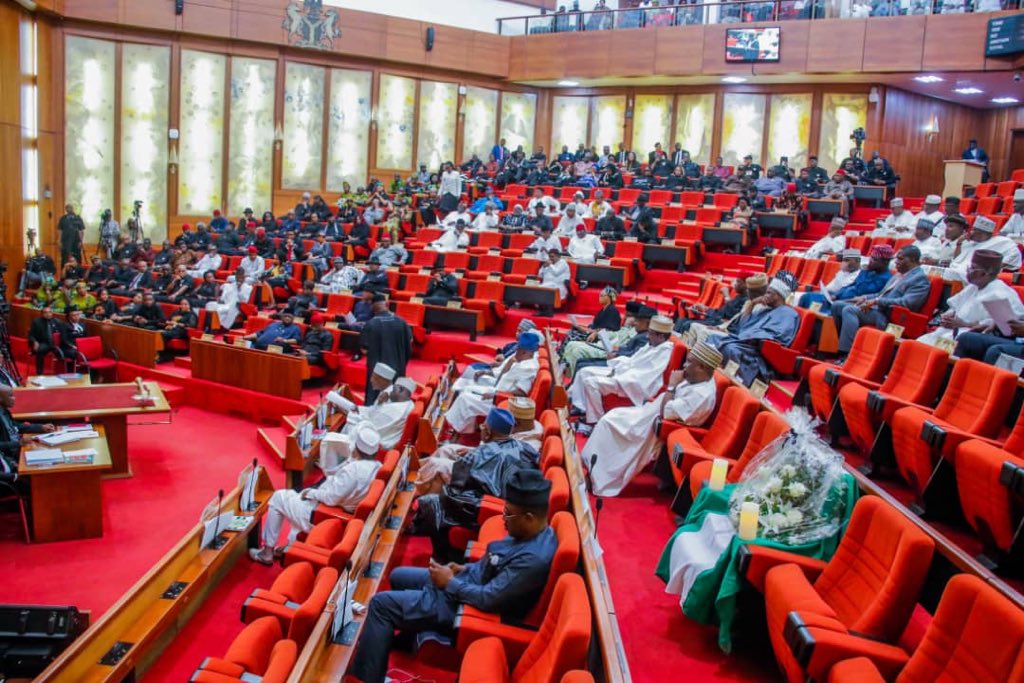
The Senate, on Tuesday, passed the Electoral Act, 2022 (Repeal and Re-Enactment) Bill 2026.

Before the passage, there was a rowdy session as the upper chamber resumed proceedings with a demand for division over Clause 60 raised by Senator Enyinnaya Abaribe (ADC/Abia South).

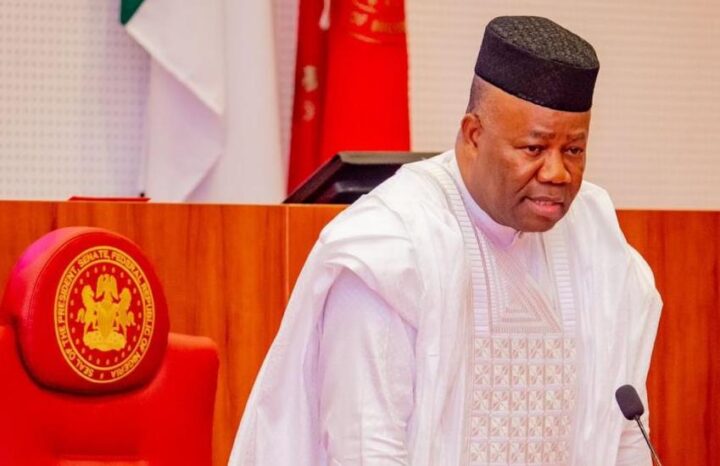
The Senate President, Godswill Akpabio, stated that he believed the demand had previously been withdrawn, but several opposition senators immediately objected to that claim.

Citing Order 52(6), the Deputy Senate President, Barau Jibrin, argued that it would be out of order to revisit any provision on which the Senate President had already ruled.

This submission sparked another uproar in the chamber, during which Senator Sunday Karimi had a brief face-off with Abaribe.

The Senate Leader, Opeyemi Bamidele, then reminded lawmakers that he had sponsored the motion for rescission, underscoring that decisions previously taken by the Senate are no longer valid.

He maintained that, consistent with his motion, Senator Abaribe’s demand was in line.

Akpabio further suggested that the call for division was merely an attempt by Senator Abaribe to publicly demonstrate his stance to Nigerians.

The Senate President sustained the point of order, after which Abaribe rose in protest and was urged to formally move his motion.

Rising under Order 72(1), Abaribe called for a division on Clause 60(3), specifically concerning the provision that if electronic transmission of results fails, Form EC8A should not serve as the sole basis, calling for the removal of the proviso that allows for manual transmission of results in the event of network failure.

During the division, Akpabio directed senators who supported the caveat to stand.

He then asked those opposed to the caveat to rise.

Fifteen opposition senators stood in opposition.

However, when the votes were counted, the Senate President announced that 15 senators were not in support of the proviso, while 55 senators voted in support of it.

Earlier, proceedings in the Senate were momentarily stalled as lawmakers began clause-by-clause consideration of the Electoral Act, 2022 (Repeal and Re-Enactment) Bill 2026, following a motion to rescind the earlier amendment.

The motion to rescind the bill was formally seconded on Tuesday, paving the way for the upper chamber to dissolve into the committee of the whole for detailed reconsideration and reenactment of the proposed legislation.

During the session, the Senate President, Godswill Akpabio, reeled out the clauses one after another for deliberation.

However, the process stalled when at clause 60, Senator Enyinnaya Abaribe (ADC/Abia South), raised a point of order, drawing immediate attention on the floor.

Following the intervention, murmurs spread across the chamber as lawmakers began speaking in small groups and approaching the Senate President’s desk for consultations.

The chamber immediately moved into a closed door session.

Before rescinding the Electoral Act, the Red Chamber raised concerns over the timing of the 2027 general elections and technical inconsistencies in the legislation.

Rising under Order 52(6) of the Senate Standing Orders, the Senate leader, Opeyemi Bamidele, moved the motion to reverse the earlier passage of the bill and return it to the Committee of the Whole for fresh deliberations.

He explained that the development follows the announcement by the Independent National Electoral Commission (INEC) of a timetable fixing the 2027 general elections for February 2027, after consultations with the leadership of the National Assembly.

He stated that stakeholders had raised concerns that the proposed date conflicts with the provisions of the amended law, particularly the requirement that elections be scheduled not later than 360 days before the expiration of tenure.

He further noted that upon critical review of the passed bill, the 360-day notice requirement prescribed in Clause 28 could result in the scheduling of the 2027 Presidential and National Assembly elections during the Ramadan period.

According to him, holding elections during Ramadan could negatively affect voter turnout, logistical coordination, stakeholder participation, and the overall inclusiveness and credibility of the electoral process.

The motion also highlighted discrepancies discovered in the Long Title and several clauses of the bill, including Clauses 6, 9, 10, 22, 23, 28, 29, 32, 42, 47, 51, 60, 62, 64, 65, 73, 77, 86, 87, 89, 93, and 143. The identified issues reportedly affected cross-referencing, serial numbering, and internal consistency within the legislation.

Continue Reading
Click to comment

Leave a Reply

Your email address will not be published. Required fields are marked *

National

Senate Amends Own Rules, Blocks ‘Freshers’ from Leadership Positions

Published

on

By

The Senate has amended its Standing Orders, limiting eligibility to contest for its presiding officers and principal officers to only members of the 10th Senate.

In the new rules, a senator shall only qualify to contest for Senate Presidency and Deputy Senate Presidency if he/she has won election to the Senate for at least one term of four years.

To be eligible to contest for any principal office, a senator must have won election for two consecutive periods, the last one must immediately precede the inauguration of the next Senate.

By implication, any senator who plans to vie to become a presiding officer in the 11th Senate (2027-20231) must have been a senator for at least one term preceding the inauguration.

For principal offices (chief whip, deputy whip, minority whip, etc), the senator must have been a member of the current 10th Senate, or they are not eligible to contest.

Under the new provision on “qualification of presiding officers”, it is stated in Order 3,”A Senator vying for the Office of the President of the Senate and the Deputy President of the Senate must have served at least one term of four (4) years in the Senate as a senator of the Federal Republic.”

Similarly, nomination for the positions shall strictly follow ranking in the following order: former president of the Senate; former deputy president of the Senate; former principal officers of the Senate; senators who had served for at least one term of four (4) years; and senators who had been members of the House of Representatives.

According to the provision, it is only the absence of the above that a first-term senator can be nominated to contest for the positions of presiding officers.

Under Order 5, a senator seeking to be a principal officer must have “served as a senator for at least two consecutive terms immediately preceding such nomination. “

The Senate passed the rules after a lengthy executive session presided over by the President of the Senate, Godswill Akpabio, on Tuesday.

The new rules impliedly gives Akpabio, other former presiding officers, principal officers and ranked senators the right of first refusal.

Findings indicated that the new rules might be what some sources described as “self-serving” or designed to serve the interest of the present presiding officers and members of the 10th Senate.

For instance, some State governors contesting the 2027 election to the Senate in the hope of vying for the presidency of the Senate, are effectively barred by the new rules.

It was also learnt that even within the Senate, the new rules will stop some senators from vying to become principal officers as they would not have attained two consecutive terms prior to 2027.

Continue Reading

National

Strike: ASUU Declares Solidarity with SSANU, NASU

Published

on

By

The Academic Staff Union of Universities (ASUU) has thrown its weight behind the Senior Staff Union of Nigerian Universities (SSANU) and the Non-Academic Staff Union (NASU), whose members are currently on nationwide indefinite strike.

SSANU and NASU, under the aegis of Joint Action Committee (JAC), had declared indefinite strike on Friday, May 1, 2026, protesting the Federal government’s delay in signing a new agreement with them.

The two unions, after repeated ultimata given to the Federal Government to finalise their long-standing 2009 Agreement renegotiation and come up with a new agreement and its immediate implementation, accused the Federal Government of using delay tactics to, among others, punish members for rejecting the once controversial IPPIS payment platform.

Speaking at a monthly impact dialogue organised by the Education Writers’ Association of Nigeria (EWAN) held virtually, ASUU President, Prof Christopher Piwuna, said the body language of the Federal Government delaying the signing of the new agreement with other unions in the university system called for serious concern.

He spoke on the theme “Delayed Salaries, FG Workers’ Agreement: Averting Impending Crisis in Nigerian Universities.”

The dialogue also featured the National President of SSANU, Muhammed Ibrahim, and his vice in charge of the South Zone, Dr. Abdulsobur Abdulsalam.

The Accountant General of the Federation, Dr Shamseeden Ogunjimi, as well as the Director of Tertiary Education in the Federal Ministry of Education, Joel Samuel Ojo, who were equally billed as panelists, were unable to attend.

Speaking further, Piwuna said the Federal Government should realise that industrial harmony in the university system does not mean one union is working, rather working together of all unions is required to move the entire system forward.

He noted that even though the Federal Government had already signed an agreement with ASUU and that its implementation has “remained at best rudimentary and haphazard,” leaving SSANU, NASU, and NAAT in the cold is unacceptable.

He explained why ASUU is taking that stand, saying salaries of lecturers and other workers in the system are being prepared by SSANU and NASU members and not the ASUU members.

“So, it is very unkind and unfair for the government to keep SSANU, NASU, and NAAT in the cold for four months after signing our own agreement.

“It will be very demoralizing for me, for example, to continue to prepare salaries for my colleagues in the university when I don’t even know whether my own agreement is going to be signed or not.

“And so ASUU would want to state in very clear terms and, in the clearest terms possible, that we stand with SSANU, we stand with NASU, we stand with NAAT to ensure that their collective bargaining process is ended on the table that it started.

“Even though, this position is not part of our agreement, it’s not part of what we signed with the government, I think for fairness and justice, it is very important for government to conclude with other unions without further delay.”

Piwuna, however, also expressed displeasure over the delay in salaries that ASUU members have been experiencing in the last four months, even with the signing of the agreement, declaring that ASUU is totally against such practice.

He explained that a standing resolution by ASUU is that any month salaries of members get delayed beyond the third day of a new month in any of its branches nationwide, the lecturers there should withdraw their service until their salaries are paid.

He noted, “That was the case in January when some universities sought permission from the national leadership to embark on an action, and we pacified them based on what the Minister of Education, Dr Tunji Alausa, told us then.

“The Minister told us that the delay in the full implementation of our agreement, especially salaries, was a result of the non-passage of the 2026 national budget.

“And we have stated this many times before that we don’t know which budget Nigeria operates.

“This is because recently, the government publicly claimed that some aspects of the 2024 and 2025 budgets were still in operation even at a time when passing the 2026 budget, and that part of the 2025 budget will remain operational until June or July.

“So, we don’t have a clear-cut budget cycle as a country, and this is very unfortunate.

“We were all taught, even in elementary school, that the annual budget starts and ends within one year.

“But it appears that the operators of our economy now seem to have an argument for any bad thing that they want to do.

“So, the salaries have not been consistent even though the budget has been passed.”

Piwuna, who equally accused the Federal Government of taking the issue of education development with levity, said there are lots of issues pressing for government attention to address.

He pointed out that ASUU would certainly take a concrete and comprehensive stance on each of those issues when the leadership of the union meets either on May 9 or 10.

He mentioned parts of the issues to include, but not limited to, delay in salaries payment and the establishment of the National Research Council that will be financing research and development, not setting aside the Stabilisation fund, infractions by some pro-chancellors and chairmen of governing councils, accused of interfering in the normal day-to-day running of universities, as well as a proposal to remove some academic courses from curriculum.

He said these issues are critical to the development of university education in the country and therefore need to be addressed by the government.

He declared that “ASUU is going to respond to all these issues and any other ones that may emerge before the NEC meeting.”

In his own contribution, President of SSANU, Mohammed Ibrahim, also expressed displeasure over what he described as insincerity of government in addressing challenges faced by the public universities and their workers, which the “pending new agreement is aimed to address.

According to him, university workers are supposed to be treated well to enable them to put in their best to solve part of Nigeria’s problems.

“But these delays in payment of salaries is like cancer, dampening the morale of members and generality of workers in the universities,” he stressed.

Giving insights into why JAC declared the nationwide strike, SSANU’s Vice President, Western Zone, Dr. Abdulsobur Abdulsalam, said it was simply because government had pushed them to the wall.

He accused the government of a lack of respect for collective bargaining with the unions, stating that the renegotiation process that has been taking place for more than two years could be addressed within two weeks if there is genuine intention and willingness on the part of the government.

Abdulsalam said JAC had given the government more than enough time to conclude the renegotiation process and commence implementation, but it was still delaying the process with no timeline in sight, and instead, introducing wage awards.

“So, our last ultimatum to government was till the end of April and there is nothing we can do again than to embark on strike as our last instrument to react and the action is going to be total and comprehensive,” he stressed.

Giving welcome remarks, Chairman of EWAN, Mr. Mojeed Alabi, said the move by SSANU and NASU to go on strike is not unexpected, noting that the signs were very visible for more than five months.

He, however, noted that the essence of EWAN’s monthly dialogue is to brainstorm on a workable solution to any pressing national issues as related to education with a view to moving the sector forward.

He said there is no country that can attain true economic prosperity without quality education in place.

Continue Reading

National

UNICEF Confirms Nigeria’s 18.3m Out-of-School Children As World’s Highest

Published

on

By

The United Nations Children’s Fund (UNICEF) has revealed that Jigawa, Kano, and Katsina states have the highest number of children who are not in school in Nigeria.

The organisation also said Nigeria has about 18.3 million out-of-school children, the highest number in the world.

An education expert from UNICEF Kano office, Aisha Abdullahi, shared this during a two-day meeting for journalists from Jigawa, Kano, and Katsina.

She said that nearly 30% of these children come from the three states due to poverty, insecurity, cultural beliefs, and poor early education.

Abdullahi explained that early childhood education is very important because it helps children build basic skills before primary school. She said it can help reduce the number of children who drop out of school.

She added that children who attend early learning programs are more likely to stay in school and finish their education. She also said that most brain development happens before age five, so early learning is very important.

Although Nigeria has a policy that includes one year of pre-primary education, access is still low, especially in rural areas.

She also noted that areas with good early childhood centres have higher school enrolment and better retention rates.

UNICEF also raised concern that few fathers take part in early childhood education, with less than 15% involvement. They said more father involvement could reduce dropout rates.

Stakeholders at the meeting called for stronger government action, including more funding for early education, and expansion of early learning centres.

They argued that improving early child education is key to solving Nigeria’s out-of-school problem.

Continue Reading

Trending