Connect with us

The Oracle

Unveiling the Enigma, Esama Igbinedion

Published

on

By Prof  Mike Ozekhome SAN

INTRODUCTION

In the heart of Nigeria, nestled in the ancient city of Benin, lives a great name that resonates with power, resourcefulness, entrepreneurship, influence, benevolence, generosity, philanthropy, altruism, social conscience, public spiritedness and exemplary leadership.

“Be not afraid of greatness. Some are born great, some achieve greatness, and others have greatness thrust upon them” – Williams Shakespeare in Twelfth Night (Act 2 Scene 5).

Our subject of discourse, was neither born great nor did he have greatness thrust upon him. Rather, he achieved greatness. He did this by dint of hardwork, perseverance and diligence. He enjoys the middle greatness of William Shakespeare. He is a colossus.

That colossus is Chief Gabriel Osawaru Igbinedion. His famous traditional title is Esama of Benin which traditionally means “the son of the people” who has the responsibility of assisting the poor in monetary and private ventures. In this, our subject of discourse has excelled. He is a man whose life story is a loud testament to the power of determination, vision and an unwavering commitment to the betterment of his community and country. With a legacy that spans over seven decades, Esama Igbinedion has left an indelible mark on the social, political and economic landscape of Nigeria. His is a story of “impossibility made possible” (Apologies to another legend, Aare Afe Babalola, SAN, CON, whose biography has the same title). Esama Igbinedion is a man whose octopaedal impact reaches far beyond the boundaries of his homeland of Edo and echoes globally.

TENDERFEET

Chief Igbinedion, a Christian, Catholic, teetotaler and Honorary Romania Consult to Edo and Delta States since 2005, was born on the 11th day of September, 1934, in the then small farming village of Okada in the present Ovia North-East Local Government Area of Edo State, Nigeria. He was born to the family of late Josiah Agharagbon Oviawe Igbinedion and Madam Okunozee (nee Ihaza), a descendant of the Royal House of Usen. He is the only surviving child of both parents. Igbinedion’s upbringing was rooted in modesty; and he was raised in a traditional African household where values of honesty, integrity, hard work, respect for elders and community solidarity were instilled in him from a very tender age. The highly revered Esama had, at the early stage of his life, beaten the dusty streets of Benin, selling kerosine in bottles. That did not deter him. He trudged on. He conquered poverty; anonymity.

These formative years showcased his potentials as a future leader. His uncompromising entrepreneurship began to manifest. He demonstrated exceptional academic ability and an innate flair for business, traits that would later serve him well in years to come. It is true the aphorisms that the morning tells the day and that the dog that would bear a curved tail can be easily spotted from its puppy stage.

A-Z ALPHABETS

Igbinedion began his A-Z alphabets learning process of primary education at the Roman Catholic School, Okada, now known as St. Gabriel’s Primary School Okada. When he moved to Benin, he was enrolled at the Benin Baptist School, now known as Emokpae Primary School on Mission Road in Benin City. This was after short periods at Ezomo Baptist School and Ore Oghene Primary School, all located in Benin City. His movement to Benin from Okada was motivated by a number of factors, fundamental amongst which was the death of his father. Being of humble beginning, Esama was not in any position to continue his education without his father. He had to seek the support of well wishers. He left Okada to live in Benin City as a househelp to, among others, Mr. Samson Aiwekhoe Idahosa, a Forest Guard at Okada who enrolled him at the Benin Baptist School. In an interview, Mr. Idahosa disclosed that he brought the young Osawaru to settle in Benin City; and that all he brought along with him were a few clothes purchased partly with the reclaimed bride price of twelve pounds which his father had paid on a young wife who was yet to join him before he died.

VENTURING INTO AN INCLEMENT WORLD

Esama Igbinedion’s journey into the harsh world of business commenced with a small-scale trading enterprise in the heart of Benin City. His initial ventures included trading in goods such as soft drinks, groceries and textiles. Chief Igbinedion’s heroic contribution is in the form of putting back the Kingdom on the map of the world as in the days of old. Benin Empire had acquired international status in the 16th century as an empire of commerce and cultural excellence, a situation that was marred partially by the event of 1897. The Benin Kingdom today has sufficiently regained a large portion of its lost glory not in terms of territorial size, but in international fame through the conscious activities of contemporary Benin heroes. However, it was his foray into the transportation industry that marked a turning point in his checkered career. In 1983, he established the Okada Air, which operated both domestic and international flights, commencing with a charter operation in September, 1983, with a fleet of BAC-One Eleven 300s.

Under his visionary leadership, Okada Air grew rapidly, with over 40 aircraft (planes and helicopters), thus becoming one of Nigeria’s most successful airlines of its time whose name could have entered the Guiness Book of Records. This marked the beginning of Esama Igbinedion’s ascent as a leading business mogul and uncommon entrepreneur in Nigeria. His success in the transportation industry paved the way for him to diversify into other sectors, including education, real estate, hospitality and banking.

It was in the peak of Nigeria’s oil boom in1981 that Igbinedion saw the need for the active participation of the private sector in the Aviation industry. In that year, Chief Igbinedion purchased his first private aircraft through one Mr. Derek Lowe of Executive Jet Sales. The HS125 was launched and blessed at Benin Airport by His Royal Majesty, Omo N’Oba N’Edo, Uku Akpolokpolo, Oba Erediuwa, the Oba of Benin. Thereafter, in 1983, Igbinedion boldly recorded the first private initiative in the fledgling Aviation industry when he established Okada Airline Ltd. His next venture was the purchase of a BAC 1-11 executive jet which was formerly owned by the deposed President Ferdinand Marcos of the Philippines.

Chief Igbinedion was enraptured with the BAC 1-11 Series. By 1988, the Okada Airline fleet comprised two executive BAC 1-11 and nine BAC 1-11 passenger/cargo aircraft. This feat was accomplished with the help of Mr. D.H. Walter of British Caledonian, who was responsible for the sale of the BAC 1-11 fleet from Sir Freddie Laker of Laker Airways. From that moment on, Okada Airline began to grow by leaps and bounds. With the support of major Aviators such as British Aerospace, Rolls-Royce, Aer Lingus, Dan Air, Rogers Aviation, A.J. Walter, FLS Aerospace, Dunlop Aviation & Tyres amongst others. At the climax of Okada Air’s tale of success, Chief Igbinedion had amassed a fleet of over 40 aircraft!.

Chief Igbinedion later made history with the acquisition of a Boeing 747 Jumbo Jet. The B747 was officially commissioned by the then Vice President, Admiral Augustus Aikhomu on behalf of the then President, General Ibrahim Badamosi Babangida who also graced the occasion. The arrival of President Ibrahim Badamosi Babangida in recognition of this unparalleled achievement by a Nigerian citizen gave the commissioning ceremony the Presidential Seal and launched the aircraft into service. This auspicious ceremony took place at the Abuja International Airport on 7th May, 1992, making Chief Igbinedion, the Chairman of Okada Airline, the first black man in the twentieth century to own and operate a Boeing 747 aircraft.

Esama Igbinedion’s commitment to economic development extended beyond his personal ventures. He actively contributed to the growth of Benin City and Edo State through various infrastructural investments and philanthropic initiatives. His investments in real estate, including the development of the sprawling Okada Wonderland Resort, contributed to the economic development and tourism potential of the region.

He introduced, arguably, the first Tennis Tournament ever held in Nigeria with the Ogbe Hard Court Tournament which threw up international Tennis Stars such as Nduka Odizor (“the Duke”), David Imonite and Veronica Oyibokia. Odizor remains the only Nigerian that ever reached the round of 16 at the Wimbledon Grand Slam. The Tournament attracted global superstars among whom was American Tennis legend, Arthur Ashe.

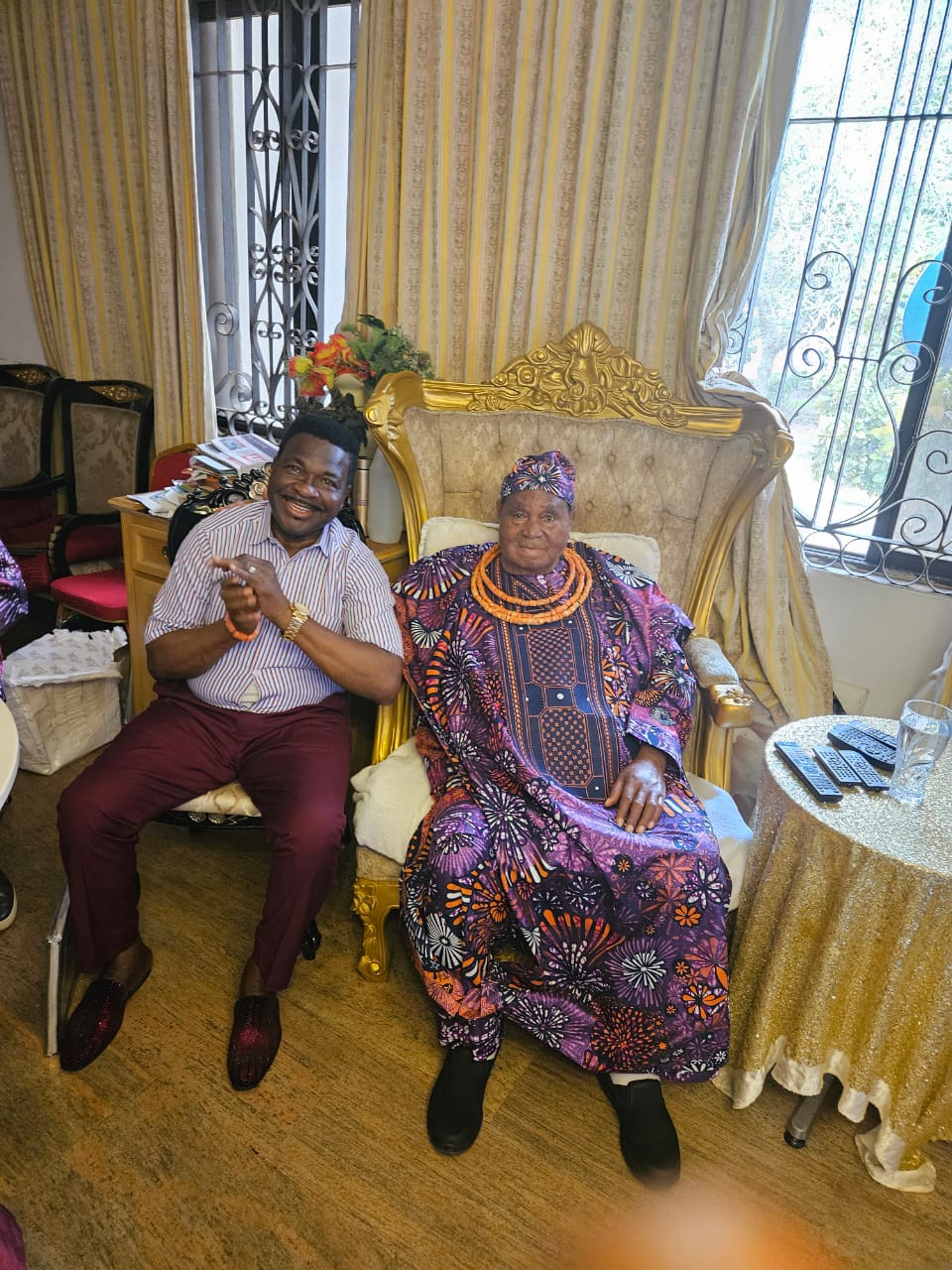
The tall, handsome, debonair, sartorial, magisterial and fair-complexioned Esama is happily married to beautiful Lady Cherry Igbinedion, an indigene of Jamaica. His children include a successful son, Chief Lucky, who was a two-term Local Government Chairman and two-term Governor of Edo State. Another son, Bright Igbinedion, is an internationally acclaimed Oil and Gas Czar; while Charles was a Local Government Chairman and one time Edo State Commissioner for Education. Yet, a third one, Peter, was the Managing Director of the Nigerian Aviation Authority (NAA). Michael Igbinedion, a chip off the old block, is Chairman/CEO of a group of companies with diverse interests in Oil and Gas, water, hospitality and realty. One of Esama’s daughters, Hon. Omosede Igbinedion, is a top politician and a former member of the Federal House of Representatives, representing Ovia Federal Constituency in Edo State. There are many other successful children, as the Igbinedion orchard has produced many illustrious fruits that did not fall far away from the parent tree. Considering Walt Disney’s quote that “life is beautiful; its about giving; its about family”; and Pope John XXIII’s dictum that “the family is the essential cell of human society”, it is as clear as a whistle that the Esama has succeeded exceptionally.

It is no easy task to render an exhaustive account of Chief Igbinedion’s conquests on the global business arena. However, it is pertinent to say that his numerous companies have over the years cut across diverse areas such as Aviation, Radio (92.3 FM); and television broadcasting (Igbinedion TV); salt manufacturing; crude oil exploration; and solid minerals (marble, gold and diamond mines across Africa). He had also ventured into soft drinks bottling; real estate; fruit and fish farming; palm oil production, petroleum and gas marketing; shipping, haulage, road transport, confectionery and hospitality (numerous hotels); among many other businesses. He once owned the now defunct famous Crown Merchant Bank. But perhaps, one of his greatest legacies will be the pioneering of Mid Motors (Nig.) Limited in 1968, the first indigenous Motor Assembly plant in Nigeria.

PHILANTHROPY

Esama Igbinedion’s philanthropic strides extend to healthcare, as he founded the Igbinedion Medical Centre, which has since provided top-notch medical services to the people of Edo State and beyond. He has built numerous churches including a grand catholic cathedral and private hospitals across Nigeria. The Esama has been a “Jack-of-all-Trades” and “Master of all”. Similarly, the Benin Kingdom has been made proud by the Esama in other circumstances. It produced through Chief Igbinedion, the highest donor to the 1984/85 Bendel State Development Fund; the Cross River State Development Fund; the Plateau State Development Fund, Langtang Chapter; Niger State Development Fund; and the highest donor in Nigeria to the Southern Africa Relief Fund. This was Chief Igbinedion’s contribution to the dismantling of apartheid amid the freedom of Nelson Mandela. He was also the first individual in Africa to provide and maintain a point-to-multipoint microwave telephone system to link Okada, his home town, to the world, a project commissioned by Col. A. Tanko Ayuba, the then Minister of Communications on 10th August,1987. Chief Osawaru Igbinedion was the first Nigerian to establish the largest and best equipped private hospital and medical research centre in Nigeria and West Africa.
It is often said, sometimes enviously, sometimes admiringly, but always with a hint of awe, that Papa Igbinedion, has wielded more powers and influence over a longer period than any business leader in Nigeria of today. But he is too polite to make such a claim himself; even as he tacitly acknowledges its validity. When asked what he has learnt about being so powerful on the Nigerian business terrain, he simply smiled and said, “It is tough and lonely at the top.” Lonely at the top? Is it not even very damp at the bottom where he trudged for decades?

Everything Igbinedion does creates a chain of spirally reactions, often leading to unexpected theories, conspiracies, combinations and conjectures. It is with gratitude to the Almighty God that it is acknowledged that the aging “Lion of Okada” has many competent children who now play the roles he once played in his business empire. But the convivial Esama still seems frisky and in no hurry to step aside, even at a nonagenarian age. Even when he does, he will continue to play the roles he dearly relishes: powerful, rococo, luminous, flamboyant, colourful and unrivalled in setting the pace and standards for others to follow. He will continue to be imitated and emulated by generations yet unborn.

The name CHIEF GABRIEL OSAWARU IGBINEDION has since become synonymous with success, courage and daring bravado, for he has always been a man who treads where even angels fear to approach.

A respected member of the Eghavbonore elite league in the Oba of Benin’s Palace in the great Benin Kingdom (a group to which I proudly belong as the Enobakhare of Benin) the Esama is today the Chancellor and Chairman of the Board of Regents of the first private University in Nigeria, the Igbinedion University at Okada. This position which he occupies is a befitting tribute to his over 50 years of tenacious struggle to bring about phenomenal development in the education sector. It was the struggle of his life to which this relentless moneybag selflessly committed enormous resources, time, energy and talents. And he has succeeded. Thanks be to God Most High.

HIS MANY CHALLENGES AND CONTROVERSIES

Like many historical figures, Esama Igbinedion’s life and career have not been without their fair share of controversies and challenges. His businesses, many a time, faced economic downturns and government interference. The aviation industry, in particular, was marked by turbulence. Okada Air eventually faced mounting financial difficulties and was liquidated in the late 1990s.

The Esama was also in 2008 suspended from participating in palace activities due to some disagreements. It is however on record that the Oba of Benin did not declare the Esama as an enemy of the Palace as was widely but wrongly speculated. He was suspended as the Esama of Benin. On the 13th day of June, 2012, upon forgiveness by the revered Oba of Benin, His Royal Majesty, Omo N’Oba N’Edo, Uku Akpolokpolo, Oba Erediuwa, the Palace made a press release (BTC.A66/VOL.V/171) which unambiguously informed the general public that the Esama had been forgiven and that the suspension earlier placed on Igbinedion had been lifted. This was an affirmation that Gabriel Osawaru Igbinedion remains the Esama of Benin Kingdom and a very loyal Palace Chief to the Oba of Benin, His Royal Majesty, Omo N’Oba N’Edo, Uku Akpolokpolo, Oba Ewuare II. Oba Ghato Kpere! Isee.

FROM POLITICS TO TRADITION

Esama Igbinedion’s influence wasn’t confined solely to the business arena. He has also played a significant role in Nigerian politics, using his boundless wealth and resources to support various political causes and candidates, including that of Chief Lucky, his son. His involvement in politics was characterized by his commitment to the betterment of his immediate community and the entire country.

The Esama as a traditional icon has played a significant role in traditional and cultural affairs. He has used his prestigious title of the Esama of Benin (a high-ranking traditional chieftaincy title bestowed upon individuals who have made significant contributions to the Benin Kingdom), to influence, promote and preserve the rich customs, traditions and renaissance of the cultural heritage of the Benin people and Benin Kingdom.

ESAMA’S IMPERISHABLE LEGACY

Regardless of the challenges he faced early in life, Esama Igbinedion’s legacy is one that cannot be denied or diminished. His contributions to the youth, business, education, healthcare, hospitality and cultural renaissance have left an indelible mark on the landscape of Edo State in particular, Nigeria and Africa in general. His philanthropic endeavors continue to impact the lives of countless individuals who have benefited and continue to benefit immensely from the various institutions he established and financed.

DRAWING THE CURTAINS

In the grand tapestry of Nigerian history and culture, the name Chief Gabriel Osawaru Igbinedion, the Esama of Benin, stands out as a symbol of resilience, determination and unwavering commitment to community development and lifting from doldrums, the holloipoloi. From his humble beginnings in Okada and Benin City, to his rise as a prominent businessman, philanthropist extraordinaire, foremost traditional icon and cultural Ambassador, Esama Igbinedion’s life story is a living testament to the power of vision, determination, hard work and doggedness.

The Esama remains a revered figure; a living prodigy and legend, celebrated for his works to uplift humanity.

In reflecting on the life and legacy of Esama Igbinedion, one cannot help but be inspired and energised by his journey from a small trading enterprise to becoming a towering figure in the Nigerian and African space. His story serves as a reminder to us all that with sheer determination, resilience, doggedness and a principled commitment to the betterment of one’s society, it is possible to leave a lasting legacy that transcends generations. The Esama is doing just that. He is a pride to Edo State, Nigeria, Africa and the Black Race. This is why he deserves to be celebrated while he is still alive. He must be told in clear terms that he has done excellently well. Papa Esama sir, march on. Continue to conquer and excel. Continue to remain regal, resplendent and noble.

Congratulations sir on your 90th birthday. For you, Genesis 6: 3 is assured.

Continue Reading
Click to comment

Leave a Reply

Your email address will not be published. Required fields are marked *

The Oracle

The Oracle: Enforcement of Fundamental Human Rights Under the 1999 Constitution of Nigeria (Pt. 4)
Published

on

By

By Prof Mike Ozekhome SAN

INTRODUCTION

In our last discourse on this series, we examined the procedure for enforcement of fundamental rights, including applications for leave; as well as the substantive application itself and the reactions that follow. Today, we shall continues from where we stopped with the substantive application itself and the reactions thereto and later x-ray the applications to squash proceedings; applications for production and/or release of persons restrained; orders for bail, production and access to medication. Please read on.

SUBSTANTIVE APPLICATION: THE MOTION OR SUMMONS (Continues)

In the case of LAWRENCE OLUSEGUN ADEYEMO V. C.O.P, OYO STATE ([2021] LPELR-56272(CA)), the applicant requested the court for a writ of habeas corpus under order 2 of the fundamental Rights (Enforcement Procedure) rules 1979 which provision enjoined the applicant to serve all parties who are or might be interested in the proceedings. Although the affected party had put up appearance, but raised a preliminary objection to the application for non-compliance with the statutory conditions. Babalakin. J. (as he then was) struck out the application on the ground that order 2(1)(4) is mandatory whether the application is for mandamus, certiorari, or habeas corpus.

However the Supreme Court in recent times in respect of the fundamental rights enforcements has favourably leaned towards the equitable principle of “Ubi Jus Ubi remedium”, therefore looking more at the substance rather than the form. Hence the liberalization of the procedure for the enforcement of fundamental rights as exposed in the case of ABACHA V. FAWEHINMI ((2000) 6 NWLR (Pt. 660) 228) and UBI UJONG INAH & ORS V. MARCUS UKOI ((2001) (CA) 41981.

APPLICATION TO QUASH ANY PROCEEDINGS

Sometimes it may be necessary for an applicant by way of certiorari to apply to the court for an order that such proceedings be removed from a particular court or tribunal to another court for the purpose of being quashed for lack of power and/or jurisdiction to entertain such proceedings or make such order.

However, an applicant shall not be able to question the validity of any order, warrant, commitment, conviction, inquisition or record unless before the hearing of his application (Motion or summons), he has served a certified copy (CTC) thereof together with a Copy of the application on the Attorney-General of the Federation or of the State in which the applicant is being heard (as the case may be).

The court in granting an application seeking to quash proceedings, shall direct that the order, proceedings, conviction or the records of an inquisition be quashed forthwith upon being removed into the court hearing the application.

APPLICATION FOR PRODUCTION AND/OR RELEASE OF PERSON RESTRAINED

By virtue of Order 4 of the Fundamental Rights (Enforcement Procedure) Rules, where an applicant complains of wrongful or unlawful detention, the court or judge to whom the application is made ex-parte may make an order forthwith for his release from such detention.

The court may also direct that an originating summons (as in form 2) be issued or that an application therefore be made by notice of motion (as in form 3). The court may also as it deem fit adjourn the ex-parte application so that notice thereof may be given to the person against whom the order for the release of the applicant is sought.

ORDER FOR BAIL, PRODUCTION, AND ACCESS TO MEDICATION

Pursuant to order 4 of the bail application, the court upon application may grant to the detainee reliefs including bail, production of the detainee, access to mediation etc.

The court may grant bail at ex-parte stage, pending the substantive application. Where an applicant complains of wrongful or unlawful detention, the court may subject to its discretion order that the person restrained be produced in court. And where such order is so made, it shall constitute a sufficient warrant to any superintendent of a prison, police officer in charge of a police station, police officer in charge of the complainant or any other person responsible for his detention, to produce or ensure the production of the person so restrained or detained in court.

For the purpose of enforcing a person’s fundamental rights, no matter where a detainee is kept he can be allowed access to his personal physician or medically prescribed drugs.

It suffices to note here, that once an order has been made by the court pursuant to the Enforcement Rules, and for the purpose of enforcing or securing the enforcement of any of the fundamental rights provided for in the constitution, such order must be complied with. Failure to obey or comply with any order so made by the court under these rules will incur proceedings for the committal of the party disobeying such an order.

CONCLUSION

Without any controversy, the idea of human rights and personal liberties has become firm and secured. The universality and immutability of human rights are now globally accepted. Consequently, any nation that slacks or shyies away from the diligent protection and enforcement of human rights stand the precarious risk of being shunned by decent and civilised nations. The United Nations seems to have captured the importance and primacy of the issue of human rights and its protection when it poignantly stated as follows:

“Human Rights and fundamental freedoms are the birth right of all human beings, their protection and promotion is the first responsibility of Government” (Universal Declaration of Human Rights (UDHR).

It is the duty of every Government everywhere and every courts of law in every jurisdiction to promote, protect, uphold, and ensure enforcement of fundamental Human rights at all times, because these rights encapsulate the very essence of man.

The end.

THOUGHTS FOR THE WEEK

“Human rights, of course, must include the right to religious freedom, understood as the expression of a dimension that is at once individual and communitarian – a vision that brings out the unity of the person while clearly distinguishing between the dimension of the citizen and that of the believer”. – Pope Benedict XVI.

“Because no matter who we are or where we come from, we’re all entitled to the basic human rights of clean air to breathe, clean water to drink, and healthy land to call home”. – Martin Luther King III

“Human rights are not only violated by terrorism, repression or assassination, but also by unfair economic structures that creates huge inequalities”. – Pope Francis.

Continue Reading

The Oracle

The Oracle: Enforcement of Fundamental Human Rights Under the 1999 Constitution of Nigeria (Pt. 3)

Published

on

By

By Prof Mike Ozekhome SAN

INTRODUCTION

Last week’s installment examined amongst others, the features of what constitutes violation of fundamental rights and posed the question- whether enforcement of such rights is restricted to the mechanism of the FREP Rules? This week contuse the same theme by discussing the procedure for enforcing fundamental rights, including applications for leave; the substantive application itself and the reactions thereto. Please read on.

PROCEDURE FOR ENFORCEMENT (Continues)
Furthermore, the Court of Appeal (Benin Division) dilated on the procedure in the case of N.U.T Vs. COSST ((2007) 23 E-WRN / 03 (CA).), thus:

“By virtue of Order 1 rule 2(2) of the Fundamental Rights (Enforcement Procedure) Rules, no application for an order enforcing or securing the enforcement within that state of any such rights shall be made unless leave therefore has been granted in accordance with the rules. Thus, while an applicant can approach the High Court in a state where the infringement of his rights occurs or is likely to occur for redress he has to obtain leave of the appropriate High Court before he can apply to enforce his rights. In the instant case, even if the case was a fundamental right case the suit was not commended by due process, as the respondents approached the court by way of originating summons contrary to the provision of Order 1 rule 2(2) of the Fundamental Right (Enforcement) Rules.

An application for the enforcement of fundamental right becomes incompetent if the main claim does not fall within the ambit or precinct of chapter IV of the Constitution. Any claim that falls outside chapter IV of the Constitution becomes ancillary claim. Therefore, for an applicant for enforcement of fundamental rights to be competent, it must be within the provisions of chapter IV of the Constitution.

This point reverberated in W.A.E.C Vs. Akinwumi, (2008) JELR 49485 (SC), where the Supreme Court succinctly held that:

“In ascertaining the justicieability or competence of a suit commenced by way of application under the Fundamental Rights (Enforcement Procedure) Rules, 1979, the court must ensure that the enforcement of the fundamental rights under chapter IV of the Constitution is the claim and not ancillary claim. Where the claim is not the enforcement of a fundamental right, the jurisdiction of the court cannot be said to be properly invoked, and the action is liable to be struck out on ground of incompetence.”

Also, in Unilorin Vs. Oluwadare (2008) JELR 55842 (CA), the court adumbrated the point as follows, when it held that:

“When an application is brought under the Fundamental Rights (Enforcement Procedure) Rules, 1979, a condition precedent to the exercise of the court’s jurisdiction is that the enforcement of fundamental rights or the securing of the enforcement thereof should be the main claim and not an accessory claim. Enforcement of fundamental right or securing the enforcement thereof should, from the appellant’s claim as presented, be the principal or fundamental claim as presented, and not accessory claim. However, where the main claim or principal claim is not the enforcement or securing the enforcement of a fundamental right, the jurisdiction of the court cannot be properly exercised as it will be incompetent. In the instant case, the respondent’s claim, being a challenge to his expulsion as a student from the 1st Appellant institution, is not one of those claims/reliefs envisaged by the Fundamental Rights (Enforcement Procedure) Rules.

See also Gafar Vs. Govt., Kwara State, (2007) JELR 53915 (SC); Unical Vs. Ugochukwu 2007-LD-CA-232.

It is important to note that an applicant seeking redress for the infringement of his Fundamental Rights shall in addition to declaratory and injunctive orders also be entitled to an award of damages. This is because in fundamental right cases, the law presumes that damages flow naturally from the injury suffered by the victim as a result of the violation of the rights.

APPLICATION FOR LEAVE

By virtue of Judgment (Enforcement) Rules in Nigeria, no application for an order enforcing or securing the enforcement within a state, of any such rights shall be made unless leave therefore has been granted in accordance with these rules. Also, any application for such leave must be made ex-parte to the appropriate court and must be supported by a statement setting out the name and description of the applicant, the relief sought, and grounds on which it is sought and by an affidavit verifying the facts relied on.

The deadline for filling an application for leave is not later than 12 (twelve) Months after the date of the happening of the event complained of, unless the judge is satisfied that extenuating circumstances exist. In case of ongoing act, an action can be brought after 12 Months deadline, at any point during the continuation of the wrong. An applicant must however file the application for leave not later than the day preceding the date of hearing. The court may in granting leave to the applicant impose such terms and condition as it may deem fit, as security for cost.
It is to be noted that leave once granted, shall operate as a stay of all actions relating to or connected with a complaint which forms the subject matter of the application until the determination of the substantive suit.

The ex-parte application for leave must specify the provisions of the enforcement procedure Rules under which it is brought, the precise content of the relief to be requested once the application for leave has been granted and cursory reference to relevant laws. This must be accompanied by an affidavit verifying relevant facts to be relied on.

The deadline for filing an application for leave is not later than 12(twelve) months after the date of the happening of the event complained of, unless the judge is satisfied that extenuating circumstances exist. In cases of ongoing act, an action can be brought after 12month deadline, at any point during the continuation of the wrong. An applicant must however file the application for leave not later than the day preceding the date of hearing. The court may in granting leave to the applicant impose such terms and conditions as it may deem fit, as security for cost.

It is to be noted that leave once granted, shall operate as a stay of all actions relating to or connected with a complaint which forms the subject matter of the application until the determination of the substantive suit.

The ex-parte application for leave must specify the provisions of the enforcement procedure Rules under which it is brought, the precise content of the relief to be requested once the application for leave has been granted and a cursory reference to relevant laws. This must be accompanied by an affidavit verifying relevant facts to be relied on.

SUBSTANTIVE APPLICATION: THE MOTION OR SUMMONS

After obtaining leave, the applicant can apply for an enforcement order by way of NOTICE OF MOTION (as in form 1) or ORIGINATING SUMMONS (as in form 2). In the celebrated case of SHUGABA, A. DARMAN V. MINISTER OF INTERNAL AFFAIRS & ORS. ((1981) 2 NCLR 459). It was held inter-alia that the proper procedure to be followed in an application for enforcement or securing the enforcement of fundamental rights and redress for violation of same is guided by the fundamental Rights (Enforcement Procedure) Rule 1979 which requires that where leave has been granted to apply for the order being asked the application for, such order must be made by notice of motion or originating summons to the appropriate court.

The motion or summons, together with a copy of the statement submitted in conjunction with the application for leave, must then be served on all persons directly affected. Unless the court directs otherwise, there must be at least 8 clear days between service of the motion or summons and the date fixed for hearing.

A substantive application either by motion or summons seeking for substantive reliefs, remedies or orders may include such prayers as:

a. Unconditional release of the detainee
b. Payment of a certain sum of money as compensation in the event of the arrest and detention being illegal, unwarranted, null and void.

The court may equally make any other ancillary order after hearing argument from counsel on all sides based on the affidavit and counter-affidavit.

It should be noted that failure to adhere to the procedure laid down by the Enforcement Rules may lead to the entire proceedings being nullified. The court shall upon objection being raised for non-compliance with the rules strike the entire proceedings out. (To be continued).

THOUGHT FOR THE WEEK

“Human rights, of course, must include the right to religious freedom, understood as the expression of a dimension that is at once individual and communitarian – a vision that brings out the unity of the person while clearly distinguishing between the dimension of the citizen and that of the believer”. – Pope Benedict XVI

Continue Reading

The Oracle

The Oracle: Enforcement of Fundamental Human Rights Under the 1999 Constitution of Nigeria (Pt. 1)

Published

on

By

By Prof Mike Ozekhome SAN 

INTRODUCTION 

Man as distinct from other beings is rational and has morals. He has the power of reason which enables him to differentiate between right and wrong, between good and bad, and also between justice and injustice. He therefore possesses honour and dignity which are higher than that of other beings. Human rights are necessary to protect this honour and dignity which nature has bestowed on human kind. They ensure (where these rights are enforced) that human kind is not degraded or made inhumane. Chapter IV (Sections 17-32) of the Constitution of the Federal Republic of Nigeria, 1963, had provided that:

“No person shall be subjected to torture or to inhuman degrading punishment or other treatment.”

This has been replicated in section 3 of the 1999 Constitution. Equally, Article 1 of the Universal Declaration of Human Right, 1984 declares that:

“All human beings are born free and equal in dignity and right. They are endowed with reason and conscience and should act towards one another in a spirit of brotherhood.” 

There is therefore a great need to protect and ensure the protection of these inherent rights and freedoms.

WHAT IS A RIGHT?

Before discussing the ways and means by which one may enforce his fundamental human rights, it is apposite to first understand the context in which “right” is used. 

‘Right’ in ordinary language means power of free action; a demand, inherent in one person and incident upon another. It is an interest recognized by law, respect for which is a duty and disregard of which is wrong. It refers to the cultural, political, social, economic advantage to which a person has just claim, either morally or in law. It is distinct from privilege.

Right described as ‘human’ refers to a category of rights which are specified and in most cases protected by law. Every human being is entitled to such rights and no person may be denied of such rights except through the due process of law. Cranston therefore holds the strong view that:

“A human right is something of which no one may be deprived without a great affront to justice. These are certain deeds which should never be invaded some things which are supremely sacred” 

Kayode Eso, JSC. (as he then was) re-affirmed the importance of human rights in RANSOME KUTI Vs. A-G OF THE FEDERATION, (1985) CLR 6(d) (SC),  when he said of human rights:

“… It is a right which stands above the ordinary laws of the land and which in fact is antecedent to the political society itself. It is a primary condition to a civilized existence… and what has been done is to have these rights enshrined in the Constitution so that the rights could be immutable to the extent of the non-immutability of the constitution itself.” 

FUNDAMENTAL RIGHTS OR FUNDAMENTAL HUMAN RIGHTS?

“Fundamental rights” are generally regarded as those aspects of human rights which have been recognized and entrenched in the constitution of a country. They are specially provided for to enhance human dignity and liberty in every modern state. In the Nigerian context, the terms “human right”, “fundamental right” and “fundamental human right” are always used interchangeably. This has been justified by a learned author who posited forcefully that:

“Human rights remain so, whether they occur in the international plane or within municipal confines and whether they are called ‘human rights’ or ‘fundamental rights’. It should be noted that the international bill of rights – the universal declaration of Human rights and the International Covenant on Civil and Political Rights- use the expression fundamental human rights, so also the U.N charter.” (the Universal Declaration of Human Rights (UDHR) of 1948). 

Since the Constitution specifically provides for fundamental rights, Nigerian Court have found it expedient to draw a line of dichotomy between ‘human rights’ and ‘fundamental rights’. Thus, in UZOUKWU & ORS Vs. EZEONU II & ORS, (1991) 6 NWLR (pt 200) p. 708, the Court of Appeal (per Nasir P. C. A) put in with apt clarity and lucidity:

“Due to the development of Constitutional law in the field, distinct difference has emerged between ‘Fundamental Right’ and ‘Human Rights’. It may be recalled that human rights were derived from and out of the wider concept of natural rights. They are rights which every civilized society must accept as belonging to each person as human being. These were termed human rights. When the United Nations made its declaration it was in respect of Human Rights which belong to all human beings irrespective of citizenship, race, religion and so on. This has now formed part of international law. Fundamental Rights remain in the realm of domestic law. They are fundamental because they have been guaranteed by the fundamental law of the country, that is by the Constitution.”   

Nature and Classification of Human Rights

Human rights are generally grouped under five sub-headings namely; Civil Rights, Political Rights, Social Rights, Economic Rights and Cultural Rights. We shall however discuss these classifications under two broad further categorization, that is:

Civil and Political Rights: these includes the right to self-determination, the right to life, freedom from torture and inhuman treatment, freedom from slavery and forced labour, the right to fair trial, right to privacy, freedom of thought conscience and religion, freedom of opinion and expression, the right of assembly, freedom of association, and movement, the right to marry and found a family, the right to participate in one’s Government either directly or through freely elected representatives, and the right to nationality and equality before the law.

Economic, Social and Cultural Rights (ECOSOC Rights) include the right to work, the right to an adequate standard of living, the right to organize, form and join trade unions, the right to social security, the right to collective bargaining, the right to property, the right to education, the right to participate in cultural life and to enjoy the benefits of scientific progress.

The importance of these rights cannot be over emphasized. So important are they that they have been universally recognized and acclaimed by the international community. The universal Declaration of Human Rights, as well as other United Nations Covenant on Human Rights, the African Charter on Human race on an equal scale as the foundation of freedom, peace and justice in the world.  

NOW THIS

HUMAN RIGHTS IN NIGERIA AND INTERNATIONAL CHARTERS AND CONVENTIONS

The emergence of human rights in documented form in Nigeria can be traced to the Nigeria Bill of Rights of 1959. This was incorporated into the 1960 Independence Constitution in 1963; these rights were reproduced 111 of the 1963 Republican Constitution. These fundamental human rights are provided for in Chapter Iv of both the 1979 and 1999 Constitutions of the Federal Republic of Nigeria with some improvements.

The reverence of these human rights can be seen from their recognition, promotion and protection under international law. Charters and Conventions have been globally drawn, and under various economic, geographical and political blocs for the promotion and protection from abuse of these rights. The United Nation (UN) has been championing the global protection of these rights as can be seen from the various chapters of the UN charter. The United Nations Declaration of Human Rights (1984) proclamation states as follows:

“This Universal Declaration of Human Rights as a common standard of achievement for all the end that every individual and every organ of society keeping this Declaration constantly in mind, shall strive by teaching and education to promote respect for these rights and freedoms and by progressive measure, national and international to secure observance both among people of member states themselves and among people of territories under their jurisdiction.”

Article 30 of the Charter further provides thus:

“Nothing in this Declaration may be interpreted as implying for any state group or person any right to engage in any activity or to perform any action aimed at the destruction of any of the  rights and freedoms set forth herein.”

The Declaration by its provisions sets out the minimum standard to be observed by countries of the world in relation to human rights. 

There is also the African Charter on Human and Peoples Rights which has become, in Nigeria, a potent source of quick remedy against gross violation of human rights under municipal laws which remedy could not be traced to the laws because of ouster clauses built in them. The charter has since been ratified in Nigeria as African Charter on Human and Peoples Rights (Ratification and Enforcement) Act Cap 10 1 FN 1990. The importance of the African Charter was underlined by Eniola Longe J, in the case of MOHAMMED GARUBA & ORS V. A.G OF LAGOS STATE & ORS (Unreported Suit No. ID/559/90), when he held:

“The African Charter on Human and Peoples Rights of which Nigeria is a signatory is now made into our law… Even if its aspect in our constitution is suspended or ousted by provisions of our local law, the international aspect of it cannot be unilaterally abrogated…”

AND THIS LIMITATION ON FUNDAMENTAL RIGHTS

Under section 45 of the 1999 Constitution and many constitutional expressions of fundamental rights, certain qualifications or restriction which are reasonably justifiable in a democratic society are incorporated in the interest of defence, public safety, public order, public morality or public health or for the purpose protecting the rights and freedoms of other persons. Consequently, the aforesaid rights are generally subjected to these limitations.

ENFORCEMENT OF RIGHTS

Procedure for the enforcement of the fundamental rights provisions enshrined in the constitution of the Federal Republic of Nigeria is guided and regulated by the Fundamental Rights (Enforcement Procedure) Rules 1979. It is pertinent to state here that the above rules are made pursuant to the powers conferred on the Chief Justice of Nigeria by section 46(3) of the Constitution, which provided thus:

“The Chief Justice of Nigeria may make rules with respect to the practice and procedure of a High Court for the purpose of this section.” (To be continued).

THOUGHT FOR THE WEEK

“Each state, so that it does not abridge the great fundamental rights belonging, under the Constitution, to all citizens, may grant or withhold such civil rights as it pleases; all that is required is that, in this respect, its laws shall be impartial”. (Lyman Trumbull).

Continue Reading

Trending