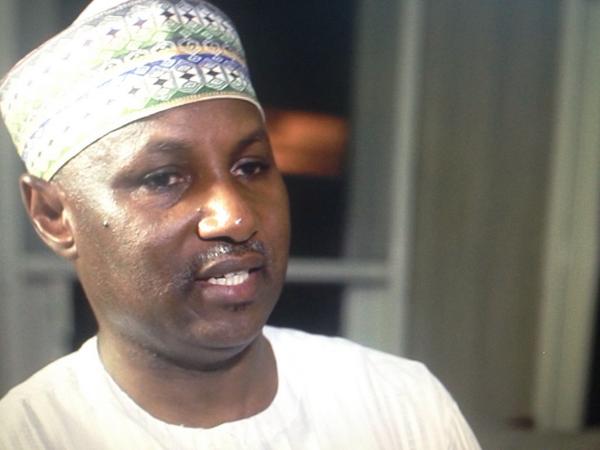
Hassan Tukur, a former ambassador, who is an expert in foreign affairs and diplomacy has proffered likely solutions to pending issues in Nigeria.
In an interview with Dele Momodu, the publisher of Ovation magazine, the former President Goodluck Jonathan’s Principal Secretary, discussed major issues affecting the country.
Introducing himself, Mr. Tukur said ”I was born in Adamawa state, my childhood days were very interesting because I grew up in the village, where life was very simple and not as complicated as today. Information and technology have taken over our lives now. Then, there was no light or water in my village, everything had to be done by one’s self.
”There was no school there so I had to leave my village to go to another village to attend primary school. So I left home at the age of Five. My senior brother that I grew up with was a primary school teacher, so I had to go live with him in the village to attend primary school.”
Describing the quality of education at that time, the Adamawa born said ”The primary schools we attended during that time, can measure up to any private or standard primary school. My local government is in a rural area bordering Cameroon, but the quality of teaching there is very qualitative, that is where I schooled. The teachers there were dedicated, selfless.
”So the quality of education then, can be compared to anyone, not presently that government schools have been neglected. I wish we could go back to those days when the children of the rich and poor can attend the same school.
Reacting to how the Almanjiri menace creeped into the northern region in the country, he said ”When I was growing up, the schools were very limited, and could not accommodate everybody. So those who could not go to a primary school attended Islamic schools. Also, at that time in the north, you had to force some parents to allow their children to send their children to western education. Then it was difficult to find people who will voluntarily send their children to school.
”My father has twenty-three children, only three of us attended school. In effect, the lack of availability of enough schools, enough classrooms, and enough government drive to ensure that everybody goes to school is the reason why we have these Almajiri menaces. And also the reluctance of parents towards western education.”
When asked if he agrees with those who said that the north became disadvantaged because of the policy of educationally disadvantaged regions, he said: ”The north is disadvantaged of course, educationally the other regions are far ahead. In the north, an average family marries two, three wives with biological children that cannot be catered for. So you find that the demographic system does not favour the north. Also, the north had few missionary schools compared to other regions.
When asked about the preferential treatment students in the northern region enjoy, he said: ”When I was growing up there was nothing like that, you have to get five credits to get into the university, you have to get certain qualifications. When you don’t have, they have what they call remedial courses so that you will meet up with the grades to go into the university, or you go into pleminary schools or you do private GCE exam. Ordinarily, people who graduated during my time can compete with anybody in this world.
”I was in foreign service for almost thirty-five years, I knew we competed with different counties, we negotiated treaties, we negotiated a lot of things. Those of us that negotiated with all these countries schooled in Nigeria, we competed with everybody.
”Secondly, even with lowering the grades, when they get into the university, because the university system presently the facilities are not there, they are congested, the books are not there, the classrooms are not adequate, the environment is not conducive to produce the kind of graduates that will compete globally. That has to be looked into.
Explaining why he decided to go into the foreign service, and what motivated him, Tukur said: ”I had the privilege of working with excellent diplomates that were able to mentor and tutor me. Those of us that came in 1981, had the privilege of working with the best diplomates and we were trained properly.
”I decided to join the foreign service way back when I was in form 3, I was going through the newspaper then and I saw the word ambassador and I decided to read further and said okay ‘i want to be an ambassador in 1973. That was how I went to study political science and international relations, in other to be admitted into the foreign service. When I graduated in political science, I was admitted to foreign service.
”I prepared myself on how to be a good diplomate. You will need to speak languages, you will need to interact. So that’s how I find myself learning languages. In the process of that service, I was able to learn about seven different languages and that gave me an advantage.
”Apart from that, I said I was going to teach in the university, so I was contemplating. But what made me go to the foreign service, my mentor and teacher in the university Dr, Bala Mohammed who was assassinated in Kano, it shocked me to my bone marrow and I was sad for almost six months, so I couldn’t see myself going into a classroom to teach, that was the game-changer so I decided to go into the foreign service.
”I have been honored to serve Nigeria in different capacities, I have fought so many battles for Nigeria, some of them we won and some we lost, but I can say I have done my best for my country during my time in foreign service.”
The foreign affairs expert speaks Chamba, a language spoken in parts of Adamawa, Cameroon, and Taraba state. He also speaks Arabic fluently, French, Spanish, English, and Hausa. He also understands a bit of Portuguese.
Speaking on the countries he has served as an ambassador, he said ”As an ambassador, I headed the embassy for five years. My first assignment was in Saudi Arabia after which I came back to Dodan barracks in Lagos, with the present head of state who was representing President Buhari, who was then the head of state. So I served under him as his principal protocol officer.
”After the change of government, I went back to the ministry and I was posted to London. When I came back from London I went to Namibia for the UN election that brought independence to Namibia When I came back to Namibia I was posted to Equatorial Guinea.”
Reacting to the question that Nigerians are often ill-treated in most parts of the world, and are like orphans, Tukur said: ”Well, you know diplomacy is a question of synchronicity. On this, I will be blunt and will tell you my experience. Nigerians where ever they go are very loud. The majority of them are law-abiding and have not been harassed or victimized but the few that are criminally minded are the ones giving bad names to Nigeria.
”There are actions that we can take to address this problem. For example, if you go to China, you have about five, six, seven hundred Nigerians on death roll, and then to Thailand, most of these cases are drug-related. When I was in Equatorial Guinea the major problem there was that it became a root for transporting both drugs and humans, especially girls prostitute the go to Europe. So I decided, we will go to the airport with my staff and cancel some of their passports to stop them from traveling.
”When I was in Saudi Arabia, it a different type of coastal problem, you will find out that people were smuggling small drugs like Indian hemp, codeine tablets, not hard drugs but little minor drugs and they come in with fake passports. We started going to the airport and on arrival, when we see that the age does not tally with the face and we ask you questions and you can not answer we cancel your passport at the airport and deport you back. When we did that for two months, it stopped.
”So the government have to take serious actions, to think out of the box to address this issue otherwise they will keep reoccurring. In certain cases you know why these Nigerians are coming, you know their localities, we need massive orientation, and then when the crimes are committed, they should be meant to face the law.
”For example in Malaysia, Thailand, Saudi Arabia, and other countries, if you are caught with hard drugs, you go for jail terms are you are executed, it’s their law, you cant change it. The best way to stop all these is to repair our country, create more jobs in our country, we should build our economy, when the opportunities are not there people are forced to do other things to survive.
Reacting to the issue of the current government not doing enough to protect Nigerians living abroad, especially cases of Nigerians in Ghana and South Africa, the former ambassador said: ”The Ghanian government, what they have done is wrong according to the ECOWAS protocol, that rule was made just to send Nigerian traders away and to harass them. It’s wrong for Ghana to have behaved in that way, but those Nigerians that went to Ghana went voluntarily. Remember the Nigerian government in 1984/ 1985, under the same Buhari government, Ghanaians were sent away and that is how we came about the ‘Ghana must go slogan.”’
”Now if Ghanaians were sent away in 1984, and now in 2020 Ghanaians are sending us away, there is something we as a country is not doing correctly, not that Ghana is right for a discriminatory approach. Not only Ghana, but every country that has a problem feels it is the foreigners that are taking away their jobs. And that is not correct, under the ECOWAS protocol you can live anywhere and be law-abiding.
”The response of the government, I don’t know if they’ve sat down to discuss with the Ghanaian government but I can tell you when we were in government, these things when they happen we will sit down with the president and they have been listening to us, I don’t know why Ghana isn’t listening to Nigeria to address this issue. Maybe it is been politized and the politicians in Ghana and Nigeria are saying the whole issue is politicized and they cannot address it.
”I can tell you the best way Nigerians can dominate West Africa, is to have a deliberate policy, whereby the Nigerian government and the Nigerian private sector will encourage the law-abiding Nigerians, where ever they are, give them the facility to expand their business, when they expand their business, and creating jobs for the community where they are living, they will not be harassed.
”If we want to change this narration, we should have a policy of assisting Nigerians in the diaspora to improve their business, education to employ citizens of the country that is their host so that they will not be harassed. If there is a deliberate government policy, to assist them there, then they will not be harassed.
”Diplomacy is reciprocated, there are Ghanaians in Nigeria, there are South Africans in Nigeria, in fact, the businesses of South Africa in Nigeria is more than the businesses of Nigerians in South Africa. So if they are not able to address these problems then you can check reciprocal actions and I believe the Nigerian economy is number one in Africa, so if we take action against any country, it will pinch them more than it will pinch us.
”Nigerians are too many in any of these countries, we are two hundred million, there is no African country that we don’t have thousands and thousands of Nigerians.”
Speaking on credit systems, and what the government should do regarding the lack of credit facilities, he said: ”If you don’t grow your economy in such a way that you are borrowing less than 10 percent, then you have a problem and if you borrow, you cannot pay, that is the cause of the matter, so it has to be a deliberate government policy whereby those that are doing legitimate business, the small and medium enterprises, they are the enterprises that grow up the economy, you have to be able to borrow to SME’s once you do that then the economy will grow.
”I think the problem is in Nigeria we are fixed on generating revenue, we should rather create jobs, industries, and companies so that when they grow they can be taxed and we can get revenue. The central bank is intervening in too many things which destroyed a lot of things in the economy. I’m not an economist, I’m only an observer. The destruction is so much that I think the government should take a step back and look at all the indices and what is it that we should o differently.”
On corruption, the former ambassador said ”The issue of corruption, there are various cases of corruption. Unfortunately, when you talk about Nigeria, it is categorized as one of the corrupt countries and every Nigerian is seen as corrupt. We don’t help ourselves, because most of the information we dash out are fake, I am not saying there is no corruption in Nigeria, there is massive corruption in Nigeria and it did not start today. We can’t say we want to fight corruption and stop corruption completely, there is nowhere they don’t have corruption, but in a few countries, it has to be very minimal.
”To address corruption, the government itself has to be very serious. When the government comes and you appoint someone that everybody knows to be very corrupt, people will not have confidence. If you want to fight corruption, get the character of people you appoint. If you appoint people of character and competence to head institutions, they will not be corrupt because they have character and they are competent.
”I was arrested by EFCC in 2016, charging me with corruption that we squandered money here and there. By the time they detained me for nine days and investigated, they found out that I was not culpable and released me, they did not take me to court because I was innocent.”
When asked if there is hope in reuniting Nigeria, he said: ”I’m a believer in Nigeria, there is hope in reuniting Nigeria, every Nigerians should vote for someone that has a passion for the country and compassion for the citizens of Nigeria, no matter the tribe. Leadership is about character, competence, and somebody that has passion and compassion. Once we have someone with these qualifications, in the next three to six months, Nigeria will be a different place.
”With each tribe, Nigeria will not be complete, we are our brothers’ keepers, our founding fathers discussed this issue and agree that we should come as one. If you want to be voted, come out clean, and state what you will do for Nigeria and you will be voted for based on your confidence and not because of your tribe.
”Nigerians are peace-loving people, we have things that unites us more than the things that have divided us. When I was in primary school, I was sitting between two Igbos, I know they are my friends. Rather than emphasizing our differences, I think the issue is leadership and leadership selection. When the leadership selection is based on sentiment and emotion then there is a problem. But when the leadership selection is based on confidence, inclusiveness, character, experience, then you will not have that problem.
”People use politics in other to divide us that should not happen, yes Nigeria will go back to where we were if we go back to qualitative leadership, leadership that has character and experience.”
On security issues, he said ”I don’t want to go into what the government has done or what the government has not done. When we left office in 2015, we had the problem of Boko Haram, I can tell you for free by the time we left in 2015, most of the places Boko Haram occupied were free, that is why we were able to conduct the 2015 election. Boko Haram was held in sambisa forest.”
Commenting on proscribed groups and their leaders, Mazi Nnamdi Kanu and Sunday Igbodo, Mr. Tukur said ”We have to think out of the box, and we have to address issues, now there are two issues, there is the rule of law to follow. If we have two citizens that have committed certain crimes or we think they have committed a crime, yes let them go through the judicial process, but the president has what they call the prerogative of mercy, he has the power to pardon them.
”So reaching out to them because they have massive followership and they have different perceptions. During the civil war, we knew late Ojukwu led a succession but he was forgiven. Government should be able to come out with a frame of engaging these people, ensuring that the rule of law is followed. It is in the overall national interest to find out how to address this problem because the flashpoints are too many, so we have to address them in other to get peace.”
Speaking on electricity, he said ”It is the question of corruption and incompetence, if you put incompetent people in positions, they will be corrupt and they will not work. I have sat in so many meetings where electricity is discussed, every time they will tell you the same story, the water level in kanji has gone down, fire has destroyed cables and so on, because that is their mentality.
”Electricity is not difficult to generate now, solar, biomass is there. If we want to improve our economy, we have to have electricity, because that way, most Nigerians will be employed.”
Culled from thestreetjournal.org