Connect with us

Featured

Nigeria’s Loss of $9.6bn: Who’s Responsible?

Published

on

By Eric Elezuo

On August 16, 2019, the Nigerian government received the greatest shock of its administration when a British Court awarded over $9 billion damages against it for failing to honour a contract in a landmark judgement.

The judgment, which was delivered by Justice Butcher of The High Court of Justice, Business and Property Courts of England and Wales, ruled against Nigeria’s objection to arbitration which in 2017 settled that the Nigerian government should pay $6.6 billion as damages to a company, Process & Industrial Development Limited (P&ID). The damages and interest add up to a figure above $9 billion.

Nigeria’s former Attorney-General, Mr. Bayo Ojo, was among the three member arbitration panel that gave judgement in favour of P&ID against the Nigerian government and at the same time secured the monetary award. While Mr. Ojo tried his best to ensure that Nigeria escaped with a paltry $250 million, the majority opinion of Lord Hoffmann and Anthony Evans, the two other members of the panel, ensured that Nigeria lost the case.

Hoffmann and Evans held that P&ID’s expenditure and income should have been about $6.597 billion if the agreement was duly performed by the government. They also insisted that the award should be paid together with interest at the rate of 7 per cent from March 20, 2013.

Ever since the judgement, blames have been traded between the present All Progressives Congress (APC) administration led by Muhammadu Buhari, and previous administrations dating back to the late Umaru Musa Yar’dua era.

Leading the blame game is the returnee Minister of Justice and Attorney General of Nigeria, Mallam Abubakar Malami. The Minister, who was reappointed by President Muhammadu Buhari, few days after the judgement described the ruling as the “consequences of the underhand dealings of the past administration”.

He said: “Sadly, in spite of the spirited and concerted efforts of the current administration to combat corrupt practices and rent-seeking in all its forms, Nigerians woke up on Friday, August 16, 2019, to the rudest consequences of the underhand dealings of the past administration that has resulted in the award of $9 billion against the Federal Republic of Nigeria, by a British court which ruled that Process and Industrial Development Limited had the right to seize $9 billion in Nigerian assets.”

The lawyer went ahead and specifically fingered the administration of former President Goodluck Jonathan as the culprit, saying he connived “with local and International conspirators in a bid to inflict grave economic adversity on the Federal Republic of Nigeria and the good people of Nigeria.”

Malami concluded his blame with a threat, stressing that the federal government would punish any government official whose action or inaction led to the award of $9 billion damages against Nigeria. He also promised that the government “will vigorously defend its rights to protect its people’s assets around the world against the enforcement of the judgement.”

It is worth knowing that the value of the penalty represents approximately a fifth of the country’s foreign reserves of $45bn. the fact of the case is itemised as follows:

  • The agreement, which set the basis for the current legal action, was a Gas Supply and Processing Agreement signed in January 2010.
  • If concluded, the deal would have offset a significant percentage of Nigeria’s energy deficit (Africa’s largest oil and gas producer has a notoriously epileptic power supply).
  • P&ID claims about $40m were expended on the project, but Nigeria did not meet its obligations and cost the company billions in damages representing future profits it had lost.
  • In 2013, after the deal failed, P&ID dragged the government to court and won a $6.6bn arbitration case against the Federal Government.
  • Four years later, the firm was awarded $6.6bn, with an additional $2.4bn included as accrued interest.
  • Nigeria for years resisted P&ID’s attempts to begin enforcement proceedings of the rulings in the US and the UK; the judgement by the British court now allows the firm to begin seizing Nigerian assets.
  • Under the Jonathan administration, Nigeria negotiated an out-of-court settlement with P&ID for a far smaller sum of $850m. However, the president left the payment to the incoming Buhari administration, which set aside the settlement and asked its lawyers to return to litigation.

Undaunted by the threats and name calling of the Buhari government, the Jonathan camp responded, throwing the blame to the feet of the present administration. It alleged that the administration failed to pay the $850million out of court settlement with P&ID just to spite the previous administration. The government has however, denied that it did not handle the case diligently.

In a statement, signed by a former aide of Jonathan, Mr. Reno Omokri, the Jonathan camp noted as follows:

“Former President Jonathan was not president in January 2010. During that time, he was completely shut out of power by an unelected cabal that ran Nigeria during the period of the ill health of the late President Yar’Adua, before the National Assembly courageously intervened on February 9, 2010.”

Jonathan assumed office in February 2010 and, according to Omokri, the deal had by then already been set in motion by Rilwanu Lukman, Umaru Musa Yar’Adua’s Petroleum Minister. The cabinet and close allies of the late president had refused to turn over sensitive documents to his deputy because Yar’Adua hadn’t handed over to him as constitutionally stipulated.

“That same cabal has resurrected and has now coalesced around President Muhammadu Buhari, with some of them being made either ministers, or formal and informal advisers. As a matter of fact, the main man behind that cabal is now one of the closest persons to General Buhari.”

Another dangerous twist was added to the crisis, when a statement purportedly made by P&ID surfaced, blaming President Buhari and Mallam Malami for the high cost of the damage. The statement detailed events that transpired since 2010 when the deal was first contracted.
An extract of the statement read thus: “The Attorney General’s pronouncements in the Nigerian press are a clear attempt to cover up his own incompetence and that of the Buhari Administration. This is a matter, which could have been settled shortly after he took office in November 2015 for $850 million. Instead, he personally took the decision to gamble on the arbitration and turned an $850 million liability into a $9.6 billion liability.”

It is okay that the Attorney General has sworn to prosecute and punish everyone involved and responsible for the loss, if it is eventually executed, one thing must be established, will he also prosecute himself if given the afore-mentioned, he also had a role to play.

Continue Reading
Click to comment

Leave a Reply

Your email address will not be published. Required fields are marked *

Featured

Sowore ‘Slumps’ Amid Police Teargas During Abuja Protest

Published

on

By

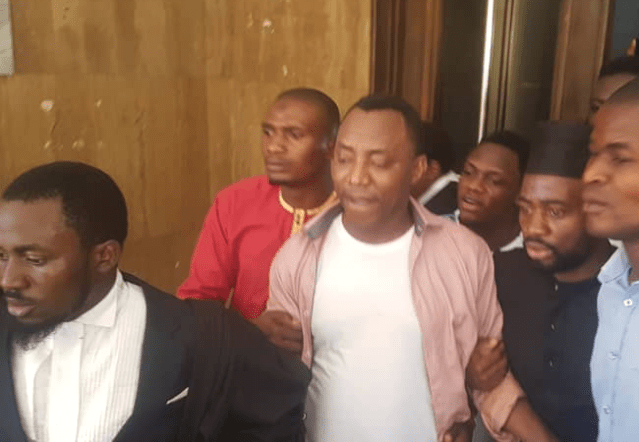
There was panic on Friday after human rights activist, Omoyele Sowore, collapsed following a confrontation with the police during a Democracy Day protest at the Unity Fountain in Abuja.

Reports said that Sowore collapsed after police operatives moved to disperse protesters gathered to demonstrate against insecurity, economic hardship and bad governance.

The demonstrators were dispersed after security personnel fired teargas canisters at the protesters in an apparent attempt to break up the gathering.

Following the incident, Sowore has reportedly been taken to an undisclosed hospital for further examination and treatment.

Continue Reading

Featured

Global Stage, Local Heart: Davido Champions Justice for Kidnapped Oyo Schoolchildren at FIFA Concert

Published

on

By

By Shakirat Akintola

He may be selling out arenas worldwide and headlining some of the biggest global stages, but Afrobeats megastar Davido proved this week that his heart remains firmly with the people of Nigeria.

On Wednesday night, during his highly anticipated performance at the official FIFA World Cup Countdown Concert in Los Angeles, the “Unavailable” crooner turned a massive moment of global celebration into a powerful, intentional act of advocacy.

Walking onto the Crypto.com Arena stage, the international icon chose not to wear high-end luxury fashion, but rather a custom black leather jacket designed to honor the 39 schoolchildren and seven teachers violently abducted from the Oriire Local Government Area of Oyo State.
A Global Icon Who Refuses to Forget His Roots

For an artist operating at Davido’s level, navigating massive global brands like FIFA usually comes with strict, highly sanitized corporate boundaries. Yet, the singer intentionally used his massive platform to ensure that the tragedy unfolding back home would not be swept under the rug by international media.

Backstage and throughout his high-energy performance of hits like “Fall,” the singer made sure his wardrobe spoke volumes. The front of his jacket was adorned with green circular buttons, each bearing the individual name of a student or teacher taken from the Ahoro-Esinele community in May.

In a heartbreaking and meticulously planned detail, the names of those still held in captivity were written in white, while the names of the victims who have tragically already died during the ordeal were highlighted in stark red. Across the back of the jacket, the message was clear and unmissable to the millions watching worldwide: “BRING THEM HOME.”

“We Represent Everywhere We Go”
Speaking moments before he climbed the stage alongside international electronic group Major Lazer, Davido was visibly carrying the weight of the situation, showing that his global success hasn’t detached him from the realities facing everyday Nigerians.

“Peace and love everywhere. May God be with the families of the abducted and the ones who have been killed,” Davido said in an emotional backstage address. “They still haven’t been rescued, we’re praying to God every day. We’re also praying to God that the government hastens… My country is going through a lot. We represent everywhere we go.”

This isn’t a passive, one-off gesture for the singer. Despite a grueling international schedule ahead of the 2026 World Cup—where he is prominently featured on the tournament’s official soundtrack album—Davido has consistently used his massive social media presence to demand immediate, decisive action from both federal and state authorities.

Amplifying the Cry for Help

By bringing the Oriire local tragedy to one of the premier entertainment capitals of the world, Davido has forcefully inserted Nigeria’s security challenges into the global conversation.

Back home, the crisis remains critical. The ongoing hostage situation has already sparked a total shutdown of public schools in Oyo State, with the Nigeria Union of Teachers (NUT) declaring an indefinite strike until their colleagues and students are safely returned.

In a landscape where international superstars are often criticized for becoming disconnected from local struggles, Davido’s bold FIFA showcase serves as a stark reminder of what true cultural ambassadorship looks like. He didn’t just perform for the world; he made the world look at the faces and names of the people who need them most.

Continue Reading

Featured

Statement on the State of the Nation by Some Concerned Nigerians

Published

on

By

We are a group of concerned Nigerians, alarmed at increasing threats to the Nigerian Nation and desirous of sharing our concerns with fellow citizens.

Our assessment of the state of the Nation reveals that Nigeria stands at a dangerous crossroads where rising insecurity, an alarming level of electoral manipulation by government, and the weakening of democratic institutions are converging into a national crisis that threatens the country’s survival.

Nigeria faces a grave threat to its foundational constitutional principle of the separation of powers. Checks and balances between the branches of government have been imperilled.

The legislative branch has been placed under near total control of the executive branch. The judiciary appears to have lost both its independence and its integrity. There are no checks on the powers of the executive who now govern as they please without accountability or respect for the people’s concerns.

Institutions have been compromised, weakened, and subordinated to the interests of the executive arm of government. This erosion of institutional independence has fuelled public distrust to its highest level in our history creating a crisis of political exclusion and impunity that is pushing violent extremism, organized crime, and communal conflict to a tipping point.

To reverse this trajectory, Nigeria must urgently recommit to democratic accountability, judicial independence, and institutional reforms that strengthen the rule of law. The electoral processes must be transparent, credible, and insulated from executive interference.

The crisis in Nigeria cannot be separated from the broader instability engulfing the Sahel region. The spread of terrorism, arms trafficking, unconstitutional changes of government, and porous borders across countries such as Mali, Burkina Faso, and Niger continue to intensify insecurity in Nigeria and the wider Lake Chad Basin. The collapse of regional cooperation and democratic governance in parts of the Sahel further emboldens armed groups, weakens state authority, and undermines civilian protection across West Africa.

Regional security cooperation between Nigeria and Sahelian states should be revitalized by establishing strong bilateral and multilateral platforms for intelligence sharing, border governance, and community-based peacebuilding initiatives.

Equally important is investing in youth employment, education, social protection, and local conflict resolution mechanisms to address the root causes of radicalization and insecurity.

Recommendations

1. Government should as a matter of urgency recognise that insecurity in the Sahel fuels the Nigerian crisis and that rapprochement between AES (Alliance of Sahel States) and ECOWAS is an important element in Nigeria’s national interest.

2. Government should immediately appoint a high-level Special Envoy for the Sahel to begin the urgent task of rebuilding trust between Nigeria, the AES and ECOWAS while revamping regional mechanisms for peace and security.

3. Civil society organisations should actively sensitize citizens and strengthen public demand for accountability. Nigerians must be bold and courageous in protecting civic rights and resisting the current climate of restricting civic space.

4. We call on the Private Sector as critical stakeholders in the nation-state agenda to continue to support and demand accountability in governance and the promotion of the rule of law as the basic premise of economic progress and nation building. Professional bodies and associations must rise to the challenge of building a broad national consensus to oppose tyranny and ensure maintenance of checks and balances in governance and the protection of the rule of law.

5. We call on our traditional leaders and members of the clergy to rise to the full weight of their moral and civic authority to promote peaceful co-existence, solidarity, and inter-faith dialogue to arrest the current slide to criminality and civil disorder.

6. Given the clear and consistent indications of the lack of neutrality and competence of INEC, professional bodies such as the Nigerian Bar Association, Unions, and other civic groups must set up mechanism of engaging the electoral body to ensure that the 2027 elections are free, fair and credible.

7. The Judiciary must address the perception of its complicity to stall democratic processes. It must remain independent and uphold the rule of law. As a matter of urgency, the Nigerian Bar Association must call its members to order for professional conduct and strengthen its monitoring on the judiciary, it must stay alert and patriotic and ensure political actors play by the rule. The National Judicial Council must set up a framework for holding judges accountable for decisions they take in the context of electoral process.

DATED AT ABUJA, NIGERIA 8th JUNE 2026

1. Dr. Husseini Abdu
2. Amb. Fatima Balla OON
3. Dr. Usman Bugaje
4. Prof. Ibrahim Gambari, CON
5. Dr. Yahaya Hashim
6. Prof. Jibrin Ibrahim
7. Prof. Attahiru Muhammadu Jega OFR
8. Prof. Mohammed Kuna
9. Abubakar Balarabe Mahmoud, SAN, OON
10. Mal Kabiru Yusuf

Continue Reading

Trending