Connect with us

Voice of Emancipation

Voice of Emancipation: Yoruba Kings and their Relevance in the 21st Century

Published

on

By Kayode Emola

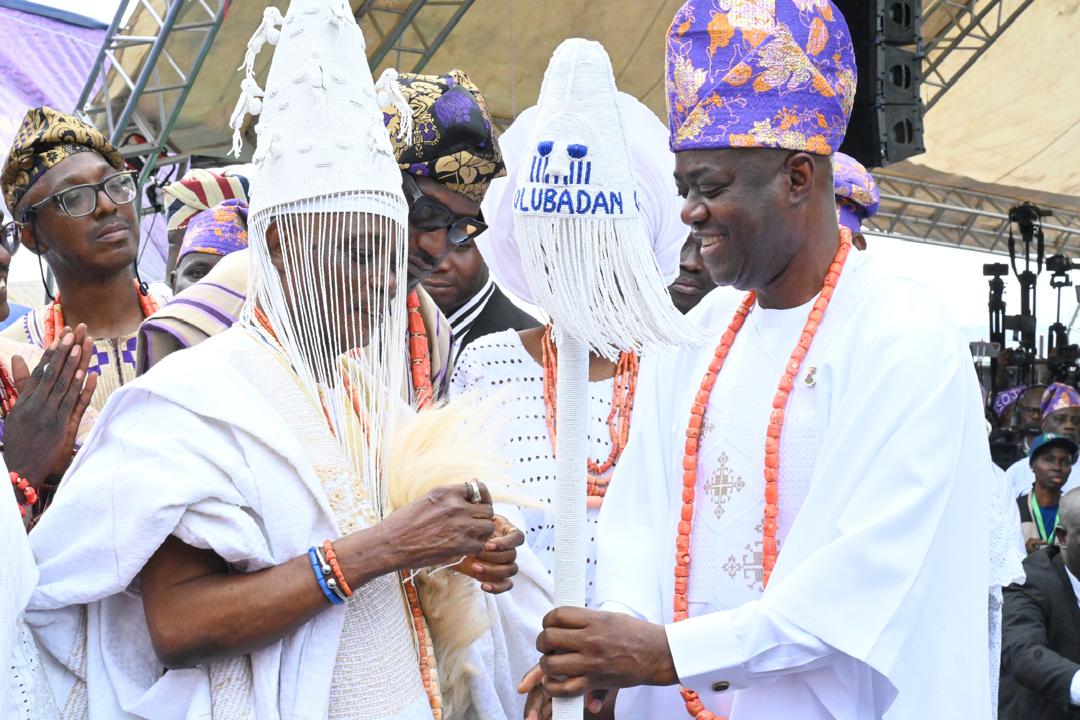
A few days ago, we witnessed the coronation of the newly appointed Olubadan of Ibadan land, His Royal Highness Oba Rasidi Ladoja, as the 44th Olubadan. During his inauguration, he could be heard asking for the creation of Ibadan State from the president, Bola Ahmed Tinubu.

It makes me wonder what the kings in Yorubaland do when they are faced with bigger challenges, such as insecurity and starvation in the land. No doubt, Ladoja may not hold any more political office until he goes to where the elders go after their time on earth.

The pressing question that should be on every Yoruba person’s lips now is, Do we need more state creation in Nigeria before development can reach the people? Or is this question from the Olubadan another showman and a means to an end for some new set of political office holders?

With the current invasion of Yorubaland by Fulani terrorists, who have not hidden their agenda for conquest. I believe the many kings in Yoruba land can do much better than just looking for political appointments for their stooges. Yoruba land is under siege with the several killings going on daily. This is not the time to be complacent; hence, what happened to northern Africa and Turkey may one day happen to us. God forbids!

There are over 3,000 kings in Yoruba land, holding that ancestral position that is linked to the ground where they have their domain. The original belief of the Yoruba people is that the kings are representatives of Olodumare (God) and are divine. As such, they should put the needs of their people at heart, and I believe nothing is more serious now than the security of the lives and property of our people.

However, we see clearly now that some of the Yoruba kings have brought disrepute to an agelong institution that should be the pinnacle of our society. Many kings look the other way whilst innocent people are being murdered by terrorists. They justify their silence by using the long-standing mantra that they can’t do anything, whereas they have enormous power and influence on any government of the day.

I believe that it is very disheartening for our kings in Yoruba land to stand on the sidelines whilst our people are being driven out of their communities en masse. Our Yoruba kings have a moral obligation and duty to come together in their thousands to confront the security menace facing the Yoruba people.
This is not the time for them to be diplomatic and watch on whilst their people are being butchered daily. The Yoruba people deserve better, and it would be best if the kings could use any political capital left in their arsenal to bring justice for the Yoruba people.

If our Yoruba kings want to be relevant in this 21st century, they must realise that they need to up their game from showmen to action takers. It can no longer be business as usual when our kings are partying away whilst Yoruba land burns.

Those who are close to them need to tell them that they can either stand up for the Yoruba land and its people now or be ready to become vassals to the Fulani people in not too long a future if the Yoruba land is finally captured by the Fulani warlords. Again, God forbids that this becomes our lot.

Continue Reading
Click to comment

Leave a Reply

Your email address will not be published. Required fields are marked *

Voice of Emancipation

Voice of Emancipation: Is Africa Left Behind in the Face of Globalisation

Published

on

By

By Kayode Emola

Recently in the news, we saw how the rise of Xenophobia in South Africa is tearing the African community in South Africa apart. Not what you would expect exactly 32 years after the end of apartheid South Africa.

One would ask, what really happened to South Africa since the return to black rule in 1994? Afterall, with a GDP of nearly $500 billion and just about 60 million population, they are still the largest economy in Africa. Would they have achieved that feat on their own if the white folks hadn’t built that economy.

That really isn’t the issue here. The main issue is that majority of the black South Africans are reeking in abject poverty with no way of escape. So, the easiest thing to do is to blame it on immigrants as though they are the cause of the problem.

The truth is Africans are being left behind in an ever-changing world. As an immigrant myself to the United Kingdom, I have achieved far more than many core British people whose ancestors were originally from Britain. I do not believe that my migration to Britain threatened the existence or survival of the locals. On the contrary, I believe I have added more value to the British society and to its progress and enriched its culture.

Which leaves me to conclude that the problem with the black/brown South Africans is not that migrants are overwhelming their society. Rather, it is a failure of the African leadership to build a good framework for sustainable development.

Many Africans always blame slavery, colonisation and neo-colonialism for the underdevelopment of Africa. As true as these things, they aren’t the major obstacles to our real development. Our real underdevelopment stems from the greed of a few individuals among our black folks who are so determined to steal from our collective commonwealth for their own personal gain.

With an economy the size of South Africa, the average person is supposed to be earning a decent $8,000 to $10,000 annually. Enough to make a good life for themselves, and their immediate family. However, the reality is that GDP doesn’t mean anything to anyone who is just scrapping by.

Estimate from the South Africa statistics department in 2023 shows that nearly 40 percent of their population live below the poverty line earning less than R1,300 ($80) per person per month. With that kind of poverty brings resentment to any successful group or groups of person(s) supposedly perceived to be taking away the wealth of the local population.

This is part of the real reason behind the Xenophobic attitude of our South African brothers whom many African countries defied all odds to stand with in their dark days. Despite, the growing South African economy, it shows that globalisation is not actually improving the lives of the ordinary man on the street. This is the same across several African countries on the continent.

It’s easy to blame the leaders of many of these African countries, but we must equally blame the followers who do not know how to hold their leaders accountable. African leaders get an easy pass despite their mismanagement of the economy in their countries propped up by international organisations and foreign government. Partly because of a docile and an uninformed population.

If our Yoruba nation must succeed, we must make conscious effort to ensure that no one is left behind. There must be specific programs by the government to ensure that no child goes to bed hungry, let alone go to school with an empty stomach.

The level of poverty in the continent is so high that it should revulsed our leaders. However, seeing that our leaders are far removed from the common man, they feel disconnected to their plight. We who are custodians of leadership must ensure that the right policies are in place to genuinely lift millions of our people out of poverty and not just cosmetic dressing.

That is the only time we too as Africans can benefit from globalisation. If not, our people will continue to wallow in poverty, blaming everything on our ancestors and the government without they themselves taking responsibility for their own personal development.

I urge our African people to wake up whilst there is still the opportunity so that we too can benefit from the globalisation the world is experiencing. This will stop the blame game, because the last time I checked, migration is a net contributor to any economy and not the other way round as some myopic people will have us believe.

Continue Reading

Voice of Emancipation

Voice of Emancipation: Nigeria’s Political Climate and the Yoruba Struggle

Published

on

By

By Kayode Emola

There is no doubt that politicians of various political colouration and ethnicity are beginning to prepare for the general election of 2027. Many governors who have served one term are no doubt seeking the opportunity to return for a second mandate, whether their first tenure was a shambles or not.

The President, Bola Ahmed Tinubu, is also no doubt seeking a second term in office, whether the people want him or not. With various sections of the country already queueing up behind him or against him. The opposition is also trying all they can to oust the President, citing broken promises like the uninterrupted power supply that has failed to materialise.

Whether Nigeria will remain one country in 2027 remains to be seen, with several ethnic nationalities, regions and stakeholders pushing to be the dominant power holder in 2027. The President, who is enjoying the power of incumbency, will do everything within his reach to retain power at all costs.

Likewise, the opposition, which is trying to oust the President from that lofty seat, will use every trick in the book to push him out of office. Whether their trick will be enough to unseat the Jagaban remains to be seen. The opposition has vowed to undertake their own live transmission of election results for the whole world to see. How this will be achieved in the face of multiple challenges in Nigeria beats my imagination.

For someone like me who had previously worked as an INEC presiding officer in the 2011 general election, I know that most results that come from polling stations are not what is eventually released to the public. How the manipulation of those results happens in high places is beyond me and a story for another day.

We all witnessed the many irregularities in the 2023 general election that brought this present administration into power. Gross manipulations of election results across several polling stations were the order of the day. Yet, that did not stop President Tinubu from winning the presidency even though he was an outsider. How anyone thinks they can unseat him as an incumbent remains to be seen.

Only time will tell whether the election will make or break Nigeria this time around, as I do not see President Tinubu bowing out after 4 years without a fight. Equally, I do not see the Fulani North enduring another 4 years of Tinubu’s presidency. The Fulani are so power drunk that they may decide to go to war to break up Nigeria if they do not get hold of the presidency in 2027. Their coalition party is not holding up presently, and doesn’t look like a formidable force that can stop President Tinubu from doing another 4 years.

This then brings us to our Yoruba nation struggle in the run-up to the 2027 general elections. Many Yoruba people who were staunch critics of Buhari and the Fulani militias’ merciless killings of Yoruba people between 2015 and 2023 are now suddenly mute because a Yoruba man is the president of Nigeria today.

Should Tinubu finish his presidency in 2031 if he wins a second term, what will be the fate of the Yoruba people, assuming another Fulani man becomes the president of Nigeria in 2031? Every right-thinking Yoruba person must know that with the current chaos in Nigeria, the country may not even exist beyond 2027. The binding glue holding the country together is now so worn out that every facet of the country is bleeding.

The terrorists troubling the peace and tranquillity of the country are now so emboldened that it will take a miracle to get rid of them. The President is not even shying away from the fact that he is not capable of solving the insecurity challenges bedevilling the country. Rightly so, if his predecessor, who was once an Army General, cannot tackle insecurity, how much more President Tinubu, who has not experienced any military training, talk less of combat.

My fellow Yoruba citizens, we must realise that the time to get out of Nigeria is now, and this is not a time to pander to the political machinations going on. We have no business in Nigeria, as there is neither hope nor future in the country that will uplift the millions of our people now trapped in abject poverty. With the abundant human and mineral resources God has blessed us with, I see no reason why we should continue to humiliate ourselves with Nigerian politics that has nothing to offer us or our future generations.

Continue Reading

Voice of Emancipation

Voice of Emancipation: Lessons from the Iran/USA War

Published

on

By

By Kayode Emola

The USA/Iran war is not going as planned, and the world is currently witnessing a stalemate. A stalemate that is bad not just for those who are directly involved but for the entire global economy. Every nation is holding its breath to see what happens with the peace talks being brokered by Pakistan.

While the US and Israel have succeeded in setting Iran back so many years in their weapons and nuclear program development. The Strait of Hormuz has handed Iran a serious lifeline. A lifeline that far surpasses any damage that the joint US-Israeli bombings may have inflicted.

Iran knows that it cannot withstand the US in an open combat. However, it knows that attacking US interests in the Gulf States will give it enormous leverage. Leverage that it can use to bargain at the negotiating table. Coupled with that, the geography of the Strait of Hormuz handed Iran an added layer of advantage, thereby multiplying its immense opportunity to reclaim its destiny.

Before February 28, 2026, when the first bombs started landing in Iran, the US held all the cards at the negotiating table. Once the table has been destroyed and no off ramp available, an exit becomes near impossible, hence the impasse that we all are witnessing.

As things stand, we don’t even know who oversees decision-making in Iran or who the decision makers are. Iran has learnt from Hezbollah’s mistake of announcing a new leader shortly after Hassan Nasrallah was killed by the Israeli forces in September 2024.

Once they announced Mojtaba Khamenei as the new Supreme Leader, Iran made sure he was not put before the public glare to keep him away from harm’s way. Fuelling speculations that he was badly injured during the attack on his father’s compound.

Whether Mojtaba Khamenei is dead or alive or in a coma, as some have suggested, the decentralised system of command built by the late Ayatollah Ali Khamenei has helped Iran withstand the firepower of the US and Israel. Iranians can come out of this war with their head held high that they have fought a good fight. Despite all the beatings they’ve received, they refuse to capitulate in the face of adversity.

If Iran, which is under severe sanctions and a broken economy, can withstand the firepower of the United States of America, then I believe the Nigerian government needs to bury its head in shame in their fight against insurgency. As it stands, we don’t even know which agency is responsible for the fight against the terrorists troubling the country.

The Nigerian Police Force (NPF) is not properly trained to combat terrorists and kidnappers in the forests. The Nigerian army is also not trained to fight insurgents that have no base from which they operate. Hence, the difficulties in putting this ugly charade to an end. Also, the corruption surrounding mismanaged funds meant to tackle insecurity shows that the country is not geared towards keeping its citizens safe.

Therefore, the over 200 million Nigerians who live in fear daily must realise that there is no one out there looking out for their safety. The Nigerian politicians are more interested in looting the treasury than in saving the lives and livelihood of the citizens. So, if we, the indigenous nationalities that make up Nigeria, continue to think we can remain as a single country with all this mayhem going on, then we must be mistaken.

Our Yoruba people must realise that we are only lucky that no Southwest state was mentioned in the travel advisory given out this week by the US. That is not to say Yorubaland is safer than anywhere in Nigeria. As any attack anywhere in Nigeria affects every Nigerian equally. We must see an attack in Jos, Maiduguri, Ebonyi, Kwara, Kogi, Ogun, Ondo etc as an attack on the Yoruba man.

We must use the ongoing mayhem as our collective starting point to start building a lasting security architecture for the Yoruba defence. One that can withstand both internal and external pressures. We must insist on building systems that will outlast an individual and even an entire generation if the Yoruba must continue to exist beyond the Nigeria that we know today.

Continue Reading

Trending