
By Reuben Abati
Nigeria held its Presidential and National Assembly elections on Saturday, February 25, 2023 across all the 36 states of the Federation and the Federal Capital Territory. It was the most competitive election since the country’s return to democratic rule in 1999, the seventh in the cycle. It was also the election with the lowest turn-out: just about 25. 2 million voters voted in that election. Close to one million votes were voided, the declared winner won just about 8.8% of the total votes cast out of 93.4 million registered voters, with a collated figure of 87.2 million registered voters. Many commentators have attributed the low voter turn-out to voter suppression, voter intimidation and the scarcity of money and fuel, although those may not have been serious reasons for voter apathy. The people were enthusiastic, but they were disappointed by INEC’s gross incompetence.
In 1999, voter turn-out was 52.3 %; in 2003, over 63 million voters showed up– that is 69.1% turn out in Nigeria’s Presidential and National Assembly elections of that year; in 2007, the reported figure was 57.5%; and in 2011, 53.7%, with the loser in that election – General Buhari getting as many as a little over 15 million votes. In 2015, the turn-out figure dropped to 43.7%; later in 2019, 34. 75%, The bigger point to be made is that Nigeria’s 2023 Presidential election has had the worst turn-out in the whole of Africa in the last decade. In 2017, Rwanda recorded a 98.15% voter turn-out, which was considered the highest in the world.
What we can hold on to is that whereas Nigerians were very enthusiastic about the National Assembly and Presidential elections of February 25, 2023, there were great apprehensions among the people which hindered the eventual outcome of the process. Nigerians now have a President-elect in the person of Senator/Asiwaju Bola Ahmed Tinubu, candidate of the All Progressives Congress (APC), with the lowest margin of victory in contemporary Nigerian history. The total number of valid votes in this election is not even up to the total number of votes won by just two candidates in previous elections. But what the law states is that the man with the majority of votes and the highest number of votes in two thirds of the 36 states of the Federation and the Federal Capital Territory is to be declared winner. Section 134 of the 1999 Constitution which addresses this is already a matter of contention in both the public domain and the courts. It would be interesting to see how in the course of the Presidential Election Petition Tribunals, this diminishes or enhances the county’s jurisprudence in that regard.
But for now, what we know is that the Independent National Electoral Commission (INEC) has declared Bola Ahmed Tinubu of the APC, winner of the Presidential election of February 25. INEC did not also waste time in giving the Certificate of Return to the APC candidate. We have not seen the same haste with the other elections, the National Assembly elections of February 25 and their legislative winners. None of them has received the Certificate of Return the following day, or nine days after. But the President-elect got his post-haste. He has also since embarked on victory laps to key political figures including the President in his home state of Daura, his wife, supported by other APC wives has visited Mrs Aisha Buhari in Aso Villa, and to cap it all, the President-elect has led a delegation to the Oba of Lagos just to say thank you. Tinubu has since moved into the Defence House in Abuja, the holding bay for a President in waiting. By now, he would be receiving daily security briefings from all relevant agencies of state. In terms of optics, Tinubu himself is already hob-nobbing with the international diplomatic community. He is visiting local traditional rulers and taking messages from foreign diplomats. He has done a victory lap of sorts to Lagos and no one should be surprised if he goes to all principal Yoruba towns and kings. He is playing a game of self-affirmation, laying concrete beneath his “Emilokan” (it’s my turn”) declaration. He has not only managed to win the election; he is already seeking to consolidate the gain by playing a fast game ahead of others. He is striving to establish himself as master and owner of the game.
I think I have a fair idea of what is playing out. The last time I ran for elective office – in the 2019 Gubernatorial race, I recall some wise persons in our camp, telling us at the time, that the way Nigerian politics is played, it is better to win the election and allow other parties and candidates to be the ones to complain. While they are preparing to go to court, you take charge of the victory and take the game to another level. Resort to the tribunal and the courts is constitutionally provided for as the place of last resort for aggrieved politicians, but the received wisdom in Nigerian politics is that if you know your way, that could be difficult to enforce at the gubernatorial level and even more difficult at the Presidential level. Nigerian politicians seem to have this implicit confidence that if you know how the system works, it would be difficult to lose the certificate of return that has been issued to you. The matter is further compounded by the fact that election matters are sui generis. This is a euphemism for the fact that in an election matter, the verdict can go in any direction.
The heavy burden of proof is on the plaintiff to prove that he has been cheated. The courts have a presumption of regularity in favour of the respondent and the electoral commission. The test in election matters is substantial compliance. It is partly why some of the election cases that go all the way to the Supreme Court always produce strange outcomes. In Presidential matters, it would be recalled that the Nigerian Supreme Court has never up-turned any Presidential dispute from Awolowo vs. Shagari to Atiku vs. Jonathan and after. Their Lordships of the Supreme Court always find a way of ruling in favour of the man who already has the Certificate of Return! The ink was yet to dry on the ballot papers before INEC produced and handed over the Certificates of Return for the Presidential election to the President-elect and the Vice-President-Elect as announced for the All Progressives Congress (APC).
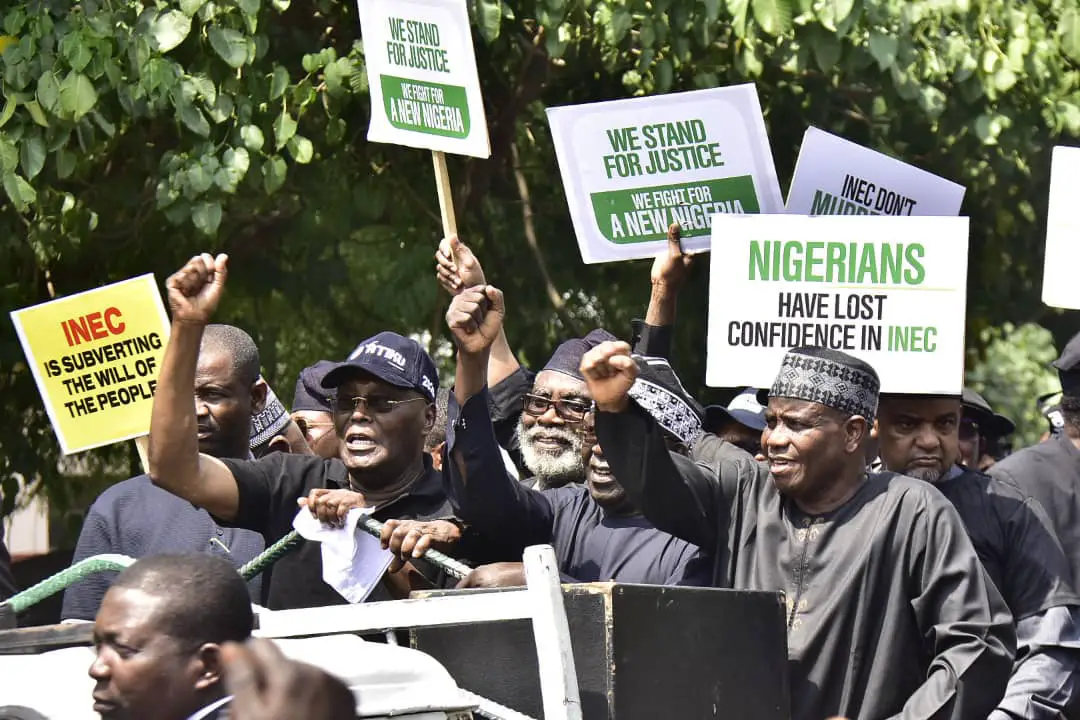
The general impression, among Nigerians, with the sole exception of the supporters of the ruling party now declared elected, is that Nigeria’s electoral commission simply keyed into the President-elect’s “emilokan message”. Whereas the technological innovation in form of BVAS – the Bimodal Voters Accreditation System and iREV – the INEC results reporting portal -was supposed to ensure transparency and accountability in form of real-time loading of results from polling units, on election day, the same BVAS process as provided for in Section 60 of the Electoral Act and Clause 38 of INEC’s own Guidelines failed on election day. To be specific, it worked seamlessly for National Assembly elections but failed to upload Presidential elections. The same device, in the same locations, in the same elections conducted on the same day chose to behave in a discriminatory manner due, I suspect, to human error or human failure. But INEC places the blame conveniently on “technical glitches” arising from the fact that this was not an off-cycle election but a general election. The people were assured that the glitches would be fixed by the engineers. Nine days later, INEC was yet to load the results from over 176, 800 polling units for the Presidential election on its portal, the engineers have not fixed anything, and yet they have declared a winner of the Presidential election. It is difficult to dismiss the aggrieved Nigerians who have blamed INEC for imposing something in the shape of “election magic” on Nigerians on February 25. The major political parties that lost out are on their way to the courts. They have asked for the leave of court to inspect INEC documents to put evidence together. The People’s Democratic Party has staged “a black uniform” demonstration in Abuja to show the party’s displeasure.
But would this make any difference? Nigeria is a funny country. Heavens don’t fall around here when people’s expectations are not fulfilled. Not in normal, everyday life. Not during elections. Expectations die daily in Nigeria. The truth is: the people are used to that reality. They hem and haw when they are aggrieved. The same people would later move on, and behave as if nothing is amiss. The psychology of the Nigerian to adapt to everything and anything is one of the major wonders of the world. The APC strategists know this. They believe it. It is why they can beat their chests and boast with the authority of the courts. They have not only been declared elected, they have assumed the authority of the courts. Meet us there! Their confidence is typically Nigerian. In reality, there is no truly independent institution in Nigeria. When you look deeply enough, you’d find some magic lying underneath.
It is okay for the international community to urge Nigerians to seek legal and necessary means to resolve disputes. That is the standard script in these matters as a way of maintaining peace and order. It is even more important to prevent a country of over 200 million from descending into chaos. Nigeria is so delicate and so strategic, you can do just about anything, people can hurt you as they wish, and no matter how, everyone would still beg you to calm down. Hence, the aggrieved political parties are expected to calm down. Only three of the parties are openly aggrieved by the way out of 18 political parties: the Peoples Democratic Party (PDP), Labour Party (LP) and the New Nigeria People’s Party (NNPP). Only three parties are talking of going to court. Other aggrieved parties like Omoyele Sowore’s African Action Congress (AAC) have been heard making small noises, but the majority of the other parties, like the Social Democratic Party (SDP) seem to have taken a pragmatic view of the matter. Nobody should be surprised if some of the other smaller political parties show up in court to support the President-elect, and argue that there was nothing wrong with the elections of February 25. No one should be surprised either if INEC finds ways of blocking the access of the aggrieved parties to critical data and evidence.
Those who will be hurt, those to whom Nigeria has happened, after a manner of speech, are those Nigerians who got brutalized before, during and after the election (I hope Mrs Efedi Bina Jennifer’s face has healed – she got stabbed in the face on election day in Surulere, Lagos), those whose votes were never counted because BVAS failed or INEC officials threw away their papers into the bush, or simply refused to upload results, those whose votes were set ablaze because hoodlums seized ballot boxes and set fire to them, those who voted, heard the results at the polling units, only to hear INEC Headquarters later announcing a different set of results. It must be painful to such persons to be told that their choice was determined by “technical glitches”. And now, four days to another round of elections – INEC seeks the leave of court to reconfigure its BVAS. What INEC could not do for months, and in nine days, it wants to do in 4 days? Candidly, no be juju be that? The biggest loser in the just concluded election is of course INEC. For failing the people, it failed as an institution. It lost the people’s trust and confidence. Whatever it does going forward, the people would be full of doubts. I pity Professor Yakubu Mahmood, the INEC Chairman. Whatever reputation he may have had before now, has been thrown out of the window. He won’t be the first INEC Chairman that would end up on the wrong side of history. But he may end up as the most vilified, and go down in history as the man who presided over the most competitive and most disputed elections in Nigerian history since the return to civilian rule in 1999. How does he hope to move about distinguished company when all this is won and lost?
He has now promised to conduct better elections on March 11 – the Gubernatorial and Houses of Assembly elections. The stakes are lower. If the technology – BVAS and iREV – works smoothly on March 11, that would be solid proof that February 25 was truly an exercise in witchcraft. Both ways: INEC and Yakubu Mahmood will lose. It does not matter what they do on Saturday, March 11. They have failed woefully in the court of public opinion. Besides, the security agencies were nowhere to be found on election day. In their presence, unscrupulous voters suppressed and intimidated voters, snatched ballot boxes, set ballot boxes ablaze – most of the reports indicated that the security agencies stood arms akimbo and did nothing. In one report, the police also helped ad hoc INEC officials to thumb-print ballot papers. The police have not reported any arrests nor have they come forward to disown the men who wore police uniforms. The same police collected money and equipment from President Buhari to ensure a hitch-free election. The only security agency that showed up on election day was the Economic and Financial Crimes Commission (EFCC) whose officials arrested persons who moved money about to buy votes or tried bank transfers to influence voters. The only news that came from the Civil Defence was that its officials had an accident on their way to a polling booth. That must have been due to careless driving because there was no traffic on the roads on election day! General Lucky Irabor boasted that soldiers would give anybody who tried to disrupt the elections, “a bloody nose”. Nobody saw the soldiers on duty!
What next for Nigeria, then? I believe it is a good thing to test our laws – the Electoral Act, the 1999 Constitution and INEC guidelines to deepen our democracy and jurisprudence. But I do not think that the courts would up-turn the Presidential election. Judges are also citizens. They know how the game is played. They will not allow themselves to be used as scapegoats when other institutions of state have failed. What we all can hold on to is Bola Tinubu’s promise of conciliation, unity and his agenda for prosperity. We may not have paid close enough attention to his agenda for “restored hope” before now, but it is time to do so. We must take charge of the future, and define for the President-elect what Nigeria needs going forward. Anyone thinking and dreaming that he would relinquish that certificate of return, which he says he regards, as “a world cup trophy” should stop dreaming. For Nigeria, the days ahead are bound to be even more interesting. I wait to be proven wrong.