
Economy
Nigeria: Sure Steady Steps to Poverty


By Eric Elezuo
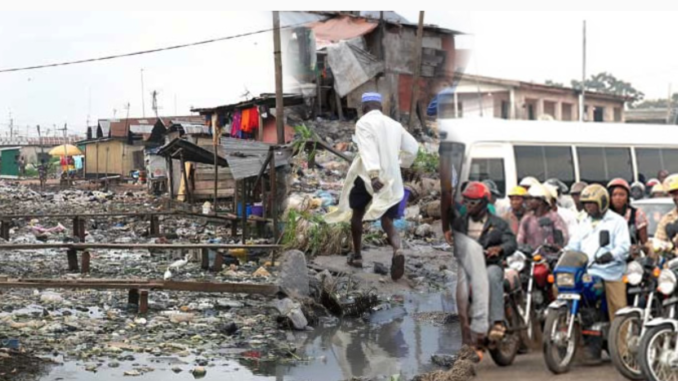
Not many people took it serious when in 2016, the National Bureau of Statistics raised the alarm that no fewer than 112 million Nigerians live below the poverty line. Today, the story has adopted international dimension as the country has hit the number one spot as the world’s greatest poverty capital.
In the newest report released by the Brookings Institution, data from the World Poverty Clock, Nigeria emerged as the country with the highest number of poor people in the world overtaking India.
According to the report, Nigeria now has over 87 million people living in poverty, and that six Nigerians become poor every minute. Many has said that the report was mild as the poverty situation is worse than the number presented, with a clear reference to the 112 million case the NBS showcased in 2016
The report says in part: “According to our projections, Nigeria has already overtaken India as the country with the largest number of extreme poor in early 2018, and the Democratic Republic of the Congo could soon take over the number two.
“At the end of May 2018, our trajectories suggest that Nigeria had about 87 million people in extreme poverty, compared with India’s 73 million.
“What is more, extreme poverty in Nigeria is growing by six people every minute, while poverty in India continues to fall.
“In fact, by the end of 2018 in Africa as a whole, there will probably be about 3.2 million more people living in extreme poverty than there are today.”
According to Wikipedia, The World Poverty Clock is a tool to monitor progress against poverty globally and regionally. It provides real-time poverty data across countries.
Created by the Vienna-based NGO, World Data Lab, in 2017, it is funded by Germany’s Federal Ministry for Economic Cooperation and Development.
Each April and October, the World Poverty Clock data are updated to take into account new household surveys and new projections on country economic growth from the International Monetary Funds’ World Economic Outlook.

These form the basic building blocks for poverty trajectories computed for 188 countries and territories, developed and developing, across the world.
Also in 2016, a United Nations presented another damning report which suggested that Nigeria was fast sliding into the category of world’s poorest citizens, reporting that over 80 million Nigerians were living below poverty line. The UN report on Nigeria’s Common Country Analysis (CCA) described the country as one of the poorest and unequal country in the world.
This was as the report revealed that the country was deeply divided on the basis of plurality of ethnic, religious and regional identities.
The report was made public during a consultative meeting on the formulation of the UN Development Assistance Framework IV (UNDAF IV) for the South East geo-political zone in Awka.
“Nigeria, with a population of over 175 million, is the most populous nation in Africa and the seventh most populous in the world. Her population will be approximately 200 million by 2019 and over 400 million by 2050, becoming one of the top five populous countries in the world.
“Nigeria is one of the poorest and most unequal countries in the world, with over 80 million or 64% of her population living below poverty line. The situation has not changed over the decades, but is increasing.
“Poverty and hunger have remained high in rural areas, remote communities and among female –headed households and these cut across the six geo-political zones, with prevalence ranging from approximately 46.9 percent in the South West to 74.3 percent in North West and North East,” the report stated.
The report is of the view that absolute marginalization along ethnic lines among many constraints has contributed to the massive poverty inherent in the nation’s economic system.
It continued: “In Nigeria, 37% of children under five years old were stunted, 18 percent wasted, 29% underweight and overall, only 10% of children aged 6-23 months are fed appropriately based on recommended infant and young children feeding practices.

“Youth unemployment which is 42% in 2016 is very high, creating poverty, helplessness, despair and easy target for crime and terrorism. Over 10 million children of school age are out of schools with no knowledge and skills.
“Nigeria’s economy is currently in a recession and it is estimated that government revenues have fallen by as much as 33 percent, which has further resulted in the contraction of the Gross Domestic Product, GDP, by 0.36 percent in the first three months of 2016.
“The vulnerable macroeconomic environment in Nigeria is affecting investors’ confidence in the domestic economy.
“Despite the fact that Nigeria is a signatory to a number of protocols on sustainable and renewable environment, the country had, over the decades, failed to protect the environment, ecosystem and natural resources.
“Over-exploitation of natural resources and pollution of the environment, desertification are exposing the population to vulnerability and risks caused by climate change, among others.
“Nigeria is well-endowed with forest resources, accounting for 2.5% of GDP. But Nigeria has one of the highest rates of forest loss in the world. Between 1990 and 2000, Nigeria lost an average of 409,700 hectares of forest per year on average deforestation rate of 3.5% per annum.
“Increase in population, human activities like farming, construction and cutting of trees, use of wood and effect of climate change lead to environmental destruction across Nigeria.
“This in turn leads to unpredictable weather, drought and floods. The implication of destruction of the environment includes reduced agricultural productivity, destruction of property and loss of lives.
“Over 80 million Nigerians live in poverty and are affected in one way or the other by the current humanitarian crisis. Available reports indicate that there are over 3.3 million Internally Displaced Persons, IDPs, which is Africa’s largest, ranking behind Syria and Columbia on a global scale.
“The major challenges Nigeria is currently facing that constrain her economic growth and social development are lack of good governance, general increased insecurity across geo-political zones in North East, Niger Delta and Lake Chad region in particular. The situation is exacerbated by the existence of systematic accountability challenges, limited capacities of independent institutions/ commissions and limited accountability at the federal, states and local government levels.
“Nigeria is a deeply divided society considering the plurality of ethnic, religious and regional identities that define her political existence. Since independence in 1960, Nigeria has struggled to build and sustain national integration.
“For decades, different segments of Nigeria’s population had, at different times, expressed feelings of marginalization, of being short-changed, dominated, oppressed, threatened, or even targeted for elimination.”
What is more is the fact that the indices that have complimented the nation’s economic woes rest solely on economic policies which stakeholders argue have not been to the best interest of the average citizen through whom the proficiency or wealth of a nation is weighed.
Many have blamed the administration of President Muhammadu Buhari for the all-time high poverty level, saying that the government is no longer in tune with the present economic system. They heaped blames on what many referred to as ‘cluenessless’ of the world’s economic indices.
Recall that Nigeria stumbled into recession shortly after the advent of the Buhari administration after which massive hunger enveloped the length and breathe of the country. Recovery has been very slow ever since. And in most homes, the recovery may never take place.



How Yahaya Bello Used Kogi’s $720k to Pay Children’s School Fees in Advance – EFCC Chairman

I’ll Resign If Yaya Bello Eacapes Prosecution, EFCC Chair Vows

Nigeria Air Scam: EFCC Arrests Former Aviation Minister, Hadi Sirika

Dana Air Confirms Runway Excursion Involving It’s Aircraft, Says Passengers, Crew Safe

Kwibuka 30: Nigerian Community In Rwanda Visits Kigali Genocide Memorial

FG Mulls Review of Admission Age into Nigerian Universities

Lagos-Calabar Coastal Highway: Prioritize Existing Unfinished Projects, Peter Obi Tells FG

Nigerian Engineer Wins $500m Contract to Build Monorail Network in Iraq

WORLD EXCLUSIVE: Will Senate President, Bukola Saraki, Join Presidential Race?

World Exclusive: How Cabal, Corruption Stalled Mambilla Hydropower Project …The Abba Kyari, Fashola and Malami Connection Plus FG May Lose $2bn

Rehabilitation Comment: Sanwo-Olu’s Support Group Replies Ambode (Video)

Pendulum: Can Atiku Abubakar Defeat Muhammadu Buhari in 2019?

Fashanu, Dolapo Awosika and Prophet Controversy: The Complete Story
Pendulum: An Evening with Two Presidential Aspirants in Abuja

Who are the early favorites to win the NFL rushing title?
Boxing continues to knock itself out with bewildering, incorrect decisions
Steph Curry finally got the contract he deserves from the Warriors
Phillies’ Aaron Altherr makes mind-boggling barehanded play
The tremendous importance of owning a perfect piece of clothing
-
 News6 years ago
Nigerian Engineer Wins $500m Contract to Build Monorail Network in Iraq
-
 Featured6 years ago
WORLD EXCLUSIVE: Will Senate President, Bukola Saraki, Join Presidential Race?
-
 Boss Picks6 years ago
World Exclusive: How Cabal, Corruption Stalled Mambilla Hydropower Project …The Abba Kyari, Fashola and Malami Connection Plus FG May Lose $2bn
-
 Headline6 years ago
Rehabilitation Comment: Sanwo-Olu’s Support Group Replies Ambode (Video)
-
 Headline6 years ago
Pendulum: Can Atiku Abubakar Defeat Muhammadu Buhari in 2019?
-
 Headline5 years ago
Fashanu, Dolapo Awosika and Prophet Controversy: The Complete Story
-
Headline6 years ago
Pendulum: An Evening with Two Presidential Aspirants in Abuja
-

 Headline6 years ago
2019: Parties’ Presidential Candidates Emerge (View Full List)